
Are Heat Pump Tax Credits Still Available?
May 8, 2026

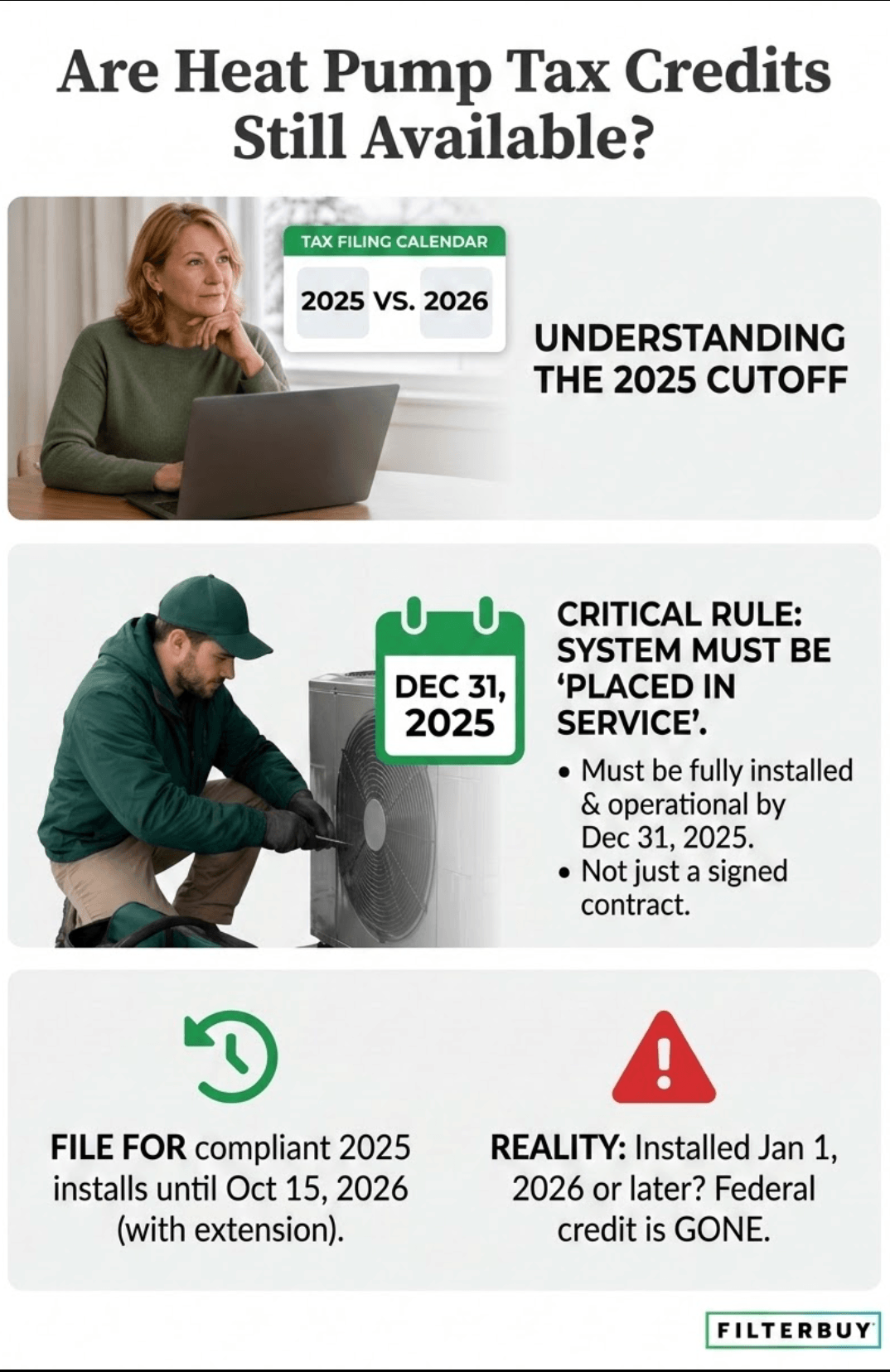
If you finished a heat pump install in 2025 and haven't filed your federal return yet, you're sitting on up to $2,000 you can still claim. If you're shopping for a system in 2026, that money is gone. The cutoff date is December 31, 2025, and the law that put it there is the One Big Beautiful Bill Act, signed July 4, 2025.
Most of the confusion we hear from homeowners traces back to old marketing material. Quotes that promise tax credits running through 2032 were written before July 2025, when the Inflation Reduction Act timeline was still in place. The IRA did extend Section 25C and Section 25D through 2032. Then Public Law 119-21 collapsed both deadlines to the end of 2025.
This page covers which credit applied to your situation, how to file it on a 2025 return, and which state and utility programs are still on the table for anyone installing now.
TL;DR Quick Answers
Heat pump tax credits are still available, but only for systems placed in service on or before December 31, 2025. If your install finished by that date, file IRS Form 5695 with your 2025 federal return. If you're starting a project in 2026, the federal credit is gone. Your savings now come from state, utility, and HEEHRA rebate programs.
• If you installed by Dec 31, 2025: Section 25C covered 30% of equipment and labor for qualifying air-source heat pumps, capped at $2,000. Section 25D covered 30% of qualifying geothermal costs with no annual cap. File on your 2025 return. The extension deadline is October 15, 2026.
• If you're installing in 2026: Public Law 119-21 (the One Big Beautiful Bill Act, July 4, 2025) repealed both credits. HEEHRA point-of-sale rebates remain in many states (up to $8,000 for income-qualified households), and so do state and utility programs.
• Income limit: There is no cap on Section 25C or Section 25D. HEEHRA does have income tiers tied to your Area Median Income.
• Refundable? Both credits are nonrefundable. They reduce what you owe in federal tax. They will not generate a refund beyond your liability.
Top Takeaways
• The federal heat pump tax credit ended for 2026 installs. Sections 25C and 25D both expired for property placed in service after December 31, 2025, under Public Law 119-21.
• If you installed in 2025, the credit is still claimable. File IRS Form 5695 with your 2025 return. The extension deadline is October 15, 2026.
• Section 25C maxed out at $2,000 for the heat pump portion. That is 30% of equipment plus labor, with a separate $1,200 sub-cap for other 25C improvements (insulation, windows, doors) inside an annual $3,200 ceiling.
• Section 25D had no dollar cap. Qualifying geothermal heat pumps installed in 2025 still get 30% of total installed cost back on the 2025 return.
• "Placed in service" is the standard, not "contract signed." Your system needed to be installed, operational, and ready for use by December 31, 2025. Signed contracts and partial installs do not count.
• HEEHRA was not repealed. State-administered point-of-sale rebates of up to $8,000 are still active in many states, with tiers tied to Area Median Income.
• Maintenance protects what the credit paid for. Your heat pump was rated for an efficiency level on day one. The filter is what keeps that rating intact across 15 to 20 years of operation.
What You Need to Know About the Heat Pump Tax Credit

What Changed in 2025: The One Big Beautiful Bill Act
Aheat pump moves heat rather than generating it, which is why federal incentive programs prioritized them. A properly sized unit can deliver three or more units of heating energy for every unit of electricity it consumes. The Inflation Reduction Act of 2022 made that efficiency cheaper to access by extending two large residential credits through 2032.
That timeline did not survive the year. Congress signed Public Law 119-21 on July 4, 2025. Among its provisions, the bill accelerated the termination of Sections 25C, 25D, 25E, 30C, 30D, 45L, and 179D. For heat pump owners, the practical effect is simple. If your system was placed in service on or before December 31, 2025, the credits apply. If it was placed in service after that date, they do not.
The IRS confirmed the implementation in IR-2025-86 and published a detailed FAQ explaining how the placed-in-service standard works. "Placed in service" means the equipment is fully installed, operational, and ready for use. A signed contract is not enough. A paid deposit is not enough. A partial install is not enough. The unit has to actually be running.
If your installation slipped from late December 2025 into January 2026, the credit is not available. The IRS uses a hard date. There is no exception for weather, supply-chain, or contractor delays.
Section 25C: The Energy Efficient Home Improvement Credit (Air-Source Heat Pumps)
Section 25C was the credit most homeowners actually used. From 2023 through 2025 it covered 30% of qualifying expenses on energy-efficient improvements to a primary residence, capped at $3,200 per year. Inside that cap, the heat pump portion had its own $2,000 ceiling. The rest of the 25C upgrades (insulation, windows, doors, electrical panel work tied to a qualifying upgrade) shared a separate $1,200 sub-cap.
To qualify, an air-source heat pump (ducted or ductless mini-split) had to carry ENERGY STAR Most Efficient certification and be installed in the taxpayer's primary U.S. residence. ENERGY STAR splits qualifying systems into two regional tiers. Northern installs required the ENERGY STAR Cold Climate designation with EER2 of at least 10. Southern installs needed SEER2 of at least 16, EER2 of at least 12, and HSPF2 of at least 9. Heat pump water heaters qualified under the same $2,000 sub-cap.
The IRA-enhanced version of 25C did one thing differently from earlier versions of the credit: labor counted. Installation costs went into the 30% calculation, which mattered on heat pump jobs where labor often runs 30% to 50% of the total invoice. Section 25C is nonrefundable, and there is no carryforward. If your federal tax liability for 2025 was less than your calculated credit, you do not get the difference back.
Section 25D: The Residential Clean Energy Credit (Geothermal Heat Pumps)
Section 25D ran on different math. It covered 30% of total installed cost with no annual dollar cap, which made it considerably more generous than 25C for high-end installations. For a $25,000 geothermal system, 25D would have returned $7,500. For the same investment, 25C would have stopped at $2,000.
Eligible costs under 25D included equipment, labor for onsite preparation and assembly, original installation, and the piping and wiring required to connect the system to the home. Property had to meet the ENERGY STAR program requirements in effect at the time of purchase. Unlike 25C, Section 25D applied to second homes and new construction. It still did not apply to rental property. And unlike 25C, unused 25D credit could carry forward to subsequent tax years, which still applies for anyone who installed in 2025 and did not have enough liability to absorb the full credit.
The geothermal credit math runs differently from air-source. The loop installation is the line item that moves the total. For the full breakdown of cost ranges, system types, and how the credit interacted with the install, see our geothermal heat pump cost, installation, and tax credit guide.
Like 25C, Section 25D ended for property placed in service after December 31, 2025. The credit remains claimable on a 2025 return for systems that were operational by that date.
Is There an Income Limit on the Heat Pump Tax Credit?
No. Sections 25C and 25D had no income cap. Any U.S. taxpayer with a qualifying system in their primary residence (and, for 25D, in a second home as well) and enough federal tax liability to absorb the credit was eligible. A high-income household could take it. A retiree on a fixed income could take it, as long as they had taxable liability to apply it against.
The income-tested program is HEEHRA, and the difference matters. HEEHRA (the Home Electrification and Appliance Rebates program, sometimes called HEAR) is a point-of-sale rebate, not a tax credit. States administer it using federal funding. Its tiers are based on your household's relationship to the local Area Median Income (AMI).
• Below 80% of AMI: Up to $8,000 toward an air-source heat pump, applied as a discount at the time of installation.
• 80% to 150% of AMI: Up to $4,000, also applied as a point-of-sale discount.
• Above 150% of AMI: Not eligible for HEEHRA. Through 2025, those households still had access to the federal tax credit. In 2026, they are working with state and utility programs only.
List of Heat Pumps That Qualified for the Tax Credit
Filterbuy does not publish a brand-by-brand qualifying equipment list. The list changes too often. ENERGY STAR maintains the source of truth, and that is where you should always verify a specific model. For 2025 installs, the rule was straightforward: the unit had to be on the ENERGY STAR Most Efficient list at the time of purchase, and it had to meet the regional efficiency tier for your install location.
To verify a specific model, search the model number on energystar.gov, confirm the "Most Efficient" designation, and check that the unit's regional eligibility matches your install location. Major brands with multiple qualifying models on the 2025 list include Mitsubishi Electric, Daikin, Bosch, Carrier, Trane, Lennox, Rheem, and Bryant. "The brand is on the list" is not the same as "this specific model and serial number qualify."
The piece of paper that makes the claim stick is the manufacturer's certification statement. Ask your installer for it before the job starts. File it with your tax records. Hold onto it for at least three years. Without it, the IRS can disallow the credit if your return is reviewed.
How to Claim the Heat Pump Tax Credit on Your 2025 Taxes
If you installed by December 31, 2025, the filing process is not complicated. The order matters more than the difficulty.
1. Confirm the placed-in-service date. Pull your contractor invoice and verify the system was installed and operational on or before December 31, 2025.
2. Pull together your documentation. You need an itemized contractor invoice with labor on its own line, proof of payment, and the manufacturer's ENERGY STAR Most Efficient certification statement. Three documents, all from the contractor.
3. Identify the right credit. Section 25C for air-source heat pumps and heat pump water heaters. Section 25D for geothermal/ground-source. Both go on the same form (5695) but in separate parts.
4. Calculate your credit. Multiply qualifying expenses (equipment plus labor) by 30%. Apply the relevant cap: $2,000 for the 25C heat pump portion, no cap for 25D.
5. File IRS Form 5695. Part I is for Section 25D. Part II is for Section 25C. The result transfers to Schedule 3 of Form 1040.
6. Confirm your liability. Both credits are nonrefundable. Excess 25C is forfeited. Excess 25D may carry forward to a future tax year, which is one reason 25D math is worth running carefully.
7. File on time. April 15, 2026, or October 15, 2026 with an extension.
This guide is for general information only. Tax rules change, and your situation is specific to you. Verify current rules at IRS.gov or talk to a licensed tax professional before filing.
If You Missed the 2025 Deadline: What's Available in 2026
There is no federal tax credit for residential heat pump purchases in 2026. That is the new baseline. The savings now come from three other places, and a coordinated stack still adds up.
HEEHRA point-of-sale rebates remain the largest single line item for income-qualified households. The program was not repealed. It runs on separate federal funding administered by states. Availability varies. Some states have launched and are accepting applications. Others are still building portals. Several have already exhausted their initial allocation, including California's single-family program (fully reserved as of February 24, 2026) and Colorado's HEAR Region 1 (closed April 28, 2026). Check your state's current status at energy.gov before counting on a HEEHRA rebate in your project budget.
State energy office programs are the second layer. Mass Save in Massachusetts pays out up to $8,500 on whole-home heat pump rebates in 2026 (down from $10,000 in 2025). Clean Heat RI tops out at $11,500 for standard households and up to $18,000 for income-qualified households. New Jersey's Whole Home program, New York State Clean Heat, and TECH Clean California all run their own incentive structures. Colorado's Power Ahead Colorado is launching in summer 2026 with a $1,500 rebate that has no income limit.
Utility rebates round out the stack. Your electric or gas company may pay anywhere from $200 to several thousand dollars for a qualifying heat pump install. ComEd in Illinois runs an Energy Efficiency Program that pays out on air-source heat pumps. Xcel Energy pays up to $2,250 per ton on cold-climate units in its Colorado territory. The DSIRE database is the central place to find what your specific utility is offering by ZIP code.
For commercial and business installations, the geothermal credit under Section 48 (the Investment Tax Credit) still exists at 6%, scaling down in 2033 and 2034, with bonus credits up to 30% available for projects meeting prevailing wage, domestic content, or energy community criteria. That is a separate program and not available for residential use.
"The homeowners I worry about right now are the ones who finished their install in November or December of 2025 and don't realize they still have the credit on their 2025 return. The deadline isn't April. It's the October extension. Twelve years in residential HVAC and the pattern is the same every spring: the credit's right there on the invoice, and people only find it after they've already filed."
— HVAC Content Specialist
7 Essential Resources for Heat Pump Tax Credits
Every link below goes to the official source. No third-party summaries, no outdated databases. Bookmark the ones that apply to your situation.
1. IRS — FAQs for Modification of Sections 25C, 25D, et al. Under Public Law 119-21 (IR-2025-86)
The IRS's official implementation guidance on how the One Big Beautiful Bill Act changed each affected credit, including the placed-in-service standard for heat pumps. This is the document tax professionals are working from.
https://www.irs.gov/newsroom/faqs-for-modification-of-sections-25c-25d-25e-30c-30d-45l-45w-and-179d
2. IRS — Energy Efficient Home Improvement Credit (Section 25C)
The IRS's main page on Section 25C: qualifying systems, dollar caps, documentation requirements, and how to calculate your credit. Updated annually — check before filing.
https://www.irs.gov/credits-deductions/energy-efficient-home-improvement-credit
3. IRS — Form 5695, Residential Energy Credits
The form itself, with line-by-line instructions. Download the current-year version from the IRS each filing season. The form is updated annually.
https://www.irs.gov/forms-pubs/about-form-5695
4. IRS — Residential Clean Energy Credit (Section 25D)
Official Section 25D guidance for geothermal heat pumps, solar PV, solar water heating, fuel cells, and battery storage. Includes carryforward rules for unused credit.
https://www.irs.gov/credits-deductions/residential-clean-energy-credit
5. ENERGY STAR — Heat Pumps Most Efficient Certified Products
The product finder for ENERGY STAR Most Efficient heat pumps. Filter by region, brand, and model number to confirm whether a specific unit qualified for the federal credit (for 2025 installs) or qualifies for state and utility rebate programs (for 2026 and beyond).
https://www.energystar.gov/products/heat_pump_air_conditioner_heaters
6. U.S. Department of Energy — Home Energy Rebates (HEEHRA / HOMES)
The DOE's official program page for HEEHRA and HOMES rebates. Shows which states are accepting applications, income tiers, qualifying equipment, and current funding status. Confirm here before assuming your state's portal is live.
https://www.energy.gov/scep/home-energy-rebates-programs
7. DSIRE — Database of State Incentives for Renewables & Efficiency
The most complete database of state, local, and utility incentive programs, maintained by the N.C. Clean Energy Technology Center. Enter your ZIP code to find rebates, tax credits, and financing programs in your area.
3 Numbers That Frame Heat Pump Tax Credits in 2026
All three figures come from federal source documents. No rounding, no estimates.
$2,000
Maximum annual federal tax credit for a qualifying air-source heat pump installed and placed in service by December 31, 2025, under Section 25C. That is 30% of eligible equipment and labor costs, capped at $2,000 within the broader $3,200 annual 25C ceiling.
Source: IRS Energy Efficient Home Improvement Credit
30%
Section 25D credit rate, with no dollar cap, for qualifying geothermal heat pumps installed and placed in service by December 31, 2025. The credit applied to equipment, labor, and the piping and wiring required to connect the system. Unused credit carried forward.
Source: IRS Residential Clean Energy Credit
$0
Federal tax credit available for residential heat pumps placed in service in 2026 or later. Sections 25C and 25D were terminated for systems placed in service after December 31, 2025, by Public Law 119-21, the One Big Beautiful Bill Act, signed into law on July 4, 2025.
Source: IRS FAQs on Public Law 119-21 (IR-2025-86)
Our Take: Don't Leave 2025 Money on the Table
The pattern we see most often right now is not homeowners missing out on 2026 rebates. It is homeowners missing out on 2025 credits they are still eligible for. If your installation finished anywhere in 2025, the credit is yours. The rules did not change for you. The only thing standing between you and the deduction is filing Form 5695 with documentation you almost certainly already have.
If you are shopping in 2026, recalibrate. Federal heat pump tax credit math is gone, and pretending otherwise wastes your time. The savings now come from the state and utility side, and for income-qualified households the HEEHRA stack can clear $14,000 in places like California and Massachusetts. That is meaningfully more generous than the $2,000 federal credit ever was. The catch is funding. State programs have caps that the federal credit never had, and several have already exhausted their initial allocations. Move sooner rather than later, and confirm your state's status before you sign anything.
Whichever side of the December 31, 2025 line your installation falls on, the part nobody talks about is what happens after the rebate clears. Your heat pump was rated for an efficiency level on the day it was commissioned. The thing that determines whether it is still hitting that number in year ten or year fifteen is the air filter. A clean filter at the right MERV rating, changed every 60 to 90 days, is the cheapest insurance policy on the most expensive appliance in your house.
Your Next Steps: From Quick Check to Filed Credit
If you installed in 2025, work the list top to bottom. If you are shopping in 2026, start at step 6.
1. Confirm your install date. Pull your contractor invoice. The system needs to have been operational by December 31, 2025. Not contracted, not partially installed. Operational.
2. Pull together your documentation. Itemized invoice with labor on its own line, proof of payment, and the manufacturer's ENERGY STAR Most Efficient certification statement. Label a folder "Heat Pump Tax Credit – 2025" and keep it for at least three years.
3. Check your federal tax liability. Both credits are nonrefundable. If your 2025 liability is under $2,000, you may not capture the full 25C amount. Section 25D carries forward. 25C does not.
4. Decide on Part I or Part II of Form 5695. Part I is Section 25D (geothermal). Part II is Section 25C (air-source heat pumps and heat pump water heaters). They are separate calculations on the same form.
5. File before October 15, 2026. That is the extension deadline. Do not wait. Interest and penalties on any related underpayment start accruing earlier.
6. If you are shopping in 2026, run the rebate stack. Start at energy.gov to confirm HEEHRA is active in your state. Run dsireusa.org with your ZIP for state and utility programs. Search your electric utility's site for current heat pump rebates. Write down each program, the cap, and the deadline before you take a single quote.
7. Set the maintenance baseline before the system runs its first full season. Choose a MERV 11 or MERV 13 filter compatible with your unit's airflow specs. Set a 60-to-90-day change cadence on your calendar. Auto-delivery removes the part where you forget.
Frequently Asked Questions
Are heat pump tax credits still available in 2026?
Not for new federal residential installations. Sections 25C and 25D both expired for property placed in service after December 31, 2025, under Public Law 119-21 (the One Big Beautiful Bill Act). If your system was operational by that date, the credit is still claimable on your 2025 tax return.
How much is the heat pump tax credit?
For installations placed in service by December 31, 2025: Section 25C covered 30% of qualifying air-source heat pump costs (equipment plus labor), capped at $2,000 per year. Section 25D covered 30% of qualifying geothermal installation costs with no dollar cap. Both credits are nonrefundable.
What heat pumps qualified for the federal tax credit?
Air-source heat pumps with ENERGY STAR Most Efficient certification, ducted or ductless mini-split, installed in a primary U.S. residence. Northern installs required ENERGY STAR Cold Climate. Southern installs required SEER2 of at least 16, EER2 of at least 12, and HSPF2 of at least 9. Geothermal heat pumps qualified separately under Section 25D's efficiency rules.
Is there an income limit for the heat pump tax credit?
No. Sections 25C and 25D had no income cap. Both are nonrefundable, so you needed federal tax liability to absorb them. The income-tested program is HEEHRA, which is a separate point-of-sale rebate (not a tax credit) with tiers tied to your Area Median Income.
Can I still claim the credit if I installed in 2025?
Yes. The credit is claimed for the tax year the system was placed in service. If installation was complete and the unit was operational by December 31, 2025, file IRS Form 5695 with your 2025 federal return. The deadline is April 15, 2026, or October 15, 2026 with an extension.
What replaced the federal heat pump tax credit?
Nothing federally on the tax-credit side. HEEHRA (the Home Electrification and Appliance Rebates program) was not repealed and remains the primary federal-funded incentive in 2026. States administer it, and availability and waitlists vary. State energy office and utility rebate programs also remain active and stack with HEEHRA.
Did the One Big Beautiful Bill end the heat pump tax credit?
Yes. Public Law 119-21, enacted July 4, 2025, accelerated the termination of Sections 25C and 25D from 2032 to December 31, 2025. The IRS published implementation guidance in IR-2025-86. Property placed in service after that date is not eligible for either credit.
How do I claim the heat pump tax credit on Form 5695?
Use Part I for Section 25D (geothermal) or Part II for Section 25C (air-source heat pumps and heat pump water heaters). Enter your qualifying expenses, calculate 30%, and apply the relevant cap. The result transfers to Schedule 3 of Form 1040. Keep your invoice and the manufacturer's certification statement for at least three years.
Ready to Make the Most of Your Heat Pump Investment?
The credit window for federal heat pump incentives closed on December 31, 2025. The window for protecting the system you installed did not. Whatever you paid for that unit, the air filter is what keeps it running at the efficiency rating that earned the credit in the first place.