
Should You Replace Your HVAC Filter Before Winter?
May 4, 2026
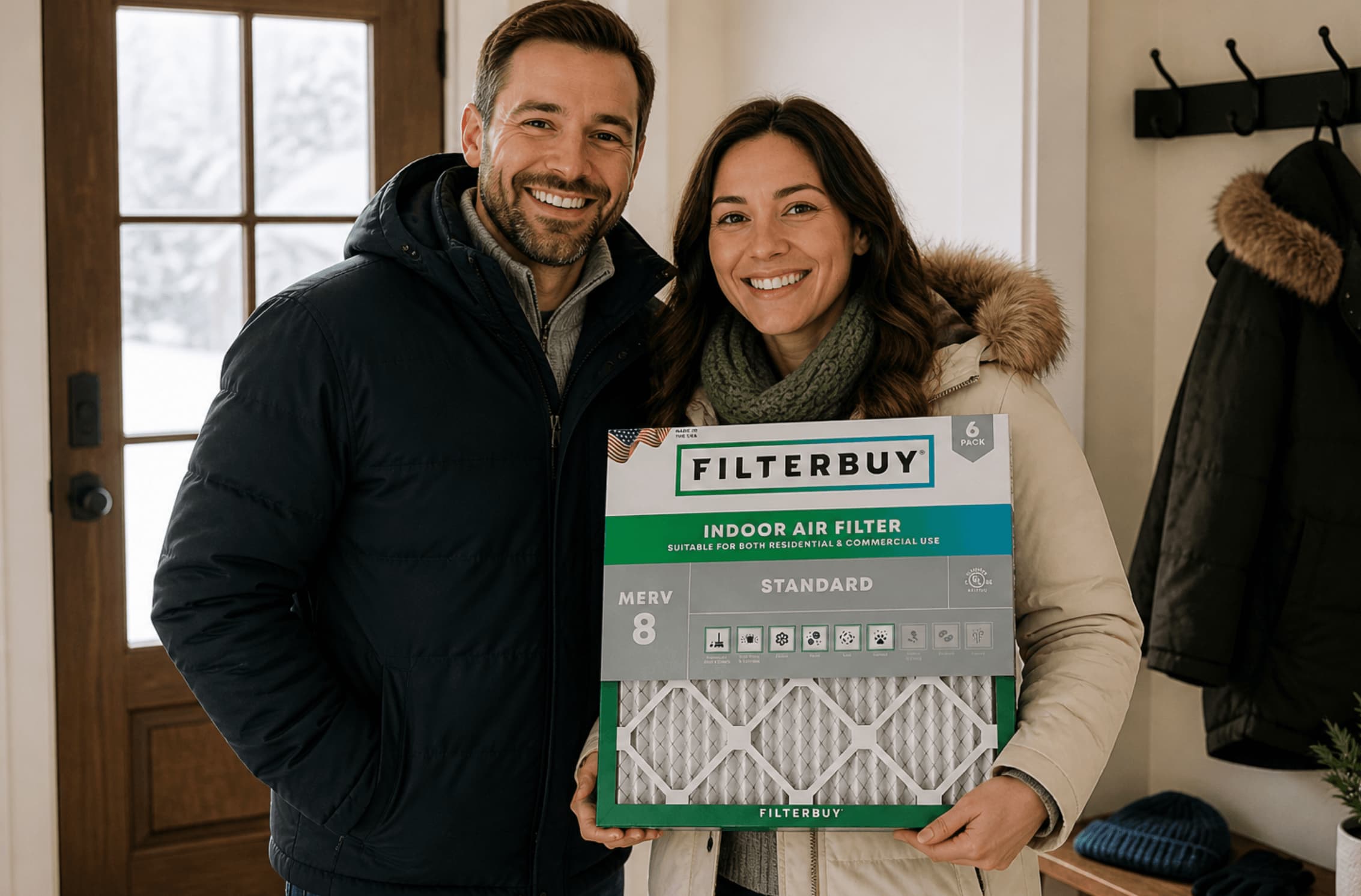
Open your furnace panel and pull out the filter. Hold it up to a lamp. If light won't pass through, the most expensive part of your winter already started, and a fifteen-dollar filter is the cheapest fix you'll get all season.
We've been building air filters in the U.S. for more than ten years, and we ship millions of them straight to families every year. The same pattern shows up every fall in our customer conversations and our own field testing. Homes that swap the filter before the first real cold snap glide through the season. The ones that wait are the ones we hear from in January, usually after an emergency service call that started, somewhere upstream, with a clogged filter nobody had checked since spring.
TL;DR Quick Answers
Replacing HVAC filter before winter
You should replace your HVAC filter before winter. Pre-winter is the best window of the year to start with a clean filter, since your furnace is about to log far more runtime than your AC ever did, and the cleaner you start the season, the less your system strains all the way through to spring. The U.S. Department of Energy estimates a 5–15% reduction in HVAC energy use just from that one swap.
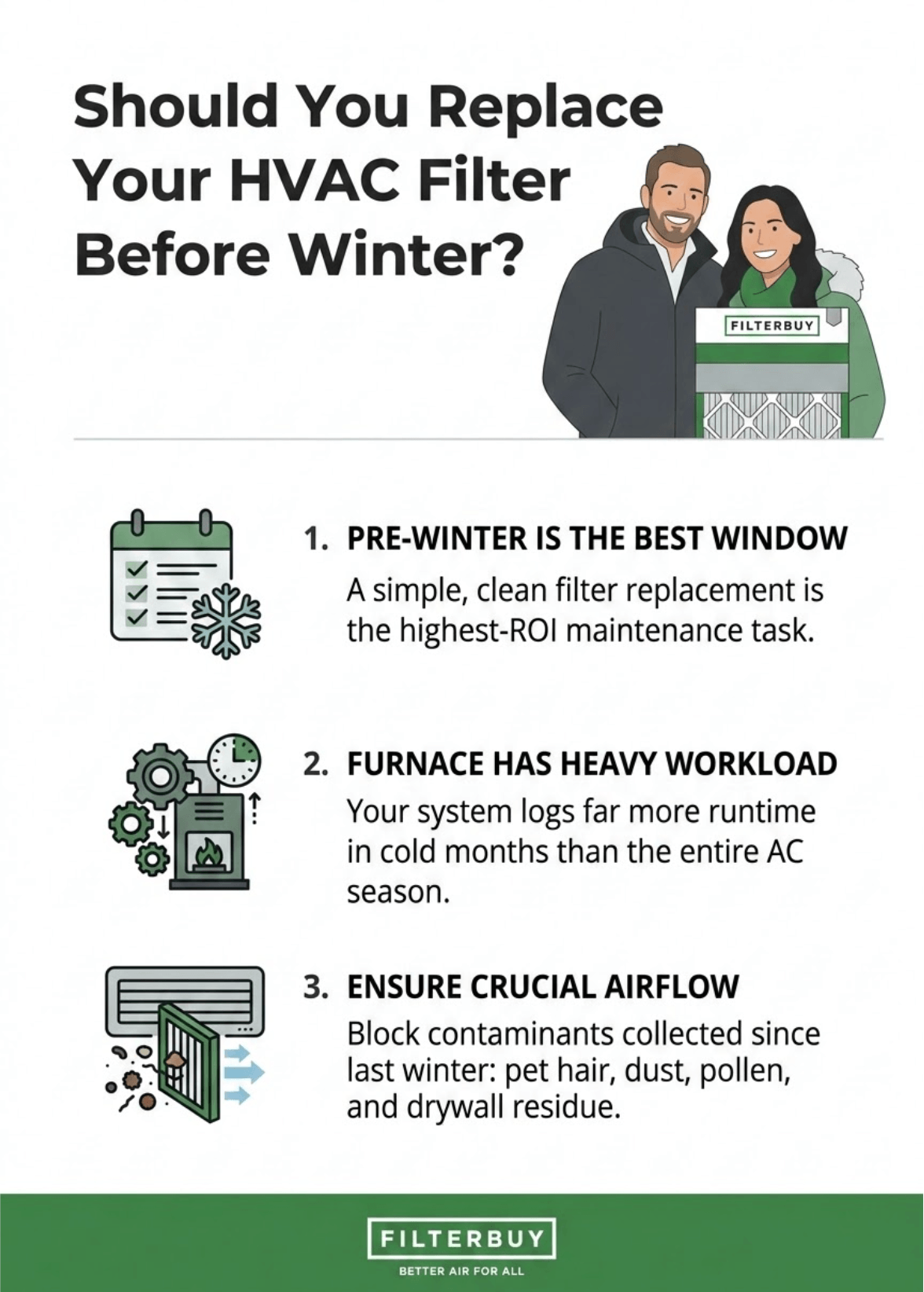
Why now? Your furnace is about to log far more hours than your AC ever did, and any dust the old filter has been collecting since spring is now standing between your system and the airflow it needs to do its job.
The quick rules:
• Replace before the first real heat call (late September through early October for most U.S. climates)
• Inspect every 30 days during peak heating, and replace every 60–90 days for most homes, or every 30–45 days if you have pets, allergies, or run a wood-burning fireplace
• Use MERV 8 for older systems, MERV 11 for most homes, MERV 13 if your equipment supports it and someone in the household has asthma, allergies, or COPD
• If light can't pass through the filter when you hold it to a lamp, it's overdue, no matter what the calendar says
Here's the pattern we see every winter at Filterbuy: homeowners who skip a $15 filter in November end up paying several hundred dollars for an emergency service call in January, and the problem traces right back to the filter slot. A fresh filter is the highest-ROI maintenance task in the entire home.
Top Takeaways
• A fresh filter before winter is the highest-ROI task in your entire home. Five minutes of work, often less than $20, real savings all season long.
• Your furnace runs more total hours in winter than your AC does in summer. Filters load up faster than people expect once the heat kicks on.
• A clogged filter doesn't just hurt the air. It strains the blower motor, can trip safety limits, and is one of the most common causes of mid-winter no-heat service calls.
• MERV 8 to MERV 13 covers nearly every home situation. Going higher than your equipment can handle is its own problem, so match the filter to the system.
• Visual checks beat a calendar. Hold the filter up to a light source once a month. If light doesn't pass through, swap it, no matter how new it looks on paper.
• Auto-delivery removes the only real obstacle most homeowners face: remembering. The filter shows up. You swap it. You move on.
Why Pre-Winter Is the Right Moment
Air conditioners get most of the spotlight, but a furnace works harder for longer in most U.S. climates. Once you flip the thermostat to heat, your system pulls air through that same filter for hours every day, sometimes around the clock during a cold snap. Whatever that filter has been collecting since last winter—pet hair, dust from a summer of open windows, drywall residue from the bathroom remodel, pollen, smoke from a regional wildfire event—is now standing between your furnace and the airflow it needs to do its job.
Starting the heating season with a clean filter gives your system the best operating baseline you can hand it. It's also the cheapest energy upgrade you'll make all year.
What Actually Happens When You Skip It
A clogged filter creates what HVAC pros call pressure drop. Your system has to pull harder to move the same amount of air, and that strain shows up in ways you'll feel directly. Your blower motor works longer, which raises your energy bill. Your heat exchanger can run hotter than designed and trip the high-limit safety switch, which feels like the heat randomly cutting out. The dust the filter is no longer catching ends up on coils, registers, and circulating right past your face.
We've watched this exact sequence play out thousands of times. A homeowner skips a $15 filter change in November, then pays a service tech several hundred dollars in January for a problem that started right there in the filter slot. It's the most preventable winter HVAC issue we know.
When Exactly to Make the Swap
For most homes, late September through early October is the sweet spot, before your first real heat call of the season. If you have a 1-inch pleated filter, plan on a fresh one going in then, with another check around the holidays. If you have a 4- or 5-inch media filter, look at the install date on the side. Four months in or longer? Time to swap, even if it doesn't look catastrophic yet.
If you've got pets, anyone in the household with allergies, or you ran a wood stove or fireplace last winter, swap the filter regardless of when it was last changed. Those conditions load a filter faster than a calendar can keep up with.
Picking the Right Filter for Cold Weather
Two questions decide it.
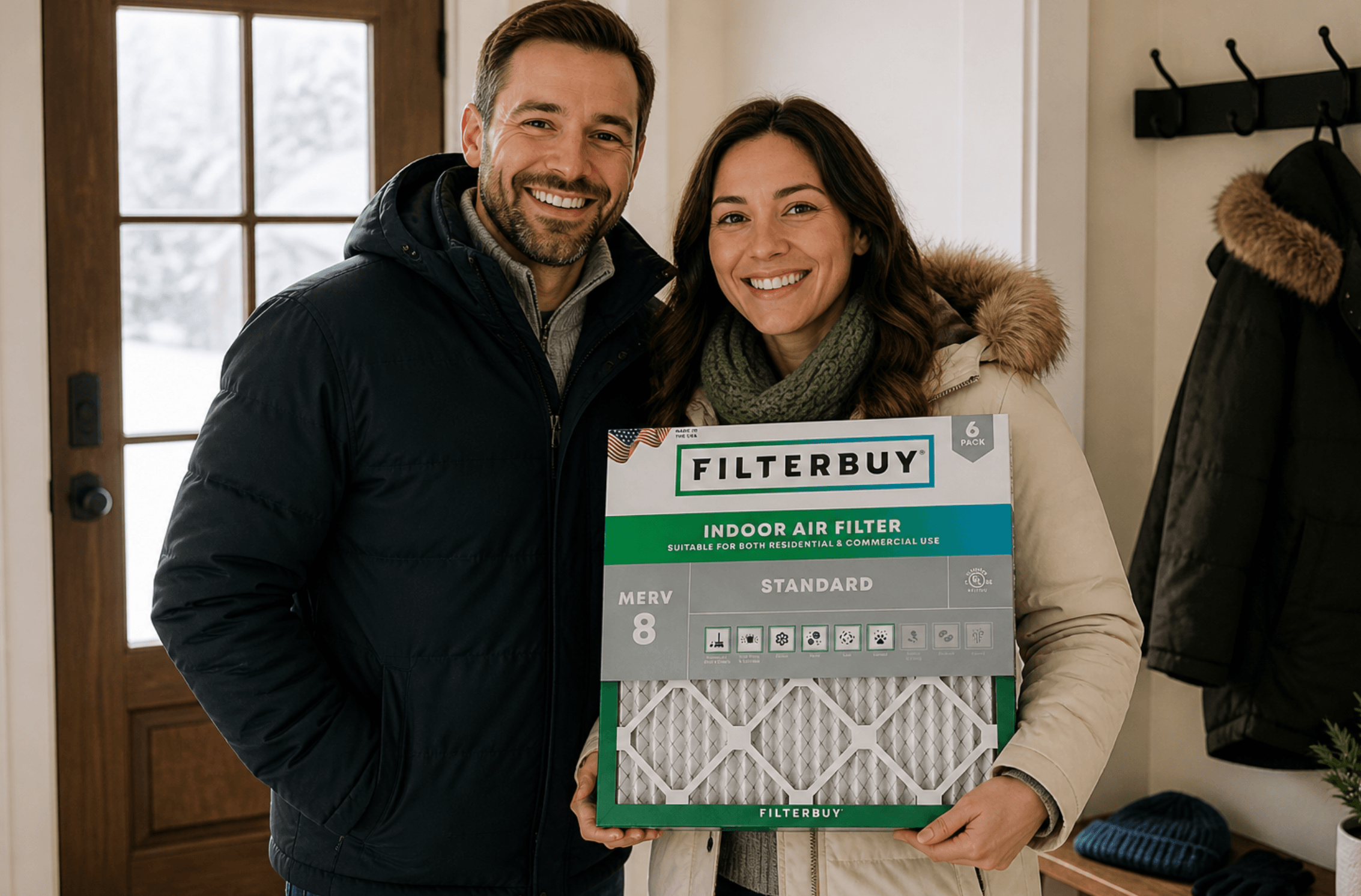
First, what does your system support? Older furnaces and weaker blower motors do better with lower-resistance filters in the MERV 8 range. Most modern residential systems handle MERV 11 without breaking a sweat. MERV 13 captures finer particles like smoke and viruses, and the American Lung Association recommends it where the equipment can support the denser media. Verify before you upgrade. A filter that's too restrictive for your system will cause its own problems.
Second, what's actually happening inside your home? Pets, allergies, smoke exposure, and family members with asthma or COPD all push you toward higher MERV. Quiet, low-traffic homes with no special concerns are well served by MERV 8 or 11. There's no trophy for using the highest number. There's a trophy for using the right one.
How to Swap It (Five Minutes, No Tools)
1. Turn the system off at the thermostat or the breaker so the blower can't kick on while the slot is open.
2. Find the filter slot. It's almost always along the return air duct or at the air handler intake.
3. Slide the old filter out and write the date and size on the new one with a marker.
4. Insert the new filter with the airflow arrow pointing toward the blower.
5. Close the panel, turn the system back on, and set a reminder for 60 days from today.
That's it. Five minutes, no tools, and you've handled the most preventable winter HVAC problem in residential service.
"After more than ten years building filters in the U.S. and tracking what actually shows up in the ones we get back from homeowners, the clearest pattern we see every winter is this: homes that swap a single $15 filter in October almost never become emergency service calls in January, and the ones that don't, almost always do."
— The Filterbuy team, drawing on more than a decade of U.S. manufacturing
7 Essential Resources
Trusted, third-party reading from federal agencies and lung-health authorities. Bookmark these. They're the same sources the most credentialed HVAC pros rely on.
1. EPA's Guide to Air Cleaners in the Home. The plain-language consumer reference on portable air cleaners and HVAC filters, with practical guidance on how MERV ratings translate to real-world particle capture. https://www.epa.gov/indoor-air-quality-iaq/guide-air-cleaners-home
2. EPA's Care for Your Air guide. A full overview of indoor pollutants, source control, ventilation, and filtration. The best starting point if you're newer to home air quality. https://www.epa.gov/indoor-air-quality-iaq/care-your-air-guide-indoor-air-quality
3. Heat & Cool Efficiently (ENERGY STAR). Joint EPA and DOE guidance on filter checks, duct sealing, smart thermostats, and seasonal HVAC tune-ups. A clean checklist you can run through in a weekend. https://www.energystar.gov/saveathome/heating-cooling
4. HVAC Maintenance Checklist (ENERGY STAR). What a qualified contractor should actually do during a fall heating tune-up, in checklist form. Useful for vetting whoever services your system. https://www.energystar.gov/saveathome/heating-cooling/maintenance-checklist
5. Air Conditioner Maintenance (U.S. Department of Energy). Federal-level technical guidance on filter replacement, coil care, and the energy cost of neglected maintenance. Short and authoritative. https://www.energy.gov/energysaver/air-conditioner-maintenance
6. Operating and Maintaining Your Heat Pump (U.S. Department of Energy). Your reference if you heat with a heat pump rather than a gas furnace. Covers filter intervals, MERV considerations, and professional service expectations specific to heat pumps. https://www.energy.gov/energysaver/operating-and-maintaining-your-heat-pump
7. American Lung Association: Air Cleaning. ALA guidance on HVAC filtration, MERV ratings, and what level of filtration is recommended for households where someone has asthma, allergies, or other respiratory conditions. https://www.lung.org/clean-air/indoor-air/protecting-from-air-pollution/air-cleaning
3 Statistics Worth Remembering
Three numbers, three federal sources, three reasons to make this filter swap before the season turns.
• 5% to 15%. The reduction in HVAC energy use that the U.S. Department of Energy attributes to swapping a clogged, dirty filter for a clean one. On winter heating bills, that often pays for the filter many times over in a single month. Source: U.S. Department of Energy, Energy Saver 101: Home Cooling.
https://www.energy.gov/sites/prod/files/2014/06/f16/HomeCooling101.pdf
• Nearly 50%. The share of an average American home's total energy use that goes to heating and cooling, according to ENERGY STAR. That makes any efficiency gain on the HVAC side, including a clean filter, one of the highest-leverage moves a homeowner can make. Source: ENERGY STAR, Heat & Cool Efficiently.
https://www.energystar.gov/saveathome/heating-cooling
• 20% to 30%. The proportion of conditioned air that ENERGY STAR estimates is lost in a typical home through duct leaks, holes, and poor connections, before it ever reaches the rooms you actually live in. Combine sealed ducts with a fresh filter and you stack two of the biggest winter wins available. Source: ENERGY STAR, How to Keep Your HVAC System Working Efficiently.
https://www.energystar.gov/products/ask-the-experts/how-keep-your-hvac-system-working-efficiently
Final Thoughts and Opinion
Here's the honest take, from a team that's spent more than a decade thinking about exactly this part of your home. The furnace filter is the most underestimated component in residential HVAC, full stop. It costs less than dinner for two, takes less time to change than a load of laundry, and quietly decides whether your system has an easy winter or an expensive one.
Every fall we watch homeowners drop hundreds of dollars on smart thermostats, premium duct sealing, and humidity controls, while the cheapest, highest-impact fix is sitting in a slot they've never opened. Start the season with a clean filter. Pick the right MERV for your equipment and your household. Then either build the habit or let auto-delivery build it for you. Everything else on your winter HVAC list gets easier from there.
Next Steps
Pick one or two that fit where you are right now. Do them today, not next weekend.
1. Open your filter compartment and pull out what's in there. Look at it under decent light. If it's gray, matted, or you can't see light through it, you're overdue.
2. Write down the size printed on the frame of the old filter (length × width × depth). That number drives every other decision.
3. Decide your MERV based on system and household: MERV 8 for older systems, MERV 11 for most homes, MERV 13 if someone has allergy or asthma concerns and your equipment supports it.
4. Order at least two: one to install now, one waiting for the mid-winter swap. Better yet, set up auto-delivery so the next one shows up without you thinking about it.
5. Schedule your fall heating tune-up while contractors still have availability. A clean filter plus a checked system equals the smoothest winter you can buy.
Frequently Asked Questions
How long does a furnace filter actually last in winter?
It depends on thickness and household conditions. A 1-inch pleated filter usually wants replacement every 60 to 90 days during heavy heating, and pet or allergy homes often need 30 to 45 days. A 4- or 5-inch media filter can run 90 days or more. The reliable answer for any size is the visual check: hold it to a light, and if light can't pass through, it's done.
Will a clean filter really lower my heating bill?
Yes. The U.S. Department of Energy estimates a 5 to 15 percent reduction in HVAC energy use from swapping a clogged filter for a clean one. The exact dollar savings depend on your equipment, your local energy rates, and how cold your winter runs, but the math very rarely works against you.
Can a dirty filter cause my furnace to shut off?
It can. When airflow is restricted enough, the heat exchanger overheats and trips the high-limit safety switch, which feels like the system cutting out for no reason. Repeated trips can damage the limit switch itself. A fresh filter is the first thing any honest technician will check on a no-heat call.
Is a higher MERV always better?
No. MERV 13 catches more particles than MERV 8, but it also offers more resistance to airflow. If your system wasn't designed for that resistance, you can starve the blower and trade one problem for another. Match the filter to your equipment first. Then improve air quality within that envelope.
What if I have a heat pump instead of a furnace?
Heat pumps need it just as much. They move a lot of air through their indoor coil in heating mode, and a clogged filter still chokes airflow and strains the equipment. The DOE recommends the same filter cadence you'd run on a furnace.
How do I know what size filter I need?
Pull out the existing filter and look at the frame. The dimensions are almost always printed there in length, width, and depth. If they aren't, measure the slot itself with a tape measure. If your system uses an odd or non-standard size, custom sizing is widely available. You shouldn't be cutting filters down to fit.
Ready Before the First Cold Snap?
Filterbuy makes filters in the United States and ships them factory-direct with free shipping. We stock more than 600 standard sizes, plus custom sizing for non-standard systems. Auto-delivery means the next filter lands on your doorstep on your schedule, so you never spend another season wondering when you last changed it.
Find your exact filter size, or set up auto-delivery before winter starts.
Made in the USA. 75,000+ five-star reviews. Free shipping. Custom sizes available.