April 23, 2026
Most HVAC systems ship from the factory with a MERV 8 filter in the slot. HVAC manufacturers pick that filter to protect the blower and the coils, not the people breathing around it. For households that include a child with asthma, an aging parent, or someone with a compromised immune system, that default MERV 8 is the biggest fixable air-quality problem in the house. Winter widens the problem.
Here's what winter does. You close the windows, weatherstrip the doors, and run the furnace for hours a day. Dust mite fragments, pet dander, mold spores, and dried respiratory droplets stop leaving the house and start cycling through the same blower instead. The EPA reports that indoor concentrations of some pollutants typically run 2 to 5 times higher than outdoor levels, and Americans spend about 90% of their time indoors. For the people in your house who are already sensitive, those numbers add up fast.
We've been making air filters in the USA since 2013, factory-direct out of plants in Alabama, Florida, Pennsylvania, and Utah. What follows is the plan we'd walk a neighbor through if they called in January asking what to try first for a kid coughing at night, a parent whose throat won't clear in the morning, or a partner whose allergies came back the week the heat turned on.
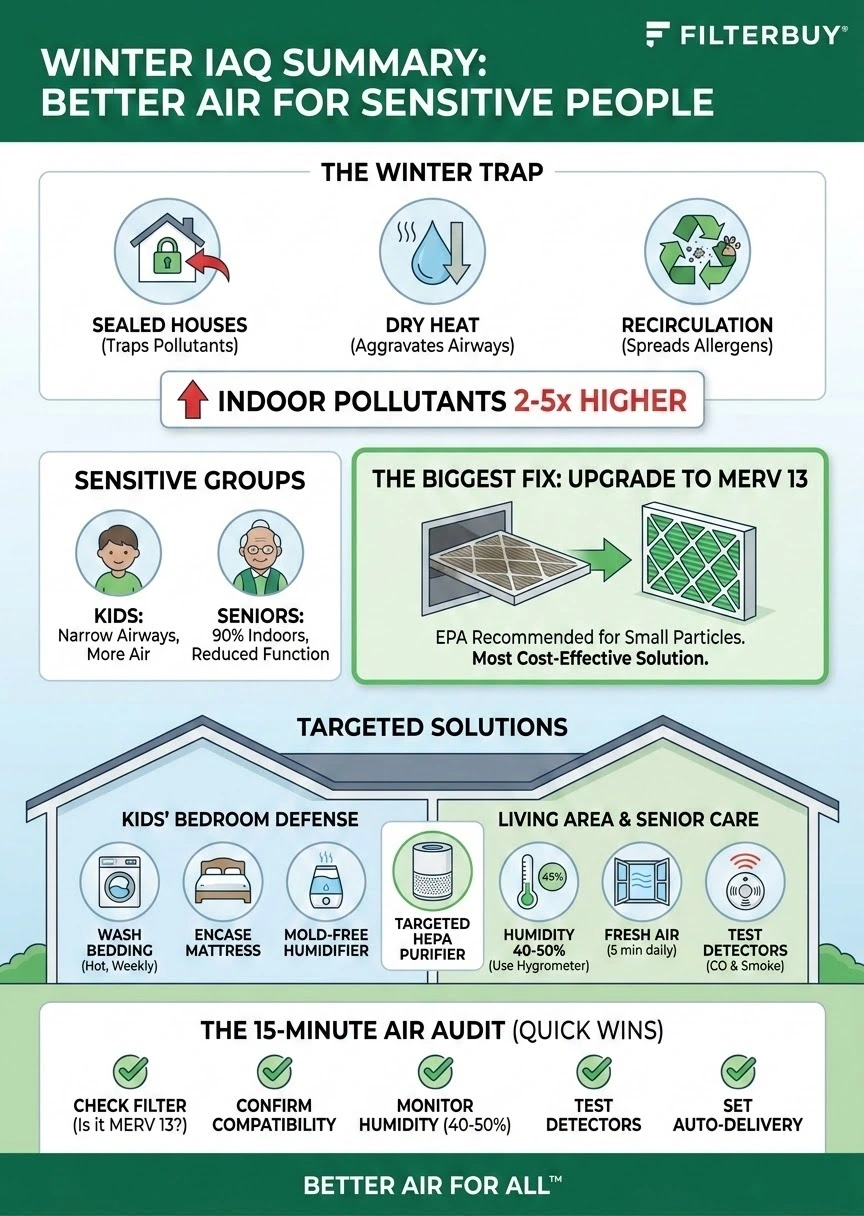
For sensitive people at home (kids with asthma, aging parents, immunocompromised family members), winter indoor air mostly concentrates what's already there. Sealed houses cycle the same dander, mold spores, and respiratory droplets through the HVAC for months at a time, and the default MERV 8 filter that shipped with most systems was picked to protect the equipment, not the people breathing around it.
The fix is layered and specific:
Upgrade to a properly sized MERV 13 pleated filter, which is the EPA's minimum recommendation for small-particle control. Change it every 60 to 90 days through heating season.
Hold indoor humidity between 40 and 50% using an inexpensive hygrometer.
Add a HEPA purifier in the bedroom of whoever in the house is most sensitive.
Test the CO detector. Filters catch particles, not carbon monoxide.
If your current furnace filter says MERV 8 or lower on the frame, that's your single biggest fixable air-quality problem today.
Winter concentrates what's already in your air. Sealed homes plus dry heat plus a recirculating blower means higher exposure for anyone already sensitive.
Kids, seniors, and immunocompromised people feel it first, each for different physiological reasons, and the solutions overlap.
MERV 13 is the EPA's recommended floor for small-particle control in most residential systems, far stronger than the MERV 8 most units ship with.
Humidity does almost as much work as filtration. A target of 40 to 50% limits mite and mold growth while keeping airways from drying out.
Build the defense in layers: HVAC filter as the whole-home baseline, HEPA in the sensitive person's room, humidity control, working CO detection, and five minutes of ventilation on mild days.
Filters don't do everything. They catch particles, not carbon monoxide, radon, or most gases. Detect those separately.
Consistency beats intensity. A properly sized MERV 13 changed every 60 or 90 days outperforms a fancier filter swapped once a season.
Three shifts happen when the heating season starts, and they compound. The house seals up and stops trading air with the outside. Furnace heat drives indoor humidity down, sometimes into the teens, and dry airways react more than hydrated ones. Meanwhile, allergens stop dispersing. Dust mites in bedding, dander on upholstery, and mold from damp corners or a neglected humidifier all ride the same blower for four or five months instead of getting diluted by open windows like they would in July.
For sensitive lungs, winter is less about new pollutants showing up and more about the old ones having nowhere to go.
Children take in more air per pound of body weight than adults do, and their airways are narrower, so the same level of pollution lands harder. The American Lung Association flags kids as one of the groups most affected by poor air quality for exactly this reason. In winter they're also sleeping ten or more hours a night in a room loaded with dust mite allergen from the bedding, so the per-hour exposure climbs even when the per-cubic-foot number stays the same.
The highest-leverage moves, in order:
Upgrade the furnace filter to a properly sized MERV 11 at minimum, MERV 13 if the system supports it. This is the change that keeps working while the kid sleeps.
Wash the bedding in hot water weekly. Hot, not warm. Warm water doesn't kill the mites.
Add a mattress and pillow encasing. Cuts the exposure they can't escape from.
Rinse and refill the humidifier every three days. A moldy humidifier is worse than no humidifier.
HEPA-vacuum the bedroom and any shared play areas twice a week.
Seniors spend more time indoors in winter, have reduced mucosal clearance, and are at higher risk for respiratory infections like flu, RSV, and pneumonia. The EPA specifically names older adults among the groups most affected by indoor pollutants, along with the very young and anyone with respiratory or cardiovascular disease.
The practical winter plan for a senior living at home:
Keep relative humidity between 30% and 50%. A $15 hygrometer tells you where you actually are. Most older adults do best closer to 40 to 50%.
Change the furnace filter every 60 to 90 days in heating season. Auto-delivery does the remembering for you.
Crack a window for five minutes a day on mild afternoons. Even a short air exchange reduces the built-up indoor concentration.
Add a HEPA purifier in the room where they spend most of their waking hours.
Test the CO detector and replace the battery before you forget. Filters catch particles, but they don't catch carbon monoxide, and winter is peak combustion-appliance season.
When someone in your home has year-round allergies, is on immunosuppressants, or is recovering from something serious, the goal is layered protection rather than a single fix. Four layers that actually work together:
A MERV 13 HVAC filter as the whole-home baseline. The EPA specifically points to MERV 13 as the minimum rating for anyone concerned about small particles.
A portable HEPA purifier in the vulnerable family member's primary room, sized so its Clean Air Delivery Rate matches the square footage.
Indoor humidity parked at 40 to 50%. This limits mold and dust mite growth while keeping airways from drying out.
An activated carbon filter if odors, cooking fumes, or VOCs are part of the picture. A MERV rating alone doesn't capture gases.
One honest disclaimer. Filters catch particles. They don't catch carbon monoxide, radon, or most gases on their own. Every sensitive household also needs a working CO detector and, in high-risk areas, a radon test, regardless of what you put in the furnace slot.
“After more than a decade of making filters in the USA, we can sort January-returned MERV 8s from sensitive-family homes just by feel: they come back loaded with fine dander, dried respiratory droplets, humidifier mold, and skin cells the filter was never built to catch. When those same families switch to a properly sized MERV 13 at 40 to 50% humidity, the six-week winter cough usually quits inside a month.”
The Filterbuy Team. Family-owned, U.S.-based, manufacturing since 2013. Factories in Alabama, Florida, Pennsylvania, and Utah.
These are the sources we trust, cite internally, and point customers toward when a question goes past what a filter alone can answer.
EPA: Guide to Air Cleaners in the Home. The federal baseline on HVAC filters and portable air cleaners, plus the MERV 13 recommendation for small-particle concerns.
EPA: Care for Your Air, A Guide to Indoor Air Quality. The short homeowner primer. Humidity targets, source control, and the basics every sensitive household should know.
EPA: What Is a MERV Rating?. Plain-English explainer of the rating your filter is measured on, and why higher ratings catch smaller particles.
American Lung Association: Why Is My Asthma Worse in the Winter?. The best short read on managing asthma in cold months, with practical indoor-trigger guidance.
Asthma and Allergy Foundation of America: Weather Triggers Asthma. How temperature, humidity, and pollen interact to trigger asthma symptoms across the seasons.
CPSC: The Inside Story, A Guide to Indoor Air Quality. A joint EPA and CPSC guide covering biological contaminants, combustion pollutants, and vulnerable populations in detail.
Wikipedia: Air Filter. A clean overview of the mechanical science behind how filters capture particles. Useful context if you want to understand what the rating on the box actually measures.
Indoor pollutants can run 2 to 5 times higher than outdoor levels, and sometimes more than 100 times higher
This is the statistic that reframes the whole conversation. You don't breathe outdoor air 90% of the time. You breathe indoor air. In winter, when the house seals up, the multiplier tends to sit at the high end of that range. Source: EPA, Why Indoor Air Quality Is Important to Schools.
Americans spend roughly 90% of their time indoors, and vulnerable populations spend even more
The very young, older adults, and anyone with a respiratory or cardiovascular condition tend to spend even more time indoors than the general population. That's exactly the group with the least biological margin to absorb poor-quality air. Source: EPA, Indoor Air Quality.
The EPA recommends MERV 13 for small-particle control, and most modern home HVAC systems can run it
For homeowners concerned about the small particles that aggravate asthma, allergies, and sensitive lungs, the EPA recommends at least a MERV 13 filter, or as high a rating as the system can accommodate. Most modern residential HVAC systems can handle MERV 13 without issues, provided the filter is sized correctly and changed regularly. Source: EPA, Guide to Air Cleaners in the Home.
Let us be straight with you. Most of the winter IAQ advice floating around the internet is either too vague to act on or too expensive for a normal family to implement. A parent trying to figure out why their kid can't sleep through the night in January doesn't need "improve your air quality." They need a specific filter, a specific size, and a specific schedule.
Our opinion, after more than a decade of manufacturing filters and talking to the households that use them: the right filter, properly sized and changed on schedule, is the single most cost-effective thing a sensitive household can do in winter. One piece of pleated media, working every minute the HVAC fan runs, outperforms most gadgets and ventilation upgrades at a fraction of the cost. For a house with a kid with asthma, an aging parent, or an immunocompromised family member, a MERV 13 pleated filter swapped every 60 to 90 days is a lever that pays back quietly, every day.
Add the other layers as the situation calls for them. A HEPA purifier in the most sensitive bedroom. Activated carbon if odors or VOCs are an issue. A whole-home humidifier in very dry climates. But don't skip the foundation to chase a gadget. And don't trust any company, Filterbuy included, that tells you a single product fixes everything. A filter plus humidity in the 40 to 50% range plus a working CO detector is the package that actually changes how the house breathes.
Set a timer. Walk through the house and do five things.
Find your current filter and read the label. Write down the size (something like 20x25x1), the MERV rating, and when you last changed it. If the label says MERV 8 or lower, you've just found the biggest upgrade opportunity in the house.
Confirm system compatibility. Look up the HVAC model online or call the installer. Most modern residential units run MERV 13 without a problem. If yours doesn't, MERV 11 still beats MERV 8 by a wide margin.
Put a hygrometer in the main living area. Target 40 to 50% relative humidity. Use a humidifier to add moisture or crack a window briefly to reduce it, whichever way you're off.
Test the CO detector and the smoke detector. Press the button. If either chirps, replace the battery right then. The house is warming up, the combustion appliances are running harder, and this is when you want those detectors working.
Decide who needs the extra layer. The most sensitive person in the house gets a properly sized HEPA purifier in their bedroom. Bedroom is the priority because that's where they spend the most concentrated time.
Ready to pick the specific filter? The companion guide goes deeper on the right MERV rating, size, and replacement cadence for winter allergy relief: Best Furnace Air Filter for Winter Allergies.
Start with a properly sized MERV 13 pleated filter for the furnace. It captures the pet dander, pollen, and fine dust that most commonly trigger childhood asthma in winter, and it keeps airflow in the range that a modern residential HVAC is built to handle. Change it every 60 to 90 days during heating season. If your system is older or small, verify compatibility before going to MERV 13. MERV 11 is the fallback.
Dial in humidity. Put a hygrometer in the main living area and hold relative humidity between 30% and 50% per EPA guidance. Most older adults do best closer to 40 to 50%. That one adjustment tends to reduce dry cough, sore throats, and morning congestion more than any other single move. Pair it with a MERV 13 furnace filter on a 60 to 90-day schedule and a tested CO detector, and you've covered the high-leverage bases.
No. They do different jobs. The HVAC filter cleans the whole home every time the system fan runs, which is hours a day. A portable HEPA purifier delivers concentrated clean air in one room. Households with a sensitive family member should run both: MERV 13 in the furnace as the baseline, HEPA in the bedroom where the sensitive person sleeps.
Partially. MERV 13 and higher filters can capture some virus-carrying droplets, which is why the EPA recommends upgrading from the default MERV 8 if virus protection is a concern. Filtration is one layer. Vaccines, handwashing, staying home when sick, and appropriate masking in risky settings still matter.
The size is printed on the frame of your current filter, usually something like 16x25x1 or 20x25x4. Reorder those exact numbers. If your current filter is an odd or non-standard size, you're not stuck with a close-enough fit. Filterbuy makes more than 600 standard sizes plus custom cuts, so the filter actually seals to the frame instead of letting air slip around the edges.
Sometimes. A MERV filter catches particles, but it doesn't trap gases or odors. If someone in the house reacts to cooking smells, off-gassing from new furniture, pet odors, or general VOCs, add an activated carbon filter. You can get it as a standalone or as a MERV-plus-carbon combination. If gases aren't the issue, MERV 13 alone is usually enough.
Every 60 to 90 days during heating season for most homes. Closer to 60 if you have pets, kids, or run the system heavily. Signs the filter is overdue: visible grey-brown loading across the surface, more dust on the furniture than usual, or the system taking noticeably longer to heat the house. Setting up auto-delivery takes the decision out of your hands.
After more than a decade of making air filters for U.S. households, here's what we've learned about winter and sensitive lungs. The families that get the best results don't overthink it. They find the right size, pick a MERV 13, put it on auto-delivery, hold humidity at 40 to 50%, and add a HEPA purifier for whoever in the house needs one. That's the whole program.
Find your filter size and shop MERV 13 filters. More than 600 standard sizes plus custom cuts, American-made across four U.S. factories, factory-direct, shipped fast. Or head straight to the winter-specific pick: Best Furnace Air Filter for Winter Allergies.
Want to stop thinking about filter changes? Set up auto-delivery. The next filter shows up right when your current one needs replacing, all winter, all year, for as long as the people you love are counting on you to keep the air in your home honest.
