
What to Do If Your Furnace Stops Heating After a Filter Change
March 4, 2026
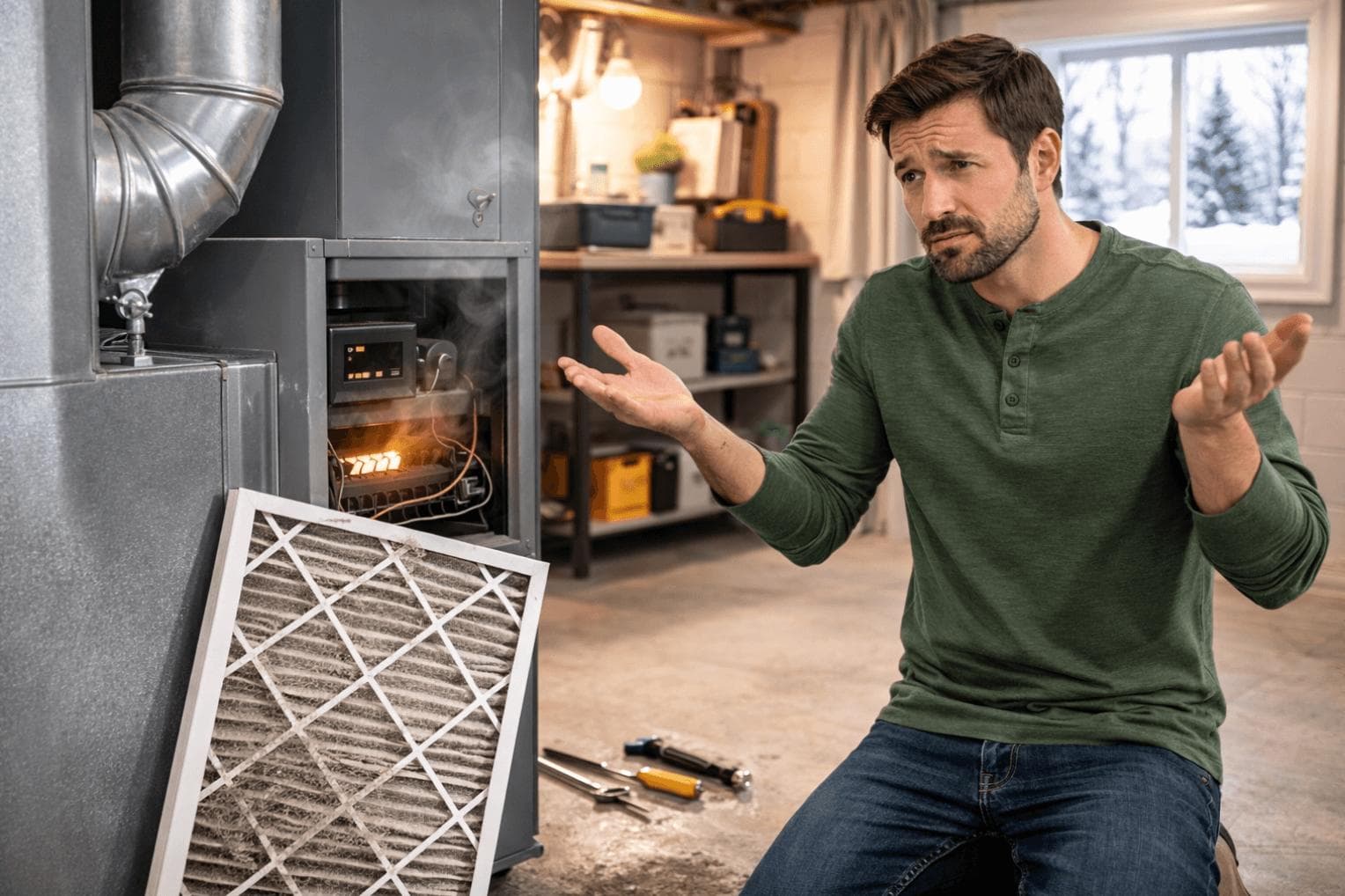
Here's something we've learned after manufacturing millions of air filters and hearing from countless homeowners: a furnace that stops heating right after a filter change is almost never a coincidence — and almost never a crisis. At Filterbuy, we've seen this scenario play out in a predictable set of ways, and the fix is usually simpler than you'd expect. Most of the time, the culprit comes down to one of three things: a filter that's too restrictive for your system, one that wasn't seated correctly, or a safety switch your furnace tripped in response. This guide cuts through the guesswork so you can diagnose the problem yourself, get your heat back on fast, and know exactly when — and whether — it's worth picking up the phone to call a pro.
TL;DR Quick Answers
What to Do If Your Furnace Stops Heating After a Filter Change
After manufacturing millions of filters and hearing from homeowners across the country, we know this: a furnace that stops heating after a filter change is almost never a crisis — and almost never a coincidence.
Do this first:
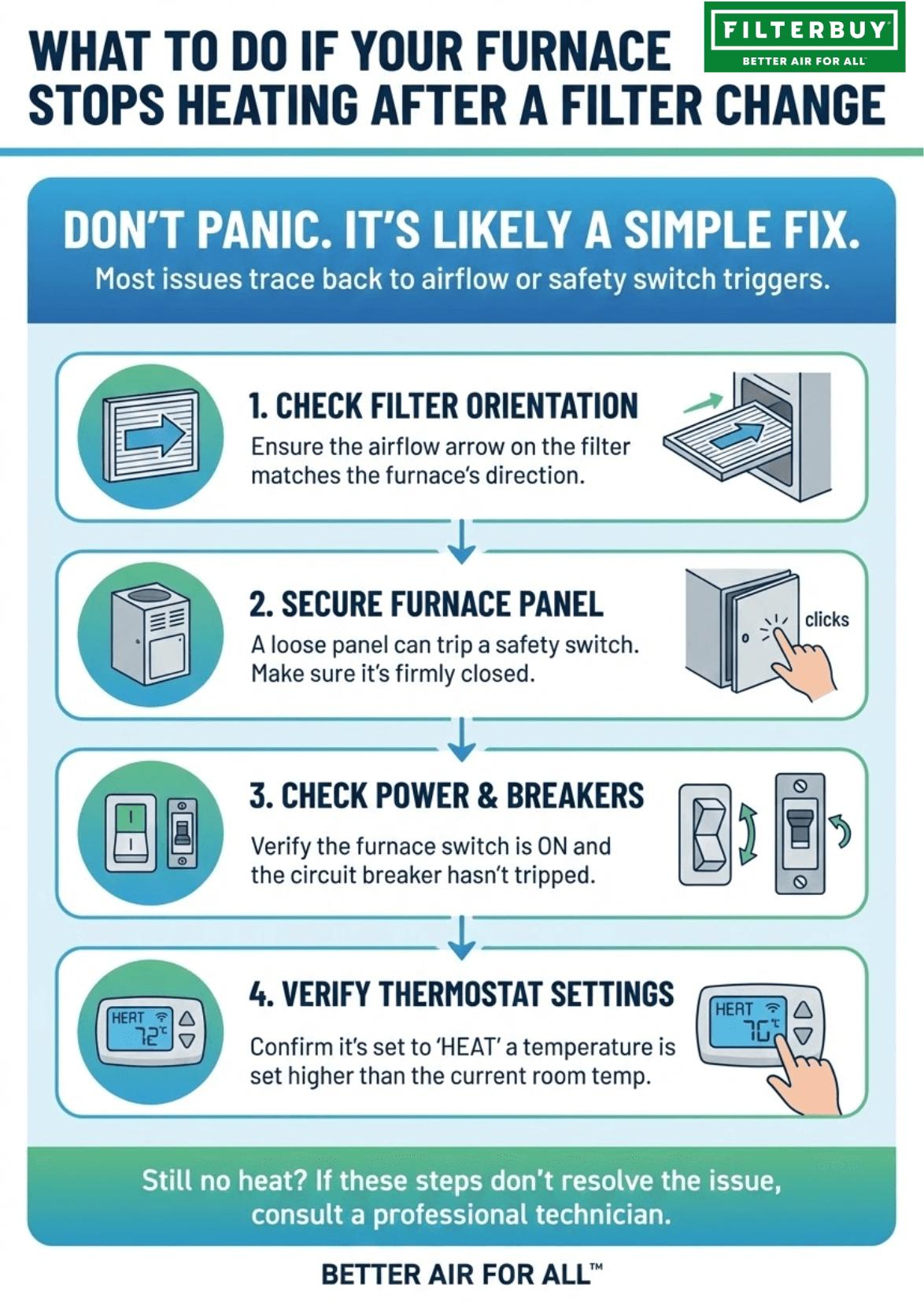
Check thermostat — set to "Heat," temperature above current room temp
Confirm furnace power switch is "On" and circuit breaker hasn't tripped
Remove the filter — verify the airflow arrow points toward the furnace
Reinstall flush with no gaps around the edges
Turn thermostat off, wait 30 minutes, restart
If it still won't heat, the filter is likely the problem:
MERV rating too high for your system → step down to MERV 8
Filter size incorrect → gaps allow air to bypass the filter entirely
Safety switch tripped → resets automatically after a 30-minute cool-down
When to call a technician: If the correct filter, correct size, and correct installation still don't restore heat — stop troubleshooting. The issue predates the filter change. A licensed HVAC technician can diagnose what the filter swap made visible.
The long-term fix: Change your filter every 60–90 days. Set up Filterbuy Auto-Delivery and the right filter arrives at your door right when you need it — no store runs, no wrong sizes, no rushed decisions that cause this problem in the first place.
Top Takeaways
It's almost always a filter problem — not a furnace problem. The cause usually comes down to one of three things:
A MERV rating too restrictive for your system
A filter that's incorrectly sized or seated
A safety switch tripped by restricted airflow
All three are fixable without a service call.
The right MERV rating matters as much as the filter itself.
Upgrading MERV without checking your system specs is the most common trigger for shutdowns
MERV 8 is the right starting point for most residential systems
Always check your furnace manual before changing filter ratings
Your filter is your home's primary air quality defense.
The EPA confirms indoor pollutant levels run 2–5x higher than outdoors
The right filter protects your health, your system, and your energy bill — simultaneously
If the right filter doesn't fix it, the problem predates the filter change.
9 in 10 HVAC systems carry at least one unresolved maintenance issue (U.S. DOE)
A filter swap reveals existing problems — it doesn't create them
Correct filter installed and still no heat? Call a licensed HVAC technician
Consistent filter changes prevent most of these problems entirely.
Change every 60–90 days — every 30–45 days with pets or allergy sufferers
Filterbuy Auto-Delivery delivers the right filter, in the right size, right when you need it
Start Here: The First Thing to Check After a Filter Change
Before anything else, check the basics. Make sure your thermostat is set to "Heat" — not "Cool" or "Fan Only" — and that the temperature is set above your current room temperature. It sounds obvious, but we've heard from homeowners who spent an hour troubleshooting before catching this. Next, confirm your furnace power switch (usually a wall switch near the unit) is on, and that your circuit breaker hasn't tripped. If everything looks right and your furnace still isn't producing heat, it's time to look at the filter itself.
The New Filter May Be Restricting Your Furnace's Airflow
This is the most common cause we see, and it's directly tied to filter selection. When you install a filter with a higher MERV rating than your system is designed to handle, it can restrict airflow so severely that your furnace overheats and shuts down as a protective measure. A MERV 13 filter, for example, captures far more particles than a MERV 8 — but that denser filtration media also creates more resistance against your blower motor. Older HVAC systems in particular weren't engineered for that level of restriction.
If you upgraded your filter rating at your last change, try stepping back down to a MERV 8 or MERV 11 and see if your furnace responds. At Filterbuy, we generally recommend MERV 8 as the right balance for most residential systems — effective filtration without the airflow penalty that causes problems like this.
Check That the Filter Is Seated Correctly
An air filter that's slightly misaligned, installed backward, or the wrong size can cause just as much trouble as the wrong MERV rating. If the filter isn't fully sealed within its slot, your furnace can pull unfiltered air around the edges — which ultimately leads to dust buildup on the evaporator coil and restricted airflow over time. Worse, a filter that's too small for its housing will allow debris to bypass it entirely, clogging internal components faster than you'd expect.
Remove the filter and reinstall it, making sure the airflow direction arrow on the filter frame points toward the furnace (away from the return air duct). The fit should be snug with no visible gaps around the edges. If you're unsure whether you have the right size, Filterbuy offers over 600 standard sizes plus custom options — so getting an exact fit is always straightforward.
Your Furnace May Have Tripped a Safety Switch
Modern furnaces have a high-limit safety switch designed to shut the system down if it detects dangerous overheating — which is exactly what happens when airflow is restricted for too long. If your furnace ran briefly after the filter change and then stopped, a tripped limit switch is a likely culprit.
In many cases, the furnace will reset automatically once it cools down (usually within 30 minutes). To test this, turn your thermostat off, wait 30 minutes, and turn it back on. If it fires up and heats normally, restricted airflow from the new filter was almost certainly the cause. If it trips again shortly after, that's a signal to check your filter selection and sizing before calling a technician.
When to Call a Professional
If you've confirmed the filter is the right MERV rating, correctly sized, and properly installed — and your furnace still isn't heating — it's time to bring in an HVAC technician. At that point, the issue likely predates your filter change and may involve a faulty igniter, a failing blower motor, or a gas supply issue. A filter change can sometimes be the event that makes an existing problem visible, not the cause of it. A licensed technician can run a full diagnostic and give you a clear answer.
Prevent This Problem Before It Starts
The best way to avoid a furnace shutdown after a filter change is to match your filter to your system from the start. Use the MERV rating recommended in your furnace owner's manual, change your filter on a consistent schedule (every 60–90 days for most homes, more frequently with pets), and always verify the size before installing. At Filterbuy, our auto-delivery option takes the guesswork out entirely — the right filter, in the right size, arrives at your door right when you need it. No store runs, no wrong sizes, no surprises.
"In our experience manufacturing millions of filters and hearing directly from homeowners across the country, a furnace that shuts down after a filter change almost always traces back to one fixable cause — and the right filter choice from the start prevents most of these calls entirely."
Keep Digging — 7 Resources That'll Help You Get Your Heat Back On and Keep It That Way
We've pointed you toward the most common causes above, but every home and every furnace is a little different. If you want to go deeper — whether that's picking the right replacement filter, understanding why your system shut itself off, or knowing when it's time to call a pro — these are the resources we'd hand a neighbor standing in our driveway asking the same question.
1. Start Here If You Think the Filter Itself Caused the Problem
We've shipped millions of filters and heard from homeowners across the country, and the pattern is consistent: most post-filter-change shutdowns trace back to airflow restriction. This guide breaks down exactly how your filter's density affects your furnace's ability to breathe — and why stepping up to a higher MERV rating without checking your system's specs first can cause more problems than it solves.
Source: Filterbuy Air Quality Experts
Read it here: https://filterbuy.com/resources/furnaces/furnace-knowledge/how-merv-ratings-affect-furnace-performance/
2. Not Sure Which Filter to Put Back In? This Clears It Up Fast
Here's what we tell homeowners every day: the best filter isn't the one with the highest rating — it's the one that matches your system. This guide walks you through MERV 8, 11, and 13 in plain language, so you can make a confident call based on your home, your household, and your HVAC without second-guessing yourself.
Source: Filterbuy Air Quality Experts
Read it here: https://filterbuy.com/resources/air-filter-basics/which-merv-rating-should-I-use/
3. Want the Government's Take on MERV Ratings? Here It Is, Straight From the EPA
If you like having a federal agency back up what you've read, this is your resource. The EPA explains how MERV ratings are measured, what each level actually captures, and why using a filter that's too restrictive for your system is a real and well-documented problem — not just an HVAC industry talking point.
Source: U.S. Environmental Protection Agency (EPA)
Read it here: https://www.epa.gov/indoor-air-quality-iaq/what-merv-rating
4. Run Through Every Common Cause Before You Pick Up the Phone
Before you schedule a service call, it's worth five minutes with this checklist. American Standard — one of the most trusted names in home heating — walks you through the full sequence of things to verify, including one step most homeowners skip entirely: making sure the furnace door panel is fully seated after a filter swap. That one detail alone has saved more than a few unnecessary service calls.
Source: American Standard Heating & Air Conditioning
Read it here: https://www.americanstandardair.com/resources/hvac-troubleshooting/furnace/
5. Furnace Completely Dead After the Filter Change? This One's for You
If your furnace isn't producing reduced heat — it's producing no heat at all and won't respond — this resource gets more specific. Trane walks through the checks that matter when a furnace won't turn on: breaker status, power switch position, thermostat wiring, and the point at which you stop troubleshooting yourself and let a licensed technician take it from there.
Source: Trane Technologies
Read it here: https://www.trane.com/residential/en/resources/troubleshooting/gas-furnaces/furnace-not-turning-on/
6. Here's What a "Hard Lockout" Means — And Why a Reset Button Won't Fix It
This is the resource for homeowners whose furnace kicked on briefly after the filter change and then went completely quiet. Fire & Ice explains the chain of events that connects airflow restriction to overheating to hard safety lockout — and why, once a furnace locks out hard, it takes more than a thermostat reset to get it running again. Good to know before you spend an hour troubleshooting something only a technician can unlock.
Source: Fire & Ice Heating & Air Conditioning
Read it here: https://indoortemp.com/resources/furnace-repair/furnace-troubleshooting/
7. If You Have a Gas Furnace, Read This Before You Rule Anything Out
Once you've confirmed the filter isn't the culprit, it's time to look at what's downstream. Trane's gas furnace troubleshooting guide covers ignition failures, pilot light issues, and — importantly — when a gas smell means you need to stop troubleshooting entirely, leave your home, and call your gas company. Worth a read for any homeowner with a gas-powered system.
Source: Trane Technologies
Read it here: https://www.trane.com/residential/en/resources/troubleshooting/gas-furnaces/
The Numbers Behind Why Your Filter — and Your Furnace — Matter More Than You Think
We've been manufacturing air filters in the U.S. since 2013. The data almost always confirms what we hear directly from our customers. These three government-sourced statistics don't surprise us — but they might surprise you.
90% of Your Time Is Spent Breathing Indoor Air
The U.S. EPA reports that Americans spend approximately 90% of their time indoors — where pollutant concentrations run 2 to 5 times higher than outdoor levels.
What we hear from customers every day reflects this exactly:
Unexplained allergy flare-ups traced back to an overdue filter
Homeowners who never connected their air quality to their filter until something went wrong
Families surprised to learn how hard a wrong-sized filter works against them
Your furnace filter isn't a minor maintenance item. For most households, it's the primary line of defense between your family and what's circulating through your air around the clock.
Source: U.S. Environmental Protection Agency — Indoor Air Quality
Cite: https://www.epa.gov/report-environment/indoor-air-quality
A Clean Filter Can Reduce Energy Consumption by Up to 15%
The U.S. Department of Energy confirms that swapping a clogged filter for a clean one can cut HVAC energy consumption by 5–15%. From experience, here's what that number doesn't capture:
A filter that's too restrictive forces your blower motor to strain against resistance it wasn't built to handle
That strain compounds month after month
The result: higher energy bills and accelerated wear on components that cost far more to replace than the filter itself
Getting the filter selection right from the start isn't just about airflow. It protects the entire system.
Source: U.S. Department of Energy — Maintaining Your Air Conditioner
Cite: https://www.energy.gov/energysaver/maintaining-your-air-conditioner
9 Out of 10 HVAC Systems Have an Unresolved Maintenance Issue
A U.S. Department of Energy field review found that 9 in 10 residential HVAC systems carry at least one unresolved maintenance issue — one that, if corrected, could deliver roughly a 12% efficiency improvement.
This is the stat we come back to most. Here's why it matters for your situation specifically:
The furnace that stopped heating after a filter change was almost never in perfect shape before the change
The filter swap is usually what makes an existing, developing problem impossible to ignore
That's not a reason to avoid changing your filter — it's a reason to act when your system tells you something is off
Catch it early and you're looking at a simple fix. Wait, and you may be looking at a significant repair.
Source: U.S. Department of Energy — Residential HVAC Installation Practices: A Review of Research Findings
Our Final Thought: A Furnace Problem Is Usually a Filter Problem in Disguise
After more than a decade of manufacturing air filters in the U.S. and working directly with millions of homeowners, we've arrived at one opinion that might be the most useful thing on this page:
A furnace that stops heating after a filter change is almost never a coincidence — and almost never a mystery.
Here's what we've consistently found to be true:
The filter is the most underestimated component in any HVAC system. It controls the airflow everything else depends on. The wrong filter — or an incorrectly installed one — puts the entire system under stress it wasn't built to handle.
Most heating problems that surface after a filter swap were already developing before it. The filter change didn't create the problem. It exposed it. That's a good thing — a problem you can see is one you can fix before it gets expensive.
Homeowners who understand their filter avoid these calls entirely. The single most effective thing you can do for your HVAC system's longevity isn't a tune-up or a smart thermostat. It's the right filter, in the right size, changed on a regular schedule. Everything else follows from that.
Why this matters to us personally:
We're a family-owned company that has built every filter we've ever sold right here in the United States. We've seen firsthand what the right filter does for a home — and what the wrong one costs a family. The stakes aren't abstract to us.
If your furnace stopped heating after a filter change:
Work through the causes outlined on this page
Confirm your MERV rating matches your system's specifications
Check sizing and installation direction before anything else
Make sure the replacement you put in is the right one this time
Clean air shouldn't be complicated. We're here to make sure it isn't.
What to Do Next — In Order
You've got the information. Here's how to put it to work.
Step 1: Diagnose Before You Do Anything Else
Start here before calling a technician or ordering a new filter:
Set thermostat to "Heat" — temperature above current room temp
Confirm furnace power switch is "On"
Check circuit breaker for a tripped switch
Inspect the new filter — no visible gaps, seated flush
Verify the airflow arrow points toward the furnace
Then turn the thermostat off, wait 30 minutes, and restart. A tripped safety switch will often reset once the system cools.
Step 2: Identify Whether Your Filter Is the Problem
If the furnace restarts but shuts off again shortly after, ask yourself:
Did I upgrade my MERV rating with this last change?
Is the filter size an exact match — or are there gaps around the edges?
Have I checked my furnace manual for the manufacturer's recommended MERV rating?
A mismatch here means you need a replacement filter — not a technician.
Step 3: Find the Right Replacement Filter
Before ordering another filter:
Find your furnace model number — front panel or inside the blower compartment
Check the owner's manual for the maximum recommended MERV rating
Measure your filter slot for the exact nominal size
When in doubt, MERV 8 is the right starting point for most residential systems
Filterbuy carries 600+ standard sizes, factory-direct and American-made. Need an unusual size? Our custom filter option has you covered.
→ Find Your Filter at filterbuy.com
Step 4: Set Up Auto-Delivery So This Doesn't Happen Again
The most common reason filters cause furnace problems? The previous filter was left in too long — creating pressure to grab whatever was available fast. That's how wrong MERV ratings and poor fits happen.
The fix:
Change your filter every 60–90 days (every 30–45 days with pets or allergy sufferers)
Set up Filterbuy Auto-Delivery — the right filter, in the right size, arrives right when you need it
No store runs. No guessing. No grabbing the wrong size off a shelf.
Step 5: Call a Professional If the Problem Persists
Correct filter. Correct size. Correct installation. Still no heat? Stop troubleshooting and call a licensed HVAC technician. The issue may be:
A faulty igniter or flame sensor
A failing blower motor
A gas supply issue
A heat exchanger problem
These are not DIY fixes. A qualified technician can run a full diagnostic and give you a clear answer on repair versus replacement.
Frequently Asked Questions
Q: Why did my furnace stop heating immediately after I changed the filter?
A: We hear this more than almost any other question. After shipping millions of filters and tracking the feedback that follows, the answer is almost always the same.
The three most likely causes:
Wrong MERV rating — new filter is too restrictive for your system
Poor fit — filter isn't seated flush, leaving gaps that disrupt airflow
Backward installation — filter is blocking airflow instead of filtering it
Any of these triggers your furnace's built-in safety switch, shutting the system down before it overheats.
What to do right now:
Remove the filter
Check the airflow direction arrow — it must point toward the furnace
Reinstall flush with no visible gaps
Turn thermostat off and wait 30 minutes
Restart the system
In most cases, that's the entire fix.
Q: What is a furnace safety switch and why does it trip after a filter change?
A: The high-limit safety switch is your furnace's self-preservation instinct. When airflow is restricted, heat builds up inside the unit faster than it can be distributed. The switch detects that spike and cuts power automatically.
Why this matters:
A cracked heat exchanger — the damage it prevents — costs $1,500–$3,500 or more to repair
The switch typically resets on its own after 30 minutes once the system cools
If it trips again shortly after restarting, the filter is still the problem
Don't ignore a second trip. It's your system telling you something specific.
Q: Can a high MERV rating cause my furnace to stop working?
A: Yes — and in our experience, this is the most consistent cause we see.
Here's why:
Higher MERV ratings mean denser filter media
Denser media creates more resistance against your blower motor
Most residential systems — especially those over 10 years old — weren't built to handle that resistance
The pattern we've seen thousands of times:
Homeowner upgrades from MERV 8 to MERV 13 with good intentions
System that ran fine for years starts short-cycling or shuts down entirely
Stepping back down to MERV 8 resolves it immediately
Always check your furnace owner's manual for the manufacturer's maximum recommended MERV rating before making any changes. When in doubt, start with MERV 8.
Q: How do I know if I need a new filter or a technician?
A: Ask this question before picking up the phone — it saves most homeowners an unnecessary service call.
Work through this sequence first:
Confirm the filter's MERV rating matches your system's specifications
Confirm the filter fits snugly — no visible gaps around the edges
Confirm the airflow arrow points toward the furnace
Turn thermostat off, wait 30 minutes, attempt a restart
If the furnace restarts and heats normally: filter issue confirmed — problem solved.
If it shuts down again shortly after: step down to a lower MERV rating before calling anyone.
If correct filter, correct size, correct installation — and still no heat: call a licensed HVAC technician. At that point, the issue likely predates the filter change:
Faulty igniter or flame sensor
Failing blower motor
Gas supply issue
The filter swap didn't cause it. It made it visible.
Q: How often should I change my furnace filter to prevent this from happening again?
A: The filter change interval matters as much as the filter itself. The most common reason homeowners end up with the wrong filter isn't ignorance — it's waiting too long, running out of time, and grabbing whatever's available at the hardware store. That's how wrong MERV ratings and poor-fitting filters end up causing shutdowns.
As a general rule: change every 30–45 days if you have pets, allergy sufferers, or a high-dust environment; every 60–90 days for the average household; and every 90 days for single-occupant homes with minimal dust and no pets.
The easiest fix: Filterbuy Auto-Delivery sends the right filter, in the right size, to your door on your schedule — no store runs, no wrong sizes, no rushed decisions. That one change prevents most of these problems from ever happening in the first place.
Don't Let the Wrong Filter Leave You Without Heat Again
Now that you know what caused your furnace to stop heating after a filter change, the next step is simple — get the right filter for your system, in the right size, delivered free to your door. Filterbuy makes it that easy, with 600+ American-made sizes, same-day shipping, and Auto-Delivery so the right filter always arrives before you need it.