
Bomb Cyclone: What It Is, How It Forms, And How To Prepare Your Home
October 19, 2026
TL;DR
A bomb cyclone is a mid-latitude storm whose central pressure falls at least 24 millibars in 24 hours, a process meteorologists call bombogenesis. Most arrive in fall or winter with heavy snow and damaging wind that can knock out power. For homeowners, the real risks are lost heat and snow-blocked furnace vents, plus generator carbon monoxide, and a few hours of prep reduces most of them.
Key Takeaways
A bomb cyclone is a rapidly strengthening storm outside the tropics, defined by NOAA as a pressure drop of at least 24 millibars in 24 hours at 60 degrees latitude.
Unlike hurricanes, bomb cyclones need no warm ocean water. They form where cold and warm air masses collide.
Bomb cyclones strike mostly in fall and winter, with U.S. hot spots in Alaska, the Pacific Northwest, the Great Lakes and the East Coast.
Most gas furnaces stop heating in a power outage because the blower and ignition both depend on electricity.
Before the storm, put in a fresh air filter and test carbon monoxide alarms, then keep outdoor vents clear as snow falls. Portable generators belong outdoors, at least 20 feet from the house.
What Is A Bomb Cyclone?
A bomb cyclone is a mid-latitude storm that strengthens unusually fast. MIT meteorologists Frederick Sanders and John Gyakum set the original benchmark in their 1980 Monthly Weather Review study of the bomb. NOAA's explanation of bombogenesis puts the bomb cyclone definition at a central pressure drop of at least 24 millibars in 24 hours at 60 degrees latitude. The bar is lower closer to the equator, about 17.8 millibars at the latitude of New York City.
In plain terms, the bomb cyclone meaning comes down to speed. A fast pressure drop pulls air inward hard enough to whip up damaging wind. If your home weather station or app shows pressure in inches of mercury, 24 millibars is about 0.71 inches and 17.8 millibars is about 0.53 inches. When your local reading falls more than half an inch in a day, a strong storm is on its way.
How Does A Bomb Cyclone Form?
A bomb cyclone forms when cold, dry air runs into warm, moist air while the jet stream overhead pulls air up and out of the storm's center. Because air leaves the top faster than it can flow in at the surface, pressure plunges.
PBS NewsHour coverage of how bomb cyclones form names Alaska, the Pacific Northwest and the Great Lakes as regions prone to these storms. Along the East Coast, a nor'easter that bombs out over the warm Gulf Stream can push blizzard conditions into New England.
Bomb Cyclone Vs. Hurricane, Nor'easter, And Blizzard
A bomb cyclone earns its name by how fast it strengthens. The others are named for where they form or the weather they bring, so one storm can carry several labels. For your home, the hazard column matters more than the name.
The blizzard thresholds come from the National Weather Service winter warning definitions. You won't see a "bomb cyclone warning," since alerts cover the hazards instead. Filterbuy's guide to winter storm watch vs. warning explains what each one means.
Recent Bomb Cyclones In 2026
In late January 2026, a bomb cyclone dropped heavy snow on the Carolinas, and a month later the Blizzard of 2026 bombed out off the Mid-Atlantic coast and buried southern New England.
WBUR's recap of the Blizzard of 2026 reports that Providence, Rhode Island, picked up 37.9 inches of snow, an all-time single-storm record. Our lesson from both storms: each strengthened in about a day, so the real window to prepare opens before the first alert.
What A Bomb Cyclone Means For Your HVAC System
A bomb cyclone hits home heating at four weak spots, each with a simple fix. Most coverage stops at the weather map, but as an air filter manufacturer, Filterbuy looks at the storm from the return vent.
Power loss stops most furnaces. Even a gas furnace needs electricity to run its blower motor and electronic ignition. Heat pumps and electric furnaces draw far more power, so they usually need a standby generator.
Snow-blocked vents shut down high-efficiency furnaces. Two white PVC pipes on a side wall point to a condensing furnace, the type most exposed to drifts, while a metal flue through the roof rarely gets buried. Many installation manuals place those PVC vents just 12 inches above the expected snow line, so a storm that drops two feet can cover them, and safety controls then shut off the burners. Filterbuy's guide to clearing a frozen furnace vent pipe covers the safe method, starting with a carbon monoxide alarm check.
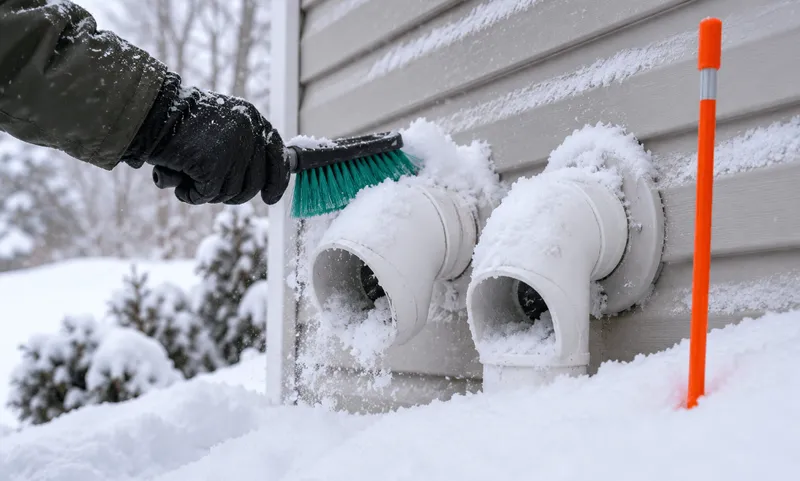
Buried heat pumps struggle to move air. The outdoor unit needs 18 to 24 inches of clearance on every side to pull in air and shed frost. Brush snow away gently, and skip full wraps. Our guide to getting a heat pump ready for winter explains what normal defrost looks like.
A sealed house works the filter harder. With the windows shut for days, the system cycles more often and the filter collects dust and pet hair faster, one reason winter indoor air quality tends to slip. We recommend swapping the filter before the storm so you have one less job once you're snowed in. Unsure when you last changed it? See how often to change your HVAC filter.
Bomb Cyclone Preparation: A 72-Hour HVAC Checklist
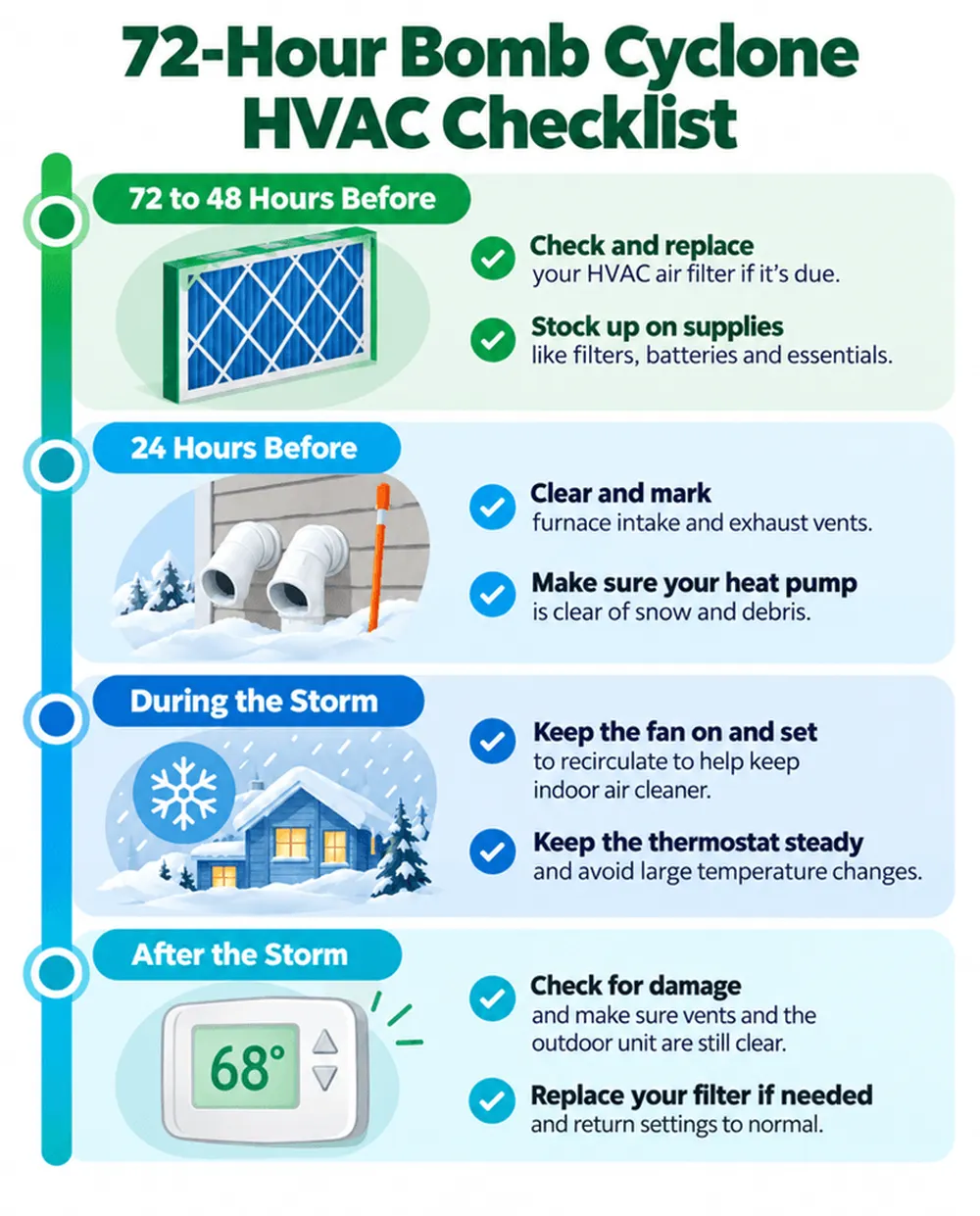
Filterbuy built this timeline from National Weather Service and CPSC guidance and the steps our winter HVAC guides return to most. Start 48 to 72 hours out, when forecasters first flag rapid intensification, so nothing waits until it's unsafe to work outside.
72 To 48 Hours Before The Storm
Replace the air filter and set a spare next to the furnace. Match the size printed on the frame, and choose a MERV rating your HVAC manual supports.
Test every carbon monoxide and smoke alarm, and put in fresh batteries.
If the furnace has been short cycling or flashing error lights, book a technician now.
Top off propane or heating oil. The National Weather Service warns that deliveries can be delayed for days after a storm.
24 Hours Before The Storm
Mark the furnace vent pipes and the heat pump with tall stakes so you can find them under the drifts.
If you own a generator, test-run it outdoors and make sure the transfer switch works.
During The Storm
When it is safe outside, clear the vent pipes and heat pump after each heavy snow band.
If the power goes out, set the thermostat to off so the system can restart in stages when service returns.
Never heat the house with a gas oven or range, and never run a generator or grill inside the home or garage.
After The Storm
Clear every vent and the outdoor unit before you turn the heat back on.
After days of heavy runtime, swap in the spare filter.
Call a technician if the furnace locks out again or you smell exhaust. Do the same for heat pump ice lasting hours.
Staying Warm And Safe In A Bomb Cyclone Power Outage
Bomb cyclone power outages tempt people to improvise heat. The U.S. Consumer Product Safety Commission winter storm safety guidance says to run portable generators outside only, at least 20 feet from the house, and to install battery-operated or battery-backup carbon monoxide alarms outside sleeping areas and on every floor.
To keep a gas furnace running on a portable generator, connect it through a transfer switch installed by a licensed electrician. A generator plugged into a wall outlet, known as backfeeding, can energize utility lines and put line crews at risk. Filterbuy's guide to heating your home in a winter power outage covers generator sizing by system type.
Without backup power, gather everyone in one closed-off interior room and layer blankets. Our space heater safety guide covers safe clearances for backup heaters. Should a carbon monoxide alarm go off, get everyone outside first, then call 911. The CDC's carbon monoxide poisoning basics lists furnaces and portable generators among common sources.
Supporting Statistics
80% of major U.S. power outages from 2000 to 2023 were weather-related, with winter weather behind 23% of them (Climate Central).
U.S. customers averaged 11 hours without power in 2024, nearly nine from major events (U.S. Energy Information Administration).
Portable heaters were involved in 3% of home heating fires but 41% of fatal ones (2017 to 2019, U.S. Fire Administration).
Frequently Asked Questions A
How long does a bomb cyclone last?
A bomb cyclone's defining burst of strengthening takes about 24 hours. Locally, the worst conditions usually last one to two days.
Is a bomb cyclone the same as a hurricane?
No. A hurricane draws its energy from warm tropical water, while a bomb cyclone forms where cold and warm air masses collide outside the tropics.
How do forecasters know a bomb cyclone is coming?
Forecast models often flag rapid pressure falls days ahead, so a bomb cyclone forecast can show up before local alerts. As the storm nears, the National Weather Service issues watches and warnings for the specific hazards. For freezing rain, see our ice storm warning guide.
Should I change my furnace filter before a bomb cyclone?
Yes, if it is nearly due. A storm keeps the system running longer, so the filter loads faster. Change it beforehand and keep a spare. The Filterbuy guide to air filter MERV ratings can help you match a filter to your system.
Can a heat pump work during a bomb cyclone?
Yes, as long as it has power and the outdoor unit stays clear of snow. Expect more frequent defrost cycles in extreme cold. The Department of Energy's overview of heat pump systems explains cold-climate models and dual-fuel backup.
Stock A Spare Filter Before Storm Season
Our advice: put a spare filter on the shelf before the forecast turns. Filterbuy manufactures furnace and AC filters in hundreds of standard and custom sizes in MERV 8, 11 and 13, and orders ship with fast and free 2-day delivery to most US states. Shop air filters by size, or set up filter auto-delivery so the next one arrives on schedule.
Glossary
Bomb Cyclone: A mid-latitude storm whose central pressure falls at least 24 millibars in 24 hours at 60 degrees latitude.
Bombogenesis: The rapid intensification that creates a bomb cyclone, also called explosive cyclogenesis.
Millibar (mb): A unit of air pressure equal to one hectopascal. Lower storm-center readings mean a stronger storm.
Transfer Switch: An electrician-installed device that connects a generator to home circuits while isolating the house from utility lines.
Carbon Monoxide (CO): An odorless, colorless gas from burning fuel, released by generators and by blocked furnace exhaust.
MERV: Minimum Efficiency Reporting Value, the 1 to 16 scale rating how well an HVAC filter captures airborne particles.