
Ragweed Pollen: Season, When It Ends, and How to Identify It
October 2, 2026
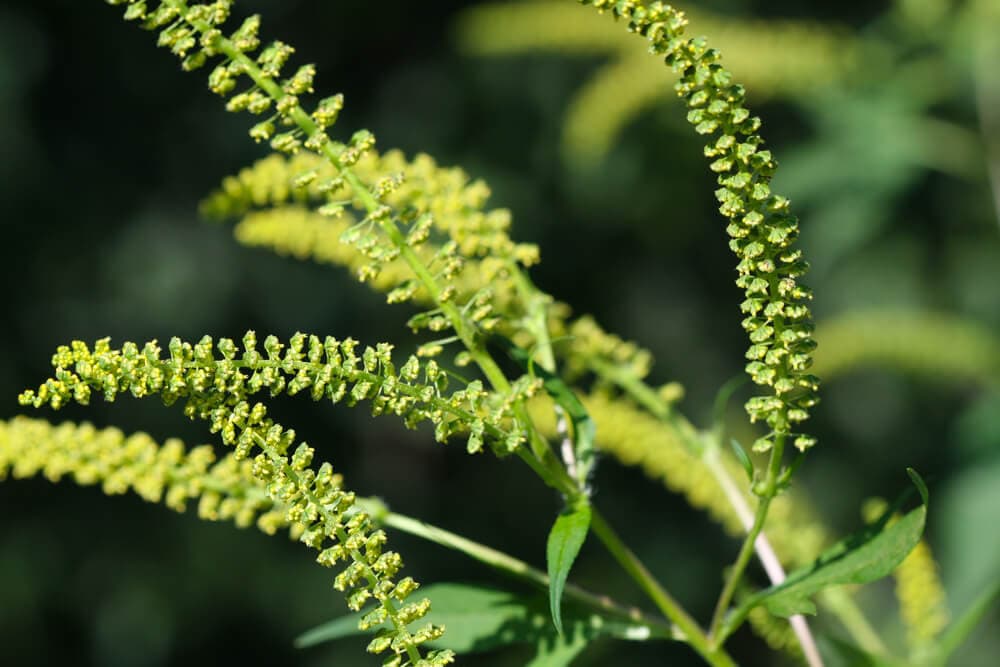
Ragweed is the quiet troublemaker of fall. Its flowers are small, green, and easy to walk right past, yet a single plant can produce up to one billion pollen grains (AAFA). Pollen.com calls ragweed "arguably the largest single seasonal allergen in North America" (Pollen.com), and across 31 National Allergy Bureau stations it was the third most abundant pollen type, behind only oak and the cypress family (Lo et al., Aerobiologia, 2019).
Here is the twist most people get wrong: the showy yellow plant everyone blames each fall is usually goldenrod, not ragweed (University of Illinois Extension). Ragweed's timing follows local weather, and the season ends when the first frost kills the plant (AAFA).
Ragweed Pollen Quick Facts
| Field | Detail |
|---|---|
| Type | Herbaceous annual weed (NC State Extension) |
| Genus and family | Ambrosia; Asteraceae, the aster or daisy family |
| Featured species | Common ragweed (A. artemisiifolia) and giant ragweed (A. trifida). About 17 ragweed species grow in North America (AAFA). |
| Typical season | Around August through October in many areas (AAFA) |
| Typical peak | Mid-September (AAFA) |
| Time of day | Warm weather, humidity, and breezes after sunrise help release pollen (AAFA). ACAAI notes levels are highest in the morning during ragweed season (ACAAI). |
| U.S. distribution | Throughout the U.S., especially the East and Midwest. AAFA notes Alaska is the only state without ragweed (AAFA). |
| Pollen grain size | About 16 to 27 micrometers (Pollen.com) |
| Pollination | Wind (NC State Extension) |
| Cross-reactions | Other ragweeds, mugwort, and certain foods (see Cross-Reactions) |
Flower release and measured airborne concentration are different things. A general morning pattern is not an exact national clock-hour rule.
Is Ragweed Pollen High Near You Today?
Ragweed pollen won't show up in your local Air Quality Index. Intact pollen grains are too large for the PM2.5 and PM10 monitors the AQI relies on, which we explain in How Pollen Affects Air Quality Readings. For daily ragweed counts, check the certified station nearest you on the AAAAI National Allergy Bureau pollen map. To see air quality where you live, use Filterbuy's Live Air Quality Index Map.
How to Identify Ragweed
Ragweed is easier to recognize once you focus on the leaves and flowers rather than height alone. Both featured species are herbaceous, so there's no bark to check. A film on your car can't identify ragweed pollen, and a lack of visible dust doesn't prove it's absent.
Common Ragweed
Common ragweed (Ambrosia artemisiifolia) is a summer annual, usually 1 to 3 feet tall but sometimes up to 6 feet. Its leaves are deeply lobed and fernlike, up to 6 inches long. Male flowers hang in terminal spikes 1 to 4 inches long and release copious amounts of pollen in late summer and fall, while female flowers sit in clusters below them (NC State Extension).
Giant Ragweed
Giant ragweed (Ambrosia trifida) can grow 6 feet or more. Its rough, hairy leaves grow in opposite pairs and are usually divided into three to five pointed lobes like the fingers of a hand, though some are undivided. It blooms from July through September in pastures, old fields, ditches, roadsides, and other disturbed ground, with petal-less flower heads in drooping spikes (Missouri Department of Conservation).
Recognizing a plant's flowers tells you it is present, but it doesn't give you a pollen count. For that, you need local monitoring data.
Ragweed vs. Goldenrod
Goldenrod gets blamed for fall symptoms because it blooms at the same time with bright yellow flowers. But the two are different plants with very different pollen habits.
| Feature | Ragweed | Goldenrod |
|---|---|---|
| Genus | Ambrosia | Solidago |
| Flowers | Small, inconspicuous, green | Showy yellow clusters |
| Pollination | Wind | Insects |
| Pollen behavior | Small, lightweight grains released into the air | Grains too heavy to be carried far by wind |
Goldenrod's bright color is a sign that it relies on insects, not wind, to move its pollen (University of Illinois Extension). That said, it's not accurate to say no one can ever be sensitive to goldenrod, or that every fall symptom proves ragweed. A local pollen count is the better guide.
When Is Ragweed Pollen Season? Timing by Region
Broad national sources support an August start and a September peak in many places. The table below keeps each source's wording and geography.
| Region | What the Source Reports |
|---|---|
| East and Midwest | Ragweed appears starting in mid-August |
| Many U.S. regions | Now begins in early August and extends through October |
| U.S. overall | Around August, peaking mid-September, lasting six to ten weeks |
| Idaho | August to early October |
| Giant ragweed, Missouri | Flowers July through September |
These are broad timing guides, not measured city peaks. Check your nearest National Allergy Bureau station for current counts.
In the Midwest or Northeast? Check current conditions for Chicago, Columbus, Detroit, Minneapolis, Philadelphia, and New York City, or find your city on the Live Air Quality Index Map. Our seasonal allergy calendar shows how ragweed fits into fall.
When Will Ragweed Season End in Your City?
Three different measures help answer this, and they don't always agree:
- Historical first-freeze normal. A seasonal guide based on past years, not this year's forecast.
- Observed local conditions. Whether a killing freeze actually arrived where the plants grow.
- Local ragweed counts. Whether airborne pollen remains, including grains carried in from elsewhere.
The National Weather Service defines a freeze as surface air temperatures of 32°F or below over a widespread area, and a hard freeze as 28°F or lower for an extended period (National Weather Service glossary). These thresholds are not interchangeable.
| Location | Normal First Autumn 32°F or Lower (1991 to 2020) | Record Range |
|---|---|---|
| Chicago O'Hare | October 19 | Earliest September 22, 1995; latest November 24, 1931 |
| Rockford, Illinois | October 13 | Earliest September 13, 1975; latest November 11, 2016 |
That October 19 normal at O'Hare is a weather benchmark, not a promise that ragweed will disappear that day. The record range shows how much a single year can vary. ACAAI also notes that symptoms can linger after pollen is no longer detected, so the end of the pollen season isn't always the end of symptoms (ACAAI).
Ragweed Pollen by the Numbers
- Up to one billion grains per plant. That is AAFA's and ACAAI's upper estimate for a single plant across its season (AAFA; ACAAI).
- More than 100 miles. ACAAI says each grain can travel more than 100 miles (ACAAI). How far it actually goes depends on weather.
- One in 10 Americans. ACAAI estimates that one in 10 Americans is affected by ragweed allergies (ACAAI).
- 13 to 27 extra days. Ziska and colleagues (2011) studied 10 sites from Austin, Texas, to Saskatoon, Canada, from 1995 to 2009. At higher-latitude sites, the season ran 13 to 27 days longer than in 1995, strongly linked to a later first fall frost (ScienceDaily summary of Ziska et al., PNAS, 2011; PubMed).
- About 17 species. That is how many ragweed species grow in North America (AAFA).
Ragweed Pollen Myths vs. Facts
MYTHGoldenrod is the main fall pollen source because it's bright yellow.
FACTGoldenrod is insect-pollinated, with grains too heavy to travel far on the wind. Ragweed's inconspicuous green flowers release lightweight pollen into the air during the same season (University of Illinois Extension).
MYTHPollen season ends when summer ends.
FACTRagweed is a late-summer and fall plant, and its season continues until the first frost kills it (AAFA).
MYTHThe average first-frost date is the exact end of this year's ragweed season.
FACTHistorical dates are guides. Chicago's first freeze has come as early as September 22 and as late as November 24 (NWS Chicago).
MYTHRagweed only grows in the countryside.
FACTRagweed thrives along roadsides, riverbanks, vacant lots, and fields, and AAFA notes that pollen levels in warmer urban areas can run significantly higher than in nearby rural areas (AAFA).
Ragweed Pollen Cross-Reactions
This section is descriptive only. It does not advise avoiding foods or predict any individual's reaction.
Pollen to pollen. Thermo Fisher Scientific reports that the four major ragweeds, short (common), giant, western, and false, strongly cross-react with each other, and that ragweed also strongly cross-reacts with mugwort, marsh elder, and cocklebur (Thermo Fisher Scientific).
Foods. The American College of Allergy, Asthma and Immunology lists banana, cucumber, melons, sunflower seeds, and zucchini as foods commonly associated with ragweed pollen in pollen food allergy syndrome. ACAAI also notes that not everyone with a pollen allergy reacts to these foods (ACAAI).
For questions about symptoms or diagnosis, speak with a board-certified allergist.
How to Keep Ragweed Pollen Out of Your Home
Ragweed season often overlaps with back-to-school and the shift from AC to heat. A few steps help:
- Keep windows closed while outdoor pollen is high, especially in the morning during ragweed season (ACAAI).
- Take shoes off at the door and change clothes that have collected outdoor pollen.
- Match your HVAC filter to your household. MERV ratings measure how well a filter captures particles between 0.3 and 10 micrometers. A MERV 8 filter must capture at least 70% of particles in the 3 to 10 micrometer range, and a MERV 11 filter at least 85% (EPA). Intact ragweed pollen grains, at roughly 16 to 27 micrometers, are larger than anything in that test. For most homes, MERV 8 is the standard choice. For households with allergies or pets, step up to MERV 11. Our MERV 8 vs. MERV 11 guide breaks down the difference.
- Change filters on schedule. Standard 1-inch filters are typically replaced about every 90 days. Filterbuy 4-inch filters last 6 to 12 months.
These steps reduce how much pollen circulates indoors. They are not a substitute for medical care, and no specific symptom outcome is claimed.
Before you switch on the heat for the first time this fall, swap in a fresh filter. Filterbuy makes MERV 8 and MERV 11 filters in more than 600 standard sizes, plus custom sizes, so it's easy to find one that fits your system.
Shop MERV 8 Filters Shop MERV 11 FiltersFrequently Asked Questions
When does ragweed pollen season start?
When does ragweed season end?
It usually lasts six to ten weeks and can extend through October, ending when the first frost kills the plant (AAFA). Warmer regions can run later.
Does the first frost end ragweed pollen immediately?
Not always. A single cold night isn't a guaranteed cutoff, and pollen can still drift in from elsewhere. Historical freeze dates are guides: Chicago's normal first freeze is October 19, but the record range spans September to late November (NWS Chicago).
What time of day is ragweed pollen highest?
What does common ragweed look like?
Common ragweed has deeply lobed, fernlike leaves and slender spikes of small green male flowers. It usually grows 1 to 3 feet tall (NC State Extension).
How is giant ragweed different?
Giant ragweed can grow 6 feet or more, with rough leaves usually divided into three to five pointed lobes (Missouri Department of Conservation).
Is goldenrod the same as ragweed?
No. They bloom at the same time, but goldenrod is insect-pollinated with heavy pollen, while ragweed is wind-pollinated (University of Illinois Extension).
Why can ragweed pollen be present when I can't see a plant nearby?
Ragweed pollen grains can travel more than 100 miles on the wind (ACAAI), so pollen can reach you even when no plant is growing in sight.
What air filter should I use during ragweed season?
It depends on your household. MERV 8 is the standard choice for most homes. For households with allergies or pets, MERV 11 captures a higher share of larger airborne particles (EPA). See our MERV 8 vs. MERV 11 guide to compare.