Chicago Real-Time AQI Tracker


Get Alerts For Unhealthy AQI In Your Area
When air quality in your area reaches unhealthy levels, we'll send you a quick alert, along with expert tips on how to reduce your exposure.
What's Actually In Chicago Air Today?
What High AQI Means for Your Lungs in Chicago
How to Read AQI
The Air Quality Index (AQI) measures how polluted the air is and how it may affect your health.
0–50 (Good): Air quality is satisfactory.
51–100 (Moderate): Acceptable, but some pollutants may pose minor concerns.
101–150 (Unhealthy for Sensitive Groups)
151–200 (Unhealthy)
201–300 (Very Unhealthy)
301+ (Hazardous)
Moderate
Still okay for most, but if you have asthma or allergies, take it easy and avoid long outdoor workouts.
Shop MERV 11 filters→What's the Right Filter for Your AQI Level?



Chicago Air Quality Today: Live AQI Map & Real-Time Index
Written by Michelle Wan · Reviewed by David Clark, Licensed HVAC Technician · Last update September 7, 2026 · Published by Filterbuy
TL;DR
The live AQI map on this page shows Chicago’s current air quality, drawn from EPA-monitored stations and refreshed through the day. Readings under 50 are Good; above 100, sensitive groups should scale back outdoors. Fine particulate and ground-level ozone drive most of Chicago’s swings, and Canadian wildfire smoke is now a regular summer factor. Whatever the map shows outside, filtration decides what you breathe indoors.
Chicago Air Quality Right Now: How to Read the Live Map
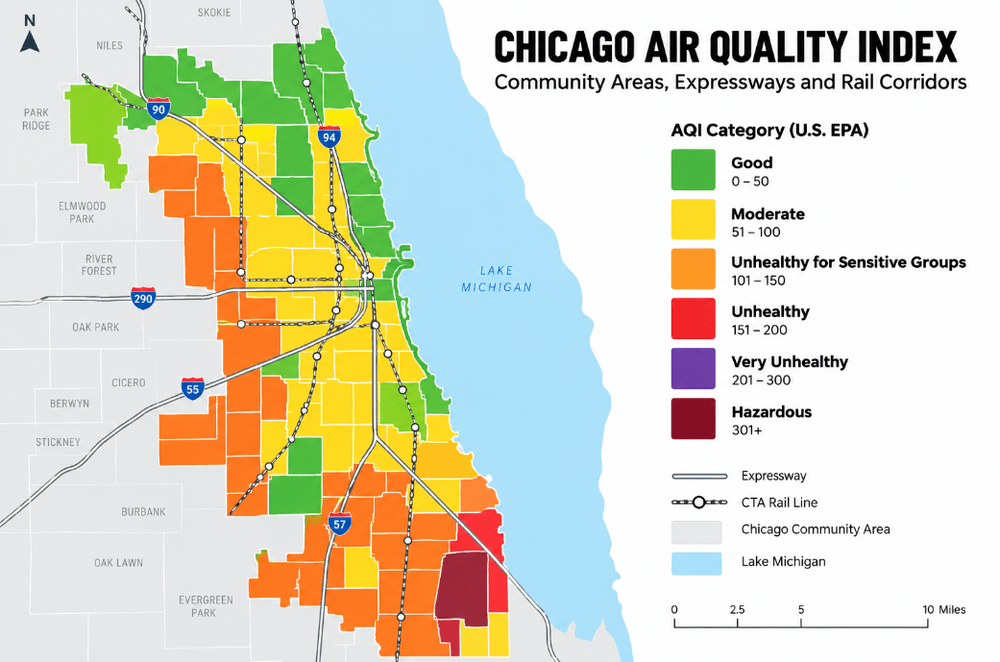
Check the map above for Chicago’s current reading. It pulls from EPA-monitored stations and colour-codes them to the six official AQI categories, so the colour tells you what to do before the number does. Green and yellow mean normal activity for most people. Orange and above mean sensitive groups should cut back. The map also shows which pollutant is driving the reading, which matters because ozone and particulate call for different responses.
Key Takeaways
The live map on this page breaks Chicago’s citywide AQI down by neighborhood, and readings can differ block to block.
Fine particulate (PM2.5) and ground-level ozone drive most of Chicago’s AQI changes, and Lake Michigan inversions trap both near ground level.
The American Lung Association’s State of the Air 2026 report ranked Chicago-Naperville 15th worst of 226 U.S. metros for ozone and 13th worst of 211 for year-round particle pollution.
The EPA recommends MERV 13, or the highest rating your system supports, during wildfire smoke events.
What Each AQI Category Means and What to Do
The U.S. AQI runs 0 to 500 across six categories. Match the colour on the map above to the row below. These thresholds and precautions follow EPA guidance; what applies to you depends on the reading the live map is showing.
Categories and precautions per EPA AirNow guidance. Follow the category shown on the live map above.
Why Chicago’s AQI Sometimes Looks Wrong
It looks smoky and the dial says yellow. That is not a broken sensor. The EPA reports AQI as a NowCast, an average of up to 12 previous hours weighted toward the last three when conditions shift fast. During a moving plume it trails what you see and smell, and two nearby monitors can land in different categories.
Trust your eyes and nose, then check the AirNow Fire and Smoke Map, which adds sensor data and tracks smoke better.
Is Chicago’s Air Safe to Breathe Today?
That depends on the reading the live map shows. Under AQI 50 the air is good for everyone. From 51 to 100 it is acceptable for most, though people with asthma may notice symptoms during long exertion. Above 100, people with asthma, COPD or heart disease, plus children and adults over 65, should limit outdoor activity. Above 150, everyone cuts back. With a diagnosed condition, follow your doctor’s plan.
Chicago Air Quality Forecast: Where to Check Before You Go Out
Chicago’s next-day air quality forecast comes from the EPA’s AirNow program and the Illinois EPA, which issues an Action Day alert when forecast AQI is expected to reach 101 or higher. AirNow’s free EnviroFlash service emails Chicago-area forecasts and alerts before the air shifts.
Chicago’s forecasts follow reliable seasonal patterns. Ozone peaks on hot, stagnant summer afternoons, so a high-ozone forecast means moving your run to early morning rather than skipping it. Fine particulate builds overnight and through morning rush hour, and lingers when a Lake Michigan inversion traps air near the ground. Wildfire smoke follows neither pattern and can lift the index sharply within hours.
Chicago Air Quality by ZIP Code and Neighborhood
Chicago air quality varies by ZIP code. Blocks near expressways, rail yards and industry often record higher fine particulate than lakefront blocks the same hour. Enter your ZIP below, or find your area in the table.
Chicago measures that variation directly. Open Air Chicago, run by CDPH with the UIC School of Public Health, operates 277 sensors measuring PM2.5 and nitrogen dioxide across roughly 60 ZIP codes. CDPH made the data public in February 2026, the largest such network in the U.S. Roughly 64 percent of sensors sit in Environmental Justice areas, because the burden falls unevenly across the South and West Sides.
Local pollution sources by area. For current readings, use the live map and ZIP lookup above.
What’s Actually in Chicago’s Air? PM2.5, Ozone, and More
Six pollutants feed Chicago’s AQI, and whichever scores highest sets the number. In Chicago it is almost always fine particulate or ozone. PM2.5 matters most indoors: particles a thirtieth the width of a human hair, small enough to bypass the body’s defenses.
For a long-run benchmark, Cook County’s annual PM2.5 design value for 2022 through 2024 was 11.0 micrograms per cubic meter, above the EPA standard of 9.0 and the WHO guideline of 5.
Ozone breaks down quickly indoors, so closing windows on a high-ozone day does the work. PM2.5 does not cooperate: it drifts in around windows and doors, rides in on clothes and shoes, then stays suspended for hours. Removing it takes filtration, where your MERV rating stops being a spec-sheet detail.
How Bad Is Chicago’s Air Quality Compared to Other Cities?
The American Lung Association’s State of the Air 2026 report ranked Chicago-Naperville 15th worst of 226 U.S. metros for ozone and 13th worst of 211 for year-round particle pollution. Cook County earned an F on 18.0 unhealthy ozone days a year. Compare on our Illinois air quality map.
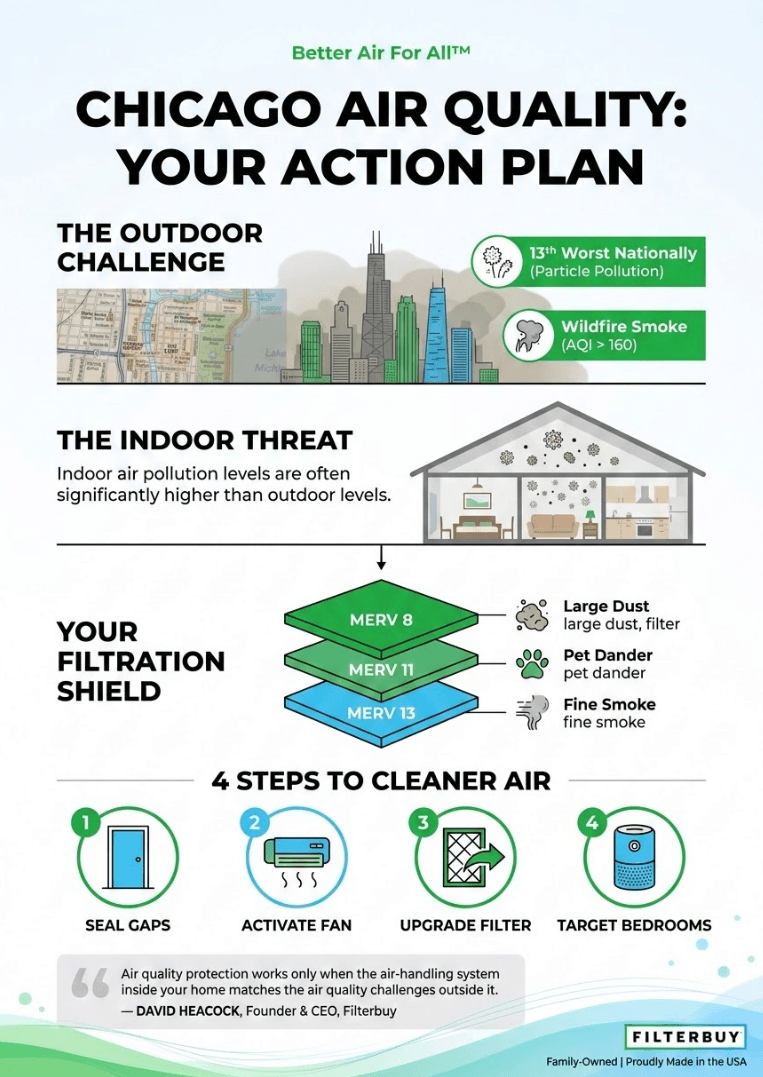
Canadian Wildfire Smoke in Chicago: What to Do
Canadian wildfire smoke is now a fixture of Chicago summers. On July 16, 2026, smoke from Ontario pushed Chicago’s AQI to 366, a hazardous reading and likely the worst air quality ever recorded in the city, with some northern suburbs above 600. Plumes ride the jet stream south and settle over the Great Lakes when a stagnant high parks over the Midwest.
When smoke moves in, the order Filterbuy works through:
Close windows and doors until the plume clears.
Switch your HVAC to recirculate and run the fan continuously.
Run a MERV 13 filter, or the highest your system supports. Check specifications; some older furnaces restrict airflow at MERV 13.
Add an activated carbon Odor Eliminator filter if smoke smell gets through, and portable HEPA filtration in bedrooms.
Skip the outdoor workout. Hard breathing pulls particulate deeper into the lungs.
The best air purifier for wildfire smoke is a true HEPA unit sized to the room, paired with a MERV 13 air filter in your HVAC. Filterbuy does not make portable purifiers, but during smoke a bedroom HEPA unit alongside whole-home filtration is right. Track plumes on our live Canada wildfire and smoke map and follow CDC guidance on wildfire smoke.
What a Chicago Air Quality Alert Means for Your Day
The Illinois EPA issues an Action Day alert when forecast AQI is expected to reach 101 or higher. A Statewide Action Day means most of Illinois will see unhealthy air; a Red Action Day signals AQI of 151 to 200 in one or more sectors.
Treat either as a forecast that the air is about to be a problem for your kids and parents, and anyone with asthma or COPD.
What If Your Home Has No Central HVAC?
Much of Chicago’s housing stock is two-flats, three-flats and prewar courtyard buildings. They run on radiators with window air conditioners. No ducts, no filter slot. If that is your home, every MERV recommendation here is useless, and Filterbuy would rather say so than sell a filter that will not fit.
What helps:
A portable HEPA air cleaner sized to the room where you sleep. For a ductless home this is the highest-value purchase available.
Keep windows shut during smoke events; set a window AC to recirculate if it offers that.
Do not seal yourself into a hot apartment. The EPA warns that closing up without cooling is dangerous in extreme heat. Chicago opens cooling centers.
Our Take: What a Filter Manufacturer Sees in Chicago’s Numbers
Most air quality pages stop at the outdoor number. Filterbuy manufactures the filters that decide what happens once that air is inside, which gives us a different reading of the data.
Three things stand out:
Chicago’s worst air day is no longer an ozone day.
For decades that meant a hot August afternoon. It is now a smoke day, and July 2026 beat 2023 by a wide margin.
The citywide number rests on six federal monitors.
Four measure PM2.5, two measure NO2. Open Air Chicago added 277 sensors because six points cannot describe 77 community areas.
Closing the windows is only half an answer.
Ozone breaks down indoors. Fine particulate does not. A window solves one; the other must be filtered.
That changes the timing. Filtration is preparation, not response. A filter ordered the morning the sky turns arrives days late.
“We have built filters in Talladega, Alabama for more than a decade. What I would tell any Chicago family is this: on the afternoon the index hits 366, the filter protecting your kids is the one that was already in the furnace that morning.”
— David Heacock, Founder & CEO, Filterbuy
Which Filter Your Chicago AQI Level Calls For
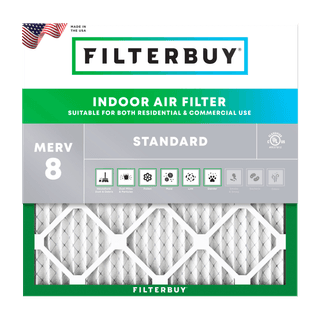
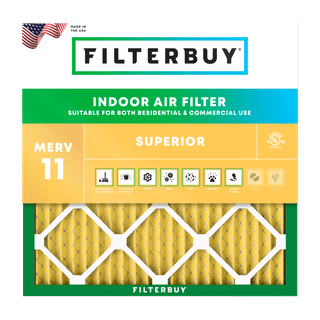
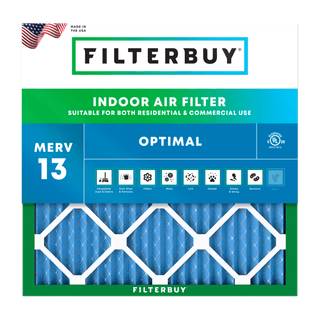
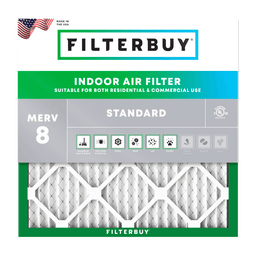
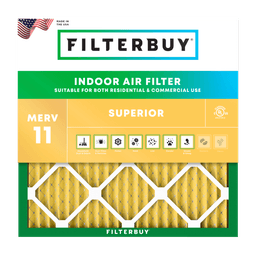
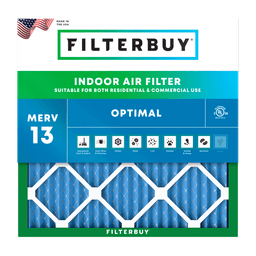
This is the part Filterbuy makes, so here is how we choose. The EPA recommends MERV 13 during smoke events, or the highest rating your system supports. It is what we run in our own homes. Shop Filterbuy MERV 8, MERV 11, MERV 13 or the Odor Eliminator carbon filter.
Check your HVAC specifications before upgrading; some older systems restrict airflow at MERV 13.
“Before you jump to MERV 13, look at the filter slot depth and the age of the blower. A one-inch MERV 13 in a system built for fiberglass will raise static pressure, and if you then forget to change it on time you lose airflow. Most homes are fine. Check first, and change it on schedule.”
— David Clark, Licensed HVAC Technician
Supporting Statistics
A MERV 13–16 filter cuts indoor particles by up to 95 percent.
Switching the fan from Auto to On cuts them 24 percent.
Portable air cleaners with high-efficiency filters, 85 percent.
Source: EPA, Wildfire Smoke Factsheet: Indoor Air Filtration (EPA-452/F-18-005)
Chicago children have Illinois’ highest childhood asthma ER rate, 120 per 10,000.
Roughly 2.6x the Healthy People 2020 target.
Austin, West Englewood and Englewood topped 300 per 10,000.
Source: Illinois Dept. of Public Health, Childhood Asthma Surveillance Report (2011–2014).
Fine particulate causes more than 50,000 premature deaths in the U.S. each year.
No safe threshold exists; harm appears below current standards.
Frequently Asked Questions
Glossary
AQI (Air Quality Index): The EPA’s 0-to-500 air pollution scale. Good (0–50), Moderate (51–100), Unhealthy for Sensitive Groups (101–150), Unhealthy (151–200), Very Unhealthy (201–300), Hazardous (301+).
PM2.5: Fine particulate 2.5 micrometers or smaller. PM2.5 most often sets Chicago’s AQI and is what high-MERV filtration targets.
Ozone (O3): Ground-level ozone, a lung irritant formed when sunlight reacts with vehicle and industrial emissions.
NowCast: The EPA algorithm behind current AQI. It averages up to 12 previous hours, weighting recent hours more when conditions change fast.
Action Day: An Illinois EPA alert issued when forecast AQI is expected to reach 101 or higher.
Design value: The multi-year concentration EPA uses to judge whether a county meets a standard.
MERV: Minimum Efficiency Reporting Value, the 1-to-16 scale for how well a filter captures particles.
HEPA: High-Efficiency Particulate Air, capturing 99.97 percent of 0.3-micron particles.
Open Air Chicago: 277 community sensors measuring PM2.5 and nitrogen dioxide, run by CDPH with the UIC School of Public Health.
Explore More... ▼