
Air Quality in Illinois
Air quality index (AQI⁺) and PM2.5 air pollution in Illinois •


Get Alerts For Unhealthy AQI In Your Area
When air quality in your area reaches unhealthy levels, we'll send you a quick alert, along with expert tips on how to reduce your exposure.
Live Air Quality Ratings in Illinois
Live Most Polluted City Ranking
Real-time most polluted cities in Illinois
Live Cleanest City Ranking
Real-time cleanest cities in Illinois
The Right Air Filter For High AQI Days
When outdoor air quality drops, the EPA recommends upgrading to a MERV 13 filter — or the highest-rated filter your HVAC system can handle — to help capture more of the fine particulate (PM2.5) that comes with poor air quality. MERV 13 is the highest rating most residential systems can run without restricting airflow.
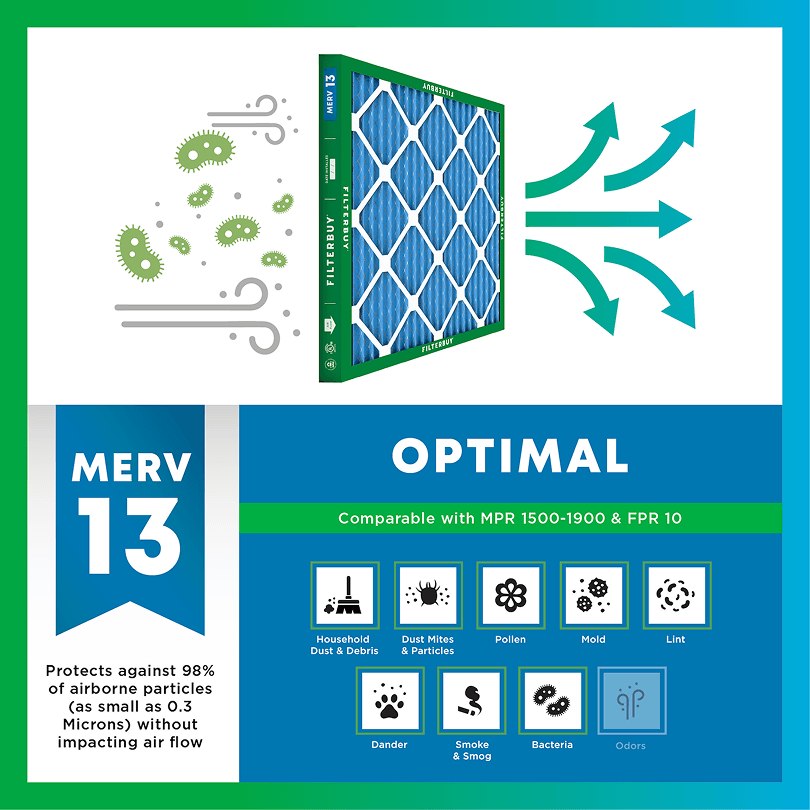

- Captures PM2.5 and other fine particulates
- Filters ash, soot, and smoke particles
- Rated to capture particles as small as 0.3 microns
- Matches the filter rating the EPA suggests during high-AQI and smoke events

AQI FAQs
What is AQI?
AQI stands for Air Quality Index, the EPA's scale for reporting daily air quality. It runs from 0 to 500. The higher the number, the greater the level of air pollution. Values at or below 100 are generally considered satisfactory; values above 100 mean air quality is unhealthy, first for sensitive groups, then for everyone as numbers climb.
What does AQI measure?
The AQI tracks five major pollutants regulated by the Clean Air Act: ground-level ozone, particle pollution (PM2.5 and PM10), carbon monoxide, sulfur dioxide, and nitrogen dioxide. The reported AQI value reflects whichever pollutant is highest at that time — most often ozone or fine particles (PM2.5).
How is AQI calculated?
Monitoring stations measure pollutant concentrations, and the EPA converts each into a standardized 0–500 score using set breakpoints. Each pollutant gets its own sub-index, and the highest sub-index becomes the reported AQI. That's why a single number can represent different pollutants on different days.
What is a good AQI?
An AQI of 0–50 is rated "Good" — air quality poses little or no risk. 51–100 is "Moderate," acceptable for most people though unusually sensitive individuals may want to limit prolonged outdoor exertion. Anything at or below 100 is generally considered satisfactory air quality.
What does an AQI of 100 (or 150) mean?
100 is the dividing line: at or below it, air quality is satisfactory for the general public. From 101–150, air is "Unhealthy for Sensitive Groups" — people with respiratory conditions, older adults, and children. From 151–200, it's "Unhealthy" and everyone may begin to feel effects.
Why is the AQI bad today?
Short-term AQI spikes usually come from wildfire smoke, temperature inversions that trap pollutants near the ground, high-ozone weather (hot, sunny, stagnant days), or heavy traffic and industrial activity. Check a real-time source like the map on this page to see which pollutant is driving today's reading in your area.
What AQI is bad for running or exercise?
Many runners follow the EPA category lines: below 50, no adjustment needed; 51–100, unusually sensitive people may shorten intense workouts; above 100, sensitive groups are advised to reduce prolonged or heavy outdoor exertion; above 150, that advice extends to everyone. Exercise increases how much air you breathe in, which is why thresholds matter more during workouts.
What AQI is safe to open windows?
A common rule of thumb is to keep windows open when the AQI is under 100 and close them when it climbs above, especially during wildfire smoke events when fine particles are elevated. When windows are closed, running your HVAC system with a fresh filter helps capture particles circulating indoors.
Should I wear a mask based on AQI?
Public health agencies generally suggest considering a well-fitted N95-style respirator outdoors when the AQI exceeds 150, particularly during smoke events. Cloth and surgical masks don't filter fine particles effectively. Follow guidance from your local health department, which may adjust recommendations during severe episodes.

Check Today's Live Real Time Air Quality Index AQI Map in Illinois Now
How safe is the air outside your home in Illinois right now?
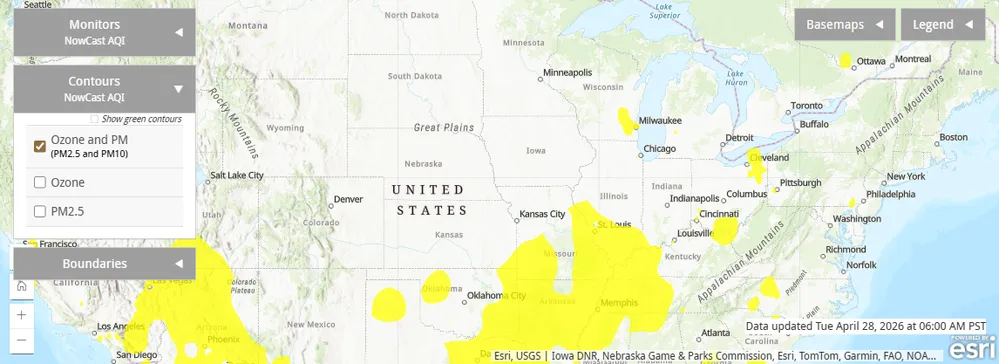
The answer changes hour by hour, and on smoke days, it can change neighborhood by neighborhood. Our live Illinois AQI map pulls real-time readings from EPA monitoring stations across the state, broken down by city and ZIP code, so you can check the air around your home, your kids' school, or your worksite in seconds.
After manufacturing air filters for over a decade and serving more than two million households, we built this tool because we're obsessed with what most people can't see. The fine particles, ozone, and seasonal pollutants moving through Illinois air every day deserve a clear, honest reading. Below the map, you'll find what the readings actually mean for your family and the steps that work when outdoor numbers turn red.
Source: U.S. EPA AirNow (cropped)
TL;DR Quick Answers
What is the air quality in Illinois right now?
Use the live Illinois AQI map on this page. It shows current readings by ZIP code, refreshed hourly from EPA and Illinois EPA monitoring stations.
Is the air in Chicago safe to breathe today?
Check the live map for your specific neighborhood. As a general rule, AQI under 100 is safe for most people, AQI 101 to 150 is unhealthy for sensitive groups, and AQI above 150 is unhealthy for everyone.
What does PM2.5 mean for my family?
PM2.5 is fine particle pollution that lodges deep in the lungs. Children, older adults, and anyone with asthma, COPD, or heart disease face the highest risk. Indoor filtration is the most reliable way to reduce exposure.
When should I close my windows in Illinois?
Close them once your local AQI exceeds 100, especially if you have sensitive members in your household. During wildfire smoke events, keep windows and exterior doors closed until the AQI drops back into the yellow or green range.
How do I protect indoor air on bad AQI days?
Run your HVAC fan continuously, install a MERV 13 or higher filter, and minimize indoor pollution sources like candles and aerosol sprays.
Top Takeaways
Illinois AQI changes by the hour, and our live map pulls real-time readings from EPA monitoring stations statewide.
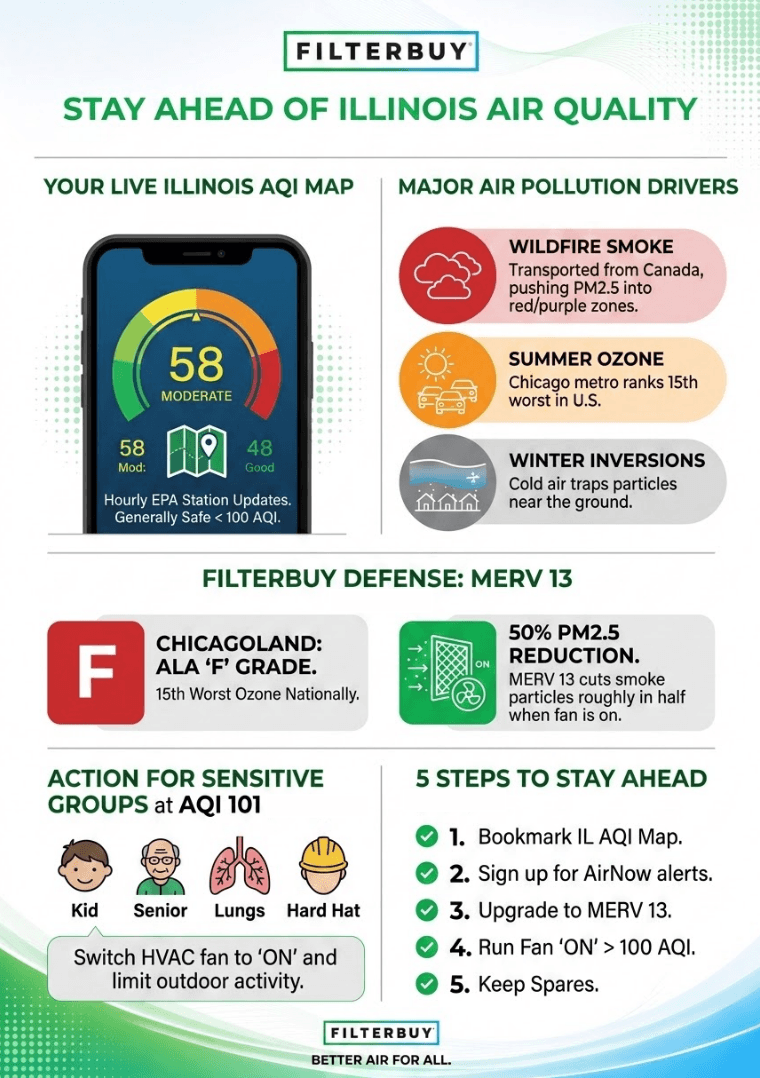
Chicago consistently ranks among the most ozone-polluted U.S. metros, with 20.3 unhealthy days per year on the latest national ranking.
Wildfire smoke from Canada and the western U.S. now drives some of the worst summer AQI spikes Illinois has ever recorded.
Indoor air can carry the same pollutants as outdoor air when windows leak, vents stay open, or HVAC filters can't capture fine particles.
A MERV 13 filter paired with continuous fan operation is the EPA-recommended baseline for Illinois homes during smoke season.
Live Illinois AQI Map
The map uses the EPA's color scale. Green (0 to 50) is good air, yellow (51 to 100) is moderate, orange (101 to 150) is unhealthy for sensitive groups, red (151 to 200) is unhealthy for everyone, purple (201 to 300) is very unhealthy, and maroon (301 and above) is hazardous. Enter your ZIP code to zoom into your neighborhood, or click any monitoring station to see ozone, PM2.5, and PM10 readings updated hourly.
What Drives Air Quality in Illinois
In our experience helping Illinois households respond to AQI alerts, four sources cause most of the bad-air days residents face.
Wildfire smoke transport. Smoke from Canadian boreal fires and western U.S. wildfires travels hundreds of miles into Illinois each summer, pushing PM2.5 readings into red and purple zones across the state.
Summer ozone formation. Heat plus vehicle emissions, industrial sources, and chemical reactions in sunlight create ground-level ozone. Readings run heaviest in the Chicago metro and along the I-55 corridor.
Winter PM2.5 buildup. Cold-air inversions trap particles near the ground, especially in Cook County and the collar counties, causing winter spikes in fine particle pollution.
Seasonal pollen. Tree pollen in spring, grass pollen in early summer, and ragweed pollen in late summer add another layer of airborne triggers, particularly for households with allergies or asthma.
You can track wildfire activity feeding into Illinois on our live wildfire and smoke map tracker, which pairs directly with the AQI readings on this page.
Air Quality in Chicago and Major Illinois Cities
Chicago-Naperville carries the state's heaviest pollution burden, with ozone the dominant summer problem in Cook, DuPage, Kane, Lake, and Will Counties. Springfield sees less overall pollution but still records unhealthy ozone days during peak summer heat. Rockford, Peoria, and Champaign-Urbana fall in between. Rockford, in particular, has seen recent declines in its particle pollution grade.
In smaller Illinois cities and rural counties, your AQI is shaped more by regional weather patterns than by local emissions. Wildfire smoke can drive a clear morning into a red-zone afternoon, regardless of how rural your county is.
Health Impact for Sensitive Groups
The Air Quality Index uses national health-based standards developed by the EPA. The threshold matters because particle pollution at moderate-to-unhealthy levels affects several groups more sharply than the general population:
Children and teenagers
Adults over 65
People with asthma, COPD, or heart disease
Pregnant individuals
Outdoor workers and athletes
For these groups, we recommend acting at AQI 101 (orange zone) instead of waiting for red. That means closing windows, running HVAC fans continuously, and limiting outdoor exertion until readings drop. If you want the technical background on how the index is built, the Wikipedia Air Quality Index reference page covers it well.
"In our years of manufacturing filters and watching how Illinois households actually respond to AQI alerts, we've found one consistent pattern. The homes that handle smoke days best aren't the ones with the most expensive equipment. They're the homes where someone checked the AQI before breakfast, switched the HVAC fan from auto to on, and made sure the filter sitting in the system was rated MERV 13 or higher before smoke arrived. Preparation beats reaction, and a properly rated filter gives Illinois families a defense their HVAC alone can't provide."
— Filterbuy Air Quality Team
Essential Resources
Watching Illinois air quality is easier when you know where to look. The seven resources below are the ones we send Illinois customers to most often, all from federal, state, and nonprofit pages we trust to keep their data current. Every link points to a specific page, not a homepage, so you land directly on what you need. Bookmark them next to our live AQI map for the fullest picture of what Illinois families are actually breathing.
Illinois EPA Outdoor Air Program. Real-time air quality data, Action Day alerts, and statewide monitoring information from the Illinois Environmental Protection Agency.
AirNow AQI Basics for Ozone and Particle Pollution. The official EPA explainer for what the AQI means, including health categories and color codes.
Using the Air Quality Index from AirNow. A practical guide for reading current AQI, NowCast values, and next-day forecasts.
AirNow Interactive National Air Quality Map. The federal real-time map shows ozone, PM2.5, and PM10 readings across the United States.
American Lung Association Illinois State of the Air. County-by-county grades for ozone and particle pollution across Illinois, updated annually.
EPA Wildfires and Indoor Air Quality. Federal guidance on protecting indoor air during smoke events, with HVAC and filtration recommendations.
EPA Create a Clean Room During a Wildfire. Step-by-step instructions for setting up a single sealed room with portable filtration when outdoor smoke is heavy.
Supporting Statistics
Numbers cut through the noise on Illinois air quality faster than any explanation can. The three statistics below come from federal and nonprofit pages we trust, each on a page-level URL that goes deeper than the headline. They show what Illinois families are breathing, what's at stake when readings turn unhealthy, and what proper filtration can do once smoke settles indoors. Read them as the case for the steps we recommend on the rest of this page.
Chicago ranks 15th worst nationally for ozone pollution. The American Lung Association's 2025 State of the Air report found the Chicago-Naperville metro area averaged 20.3 unhealthy ozone days per year and earned an F grade for ozone.
PM2.5 contributes to more than 50,000 premature deaths annually in the United States. Researchers cited by the American Lung Association estimate that fine particle pollution drives over fifty thousand early deaths every year, with no safe threshold of exposure identified.
A MERV 13 HVAC filter can reduce indoor PM2.5 by about 50 percent during smoke events. The U.S. EPA reports that upgrading to a high-efficiency filter rated MERV 13 or higher and running the HVAC fan continuously may cut indoor PM2.5 concentrations by roughly half during wildfire smoke periods.
Final Thoughts and Opinion
Outdoor AQI tells you only half the story. Illinois families spend roughly 90 percent of their time indoors, and indoor air is where you actually live, sleep, and breathe. When the outdoor AQI in Chicago hits 150, and you close the windows, particles still pull in through gaps around doors, exhaust vents, and the fresh-air intake on your HVAC system. The filter sitting inside your furnace is what stops them.
After watching Illinois homes through dozens of wildfire smoke events, summer ozone alerts, and winter inversions, our position is straightforward. The most prepared families aren't the ones with the most expensive equipment. They're the ones who treat their HVAC filter as the primary line of defense, who upgrade ahead of the season instead of during a crisis, and who use the AQI map as a daily habit rather than an emergency tool.
You don't need to feel powerless when the smoke rolls in. You have more control over your family's air than the headlines suggest, and the small actions you take today put you ahead of the next alert.
Next Steps
Five actions to put you ahead of the next Illinois AQI alert:
Bookmark this page for daily Illinois AQI checks.
Sign up for free AirNow alerts through the Illinois EPA program for your ZIP code.
Check your current HVAC filter's MERV rating. If it's below MERV 13, plan an upgrade.
Run your HVAC fan on the "on" setting, not "auto," whenever your local AQI exceeds 100.
Keep at least two replacement filters on hand so you can swap mid-event when smoke clogs the first one early.
Frequently Asked Questions
Stay Ahead of Illinois Air Quality Changes
Bookmark this page so you can check the live Illinois AQI map every morning and act before smoke, ozone, or seasonal particles reach your family. Then upgrade your HVAC filter to a Filterbuy MERV 13, the EPA-recommended baseline for wildfire smoke, and put a real line of defense between outdoor Illinois air and the air your family breathes at home.