
Oak Pollen: Season, Where It Grows, and How to Spot It
September 28, 2026
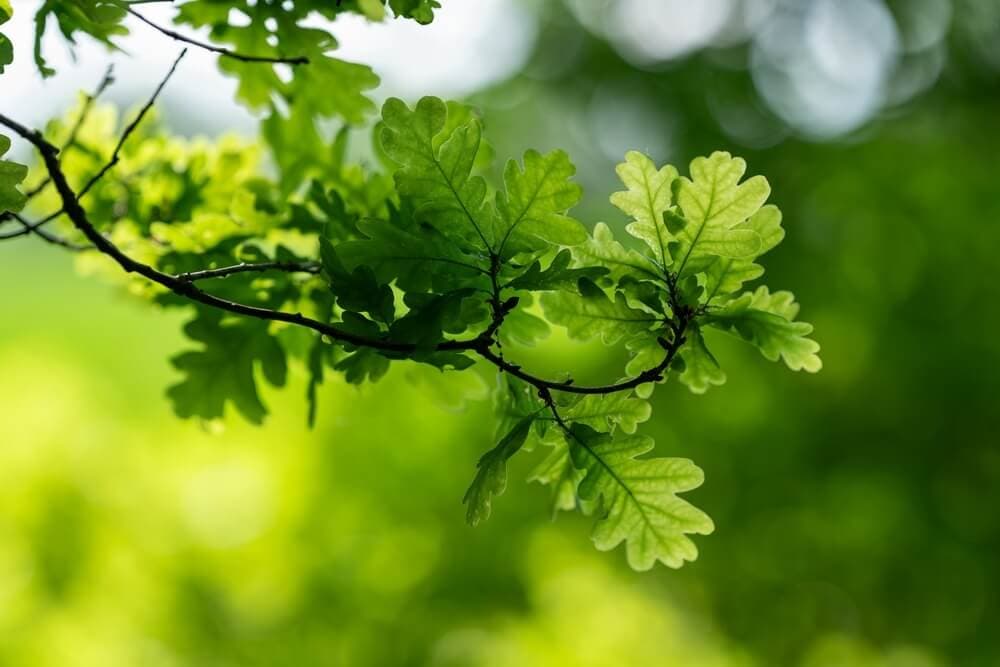
Oak is the heavyweight of spring tree pollen. In a 15-year analysis of 31 National Allergy Bureau counting stations across the U.S. and southern Canada, oak (Quercus) was the single most abundant pollen type, making up 19.6% of everything counted (Lo et al., Aerobiologia, 2019). Yet pine usually takes the blame, because pine is the pollen you can see.
That yellow-green coat on your windshield is mostly pine. Oak releases its pollen from small, drooping flower clusters called catkins, and its grains are fine enough to remain airborne rather than piling up where you would notice them.
This guide covers how to identify oak trees and their catkins, how oak compares with pine, hickory, and pecan, and when oak season typically hits your part of the country.
Oak Pollen Quick Facts
| Field | Detail |
|---|---|
| Scientific name | Quercus, beech family (Fagaceae) |
| Main groups | Red oaks, white oaks, and live oaks |
| Pollination method | Wind-pollinated |
| Flower type | Male catkins (drooping, string-like clusters). Flowers are not showy. |
| Pollen grain size | About 24 to 38 micrometers (Pollen.com) |
| Average season start | February 11 in Houston, TX, to May 2 in Rochester, NY (Lo et al., 2019) |
| Average season length | 23 days in Seattle, WA, to 103 days in San Jose, CA (Lo et al., 2019) |
| Native U.S. species | About 58 tree species and 10 shrub species (U.S. Forest Service) |
| Visible yellow dust | Mostly pine, not oak (Clemson Extension) |
| Peak time of day | Varies with weather and location. No universal hour (see Oak Pollen Myths vs. Facts). |
Is Oak Pollen High Near You Today?
Oak pollen won't show up in your local Air Quality Index. Intact pollen grains are too large for the PM2.5 and PM10 monitors the AQI relies on, which we explain in How Pollen Affects Air Quality Readings. For daily oak counts, check the certified station nearest you on the AAAAI National Allergy Bureau pollen map. On days when smoke or ozone is also a concern, pair it with Filterbuy's AQI Near Me tool.
How to Identify Oak Pollen at the Source: Trees and Catkins
Oaks flower in spring, before or as their new leaves come out, generally between February and May depending on species and location (U.S. Forest Service Woody Plant Seed Manual). The male flowers hang in catkins that release pollen into the wind. The female flowers are tiny and easy to miss. As Clemson Extension puts it, oak flowers "are not showy" (Clemson HGIC).
To identify an oak in spring, look for:
- Catkins. Thin, dangling, yellow-green strands bunched near the branch tips in early spring, often before the leaves are fully open.
- Leaf shape by group. Red oaks have pointed lobes with bristle tips. White oaks have rounded lobes with no bristles (Clemson HGIC).
- Live oaks, which break the lobe rule. Southern live oak has thick, glossy, unlobed leaves 2 to 5 inches long and holds them until the new leaves push out in spring. It grows from southeastern Virginia to Florida and west to eastern Texas (NC State Extension). If you are only looking for lobed leaves, you will miss the most common oak in much of the South.
- Acorns. The clearest giveaway. Last year's acorns and caps under the tree are an easy spring clue. White oak acorns mature in one season, while red oak acorns take two (Clemson HGIC).
Is That Yellow Dust Oak Pollen? Usually Not
Pine pollen grains are big, measuring up to about 100 micrometers, and each one carries two air-filled bladders. Pines release so much of it that it coats cars, mailboxes, and walkways. Clemson Extension notes that most of the yellow-green coating seen from late March through April in South Carolina comes from pine trees (Clemson Extension).
Oak grains are much smaller, at roughly 24 to 38 micrometers (Pollen.com), and they don't pile up in a visible film. That does not make the car dust pure pine, though. Oak and pine shed during overlapping weeks in much of the Southeast, and University of Florida extension agents describe the yellow film on vehicles as "very likely" pine or oak pollen (UF/IFAS Extension). A layer of dust tells you pollen is falling. Only a pollen count from a monitoring station tells you which pollen is in the air.
The fine grains are also why oak pollen ends up indoors. Pollen enters homes through open doors and windows and on people and pets, and indoor levels depend heavily on whether a home uses forced-air or natural ventilation (2023 scientific review, PMC).
Oak Pollen Look-Alikes: Pine, Hickory, and Pecan
Pine
Pine produces the most visible spring pollen but is not usually the main allergy trigger. Clemson Extension advises, "Don't automatically blame the pine pollen for your seasonal allergies," and lists oak among the usual spring culprits (Clemson Extension). Pines have needles and cones, not catkins, so they are easy to tell apart up close.
Hickory
Hickories also release pollen from catkins, but they belong to the walnut family (Juglandaceae), not oak's beech family. Their male catkins usually hang in groups of three from a single point, and their leaves are compound, with 5 to 13 unlobed leaflets per leaf. Hickories bloom from April through May (Missouri Department of Conservation), which overlaps late oak season in many areas.
Pecan
Pecan is a hickory (genus Carya), so it shares the same three-branched catkins and compound leaves (Missouri Department of Conservation). It is widely planted across Texas and the South. If a tree has compound leaves and no acorns, it is not an oak.
When Is Oak Pollen Season? Timing by Region
Oak season moves north with spring. Across the National Allergy Bureau network, stations at lower latitudes start earlier and have longer oak seasons (Lo et al., 2019). Treat the windows below as typical ranges. A warm late winter can push the start earlier, and a cold snap can delay it.
| Region | Typical Oak Window |
|---|---|
| Gulf Coast | Starts around mid-February (average start Feb. 11 in Houston) |
| Central Texas | Late February through April, peaking in March. Live oaks start first, followed by red and post oaks. |
| Southeast | Tree season runs late February to May in Atlanta, peaking late March to mid-April, with oak and pine overlapping |
| Midwest | April through May |
| Northeast | Starts around early May (average start May 2 in Rochester, NY) |
| Pacific Northwest | Short spring season, averaging about 23 days in Seattle |
| California | Long season, averaging about 103 days in San Jose |
Averages reflect National Allergy Bureau data from 2003 to 2017. Check your local station for the current year.
Live in Texas or the Southeast? Check current conditions for Houston, Austin, Dallas, and Atlanta. Florida readers can see our Florida pollen season guide, and our seasonal allergy calendar covers what follows oak through summer and fall.
Oak Pollen by the Numbers
- The species count depends on the map. The U.S. Forest Service counts about 58 tree species and 10 shrub species of oak native to the United States (USFS). The National Park Service says about 90 oak species grow in North America, out of roughly 435 worldwide (NPS). Both are accurate. North America includes Mexico and Canada, so the "about 90 U.S. oaks" figure you may see elsewhere overstates the U.S. total.
- One tree releases billions of grains. A 2020 study of six oak species in northwestern Spain estimated an average of 436 billion pollen grains per English oak tree in a season. A single catkin of northern red oak, native to eastern North America, held about 716,000 grains (Forests, 2020).
- Oak outranked every other pollen type. Across 31 National Allergy Bureau stations, oak made up 19.6% of all pollen counted, edging out the cypress family (Lo et al., 2019).
- Southern seasons run longer. Oak season in San Jose averages 103 days, more than four times Seattle's 23 days (Lo et al., 2019).
Oak Pollen Myths vs. Facts
MYTHThe yellow dust is all pine.
FACTThe visible film is mostly pine, but during peak spring weeks it is often a mix, and oak is one of the likely co-contributors (UF/IFAS Extension). The pollen most often behind spring symptoms is the part you can't see. FOX 5 Atlanta, reporting on local pollen data, noted that oak and birch are usually the actual cause of itchy eyes and sneezing, while pine is simply the most visible (FOX 5 Atlanta).
MYTHOak pollen always peaks in the morning.
FACTThere is no universal peak hour. Allergists in Central Texas report oak counts running highest in the morning there (Allergy & Asthma Center of Waco). But a study near downtown Atlanta, presented at the 2021 American College of Allergy, Asthma and Immunology meeting, found spring pollen lowest between 4 a.m. and noon and highest between 2 p.m. and 9 p.m. (Healthline). Wind, humidity, temperature, and rain all shift the pattern.
MYTHAll oaks release pollen at the same time.
FACTTiming varies by species and by region. In Central Texas, live oaks start in late February and red and post oaks follow in March (Allergy & Asthma Center of Waco). Nationally, the average start date spans nearly three months, from February in Houston to May in upstate New York (Lo et al., 2019).
Oak Pollen Cross-Reactions
This section is descriptive only and is not medical advice.
Oak's major allergen, a protein called Que a 1, is structurally similar to proteins found in other trees of the beech and birch families. Thermo Fisher Scientific's allergen encyclopedia reports that Que a 1 shares 88% of its amino acid sequence with a sweet chestnut protein, 74% with beech and hazel proteins, and 68% with the main birch allergen (Thermo Fisher Scientific). Its patient fact sheet notes that people sensitive to oak may also react to birch, alder, hazel, and beech pollens (Thermo Fisher Allergy Insider).
Shared proteins do not mean everyone sensitive to oak will react to these trees. An allergist can test for specific sensitivities and explain what they mean for you.
How to Keep Oak Pollen Out of Your Home
You can't stop oak season, but you can limit how much of it comes inside:
- Keep windows and doors closed on high-count days. Open windows and doors are one of the main ways pollen gets indoors (2023 scientific review, PMC).
- Leave pollen at the door. Change clothes after yard work and wipe down pets after they have been outside. Our spring allergy prep guide has a full room-by-room checklist.
- Match your HVAC filter to your household. MERV ratings measure how well a filter captures particles between 0.3 and 10 micrometers. A MERV 8 filter must capture at least 70% of particles in the 3 to 10 micrometer range, and a MERV 11 filter at least 85% (EPA). Intact oak pollen grains, at roughly 24 to 38 micrometers, are larger than anything in that test. For most homes, MERV 8 is the standard choice. For households with allergies or pets, step up to MERV 11. Our MERV 8 vs. MERV 11 guide breaks down the difference.
- Change filters on schedule during pollen season. Standard 1-inch filters are typically replaced about every 90 days. Filterbuy 4-inch filters last 6 to 12 months.
These steps reduce how much pollen circulates indoors. They are not a substitute for medical care, and no specific symptom outcome is claimed.
If your filter is due before oak season starts, Filterbuy makes MERV 8 and MERV 11 filters in more than 600 standard sizes, plus custom sizes, so it's easy to find one that fits your system and have it in place before the catkins open.
Shop MERV 8 Filters Shop MERV 11 FiltersFrequently Asked Questions
When is oak pollen season?
Oak pollen season runs from about mid-February on the Gulf Coast to early May in the northern U.S. Across much of the country, oak peaks in April and May, while Central Texas and the Gulf South peak earlier, in March (Lo et al., 2019; Filterbuy allergy calendar).
How long does oak pollen season last?
Anywhere from about three weeks to more than three months. Average oak season length ranges from 23 days in Seattle to 103 days in San Jose, and seasons are generally longer farther south (Lo et al., 2019). In Central Texas, it typically lasts six to eight weeks (Allergy & Asthma Center of Waco).
Is the yellow-green dust on my car oak pollen?
Mostly not. The visible yellow-green coating is mostly pine pollen, which has large grains and falls in heavy amounts (Clemson Extension). In the Southeast during peak weeks, the film is often a mix that can include oak (UF/IFAS Extension).
What does oak pollen look like?
Individual oak pollen grains are microscopic, about 24 to 38 micrometers across (Pollen.com), so you won't see them in the air. What you can see is the source: thin, drooping, yellow-green catkins hanging from oak branches in spring.
What time of day is oak pollen highest?
It depends on local weather. Central Texas allergists report morning highs for oak (Allergy & Asthma Center of Waco), while an Atlanta study found spring pollen peaking between 2 p.m. and 9 p.m. (Healthline). Check your local count rather than relying on a set hour.
How many oak species are native to the United States?
Can oak pollen get inside my house?
Yes. Pollen comes in through open doors and windows and on clothing, people, and pets (2023 scientific review, PMC). Keeping windows closed on high-count days and running your HVAC system with a clean filter helps limit how much circulates.
What air filter should I use during oak season?
It depends on your household. MERV 8 is the standard choice for most homes. For households with allergies or pets, MERV 11 captures a higher share of larger airborne particles (EPA). See our MERV 8 vs. MERV 11 guide to compare.