
Bombogenesis Meaning: What A Bomb Cyclone Is And How To Prepare Your Home
October 19, 2026

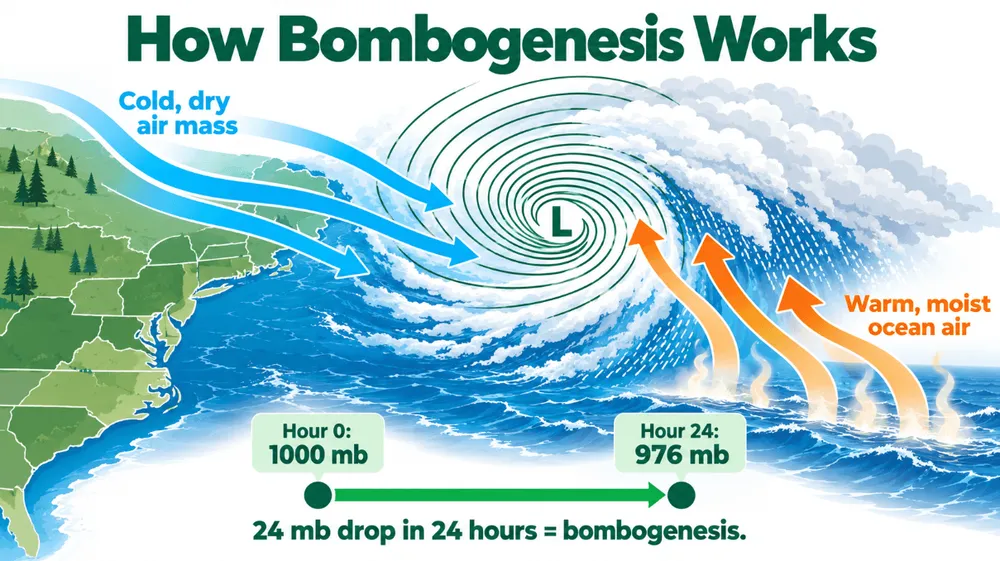
Bombogenesis is the meteorological term for a storm that strengthens explosively fast. When the pressure at the center of a midlatitude low falls at least 24 millibars in 24 hours, adjusted for latitude, the storm has bombed out, and the result is a bomb cyclone.
TL;DR
Bombogenesis means a storm is intensifying fast, with its central pressure dropping about 24 millibars in a day. The resulting storm is a bomb cyclone, and many nor'easters get there. If a forecast mentions bombogenesis, get your heating system and air filter ready before it arrives.
Key Takeaways
Bombogenesis is the process of a midlatitude cyclone strengthening rapidly. A bomb cyclone is the storm it produces.
The benchmark is a 24-millibar pressure drop in 24 hours at 60 degrees north, which shrinks to about 17.8 millibars near 40 degrees north.
Bombogenesis is mostly a cold-season event over the ocean, which is why it so often shows up in nor'easters.
A bomb cyclone tests two easy-to-miss parts of a heating system: the air filter and any equipment installed outdoors.
What Does Bombogenesis Mean?
Bombogenesis is the rapid strengthening of a low-pressure storm system. In its National Ocean Service explainer on bombogenesis, the National Oceanic and Atmospheric Administration (NOAA) describes it as a midlatitude cyclone that rapidly intensifies over a 24-hour period. In simple terms, a storm "bombs out" when its central pressure falls so quickly that wind and precipitation ramp up within a day.
A midlatitude cyclone is the ordinary winter low behind most stormy weather in North America. Bombogenesis usually begins when cold air runs into warm, moist air over the ocean. That contrast feeds the storm, and as its central pressure plunges, air rushes inward faster to fill the gap. That inrush gives a bombing storm its stronger winds.
Where Does The Word Bombogenesis Come From?
Bombogenesis blends "bomb" with "cyclogenesis," the scientific term for a cyclone's formation and growth. The criteria meteorologists still use come from a 1980 Monthly Weather Review paper by Frederick Sanders and John R. Gyakum. The American Meteorological Society (AMS) lists bombogenesis and explosive cyclogenesis as other names for a bomb in its Glossary of Meteorology entry for bomb cyclone. In a forecast, you might read that a low "will undergo bombogenesis overnight."
How Much Does Pressure Have To Drop For Bombogenesis?
To qualify, a storm's central pressure has to fall an average of at least 1 millibar per hour for 24 hours at a reference latitude of 60 degrees north. Closer to the equator, the bar is lower. NOAA puts it at about 17.8 millibars near 40 degrees north, the latitude of the Mid-Atlantic coast.
The threshold shifts with latitude because of Earth's rotation. Filterbuy ran the AMS formula across common storm latitudes to show the full range.
Bombogenesis Threshold By Latitude
Filterbuy calculation using the AMS adjustment: 24 x sin(latitude) / sin(60 degrees), rounded.
Bombogenesis Vs. Bomb Cyclone Vs. Nor'easter
Bombogenesis is a process and a bomb cyclone is the storm it produces. A nor'easter is named for where a storm travels, not how fast it strengthens.
On its nor'easter safety page, the National Weather Service (NWS) describes a nor'easter as an East Coast storm that is most frequent and most violent between September and April. Bomb cyclones also form over the North Pacific and the central United States.
What Weather Does Bombogenesis Bring?
Expect damaging wind from a storm undergoing bombogenesis, along with heavy snow or rain depending on temperature. Coastal areas can also flood from storm surge and high surf, and if freezing rain joins in, Filterbuy's ice storm warning guide covers those added risks. A dramatic example is the January 2018 East Coast storm, whose pressure dropped 59 millibars in 24 hours, more than double the benchmark, according to NASA's Earth Observatory.
NOAA reports that 14 of 20 hurricane-force wind events in the North Atlantic during the first two months of 2014 underwent bombogenesis.
How Does A Bomb Cyclone Affect Your Home's Heating And Air?
A bomb cyclone can knock out power and bury vents just as your HVAC system is working its hardest in a closed-up house.
It all depends on how you heat. Even gas furnaces need electricity for the blower and igniter, as Filterbuy's guide to heating your home in a winter power outage explains. Snow over plastic vent pipes trips high-efficiency furnace safety controls, so learn how to clear a frozen furnace vent pipe. Heat pumps need room to breathe, so keep the clearance our heat pump winter prep guide recommends.
Bomb Cyclone Prep By Heating System
Filterbuy summary. Follow your equipment manual and use the MERV rating it approves.
Your air filter works overtime. With the furnace running almost nonstop, dust and fireplace particles build up on the filter faster. A clogged filter chokes airflow right when you need heat most, and sealed-up houses are one reason winter indoor air quality is often worse.
Filterbuy's Take: Treat A Bomb Cyclone Forecast As An HVAC Forecast
Most bombogenesis explainers stop at the weather map. As an air filter manufacturer, we picture the same storm from inside a sealed house where the furnace may run for days. Filterbuy's heat pump winter prep guide traces most December heat pump complaints to a neglected filter or a buried outdoor unit, and a bomb cyclone exposes both at once.
"When I hear a storm is bombing out, I think less about snow totals and more about a furnace running three days straight in a sealed-up house. A fresh filter plus one spare in the closet is the simplest storm prep there is, and it's the step people skip."
Michelle Wan, Brand Manager and Air Quality Writer, Filterbuy
How To Prepare Your Home Before A Bomb Cyclone
The NWS doesn't issue a bombogenesis alert. Its warnings name the hazard, such as a winter storm or high wind warning, while the word itself surfaces in forecast discussions and news coverage. Start preparing the day you first see it.
Track the alerts. Knowing the difference between a winter storm watch and warning tells you how much time you have to work with.
Install a fresh air filter. A clean filter keeps air moving through days of heavy use. Filterbuy makes MERV 8, MERV 11, and MERV 13 pleated filters, but stick with a rating your HVAC system's manual approves. The EPA's guide to MERV ratings explains the scale.
Keep a spare filter on hand. Deliveries can stall for days on snowbound roads. With Filterbuy auto-delivery, replacements ship on your schedule, so the next filter is already in the closet.
Test smoke and carbon monoxide alarms. The Consumer Product Safety Commission (CPSC) advises CO alarms on every level of the home and outside sleeping areas. Fireplace questions in Filterbuy's customer-support queue peak each January, so read our fireplace air quality tips and space heater safety guide.
Plan your generator spot. The Centers for Disease Control and Prevention (CDC) advises keeping generators outside and at least 20 feet from doors, windows, and vents.
What To Do After A Bomb Cyclone Passes
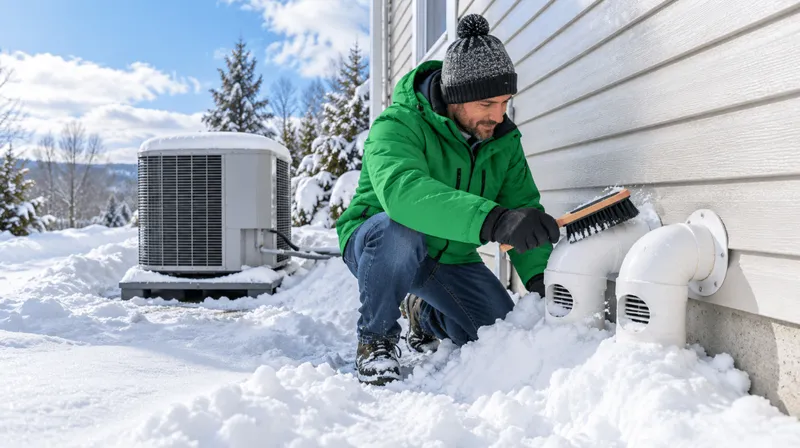
Clear snow from vents and outdoor units by hand or with a soft brush.
Check your air filter. If it is gray or clogged after days of nonstop heating, replace it and use Filterbuy's guide on how often to change your air filter to get back on schedule.
If the furnace won't restart once power returns, check the breaker and thermostat before calling a licensed HVAC technician.
Working CO alarms and clear vents are what protect you from carbon monoxide, because no air filter removes carbon monoxide.
Supporting Statistics
11 hours. U.S. customers averaged 11 hours without power in 2024, nearly nine from major events, per EIA 2024 outage data.
41%. Portable heaters caused 3% of home heating fires from 2017 through 2019 but 41% of fatal ones, per U.S. Fire Administration heating fire data.
$1.4 billion. Winter storms caused nearly $1.4 billion in U.S. insured losses in 2025, per Insurance Information Institute winter storm data, citing Aon.
Frequently Asked Questions
Is a bomb cyclone the same as a hurricane?
No. A hurricane is a tropical cyclone powered by warm ocean water, while a bomb cyclone is a midlatitude storm driven by clashing cold and warm air masses. Even so, a bomb cyclone can produce hurricane-force winds.
Does A Bomb Cyclone Affect Indoor Air Quality?
Yes. With windows shut and the furnace running for days, dust and fireplace particles build up and load your filter faster, so start the storm with a fresh one.
When does bombogenesis usually happen?
Bombogenesis is mostly a cold-season event over the ocean, according to the AMS. It often starts when cold continental air flows over warmer seas, and it can also happen over land when a sharp temperature contrast sets up.
Is bombogenesis dangerous?
Bombogenesis itself only measures how fast a storm strengthens, but the resulting storms can bring hurricane-force winds and blizzards that knock out power for days.
Should I change my air filter before a bomb cyclone?
Yes, if your current filter is near the end of its life, because a major storm means long runtimes. Choose the MERV rating your HVAC system's manual allows.
Get Your Home Ready Before The Next Bomb Cyclone
Before the next bombogenesis forecast rolls in, find your filter size at Filterbuy and get fast and free 2-day delivery to most US states.
Glossary
Bombogenesis: Rapid strengthening of a midlatitude cyclone, measured by a fast drop in central pressure.
Bomb Cyclone: A storm that has undergone bombogenesis, also called a weather bomb.
Cyclogenesis: The formation and strengthening of a low-pressure system.
Midlatitude Cyclone: A low-pressure storm forming outside the tropics, also called an extratropical cyclone.
Millibar (mb): A unit of air pressure equal to one hectopascal.
Nor'easter: A storm along the East Coast of North America.
Hurricane: A tropical cyclone with sustained winds of at least 74 mph.
Agencies Cited: NOAA (National Oceanic and Atmospheric Administration), NWS (National Weather Service), AMS (American Meteorological Society), CDC (Centers for Disease Control and Prevention), CPSC (Consumer Product Safety Commission), EIA (Energy Information Administration), EPA (Environmental Protection Agency), and NASA (National Aeronautics and Space Administration).
MERV: Minimum Efficiency Reporting Value, a scale rating how well an HVAC filter captures airborne particles.
HVAC: Heating, ventilation, and air conditioning.
Carbon Monoxide (CO): A colorless, odorless gas from burning fuel that air filters cannot remove.