
Fireplace Season: How to Protect Indoor Air Quality in Winter
May 5, 2026
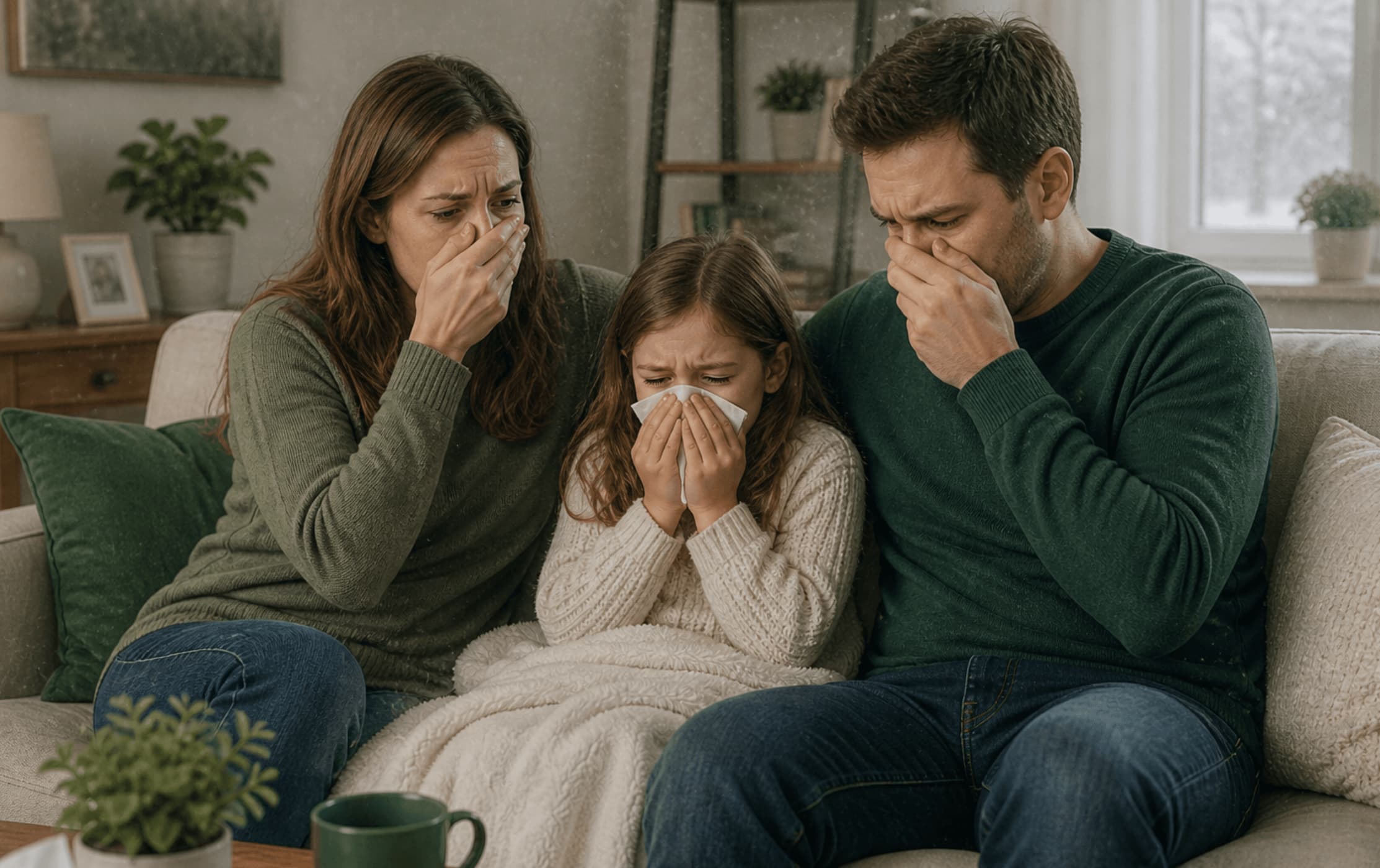
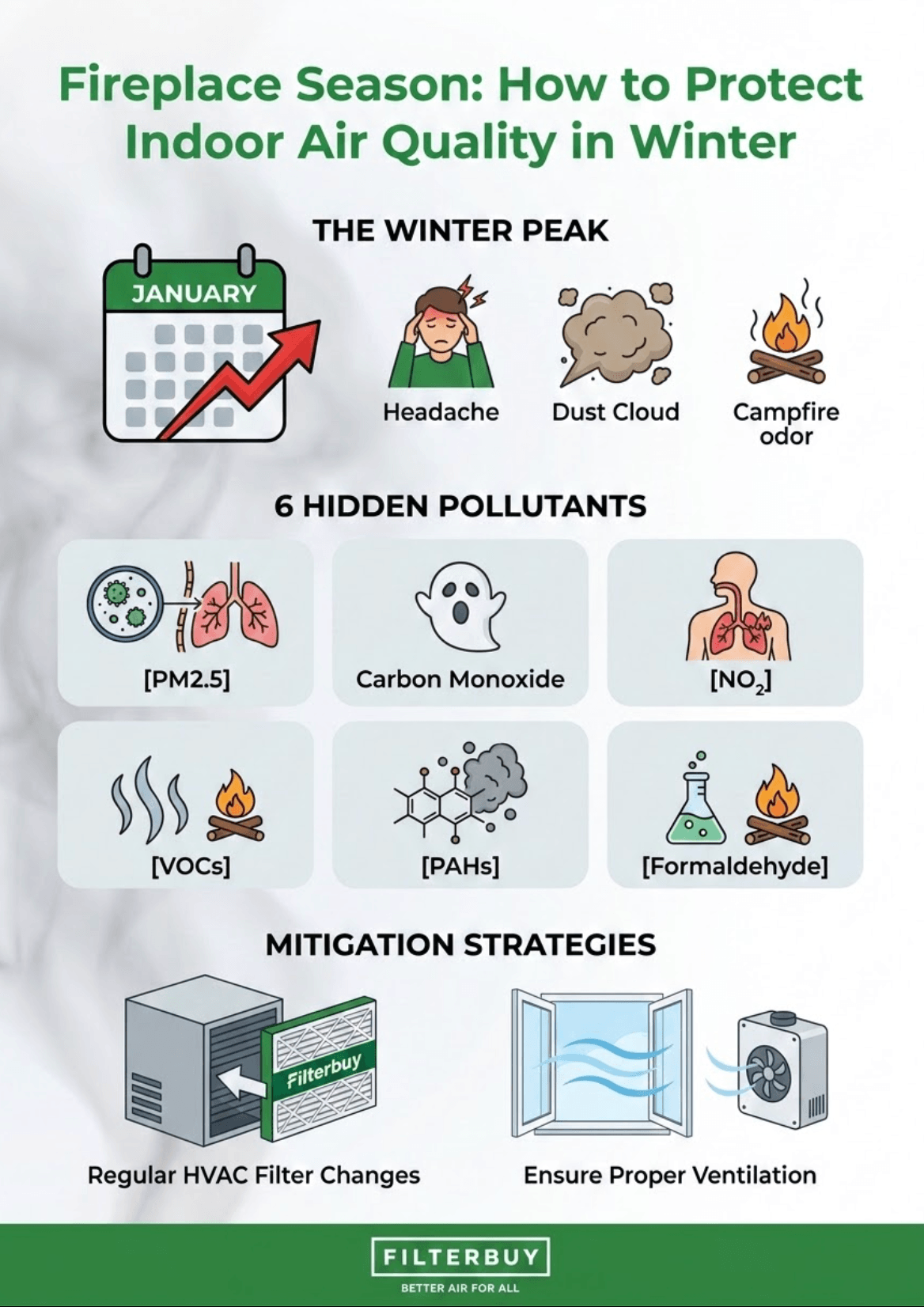
Most fireplace complaints in our customer-support queue land in December, peak in January, and quiet down by March. The pattern's been steady for years, and the questions barely change: a headache that won't quit, dust that's heavier than last winter, a couch that still smells like a campfire in spring. After more than a decade of building filters in the U.S. and shipping millions of them to families like yours, we can usually trace those calls back to the same place. The fireplace.
This guide is the practical answer to "are fireplaces bad for indoor air quality?" without the panic and without the hand-waving. We'll walk through the six pollutants every wood and gas fire releases into your living room, the actual difference between wood and gas (yes, gas counts too), the symptoms worth taking seriously, and the layered filtration setup that lets you keep enjoying the fire without breathing it in.
TL;DR Quick Answers
Fireplace indoor air safety
Fireplace season is the highest-risk stretch of the year for indoor air, so how to protect indoor air quality in winter comes down to four moves we've watched work for years: control the source, filter the room, vent the gases, and detect the one pollutant a filter can't catch.
• Burn clean. Use seasoned hardwood at 20% moisture or less. Sweep the chimney every year. Confirm the damper is open and the fire is drafting up the chimney, not back into the room.
• Filter at two levels. Run a MERV 13 furnace filter for the whole house, and add a portable HEPA + activated carbon purifier in the room with the fireplace. Change the furnace filter every 30 days during burning season — fires load filters fast.
• Add carbon for the smell. MERV filters trap particles, not gases. Activated carbon handles the VOCs and that lingering campfire smell in your couch.
• Install a CO detector on every level. No filter or purifier removes carbon monoxide. The CDC recommends one detector on every floor and near every sleeping area, tested monthly.
• Skip the fire on bad-air nights. Check AirNow.gov before lighting. If your local AQI is already high from wildfire smoke or a winter inversion, that's a "skip it" night.
Run all five together and the fireplace stops being an air-quality problem — without giving up the fire.
Top Takeaways
1. Wood smoke is where most of the health story lives. PM2.5 from wood fires drives the bulk of the winter-air complaints we hear from customers.
2. Gas isn't a free pass. Ventless gas units in particular send their combustion byproducts straight into the room you're sitting in.
3. Source control beats filtration. Burn dry, seasoned hardwood. Sweep the chimney every year. Make sure the fire actually drafts up the chimney instead of back into the living room.
4. Layered filtration wins. A MERV 13 furnace filter for the whole house plus a portable HEPA + carbon purifier in the fireplace room is the combination that consistently works for the families we hear from.
5. A filter can't replace a carbon monoxide detector. They solve different problems, and your home needs both.
The 6 Pollutants Your Fireplace Releases Into Your Living Room
Every fire produces a mix of pollutants that can drift into your home's breathing zone, whether the source is a roaring oak log or a tidy blue gas flame. The big six:
1. Fine Particulate Matter (PM2.5). Microscopic particles small enough to slip past your body's defenses and into your bloodstream. Wood-fire dominant. The biggest single health concern from any wood-burning fireplace.
2. Carbon Monoxide (CO). A poison gas you can't see, smell, or taste. Both wood and gas fires produce it, and no filter or purifier will remove it. You need a CO detector.
3. Nitrogen Dioxide (NO₂). A respiratory irritant that's particularly elevated around gas fires, especially ventless models.
4. Volatile Organic Compounds (VOCs). Gases like benzene that vaporize at room temperature. Both wood and gas fires release them. Activated carbon filtration is the answer here.
5. Polycyclic Aromatic Hydrocarbons (PAHs). Cancer-linked compounds that ride on wood smoke particles. Long-term exposure is the concern.
6. Formaldehyde. A known irritant and possible carcinogen, released by both wood and gas fires, with ventless gas appliances flagged in particular by health organizations.
Wood vs. Gas: An Honest Comparison
Wood fires release more PM2.5 and PAHs by a wide margin. The American Lung Association connects wood smoke directly to coughing, wheezing, worse asthma, heart attacks, and even premature death, and most of that risk traces back to the fine particles.
Gas fires shift the pollutant mix but don't eliminate it. Vented gas units send most of the combustion byproducts up and out, which is a real improvement over an open wood hearth. Ventless gas units don't. They release water vapor, NO₂, CO, and formaldehyde directly into the same room you're sitting in. California is currently the only state with a full ban on ventless gas fireplaces, and the U.S. Department of Housing and Urban Development bans them in HUD housing nationwide. Federal safety standards require modern ventless units sold in other states to include an oxygen depletion sensor that shuts the appliance off before CO builds up to dangerous levels.
Neither type is clean. Both can be made far safer.
Symptoms That Might Be Coming from Your Fireplace
If your headaches, scratchy throat, watery eyes, or extra dust seem to track with fire nights, that's not a coincidence. Wood smoke can irritate your lungs, make asthma flare up, and produce flu-like symptoms. The people most at risk are kids, older adults, pregnant people, and anyone with asthma, COPD, or heart disease.
Sustained headache, dizziness, nausea, or confusion is a different category. Treat that as possible carbon monoxide exposure: get fresh air, turn the fire off, and call 911 if symptoms keep getting worse.
How to Reduce Fireplace Smoke at the Source
Filtration matters, but the major IAQ authorities (EPA, the American Lung Association, the CPSC) all put source control first. Here's the order we recommend:
1. Burn the right wood. Seasoned hardwood at 20% moisture or less. Wet wood is the number-one reason for excess smoke in our customer reports.
2. Schedule annual chimney sweeps and inspections. Creosote causes both chimney fires and backdrafting.
3. Confirm the damper is open and the fireplace is drafting properly. A bad draft pushes smoke into the room instead of up the chimney.
4. Watch for backdraft conditions. In tightly sealed modern homes, running a kitchen exhaust fan or bathroom fan during a fire can pull smoke right back down the chimney.
5. Consider an EPA-certified wood stove insert. Cleaner-burning models cut PM2.5 dramatically compared to an open hearth.
6. For gas fireplaces: schedule annual professional inspection, never use a ventless model as your primary heat source, and crack a window for combustion air during long burns.
The Filtration Playbook
Once the source is handled, layered filtration takes care of what's left. This is the same setup that consistently works for the homeowners we hear from in customer support.
Step 1: Upgrade your HVAC filter to MERV 13. It's the residential sweet spot for catching PM2.5 from wood smoke. Our deep-dive on replacing your HVAC air filter before winter walks through the same logic that applies through fireplace season. Change the filter every 30 days while you're actively burning. If you want a refresher on how an air filter actually works, the basics are simple. The rating you choose is what determines whether wood smoke gets caught.
Step 2: Add activated carbon for VOCs and odor. MERV-rated filters trap particles, not gases. For the smoke smell that lingers in your couch and curtains, you need carbon. Filterbuy's Odor Eliminator filters combine pleated MERV media with a layer of activated carbon, so one filter handles both jobs.
Step 3: Run a portable HEPA + carbon purifier in the fireplace room. Size the unit for the room, with a CADR rating roughly equal to the square footage. Run it during the fire and for two to four hours after, because most of the fine particulate stays airborne well past the last log.
Step 4: Install carbon monoxide detectors. No filter, purifier, or HVAC upgrade will remove CO. The CDC recommends one detector on every level of the home and near every sleeping area. Test them monthly and replace the batteries every year.
That's the layered approach. Run it together, and the fireplace stops being an air-quality problem.
“After more than a decade of building filters in the U.S. and hearing from homeowners every winter, the families who pair a fresh MERV 13 filter with a portable HEPA in the fireplace room consistently tell us they notice the difference within a day, with fewer headaches, less dust, and a couch that finally stops smelling like the last fire.”
— The Filterbuy Team
7 Essential Resources
These are the trusted government and health-authority sources behind this guide. Each one is worth a bookmark.
1. U.S. EPA — Wood Smoke and Your Health. The clearest plain-language summary of why wood smoke matters and who's most at risk.
https://www.epa.gov/burnwise/wood-smoke-and-your-health
2. U.S. EPA — Burn Wise: Facts, Figures & Health Tips. Best-burn practices, appliance options, and the data behind residential wood smoke emissions.
https://www.epa.gov/burnwise/burn-wise-facts-figures-health-and-safety-tips
3. American Lung Association — Residential Wood Burning. Pollutant-by-pollutant breakdown plus practical reduction tips for indoor and outdoor air.
https://www.lung.org/clean-air/indoor-air/indoor-air-pollutants/residential-wood-burning
4. American Lung Association — Health Impacts of Combustion in Homes. Evidence review covering wood, gas, and propane appliances and their indoor air consequences.
https://www.lung.org/policy-advocacy/healthy-air-campaign/residential-combustion
5. CDC — Carbon Monoxide Poisoning Basics. Symptom guide, prevention checklist, and the case for CO detectors on every level of the home.
https://www.cdc.gov/carbon-monoxide/about/index.html
6. U.S. CPSC — Hazards from Furnaces, Space Heaters & Fireplaces. Federal guidance on home heating equipment and CO risk, including ventless gas units.
7. EPA AirNow. Real-time AQI plus the Fire and Smoke Map, useful for deciding whether tonight is a "skip the fire" night.
3 Statistics
The numbers behind why we wrote this. Each one is from a primary, citable source.
1. Each year, more than 400 Americans die from unintentional, non-fire-related carbon monoxide poisoning, with over 100,000 emergency-department visits and more than 14,000 hospitalizations. December, January, and February account for over a third of those deaths.
Source: https://www.cdc.gov/carbon-monoxide/about/index.html
2. Residential wood smoke emits more PM2.5 pollution than the on-road and non-road motor-vehicle sectors combined, and roughly five times more PM2.5 than petroleum refining in the U.S.
Source: https://www.epa.gov/burnwise/burn-wise-facts-figures-health-and-safety-tips
3. Residential wood combustion contributes about 21.9% of the population-weighted winter PM2.5 in the U.S., linked to roughly 8,600 premature deaths a year.
Source: https://pmc.ncbi.nlm.nih.gov/articles/PMC12829573/
Final Thoughts and Opinion
We're not going to tell you to give up your fireplace. We're not giving up ours either.
After a decade of customer-support tickets and conversations with families whose kids can't shake a winter cough, here's where we've landed. The fireplace is too easily defended as harmless when it isn't, and too easily turned into a fear story when it doesn't have to be. The truth lives in between. Both wood and gas fireplaces release pollutants into the room you're sitting in, and both are manageable if you handle four basic things: burn dry wood (or get the gas unit serviced), keep the chimney clean, put a quality filter in the furnace, and install a carbon monoxide detector.
That's the Filterbuy take. Better air without giving up the fire.
Next Steps
If you do nothing else after reading this:
1. Check the date on your current furnace filter. If you're more than 30 days into fireplace season, swap it.
2. Confirm a working CO detector outside every sleeping area. Test it tonight.
3. Book a chimney sweep if you're due. Get it done before your next big burn.
4. Pick up a portable HEPA + carbon purifier for the fireplace room.
5. Bookmark AirNow.gov so you can spot the high-AQI nights worth skipping.
Frequently Asked Questions
Are fireplaces bad for indoor air quality?
Yes. Both wood and gas fireplaces release pollutants into your home, including fine particulate matter, carbon monoxide, NO₂, VOCs, and formaldehyde. The good news is that source control, a MERV 13 furnace filter, a portable HEPA purifier, and a working CO detector reduce the risk dramatically without forcing you to give up the fire.
Is a gas fireplace safer than a wood fireplace for indoor air?
A vented gas fireplace produces less PM2.5 than a wood fireplace, so for fine-particle pollution, vented gas is generally cleaner. Ventless gas units are different. They release combustion byproducts directly into the room and carry their own NO₂ and CO risks. Neither type is automatically safe. Both depend on use and ventilation.
What MERV rating do I need to filter fireplace smoke?
MERV 13 is the residential rating we recommend for households dealing with wood smoke. It captures particles down into the PM2.5 range. MERV 11 is acceptable as a minimum for most homes. Going higher than MERV 13 in a residential furnace can restrict airflow and usually isn't worth the trade-off.
Will an air purifier remove carbon monoxide from a fireplace?
No. Carbon monoxide is a gas, not a particle, so standard HVAC filters and HEPA purifiers can't remove it. The only reliable defense against CO is a working detector installed on every level of your home, plus annual professional inspections of any fuel-burning appliance.
Why does my head hurt after using the fireplace?
PM2.5 and VOCs cause most after-fire headaches by irritating your sinuses and airways. But headache, dizziness, and nausea together can also signal carbon monoxide exposure. If symptoms come on quickly, get fresh air, turn off the fire, check your CO detector, and call 911 if symptoms keep getting worse.
Are ventless gas fireplaces safe?
Ventless gas fireplaces are legal in most states. Federal safety standards require modern units to include an oxygen depletion sensor, but the unit still releases combustion byproducts directly into the room. California has a full ban, and HUD bans them in HUD housing. Don't use one as your primary heat source, crack a window during use, and never run one while sleeping.
How often should I change my furnace filter during fireplace season?
Every 30 days while you're actively burning. Fires load filters faster than you'd expect. The same filter that lasts 90 days in the off-season can be visibly gray three or four weeks into regular fireplace use. Auto-delivery is the easiest way to stay on schedule without thinking about it.
Ready for a Safer Fireplace Season? Start with Better Indoor Air Quality This Winter
Protecting indoor air quality in winter starts with the one upgrade that does the most work for the least money: a fresh MERV 13 filter sized for your system. Find your exact fit at Filterbuy — factory-direct, made in the USA, with auto-delivery so you're covered every 30 days through fireplace season.