
Winter Inversions: Why Some Cities Get Their Worst Air in January
September 22, 2026
Winter Inversion Air Quality: Why Cold Valleys Trap Pollution
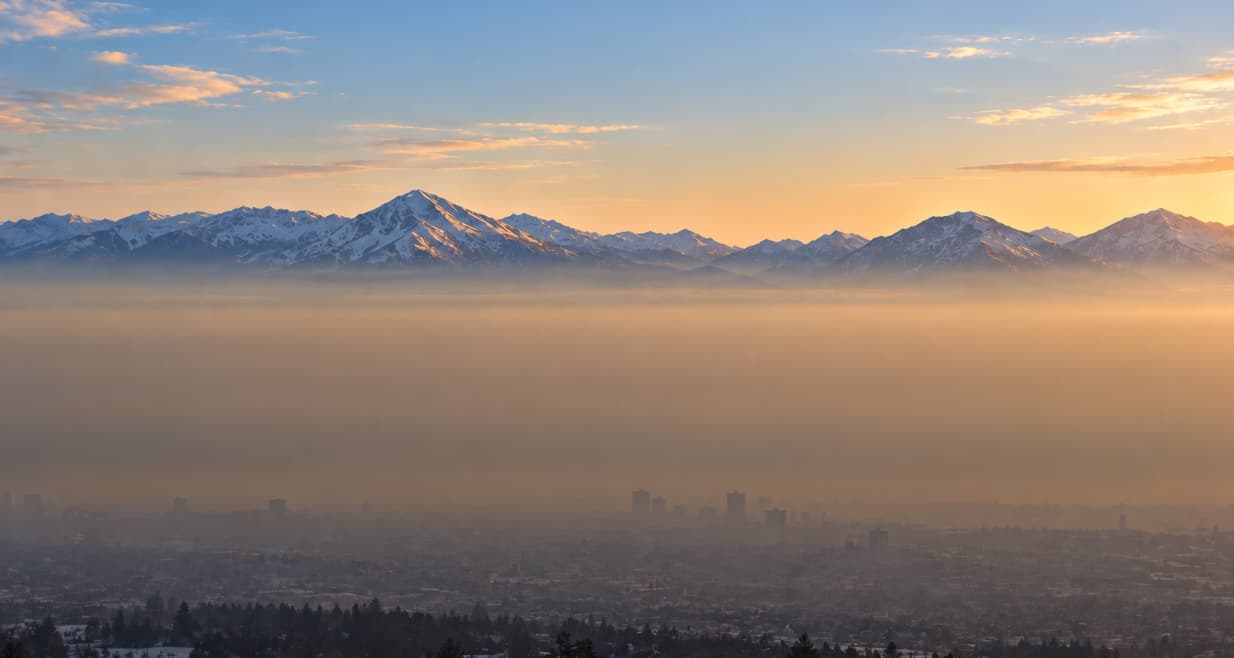
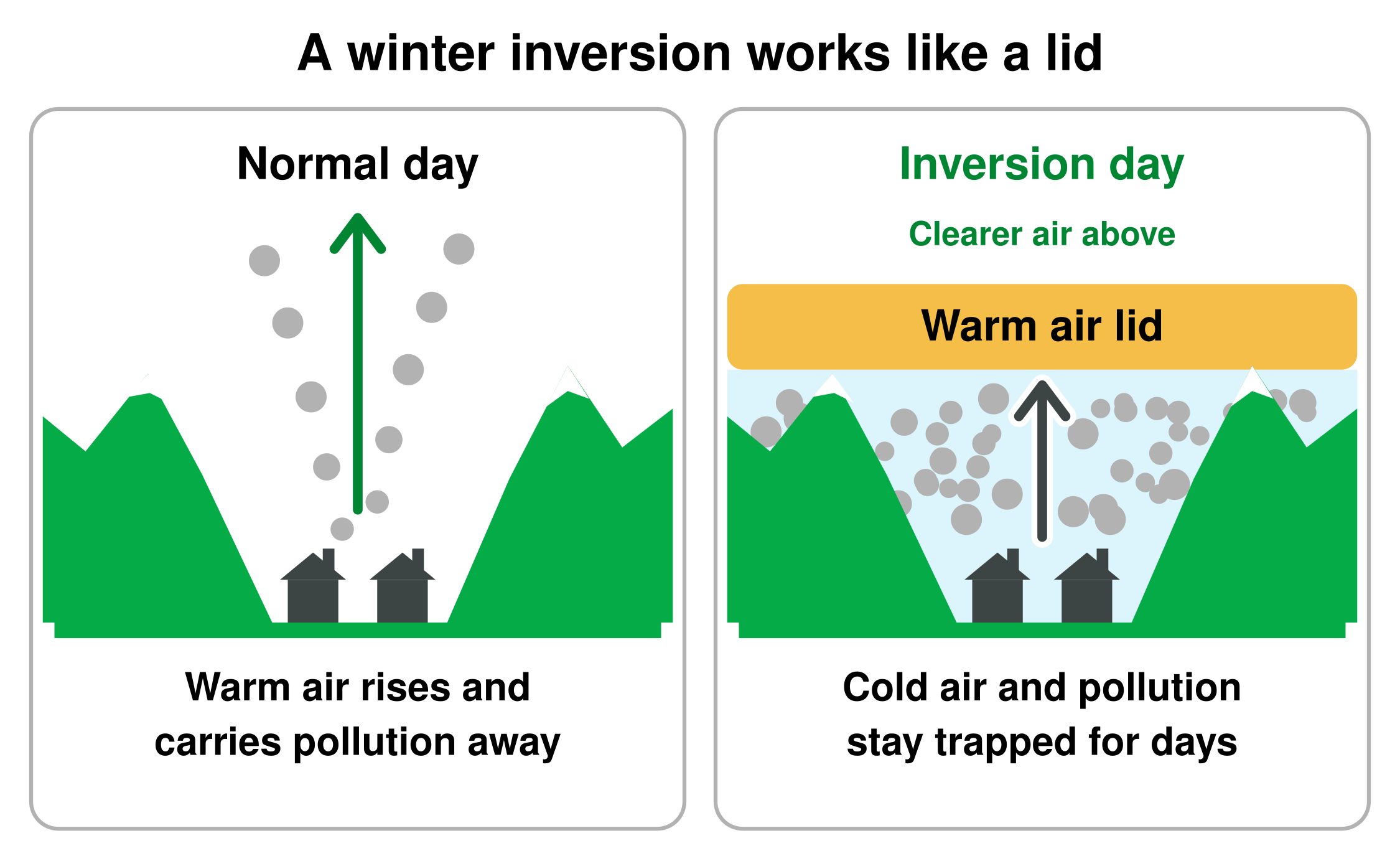
A winter inversion is a layer of warm air sitting on top of cold valley air. It works like a lid, trapping car exhaust and wood smoke near the ground for days.
That’s why valleys like Salt Lake City, Fairbanks, and Boise often see their worst fine-particle pollution from December through February. Indoors, keep windows shut and set your thermostat fan to ON. Then run a MERV 13 furnace filter, which captures microscopic particles, if your system can handle one.
Not sure which filter fits your home? The quick quiz below will match you.
Find your filter match
Answer a few quick questions and we’ll match you to the right filter for inversion season.
Already know your filter size?
TL;DR
A winter inversion happens when warm air settles over colder air in a valley and acts like a lid, holding car exhaust and wood smoke near the ground for days. That's why valleys like Salt Lake City, Fairbanks, and Boise often see their worst fine-particle pollution between December and February. Indoors, Filterbuy, a U.S. air filter manufacturer, recommends a MERV 13 furnace filter, an HVAC fan set to run continuously, and a properly sized air purifier in the bedrooms.
Key Takeaways
An inversion traps cold, polluted air beneath a layer of warmer air.
Calm high pressure, long nights, and fresh snow build inversions; storms clear them.
A typical Utah winter brings five to six multi-day inversions and about 18 days above the federal PM2.5 standard.
Ammonium nitrate, formed in the air itself, accounts for up to 70 percent of Utah's inversion haze.
The U.S. Environmental Protection Agency (EPA) advises a MERV 13 filter, or the highest rating your system can handle.
Filterbuy's rule of thumb: a filter changed on schedule protects you better than a higher MERV left in too long.
What Is a Winter Inversion?
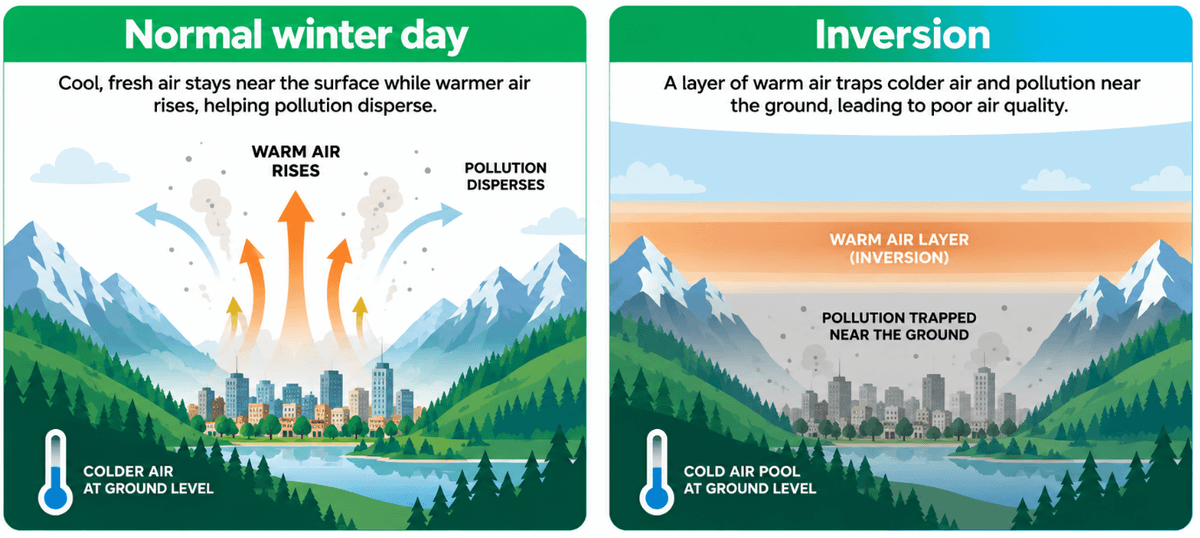
A winter inversion, also called a temperature inversion or persistent cold-air pool, forms when warm air sits on top of colder air near the ground. Normally, warm surface air rises and disperses pollution. During an inversion, the warm layer acts as a lid, so whatever is emitted in the valley stays there.
Geography makes it worse. In the Salt Lake Valley, the Wasatch and Oquirrh Mountains and Traverse Mountain form a basin that shelters pooled cold air from clearing winds.
Short overnight inversions usually erode after sunrise, according to the National Weather Service. The ones that hurt air quality are multi-day cold-air pools the winter sun can't break.
Why Is Air Quality Worst in January?
January brings together everything an inversion needs: long nights, a low sun, snow on the ground, and stagnant high pressure between storms. Home heating and wood burning also run high, so emissions peak just as the air stops carrying them away.
In Utah, winter inversions generally occur between December and February. Snow-covered valley floors reflect heat, so inversions often follow snowstorms. And because most of Utah's winter PM2.5 forms in the air as gases like nitrogen oxides and ammonia react, the haze thickens the longer an inversion lasts.
Which Regions Get Winter Inversions?
Inversion smog is most common in mountain-ringed valleys across the West and Alaska. Utah's northern valleys are the best-known example, and they're close to home for us: Filterbuy builds filters at its plant in Ogden, on the Wasatch Front.
Sources: Utah Department of Environmental Quality, Alaska Department of Environmental Conservation, Idaho Department of Environmental Quality, San Joaquin Valley Air Pollution Control District, Sacramento Metropolitan AQMD.
Fairbanks: PM2.5 is the main concern from October through March. Per Alaska DEC figures in the Fairbanks Daily News-Miner, wood stoves produce 40–60% of PM2.5 emissions in Fairbanks and 60–90% around North Pole.
Boise: winter inversions produce the Treasure Valley's worst particulate pollution events each year.
San Joaquin Valley: the Valley Air District counts home wood burning among its largest winter PM2.5 sources.
How Long Do Inversions Last?
Persistent winter inversions can hold for several days to more than a week, and pollution climbs each day. In Utah, a strong storm or low-pressure system is often needed to clear one out.
Until an inversion breaks, watch elevation rather than the citywide AQI. As Filterbuy's Salt Lake City AQI guide points out, the haze is thickest on the valley floor, while benches and canyons often sit above it. A daily air quality forecast helps you plan around the worst days.
Signs an Inversion Is Setting In
A snowstorm followed by clear, calm days under high pressure.
A flat gray-brown layer over the valley, with sunny peaks poking out above it.
A burn status that shifts to voluntary or mandatory no-burn, like Utah's daily Action Forecast.
If you notice two at once, start the Day 1–2 steps below.
Is Inversion Air Unhealthy?
Yes. Inversion haze is mostly PM2.5, fine particles that settle deep in the lungs. Utah DEQ links particle pollution to worsening asthma, reduced lung function, and nonfatal heart attacks. Children, older adults, and people with heart or lung conditions should limit time outdoors once the AQI turns orange.
What Should You Run Indoors During an Inversion?
Filterbuy boils inversion defense down to three moves: seal, filter, and clean. Seal the house by keeping windows shut and the fireplace cold. Filter with a MERV 13 furnace filter, if your system can handle one, and the thermostat fan set to ON. Then clean the air where you sleep with a HEPA purifier.
The thermostat fan setting matters more than most people expect: EPA notes that HVAC filters only clean air while the system runs, often less than 25% of the time in heating season.
The Inversion-Day Indoor Playbook
Fan ON runs the blower nonstop so air keeps passing the filter; AUTO runs it only while the system heats or cools.
Closing fresh-air intakes on Day 3 follows EPA's guidance for outdoor particle events. Reopen them once the air clears.
Which Setup Fits Your Home?
Sources: U.S. EPA, Guide to Air Cleaners in the Home; Filterbuy filter guidance reviewed by David Clark, Licensed HVAC Technician.
Choosing a Furnace Filter
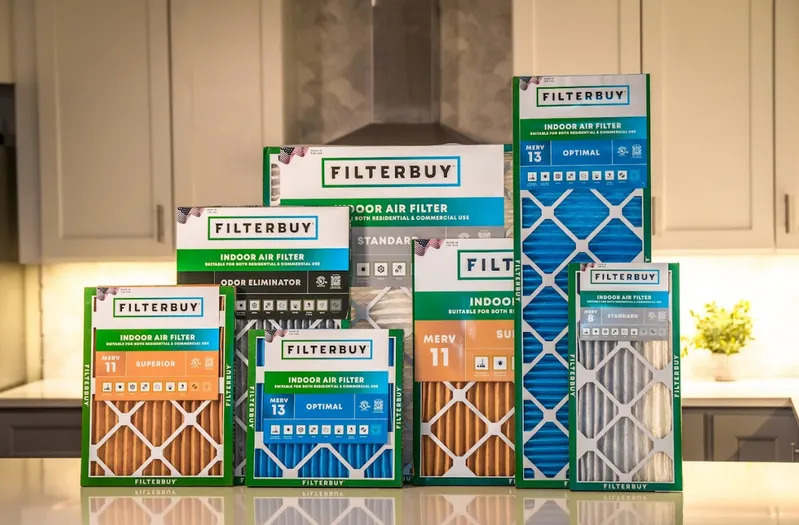
According to EPA, most HVAC systems can handle a MERV 13 filter as long as it's replaced frequently. Filterbuy's MERV rating chart shows what each level captures.
How often is frequently? David Clark, a Licensed HVAC Technician with Filterbuy HVAC Solutions, sets Filterbuy's baseline at 90 days, shortened to 30 during smoke. An inversion loads a filter much the way smoke does, so plan on the shorter end through January.
Fit matters just as much. Clark says the problem Filterbuy hears about most is a filter that doesn't fill its rack, letting air slip around the media. Check where your HVAC filter is located and make sure it seats snugly; with 600+ standard sizes plus custom options, Filterbuy can match odd racks.
"What actually hurts systems is the filter nobody remembered to change." — Michelle Wan, Brand Manager and Air Quality Writer, Filterbuy
That's why Michelle would rather see a MERV 11 changed on schedule than a MERV 13 left in for months, a point she makes in Filterbuy's 20x25x1 filter guide. Unsure about upgrading? Read when to upgrade from MERV 8 to MERV 13.
Pro Tip: Try Filterbuy's white-paper test. Write the install date on the frame, and at 30 days, hold the filter next to a new one on white paper. If it looks gray, stay on a 30-day cycle until inversion season ends.
Sizing an Air Purifier
Choose a purifier with a tobacco smoke CADR of at least two-thirds of the room's square footage (80 for a 120-square-foot bedroom), per EPA's smoke-preparedness guidance. Avoid any model that produces ozone.
What a Filter Can't Fix
A filter won't catch carbon monoxide, and inversion season is also furnace season. EPA recommends a professional inspection of fuel-burning appliances each heating season, with a CO alarm as backup.
Supporting Statistics
Sources: American Lung Association, State of the Air 2026; U.S. EPA, Guide to Air Cleaners in the Home; Antonopoulos, Dillon and Gall, Pollutants (2024), via NIH PubMed Central.
See the American Lung Association, EPA, and Portland study findings; the study measured smoke, another PM2.5 event.
Frequently Asked Questions
Does an inversion affect indoor air quality?
Yes. Fine particles drift indoors through gaps and fresh-air intakes, so indoor PM2.5 rises along with outdoor levels. Running a MERV 13 filter together with a HEPA purifier keeps indoor levels well below what's outside.
Should I open my windows during an inversion?
No. Opening windows lets trapped valley air inside. Wait until a storm clears the valley and your AQI returns to green.
Can I use my fireplace during an inversion?
Check your local burn status first. In Utah, the Division of Air Quality posts a daily Action Forecast, and wood- and coal-burning stoves and fireplaces can't be used on Mandatory Action days.
Is it safe to exercise outside during an inversion?
On orange days, people with asthma, COPD, or heart disease should move hard exercise indoors; on red days, everyone should limit outdoor exertion. Heading uphill, above the haze, helps. If you have asthma or COPD, ask your doctor for an inversion-season plan.
What's the difference between an inversion and smog?
An inversion is the weather pattern, and smog is the pollution it traps. Smog forms when traffic exhaust and wood smoke build up beneath that warm layer.
Glossary
Temperature inversion: A layer where temperature rises with height, trapping air below.
Persistent cold-air pool (PCAP): The technical name for a multi-day valley inversion.
PM2.5: Particles 2.5 micrometers or smaller.
Ammonium nitrate: A particle formed from ammonia and nitrogen oxides; the main ingredient in Utah's winter haze.
AQI (Air Quality Index): EPA's color-coded 0–500 scale for daily air quality.
MERV: Minimum Efficiency Reporting Value, a 1–16 rating for how well an HVAC filter captures particles.
CADR: Clean Air Delivery Rate, used to size a purifier.
HEPA: High-efficiency particulate air, a filter standard common in portable purifiers.
Your Next Step
Start by checking your local AQI on Filterbuy's live map. If a stagnant week shows up in the forecast, measure your air filter now and set up auto-delivery so a spare MERV 13 filter is already on the shelf.
Sources: Utah DEQ: Inversions; Utah DEQ: Particulate Matter Overview; Utah DAQ Current Conditions and Action Forecast; Alaska DEC: Fairbanks PM2.5 Background; Alaska DEC: Fairbanks Particulate Matter; Washington State University; San Joaquin Valley Air District; Sacramento Metropolitan AQMD; U.S. EPA: Guide to Air Cleaners in the Home; U.S. EPA: Preparing for Smoke and Heat; U.S. EPA: Carbon Monoxide Poisoning; NOAA National Weather Service Glossary; Fairbanks Daily News-Miner; American Lung Association: State of the Air 2026; NIH PubMed Central: Antonopoulos et al. (2024).
About the Author
Michelle Wan is Brand Manager and Air Quality Writer at Filterbuy. She works directly with Filterbuy's U.S. manufacturing team, including its plant in Ogden, Utah, so her advice comes from how filters are built and used in real homes. She holds a B.A. in Sociology from the University of California, Santa Cruz, and appears in Filterbuy's educational videos and social content.
About the Reviewer
David Clark is a Licensed HVAC Technician and President of Filterbuy HVAC Solutions. An EPA-certified technician and graduate of the South Florida Academy of Air Conditioning, he has worked in HVAC installation, dispatch, maintenance, and customer service, and he reviews Filterbuy's technical air quality content.