
How to Read an Air Quality Forecast (And Plan Ahead for Bad Air Days)
June 12, 2026
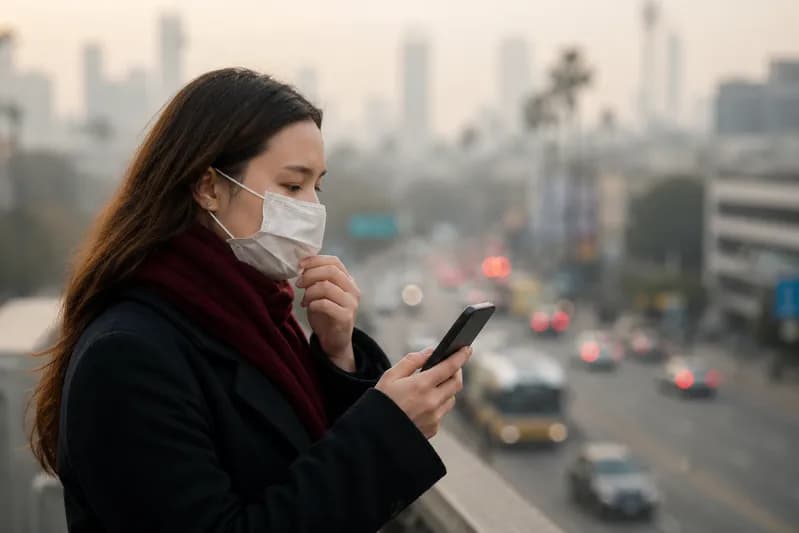
Most of us check tomorrow's weather without a second thought. Almost nobody checks tomorrow's air. An air quality forecast closes that gap. It tells you what your air will likely do before it does it, so you can slot in a fresh filter and shut the windows the night before instead of scrambling once the haze rolls in. We're air-obsessed around here, so we read tomorrow's AQI the way most people read tomorrow's rain. Here's how to read one for yourself, find it for your zip code, and turn it into a plan that protects your family.
TL;DR Quick Answers
Air Quality Forecast
An air quality forecast predicts the Air Quality Index for your area a day or more out, built from weather patterns, local emissions, and the pollution readings coming in right now. We read it the way we read a weather report. When it climbs, we get the house ready before the air turns.
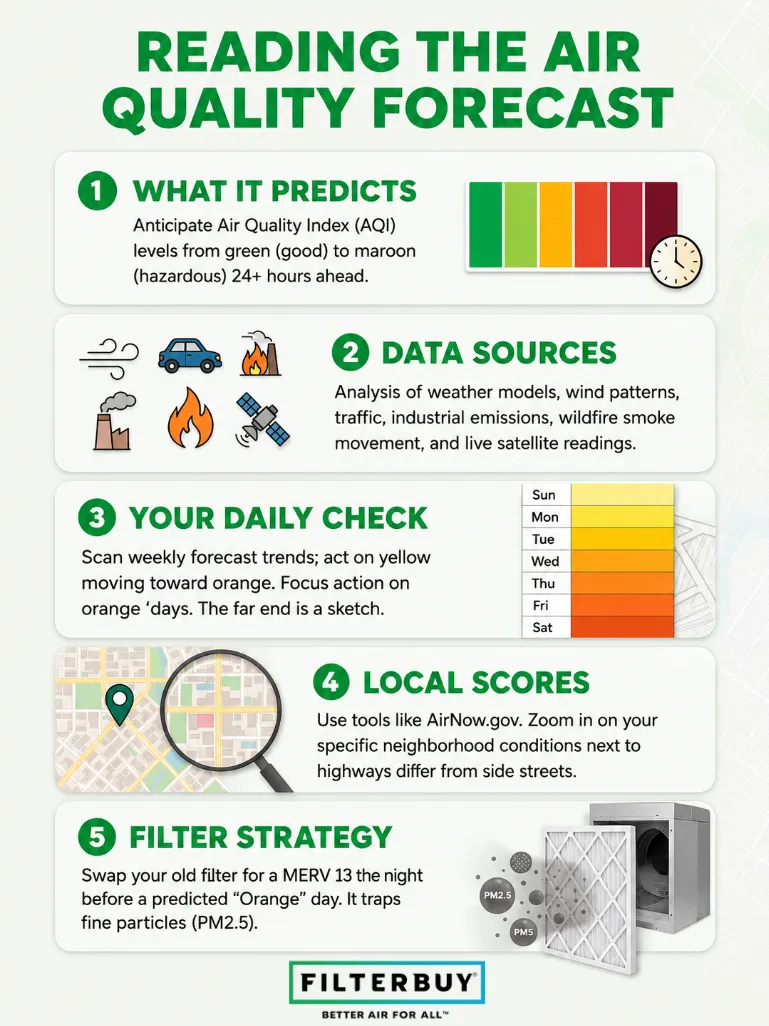
What it predicts: tomorrow's AQI, often with an outlook for the next several days, scored from green for good to maroon for hazardous.
Where the data comes from: weather models, traffic and industrial emissions, wildfire smoke on the move, and live readings from ground monitors and satellites.
How to find yours: type your zip code or share your location on a trusted forecast tool, and you'll see your next-day and multi-day outlook.
Why it matters to us: a predicted orange day or worse is your cue to slot in a fresh, higher-rated filter, close up, and run your HVAC system on circulate before the pollution shows up.
Top Takeaways
An air quality forecast predicts tomorrow's air quality, not just today's conditions.
Forecasters build that prediction from weather, local emissions, smoke movement, and live monitoring and satellite data.
It uses the same six AQI colors as a live map, and orange is where planning starts to pay off.
You can pull a forecast for your exact area by zip code, and many tools show a 7-day air quality forecast.
A filter change you plan the night before beats one you scramble for after the air's already turned.
What An Air Quality Forecast Is And How It Predicts Tomorrow's AQI
An air quality forecast predicts how clean or polluted your air will be over the next day or two, scored on the Air Quality Index. A live map shows you what the air's doing right now. An AQI forecast shows you what it'll likely do next, and that second part is what lets you plan instead of react.
Most forecasts zero in on the two pollutants behind the majority of bad-air days, fine particulate matter (you'll see it written as PM2.5) and ground-level ozone. PM2.5 is the one we lose sleep over. The particles are small enough to reach deep into your lungs and even slip into your bloodstream, which is exactly why a rising forecast is worth acting on instead of just noticing. Want the full method behind the score? the Air Quality Index reference lays out the formula and every pollutant it tracks.
An AQI prediction isn't a guarantee, just a strong, science-backed estimate that gets more confident the closer you are to the day in question. Tomorrow's air quality is usually a solid call. A reading five days out is more of a heads-up than a promise.
How Forecasters Use Weather, Traffic, And Pollution Data To Predict Air Quality
A forecast can see tomorrow coming because air quality runs on patterns, and forecasters watch all of them at once. The prediction pulls from three places.
Weather sets the stage. Wind either scrubs the air clean or hauls pollution in from somewhere else. Hot, still days let ozone build, and a temperature inversion traps smoke and exhaust near the ground like a lid on a pot. Rain helps. A good downpour washes a lot of particles right out of the sky.
Emissions supply the pollution. Rush-hour traffic, nearby industry, and seasonal sources like wood smoke all push the numbers up, and forecasters factor in the usual rhythm of your area and the day of the week. Wildfire smoke is the wild card. When a fire's burning upwind, the models track the plume and call when it'll reach you.
Live readings keep everyone honest. Ground monitors and satellites measure what's actually in the air this minute, and that real-time picture anchors the forecast for the hours and days ahead. Stack the three together, and you get one readable score for tomorrow's air quality.
How To Read A 7 Day Air Quality Forecast and a Weekly Air Quality Forecast
A weekly air quality forecast lines up the days ahead so you can spot trouble early. Reading one is simpler than it looks.
Start with today and tomorrow. These are your most reliable readings, so let them drive the next 24 hours.
Scan the week for direction, not exact numbers. A line creeping from yellow toward orange is telling you something's coming.
Catch the jump. The day a 7-day air quality forecast tips from yellow into orange is the day to have your home ready.
Treat the far end as a rough sketch. Days six and seven still move, so check back as they get closer instead of locking in plans now.
If you'd rather start with right-now conditions before looking ahead, check today's outdoor air quality first, then come back to the weekly view to plan.
How To Find An Air Quality Forecast Near You
Finding an air quality forecast near you takes about as long as checking the weather. Here's the routine we'd recommend.
Open a trusted air quality tool and enter your zip code, or let it use your location.
Read today's AQI and color first, then look at tomorrow's forecast right beside it.
Open the multi-day or weekly view to see where things are headed.
Zoom in on your part of town. The air next to a busy highway can read very differently from a quieter street a few miles away.
A forecast and a live air pollution map work best as a pair. The map shows you where the air stands today. The forecast shows you what's coming. Check the map now, then check the forecast to plan for tomorrow.
How To Plan Filter Changes Around Predicted High-Pollution Days
Here's where a forecast turns into real protection for your family. Outdoor pollution doesn't stay outside. Those fine particles ride in through open windows, the gaps around your doors, and the fresh air your HVAC system pulls in. On a high-pollution day, the air in your living room can drift toward the same ugly numbers you saw on the forecast.
A forecast hands you a head start that a live reading never can. When tomorrow's set to hit orange or worse, you've got all evening to get ready instead of reacting once the haze is already here.
This is the plan we run ourselves. The night before a predicted bad-air day, check your filter and swap it if it's past due, so it's fresh and pulling its full weight when you need it. If your system can take one, go with a higher-rated MERV 13 filter, since it traps far more of the fine particles the forecast is warning you about. Then shut the windows in the morning and run your HVAC system on circulate, so it keeps cleaning the same indoor air instead of inviting more pollution inside. A little planning the night before does more for your family's air than anything you can pull off once the numbers spike.
After manufacturing filters for over a decade and serving more than two million households, we've learned that the smartest homeowners act on the forecast, not the emergency. When tomorrow's set to turn orange, the move is simple. Put in a fresh, higher-rated filter tonight, close up the house in the morning, and let that filter do the heavy lifting. A forecast only protects your family if it changes what you do before the air goes bad.
— Filterbuy Team
7 Essential Resources
Air pollution is invisible, but these seven tools make tomorrow's air something you can see and plan around. They're the forecasts and references we trust to read the air outside before it reaches the air inside your home.
See Tomorrow's Air Before It Arrives
This is the forecast we open first. Punch in your zip code or share your location, and you'll get today's reading, tomorrow's outlook, and an alert when a bad-air day is headed your way.
Source: AirNow air quality forecasts
Pair The Air Forecast With Your Weather
Air quality and weather travel together. This page connects the two, so you can see how wind, heat, and rain will shape tomorrow's air.
Source: National Weather Service air quality safety
Understand The Model Behind The Prediction
If you've ever wondered how a forecast sees tomorrow coming, this walks through the modeling that turns weather and emissions data into a next-day air quality call.
Source: NOAA air quality forecasting
Learn What Each AQI Number Means
A forecast only helps once you know what the number stands for. This breaks down every AQI category and what each one means for your day.
Source: EPA's AQI category guide
Watch Smoke Move Before It Reaches You
When wildfire smoke is the story, this satellite view lets you watch the plume drift across the map and catch haze heading your way before it ever touches the ground.
Source: NASA satellite air quality view
Know Who In Your Home Feels It First
A forecast matters most for the people who feel the bad air the soonest. This CDC guidance helps you look out for kids, older adults, and anyone with heart or lung conditions.
Source: CDC air quality and health guidance
See How Your Community's Air Trends
Maybe your area has a real air problem, or maybe it's just an off week. This annual report grades and ranks communities so you can see where yours stands.
Source: American Lung Association State of the Air
Supporting Statistics
We think about air all day, so a handful of numbers shape how seriously we take a rising forecast. Here they are, and what each one means for your home.
1. A major study of Medicare records found that deaths among older adults rose almost in step with fine particle pollution, and that any level of air pollution, no matter how low, is harmful to health.
This is why we act on a moderate forecast instead of waiting for red.
If there's no safe floor, every bad-air day you plan around counts.
Source: NIH research on air pollution and early death
2. Researchers estimate that about 164,000 premature U.S. deaths in a single year were tied to fine particle pollution (PM2.5).
A rising forecast is a hometown risk, not a distant headline.
We read a climbing local number as personal, because it is.
Source: County Health Rankings analysis of particulate matter
3. Air pollution is the fourth leading risk factor for early death worldwide, behind only high blood pressure, dietary risks, and tobacco use.
That's the backdrop behind any weekly or global forecast you check.
Cleaner indoor air is one of the few parts of that picture you fully control.
Source: State of Global Air health burden report
Final Thoughts
A forecast only earns its place if it changes what you do next. In our experience, the homeowners who get the most out of one treat a predicted color change as a reason to act the night before, not a fact to file away. Pick the level where you'll close up and switch to indoor mode. Plenty of families draw that line at orange. Then check the forecast the way you check the weather, and let it tell you when to get the filter and the windows ready. That one small habit protects the people under your roof better than almost anything else you can do.
Next Steps
Bookmark a forecast set to your zip code, so one glance each morning tells you what the air's doing today and tomorrow.
Pick your personal line. Plenty of families flip to indoor mode the second tomorrow's forecast turns orange.
Check your filter now and swap it if it's past due, so it's ready the next time the forecast climbs.
Frequently Asked Questions
What Is An Air Quality Forecast?
An air quality forecast predicts the Air Quality Index for your area over the next day or several days. It's built from weather patterns, local emissions, and current pollution readings, so you can see when the air's likely to turn before it does.
How Accurate Is A Tomorrow Air Quality Forecast?
A next-day forecast is usually reliable, a lot like a next-day weather forecast. Accuracy drops the further out you look, so tomorrow's air quality is a stronger call than a reading five or six days away.
How Do I Find An Air Quality Forecast Near Me?
Open a trusted air quality tool, enter your zip code or share your location, and read tomorrow's outlook next to today's reading. Zoom in on your part of town for the most local view.
Is There A 7 Day Or Weekly Air Quality Forecast?
Yes. Plenty of tools show a 7-day air quality forecast next to the current reading. Treat the first day or two as reliable and the later days as a heads-up that can still shift.
How Often Is An AQI Forecast Updated?
Most forecasts refresh at least once a day, and often more, as fresh weather and monitoring data come in. Check again in the evening if a bad-air day is on the board for the morning.
What AQI Level Should Make Me Plan Ahead?
A good rule is to get ready once tomorrow's predicted to reach orange, the Unhealthy for Sensitive Groups range. That's the level where closing up and running a quality filter starts to matter for your family.
Does A Forecast Predict Wildfire Smoke?
Many do. When a fire's burning upwind, forecast models and satellite tools track the smoke plume and estimate when it'll reach your area, which buys you time to close up and protect your indoor air.
Should I Change My Filter Before A High-Pollution Day?
If your filter's near the end of its life, yes. Swapping in a fresh, higher-rated filter the night before a predicted bad-air day means it's working at full strength right when your home needs it.
Protect The Air Inside Your Home
Next time the forecast turns orange, get your home ready before the air is. Find the right filter for your home and breathe easier knowing you're protecting your greatest assets: your family, your home, and your HVAC system.