
How to Check the Air Quality Index by ZIP Code
June 10, 2026
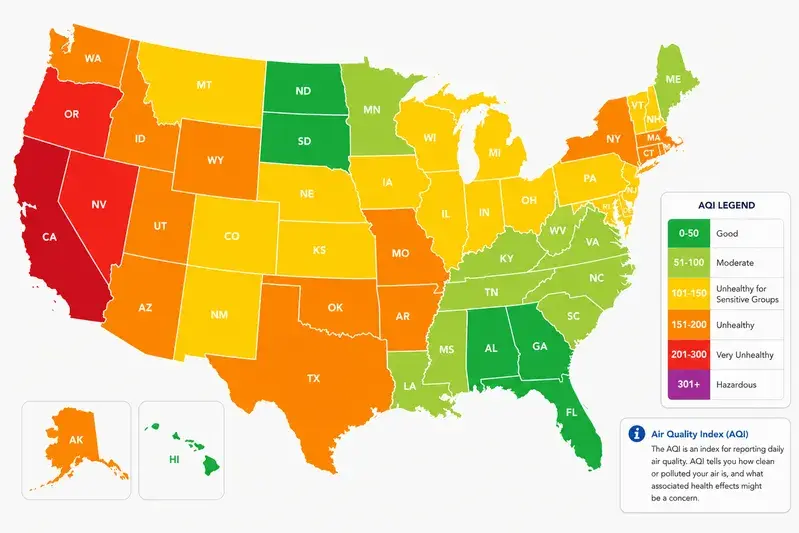
Wildfire smoke can push your neighborhood from a clean green 30 to an angry red 180 between breakfast and dinner, and you would never catch it by looking out the window. An air quality index by ZIP code lets you see it anyway. Type in your ZIP, read the number and the color, and the stuff drifting around your home that you can’t see turns into something you can act on.
We’re obsessed with the air you breathe, and a ZIP-level reading is the fastest way to know what’s actually around your house right now. Reading it well takes about a minute once you know what the number and the color are telling you. That minute is what keeps you a step ahead for the people under your roof.
TL;DR Quick Answers
How Do I Check The Air Quality Index By ZIP Code?
An air quality index by ZIP code shows your local AQI as a live number and color, pulled from air monitors near you.
To check it, open EPA AirNow or another trusted AQI source, type in your ZIP code, and read the number and its color category.
Colors run from green for good air up to maroon for hazardous air. Orange and above means sensitive groups should cut back on time outside.
Once your AQI passes 150, close up the house, set your HVAC to recirculate, and check your filter.
Top Takeaways
A ZIP-level reading turns live local air data into one number and one color you can read in seconds.
Green and yellow days are routine. When the color hits orange or higher, sensitive groups should take it easier outside.
Once the AQI passes 150, close the home, run the HVAC on recirculate, and look at your filter.
Match the filter to the air. MERV 8 handles everyday dust, MERV 11 catches allergens, and MERV 13 captures smoke as long as your system keeps normal airflow.
What The Air Quality Index Measures
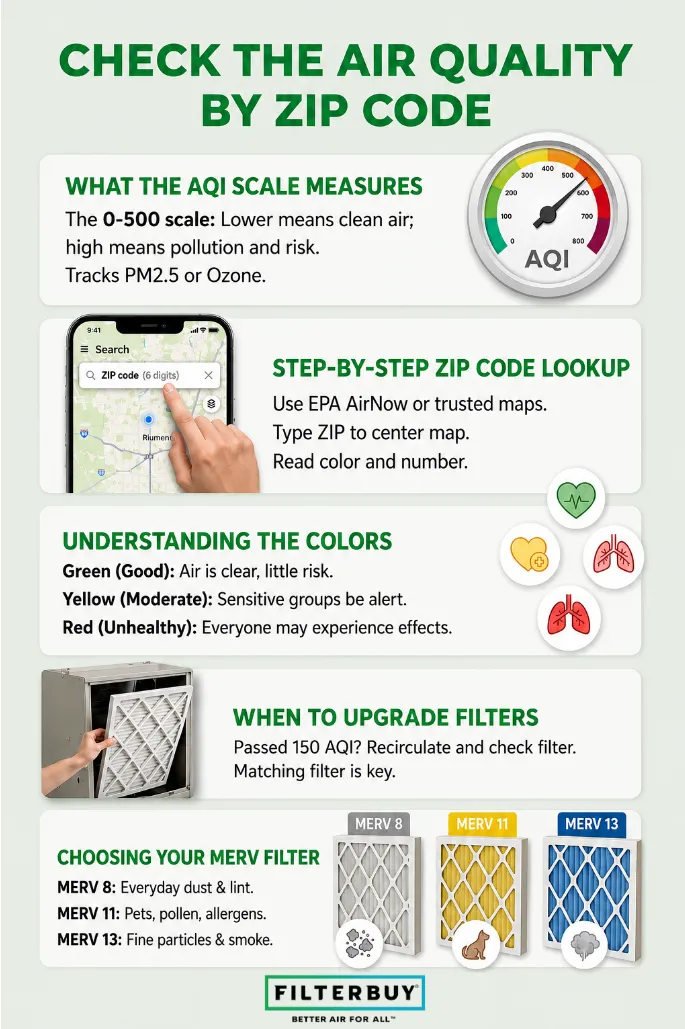
The Air Quality Index runs from 0 to 500. Low numbers mean clean air that’s safe for everyone, and high numbers mean more pollution and more risk to your health. When you pull a reading for your ZIP code, a monitor or sensor near you reports the level of whatever pollutant is worst at that moment, usually the fine particles called PM2.5 or ground-level ozone.
If you’re new to the index, start with what the Air Quality Index is, and the colors will make a lot more sense before you check a single reading. For the math behind the scale, the reference on how the AQI is calculated lays out the formula in full.
How To Look Up Your AQI By ZIP Code, Step By Step
Reading your ZIP code’s air quality takes about a minute once you know the order to follow. Here’s how we walk customers through it.
Type your ZIP code or city into the search box on EPA AirNow or whatever map you trust, so it centers on your area.
Read the number and color at your spot. That’s your current AQI and its category.
Tap the nearest monitoring station to see the main pollutant and how it’s moved over the past few hours.
Compare a couple of nearby ZIP codes. Readings can jump from one neighborhood to the next during smoke or heavy traffic.
Check again later if the wind picks up or the sky turns hazy, since the number can shift within hours.
Reading The Color-Coded AQI Scale
The U.S. AQI uses six colors, and each one tells you who should pay attention.
Green, 0 to 50, Good. The air is healthy for everyone.
Yellow, 51 to 100, Moderate. A few unusually sensitive people may want to ease up on long stretches outdoors.
Orange, 101 to 150, Unhealthy for Sensitive Groups. Kids, older adults, pregnant people, and anyone with asthma or a heart or lung condition should take it easier outside.
Red, 151 to 200, Unhealthy. Everyone may start to feel it, and sensitive groups feel it first.
Purple, 201 to 300, Very Unhealthy. Treat it as a health alert and cut your time outdoors.
Maroon, 301 and up, Hazardous. Stay inside with the air sealed and filtered.
One glance at the color tells you whether today is a normal-plans day or a slower, stay-inside kind of day.
Using EPA AirNow To Check Your ZIP Code
Almost all U.S. air quality data starts at the Environmental Protection Agency and runs through AirNow, the government’s official reporting system. Open an EPA air quality map, type in your ZIP code, and you’re usually looking at AirNow data. Consumer maps and low-cost sensor networks fill the gaps between official monitors, adding coverage where no government station sits nearby.
There’s a trade-off worth knowing. Official monitors are highly accurate, but they can sit miles apart. Sensor networks cover more ground with a little less precision. Read both together and you get a fuller picture than either one gives you alone, which matters most when smoke is on the move. When you want the visual version, our AQI map by ZIP code lets you search any ZIP in seconds.
When A High AQI Reading Means It Is Time To Check Your Filter
A reading earns its keep when it changes what you do. Once your local AQI passes 100, ease off hard outdoor activity and start closing windows and doors. Past 150, switch your HVAC to recirculate and pull your filter for a look. Smoke and fine particles load a filter far faster than everyday house dust, so the one that looked fine last week can clog after a couple of smoky days.
Match the filter to the air. MERV 8 handles everyday dust and lint. MERV 11 grabs the smaller stuff from pets and pollen. When the sky goes orange, MERV 13 for wildfire smoke captures fine particles, as long as your system keeps normal airflow with one installed. We see this firsthand. After a rough air stretch, the filters customers send back to us arrive darker and heavier than any normal month, explains, and that’s the clearest sign it’s time for a fresh one.
After manufacturing filters for over a decade and serving more than two million households, we've found that the AQI usually spikes hours before a family even notices smoke indoors. That's exactly why the filter you install before fire season matters more than anything you do once the haze arrives. A MERV 13 sized to your system is the single change we see make the biggest difference in how clean a home stays through a smoke event.
— Filterbuy Team
7 Essential Resources For Acting On Your AQI Reading
Reading the number is step one. Acting on it is how you protect your family. We’re obsessed with clean air, and we want you to leave this page knowing exactly where to turn next. These seven trusted sources take you from a number on a screen to real protection inside your home.
Pull Your Live Reading From The Official Source
When you want the official number, go to the people who set the standard. AirNow is the EPA’s AQI system, so you can trust the reading and its category before you make a single call for your household.
Source: AirNow’s official guide to using the Air Quality Index
Choose The Right Filter And Air Cleaner
This is where a reading turns into protection. The EPA’s guide walks you through portable air cleaners and HVAC filters and points you toward MERV 13, or the highest rating your system can handle. It’s the choice we help families get right every day.
Source: The EPA’s Guide to Air Cleaners in the Home
Know Who In Your Home Needs Extra Care
You’re the one looking out for everyone under your roof, and the CDC helps you do it well. It spells out which family members feel poor air first and what to do as the AQI climbs.
Source: The CDC’s guidance on air quality and your health
Plan Ahead With The Air Quality Forecast
Good protection starts before the air turns. The National Weather Service forecasts ozone and smoke, so you can time workouts, errands, and the kids’ outdoor plans around cleaner hours instead of guessing.
Source: The National Weather Service air quality safety guidance
Turn A High Reading Into Simple Daily Actions
Protecting your home shouldn’t feel complicated. The American Lung Association answers the everyday questions about using the AQI and turns a worrying number into a few simple moves anyone in the family can follow.
Source: The American Lung Association’s guide to protecting yourself from poor air quality
Find The Best Air Cleaner For Allergies And Asthma
When someone you love has asthma or allergies, the right gear matters even more. The Asthma and Allergy Foundation covers room size, clean air delivery rate, and the devices worth skipping, so you can pick air cleaning that actually cuts their triggers.
Source: The Asthma and Allergy Foundation’s advice on choosing an air cleaner
Understand Why Clean Air Is Worth The Effort
Once you see what poor air really does to the body, you won’t look at your home the same way. MedlinePlus lays out the health costs of air pollution in plain language and gives you the reason behind every filter change and window check.
Source: MedlinePlus on the health costs of air pollution
Supporting Statistics
Here’s the evidence behind our advice. Every figure matches what we see in the filters that come back to us.
More than 40 percent of Americans live where the air turns unhealthy at times, so a quick ZIP check catches trouble early.
Source: NASA’s report on its TEMPO air-monitoring instrument
Long-term PM2.5 exposure was linked to more than 4 million deaths in 2019, now the top environmental health risk. Clean indoor air is one of the few defenses you fully control.
Source: The Health Effects Institute’s State of Global Air analysis
In a wildfire study, a MERV 13 filter plus a portable air cleaner cut a home’s indoor-to-outdoor PM2.5 ratio to 0.22, down from 0.55. We see the same pattern in the filters customers send us.
Source: A peer-reviewed study of household PM2.5 interventions during a wildfire
Final Thoughts And Opinion
Treat a reading as a prompt, not a verdict. One orange afternoon doesn’t mean you need to overhaul your home. It means today’s a good day to close the windows, run the system on recirculate, and glance at your filter. The habit that protects your household is small and easy to repeat. Check the ZIP-level reading when the air looks or smells off, then let what you see guide a couple of simple moves. You’re the one watching out for the people under your roof, and a clear reading paired with a good filter makes that job a whole lot easier.
Next Steps
Bookmark a trusted ZIP-level AQI source and check it on hazy, windy, or smoky days.
Write down your current filter size, then confirm which MERV rating to use for the air you usually deal with.
Keep a spare filter on hand before smoke season starts.
Frequently Asked Questions
How Do I Find The Air Quality Index For My ZIP Code?
Open EPA AirNow or another trusted AQI source, type your ZIP code or city into the search box, and read the number and color for your spot. Tap a nearby station to see the main pollutant and its recent trend.
What Do The Colors On An AQI Reading Mean?
Green is good, yellow is moderate, orange is unhealthy for sensitive groups, red is unhealthy for everyone, purple is very unhealthy, and maroon is hazardous. The higher the number behind the color, the bigger the health concern.
Is The EPA AirNow Reading The Same As A Real-Time AQI?
They overlap. AirNow supplies the official EPA data behind most real-time AQI maps, and many consumer maps add sensor readings for denser coverage.
What AQI Level Is Unhealthy?
Air turns unhealthy for sensitive groups at an AQI of 101 and unhealthy for everyone at 151. Readings of 201 and up are very unhealthy or hazardous and call for staying indoors.
Can I Check Air Quality By Postal Code Outside The United States?
Yes. Many global maps take a postal code or place name. The U.S. AQI scale and colors can differ from other national indexes, so read the legend on whatever map you use.
When Should A High Reading Make Me Change My Filter?
Check your filter once your local AQI passes 150, especially during wildfire smoke. Fine particles load filters fast, so swap yours early if it looks dark or your airflow drops.
Breathe Easier On Every Reading
Air quality can turn fast, but staying ready doesn’t have to be hard. Check the live AQI for your ZIP whenever the air looks off, and keep the right filter on hand for the days it counts. Filterbuy has been making pleated MERV 8, MERV 11, and MERV 13 filters in the USA since 2013, in standard and custom sizes, so a clean one is ready the moment your reading climbs.