
Air Quality Near Highways And Busy Roads: What Homeowners Should Know
July 29, 2026
Author: Michelle Wan, Brand Manager and Air Quality Writer | Technical Reviewer: David Clark, Licensed HVAC Technician | Published: July 29, 2026 | Updated: July 29, 2026
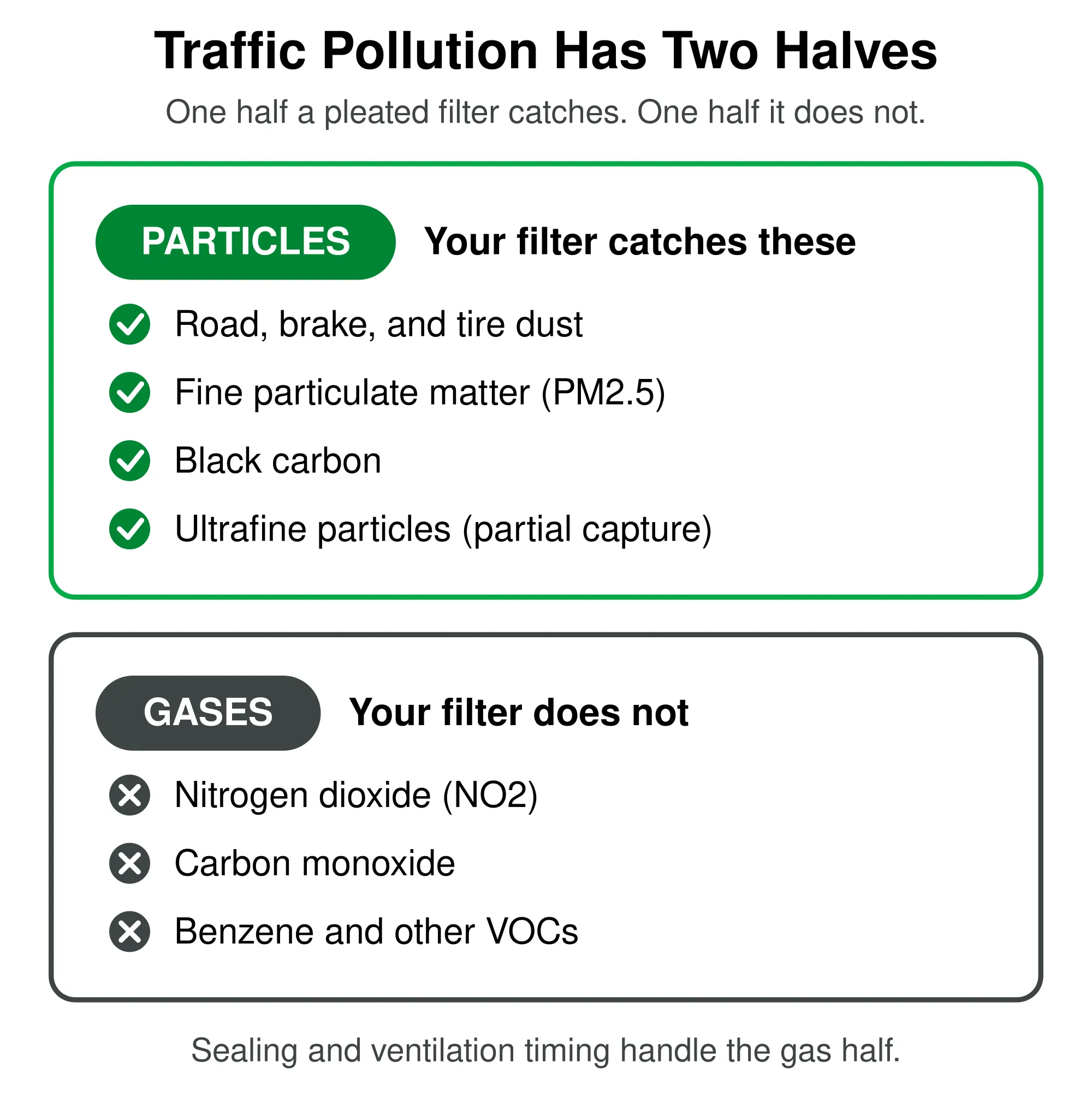
Traffic pollution runs highest within about 300 feet of a roadway and thins across the next thousand feet. The air near a road carries two different things, and each half answers to a different fix. A pleated MERV filter captures the particle half, including road dust, fine particulate matter (PM2.5), and black carbon. It captures no nitrogen dioxide, carbon monoxide, or benzene, because those are gases that pass straight through pleated media.
Here is what each rating captures:
- MERV 8: larger debris, dust, and dust mites
- MERV 11: finer particles like pet dander and mold spores
- MERV 13: microscopic particles, the highest rating most home systems accept
- Odor Eliminator (OE): activated carbon for odor reduction
Take the quiz below to find the rating your system accepts.
Answer a few quick questions and we will match you to your filter.
TL;DR
Homes near highways sit inside a measurable pollution gradient. Ultrafine particles, nitrogen dioxide, and carbon monoxide run highest within roughly 300 feet of the roadway and fall across the next several hundred feet. A pleated MERV filter captures the particle half of that mixture and none of the gases, so sealing and ventilation timing matter as much as the rating does.
Key Takeaways
Traffic pollution is a mixture of airborne particles and gases, and each half responds to a different control.
The combustion gases and the smallest particles fall off sharply with distance from a road. PM2.5 does not.
Plumes reach farther in the early morning than the afternoon, so the highest-exposure hour often arrives before sunrise.
A MERV 13 pleated filter captures 50 to 90 percent of particles depending on size and captures no nitrogen dioxide, because nitrogen dioxide is a gas.
An HVAC filter only treats air that reaches the return, so sealing and run time govern what the filter rating is worth.
What Traffic Pollution Puts In Your Air
Traffic-related air pollution is a mixture of particles and gases, and each half answers to a different control. Particles include fine particulate matter (PM2.5), black carbon, ultrafine particles smaller than 0.1 micrometer, brake dust, tire wear, and road dust that traffic lifts off the pavement. Gases include nitrogen dioxide, carbon monoxide, and volatile organic compounds such as benzene. The American Lung Association describes tailpipe emissions as particulate matter, nitrogen oxides, carbon monoxide, and volatile organic compounds that react to form ground-level ozone.
How Far Highway Pollution Travels From The Road
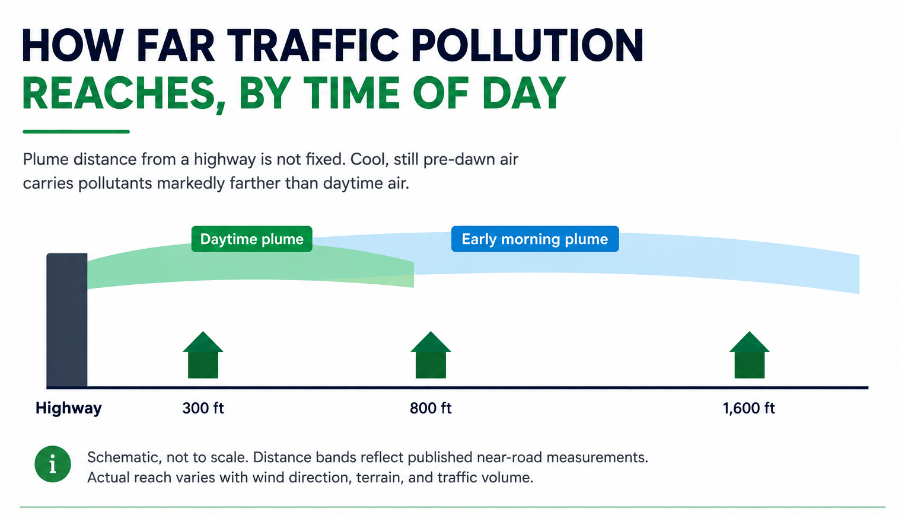
Traffic pollution runs highest within 300 feet of a roadway and thins across the next thousand feet, unevenly by pollutant. Combustion gases and ultrafine particles decay steeply within the first few hundred feet. PM2.5 decays gradually.
Distance bands synthesized from U.S. Environmental Protection Agency near-roadway research, Health Effects Institute Special Report 23 (2022), and Los Angeles County public health guidance.
Time of day matters as much as distance. Cool, stagnant overnight air holds pollutants near ground level instead of dispersing them, stretching the affected zone past its daytime footprint. A house in clean air at 3 p.m. can sit inside the plume at 5 a.m.
How To Tell Whether Your Home Is In Range
Measure to the edge of the nearest travel lane rather than the centerline, which can add fifty feet or more of false distance on a wide highway. Three factors then shift your real exposure more than the raw number does.
Prevailing wind direction decides whether you sit most days downwind, which matters more than distance inside the first few hundred feet.
A solid sound wall or an unbroken row of buildings reduces concentrations. A thin tree line does not.
Diesel share matters more than traffic volume, so a freight or bus corridor can expose you more than a busier commuter road.
What The Research Says About Health Near Busy Roads
The strongest evidence comes from the Health Effects Institute, an independent nonprofit studying air pollution health effects. Its 2022 Special Report 23 is the largest systematic review on the question to date, with 13 experts evaluating 353 studies published from 1980 through 2019. The panel reported high or moderate-to-high confidence in associations between long-term exposure and non-accidental mortality, respiratory effects in children, and cardiovascular effects. Those findings describe populations rather than any single household. The Asthma and Allergy Foundation of America lists people living near busy roadways among the higher-risk groups, alongside children, older adults, and people with existing lung or heart disease. If someone in your household has asthma, raise filtration and talk with a physician.
How Much Of It Gets Inside Your Home
Indoor levels near a road track outdoor levels at a reduced rate, and three variables set that reduction in order of weight. Envelope tightness comes first, because gaps around windows, doors, and sills admit particles and gases alike. Fan run time comes second, and the filter rating comes last. A leaky house with a fiberglass filter and short cycles gives almost no separation from the road.
What A Pleated Filter Can And Cannot Remove
A pleated HVAC filter is a particle device and removes no gases at all. Media captures solid and liquid particles as air passes through, and gas molecules slip past because they are smaller than the fibers can intercept.
MERV performance follows the particle size ranges defined in ASHRAE Standard 52.2. MERV 13 is not HEPA. Gases pass through pleated media because gas molecules are far smaller than the fibers can intercept.
Capture percentages follow U.S. Environmental Protection Agency MERV guidance. MERV 8 removes at least 70 percent of 3 to 10 micron particles. MERV 13 removes 50 percent of 0.3 to 1 micron particles and 90 percent of 3 to 10 micron particles.
MERV 13 is not HEPA. It is the highest-efficiency media most residential systems accept without airflow problems, and it captures fewer particles than true HEPA. Filterbuy builds its domestically manufactured filters to the actual slot dimension rather than the nominal one, because bypass around a loose frame undoes a rating upgrade.
The gas side needs different media. Filterbuy makes activated carbon filters built for odors and gases, which adsorb some volatile organic compounds that pleated media passes through. Confirm compatibility with your equipment first, using our guide on how to choose the right MERV filter for your system.
What To Do If You Live Near A Busy Road
Work down this list in order and stop when you run out of budget or landlord permission.
Fix filter bypass. Air that slips around a loose frame never gets filtered at any rating, so a snug fit beats a higher MERV number.
Seal the road-facing side. This is the only step here that touches nitrogen dioxide.
Raise the filter rating to the highest your system accepts.
Extend fan run time during commute peaks and pre-dawn hours.
Add a room-level cleaner in the bedroom, where exposure hours concentrate.
If You Own The Home
Relocate fresh-air intakes away from the road-facing side.
Seal the door to an attached garage, a direct path for carbon monoxide and fuel vapors no filter will catch.
Have the return resized if the slot allows air around the frame. Filterbuy cuts custom sizes to the actual measurement when a return does not match a standard one.
If You Rent
Replace the filter yourself if the lease allows, matching the size exactly rather than forcing a near fit.
Keep road-facing windows closed during commute peaks and ventilate mid-day instead.
Use the recirculate setting on a window unit during heavy traffic.
For Every Household Near A Road
Check conditions on the Filterbuy live air quality index and wildfire smoke map before you open windows, since readings shift by hour and wind direction.
Change filters more often than the package suggests, since near-road loading shortens filter life, and install carbon monoxide alarms.
For help choosing a rating, see our breakdown of the right MERV rating for high AQI days, or read the AQI scale explained if the numbers are unfamiliar. Our explainer on how MERV, MPR, and FPR ratings compare translates across labeling systems. Shop MERV 13 pleated filters by size once you know what your equipment accepts.
What Helps Less Than People Expect
Houseplants do not meaningfully reduce traffic pollution indoors, because the air exchange rate in an occupied house overwhelms what foliage can absorb. A high-MERV filter running with road-facing windows open during rush hour is working against an open door, and no filter rating addresses carbon monoxide.
Where Filterbuy Stands On This
Most near-road advice stops at running a better filter, which leaves homeowners believing an upgrade handles nitrogen dioxide and benzene when it cannot touch either one. A homeowner who seals the road-facing wall and runs a longer fan cycle outperforms one who only buys a better filter.
After manufacturing filters for over a decade and serving more than two million households, I can tell you the near-highway complaints that reach me are almost always about a smell, and a smell is a gas our pleated media was never built to catch. I would rather tell that homeowner to seal the road-facing wall than sell a rating that cannot touch nitrogen dioxide.
— David Heacock, Founder and CEO, Filterbuy
7 Sources To Check Every Claim On This Page
Three are verified live as of July 28, 2026. Four need a manual URL check before publication.
Federal Near-Roadway Research
U.S. Environmental Protection Agency, updated June 2, 2026.
Source: Research on Near Roadway and Other Near Source Air Pollution
Largest Health Review
Health Effects Institute Special Report 23, 2022.
Household Risk Groups
Asthma and Allergy Foundation of America, medically reviewed April 2024.
Source: Air Pollution and Asthma
Live Outdoor Readings
U.S. Environmental Protection Agency AirNow program
Source: AirNow Air Quality Index Basics
Mitigation Evidence
California Air Resources Board
Source: Reducing Near Roadway Exposure to Air Pollution, Research Synthesis 17-03
The MERV Test Standard
(ASHRAE)
Source: Standard 52.2 Technical FAQ on MERV and Filter Efficiency
Infiltration And Filtration
(Lawrence Berkeley National Laboratory)
Source: Indoor Air Quality Scientific Findings on Particle Filtration
Supporting Statistics
1. An estimated 30 to 45 percent of people in North American cities live or work close enough to a busy road to face higher pollution levels.
American Lung Association, page updated October 15, 2025.
Source: Highway Air Pollution and Your Health: Six Things You Need To Know
2. Traffic-related pollutants are elevated within 200 to 400 meters of highways and major roadways.
PubMed Central PMC4939908 (National Institutes of Health)
Source: Developing Community-Level Policy and Practice to Reduce Traffic-Related Air Pollution Exposure
3. More than 45 million people in the United States live within 300 feet of a major transportation facility, most often a busy road.
Health Effects Institute.
Frequently Asked Questions
Glossary
Traffic-Related Air Pollution (TRAP): The mixture of particles and gases produced by motor vehicle traffic, including tailpipe emissions, brake and tire wear, and road dust.
PM2.5: Fine particulate matter 2.5 micrometers in diameter or smaller, small enough to travel deep into the lungs.
Ultrafine Particles: Airborne particles smaller than 0.1 micrometer, produced mainly by combustion and not covered by U.S. ambient air quality standards.
Black Carbon: The sooty component of particulate matter from incomplete fuel combustion, used as a marker for diesel traffic.
Nitrogen Dioxide (NO2): A reddish-brown gas formed when fuel burns at high temperature, associated with respiratory irritation.
MERV: Minimum Efficiency Reporting Value, the ASHRAE Standard 52.2 scale rating how effectively a filter captures particles by size.
HEPA: High Efficiency Particulate Air, a classification removing at least 99.97 percent of 0.3 micrometer particles, used in portable air cleaners rather than residential HVAC systems.
AQI: Air Quality Index, the 0 to 500 scale the U.S. Environmental Protection Agency uses to report daily outdoor air quality.
Health Effects Institute (HEI): An independent nonprofit in Boston producing peer-reviewed science on health effects of vehicle and other air pollution.