
St Louis Real-Time AQI Tracker


Get Alerts For Unhealthy AQI In Your Area
When air quality in your area reaches unhealthy levels, we'll send you a quick alert, along with expert tips on how to reduce your exposure.
What's Actually In St Louis Air Today?
What High AQI Means for Your Lungs in St Louis
How to Read AQI
The Air Quality Index (AQI) measures how polluted the air is and how it may affect your health.
0–50 (Good): Air quality is satisfactory.
51–100 (Moderate): Acceptable, but some pollutants may pose minor concerns.
101–150 (Unhealthy for Sensitive Groups)
151–200 (Unhealthy)
201–300 (Very Unhealthy)
301+ (Hazardous)
Moderate
Still okay for most, but if you have asthma or allergies, take it easy and avoid long outdoor workouts.
Shop MERV 11 filters→What's the Right Filter for Your AQI Level?


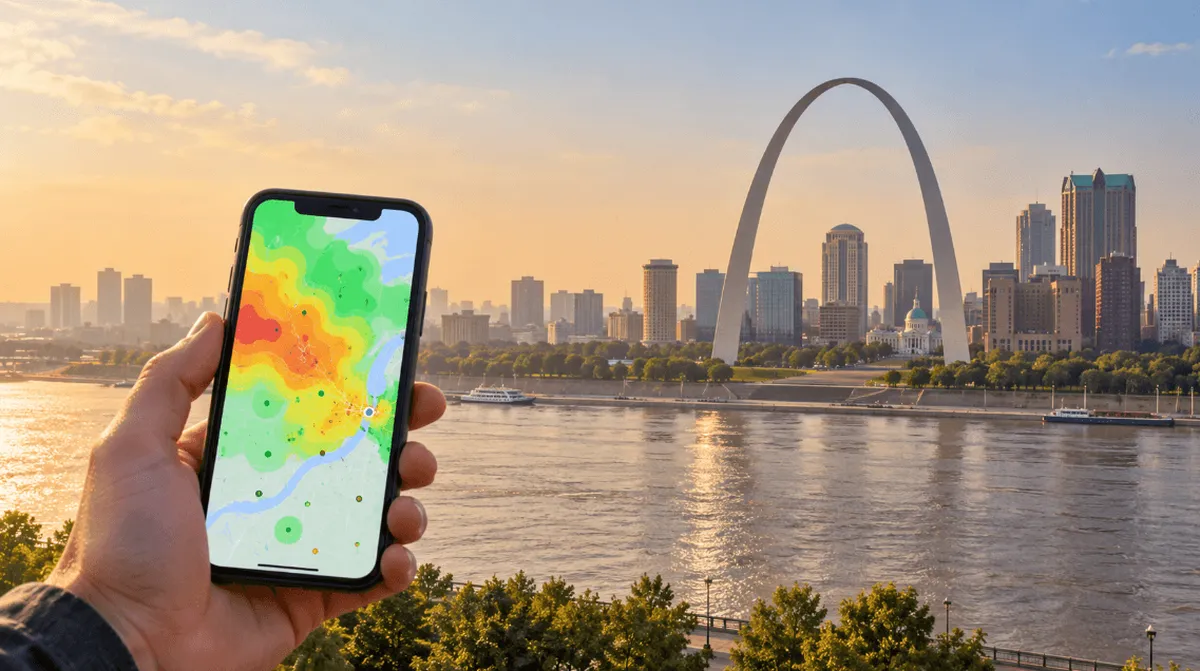
Check Today's Live Real Time Air Quality Index AQI Map in St. Louis, MO Now
TL;DR
The live map above shows the current Air Quality Index (AQI) for St. Louis, refreshed hourly from EPA AirNow. Most bad readings come from summer ozone or fine particles. At 100, where Filterbuy tells its own customers to act, close up, run a MERV 13 filter with the fan On, and add a portable HEPA cleaner in each occupied room. Homes without ducts rely on the HEPA cleaners alone.
Key Takeaways
Summer ozone and fine particle pollution (PM2.5) cause most unhealthy St. Louis readings.
At AQI 100, Filterbuy says to close up, run MERV 13 with the fan On, and add HEPA in occupied rooms.
Homes without ductwork need portable HEPA cleaners.
How to Read the Live St. Louis Air Quality Map
The live map shows the NowCast AQI, EPA’s hourly estimate from recent monitor data. At Filterbuy, we look at the pollutant before the color, because it decides the fix. On summer afternoons that is usually ozone, while smoke events and still winter mornings bring fine particles.
The scale runs from 0 to 500, as EPA’s AQI basics guide explains. A reading of 100 generally matches a pollutant’s short-term federal standard. Our guide to the AQI scale from 0 to 500 explains each band. City readings come from Missouri Department of Natural Resources (MoDNR) monitors, and the live Missouri AQI map covers the rest of the state.
What Each AQI Color Asks of St. Louis Households
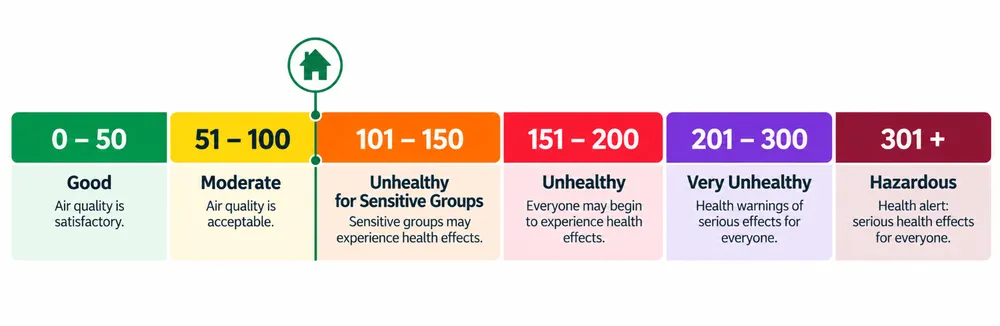
Filterbuy draws its home action line at 100. At that point, switch to MERV 13, set the fan to On, run a portable HEPA cleaner in each occupied room, and close up. That line is ours, not an EPA category change. The number 100 still tops the Moderate band.
Categories and ranges per EPA AirNow. The AQI 100 action line is a Filterbuy recommendation.
Why a St. Louis AQI Reading Can Look Off or Lag Behind
The NowCast blends recent hours, so it lags fast changes, and the headline number shows only the worst pollutant. Haze can also be smoke too high to breathe. When Filterbuy ran EPA’s formula for its explainer on how NowCast AQI averaging works, we found the number trails a plume both ways. AirNow’s wildfire guidance adds that its dial may miss smoke when ozone outranks PM2.5, so check the AirNow Fire and Smoke Map on hazy days.
“The number and your nose are answering two different questions. … On a service call during fire season I go by what the filter looks like, not what the app says.”
David Clark, Licensed HVAC Technician
Is It Safe to Breathe the Air in St. Louis Today?
Safety comes down to the live number. Most people are fine up to 100. Above it, children, older adults, outdoor workers, and anyone with asthma, COPD, or heart disease should ease off hard outdoor exertion. On orange days, run or mow early, and follow your doctor’s action plan if you have a lung or heart condition.
Where to Find the St. Louis Air Quality Forecast and Alerts
Regional alerts come from the St. Louis Clean Air Partnership, and the National Weather Service office in St. Louis relays them for St. Louis City and seven counties across Missouri and Illinois.
MoDNR runs ozone season from March 1 through October 31, and its current air quality page for St. Louis posts daily forecasts plus a link to EnviroFlash email alerts. The calendar below maps those dates.
Dates per MoDNR and Missouri's vehicle inspection program; home moves are Filterbuy recommendations.
How Air Quality Shifts Across St. Louis Neighborhoods
MoDNR’s four city monitors range from an industrial block near metal recyclers and I-70 to a residential street in south city. Blocks beside interstates and rail lines carry more particulate, as do those near industry, so check the AQI by ZIP code.
Source: MoDNR monitoring site pages.
What’s in St. Louis Air and Where It Comes From
Most St. Louis air pollution days trace back to ground-level ozone or fine particulate matter. Ozone forms when vehicle and power plant emissions react in summer sun, while PM2.5 comes from engines and industry plus wood and wildfire smoke.
The bi-state area was designated nonattainment for EPA’s 2015 ozone standard in 2018 and reclassified to Serious in 2024, a step a federal appeals court has stayed for Missouri. In August 2026, EPA finalized the Missouri clean data determination and its Illinois counterpart after setting aside event-influenced days, but the area stays nonattainment until EPA redesignates it.
How St. Louis Air Stacks Up Against Other U.S. Metros
The American Lung Association’s “State of the Air” 2026 report, covering 2022 to 2024, ranked the St. Louis metro 24th worst for ozone and 31st for year-round particles. Madison County, Illinois, drove both grades, while St. Louis City had the metro’s worst short-term particle record. Compare the Kansas City live AQI map, or the live Illinois AQI map for the Metro East.
Wildfire Smoke Days in St. Louis
Wildfire smoke is the event most likely to push St. Louis readings into the red. In late June 2023, Canadian smoke pushed parts of Missouri into the Unhealthy and Very Unhealthy ranges, and it returned with orange alerts in summer 2025.
To follow fires and smoke plumes, use Filterbuy’s live St. Louis wildfire and smoke map and its wildfire smoke and AQI guide.
What a St. Louis Air Quality Alert Means for Your Home
An orange Clean Air Partnership alert means ozone is forecast to reach levels unhealthy for sensitive groups. When smoke or PM2.5 pushes the map to 100, check AirNow and local guidance first, then take these steps:
Close windows and doors.
Install a MERV 13 air filter and set the thermostat fan to On so the system filters continuously.
Run a portable HEPA cleaner in each occupied room, bedrooms first. EPA’s cleaner air room steps call for a smoke CADR (clean air delivery rate) of at least two-thirds of the floor area, so a 300 sq ft bedroom needs about 200, plus a low-ozone model certified by the California Air Resources Board.
Skip candles and frying, and use only a HEPA vacuum.
Check the filter and replace it when it looks dark brown or black, which can be well before its normal interval. Keep spares, and see how often to change a filter when AQI is high.
St. Louis Homes Without Central Air or Ductwork
Filterbuy makes filters, so we’ll say it plainly: no ducts, no filter slot. That matters here, since St. Louis has one of the largest shares of older homes among U.S. cities, per Census estimates analyzed by Governing. In radiator or window-unit homes, a portable HEPA cleaner does the filtering instead.
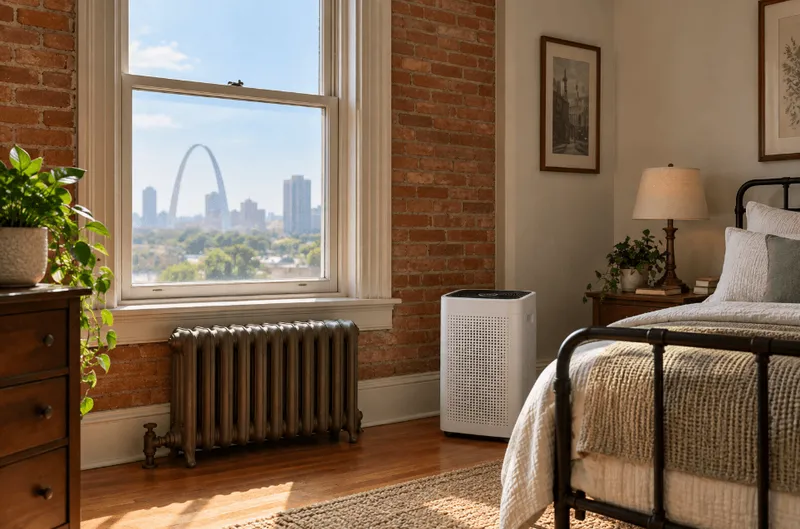
If you can buy only one unit, run it continuously in a closed-off bedroom as your cleaner air room.
Filterbuy’s Take: Ozone Days and Smoke Days Need Different Fixes
Filterbuy learned this distinction from making pleated filters. Our media captures particles, not gases, and ground-level ozone is a gas. On an ozone afternoon, closing the windows helps more than an upgrade, while on a smoke day the MERV 13 filters we make in the U.S. capture the fine particles.
“I don’t want anyone to feel like they need an HVAC license just to pick the right filter. My job is to give you the straight answer, explain why it matters, and let you get back to your day.”
Michelle Wan, Brand Manager and Air Quality Writer, Filterbuy
Which Filter the St. Louis AQI Reading Calls For
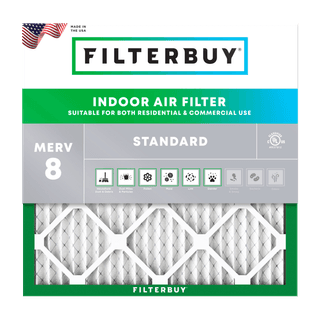
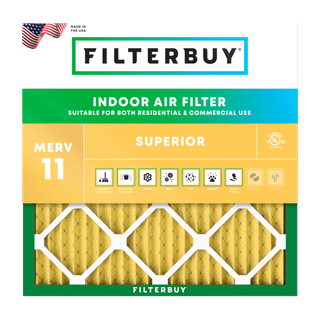
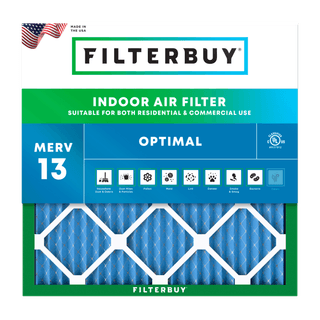
At 100 and above, use MERV 13, the tier Filterbuy recommends for smoke. Below 100, a MERV 8 air filter or MERV 11 air filter handles everyday dust and pollen.
Most HVAC systems take MERV 13 without problems when the filter is replaced often. Confirm your size first.
Fit matters as much as rating, so Filterbuy cuts custom sizes to within an eighth of an inch for the odd returns common in older St. Louis homes. EPA’s Guide to Air Cleaners in the Home notes that most furnaces and HVAC systems can run MERV 13 without problems when the filter is replaced often. Filterbuy’s guide on which MERV rating to use can help; filter auto-delivery keeps spares on hand.
Supporting Statistics
497,182 Missouri kids breathe unhealthy levels of air pollution.
Kids breathe more air for their size, so check the forecast before play.
Source: American Lung Association’s “State of the Air” 2026 report
Asthma ER visits ran 17% above expected on 2023 smoke days nationwide, with a smoke day counted from AQI 101.
Longer smoke stretches brought bigger jumps; keep a spare filter.
With doors and windows shut and no air cleaner on, indoor PM2.5 typically runs 55% to 60% of outdoor levels during smoke events.
Closing up is step one; MERV 13 and portable HEPA reduce what still gets in.
Frequently Asked Questions
Glossary
Filterbuy: A family-owned U.S. maker of pleated HVAC filters.
AQI (Air Quality Index): EPA’s 0 to 500 scale in six color-coded categories.
NowCast: EPA’s method for estimating the current AQI from recent hours.
Ozone: A gas formed when emissions react in sunlight; smog’s main ingredient.
PM2.5: Fine particulate matter 2.5 micrometers or smaller.
Nonattainment: An EPA designation for an area not meeting a federal air standard.
St. Louis Clean Air Partnership: The regional group behind St. Louis air alerts.
MERV: Minimum Efficiency Reporting Value, a filter’s particle capture rating.
HEPA: High-efficiency particulate air filter.