
Air Quality in Missouri
Air quality index (AQI⁺) and PM2.5 air pollution in Missouri •


Get Alerts For Unhealthy AQI In Your Area
When air quality in your area reaches unhealthy levels, we'll send you a quick alert, along with expert tips on how to reduce your exposure.
Live Air Quality Ratings in Missouri
Live Most Polluted City Ranking
Real-time most polluted cities in Missouri
Live Cleanest City Ranking
Real-time cleanest cities in Missouri
The Right Air Filter For High AQI Days
When outdoor air quality drops, the EPA recommends upgrading to a MERV 13 filter — or the highest-rated filter your HVAC system can handle — to help capture more of the fine particulate (PM2.5) that comes with poor air quality. MERV 13 is the highest rating most residential systems can run without restricting airflow.
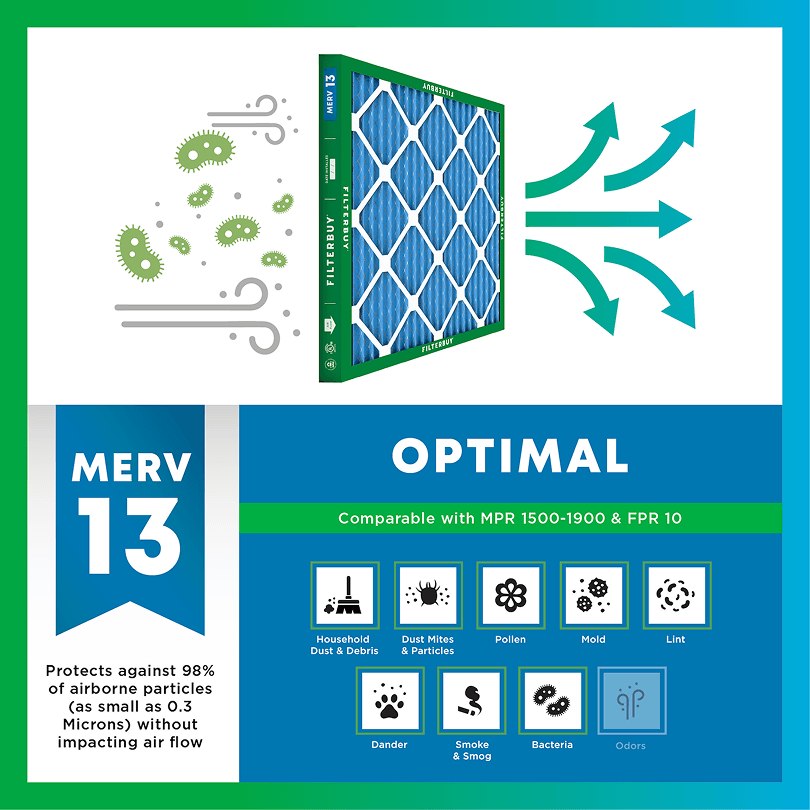

- Captures PM2.5 and other fine particulates
- Filters ash, soot, and smoke particles
- Rated to capture particles as small as 0.3 microns
- Matches the filter rating the EPA suggests during high-AQI and smoke events

AQI FAQs
What is AQI?
AQI stands for Air Quality Index, the EPA's scale for reporting daily air quality. It runs from 0 to 500. The higher the number, the greater the level of air pollution. Values at or below 100 are generally considered satisfactory; values above 100 mean air quality is unhealthy, first for sensitive groups, then for everyone as numbers climb.
What does AQI measure?
The AQI tracks five major pollutants regulated by the Clean Air Act: ground-level ozone, particle pollution (PM2.5 and PM10), carbon monoxide, sulfur dioxide, and nitrogen dioxide. The reported AQI value reflects whichever pollutant is highest at that time — most often ozone or fine particles (PM2.5).
How is AQI calculated?
Monitoring stations measure pollutant concentrations, and the EPA converts each into a standardized 0–500 score using set breakpoints. Each pollutant gets its own sub-index, and the highest sub-index becomes the reported AQI. That's why a single number can represent different pollutants on different days.
What is a good AQI?
An AQI of 0–50 is rated "Good" — air quality poses little or no risk. 51–100 is "Moderate," acceptable for most people though unusually sensitive individuals may want to limit prolonged outdoor exertion. Anything at or below 100 is generally considered satisfactory air quality.
What does an AQI of 100 (or 150) mean?
100 is the dividing line: at or below it, air quality is satisfactory for the general public. From 101–150, air is "Unhealthy for Sensitive Groups" — people with respiratory conditions, older adults, and children. From 151–200, it's "Unhealthy" and everyone may begin to feel effects.
Why is the AQI bad today?
Short-term AQI spikes usually come from wildfire smoke, temperature inversions that trap pollutants near the ground, high-ozone weather (hot, sunny, stagnant days), or heavy traffic and industrial activity. Check a real-time source like the map on this page to see which pollutant is driving today's reading in your area.
What AQI is bad for running or exercise?
Many runners follow the EPA category lines: below 50, no adjustment needed; 51–100, unusually sensitive people may shorten intense workouts; above 100, sensitive groups are advised to reduce prolonged or heavy outdoor exertion; above 150, that advice extends to everyone. Exercise increases how much air you breathe in, which is why thresholds matter more during workouts.
What AQI is safe to open windows?
A common rule of thumb is to keep windows open when the AQI is under 100 and close them when it climbs above, especially during wildfire smoke events when fine particles are elevated. When windows are closed, running your HVAC system with a fresh filter helps capture particles circulating indoors.
Should I wear a mask based on AQI?
Public health agencies generally suggest considering a well-fitted N95-style respirator outdoors when the AQI exceeds 150, particularly during smoke events. Cloth and surgical masks don't filter fine particles effectively. Follow guidance from your local health department, which may adjust recommendations during severe episodes.

Check Today's Live Real Time Air Quality Index AQI Map in Missouri Now
In the summer of 2023, smoke from Canadian wildfires drifted hundreds of miles south and smudged Missouri skies a dull brown. Readings jumped, and plenty of families learned the hard way that a clear-looking afternoon can still be a bad day to send the kids out to play. The map above takes the guesswork out of it. Check it right now, see what you and your family are breathing across Missouri today, and decide your next move before you open the door.
At Filterbuy, clean air is what we think about all day. We built this page so one glance tells you what the air is doing before your lungs do.
TL;DR Quick Answers
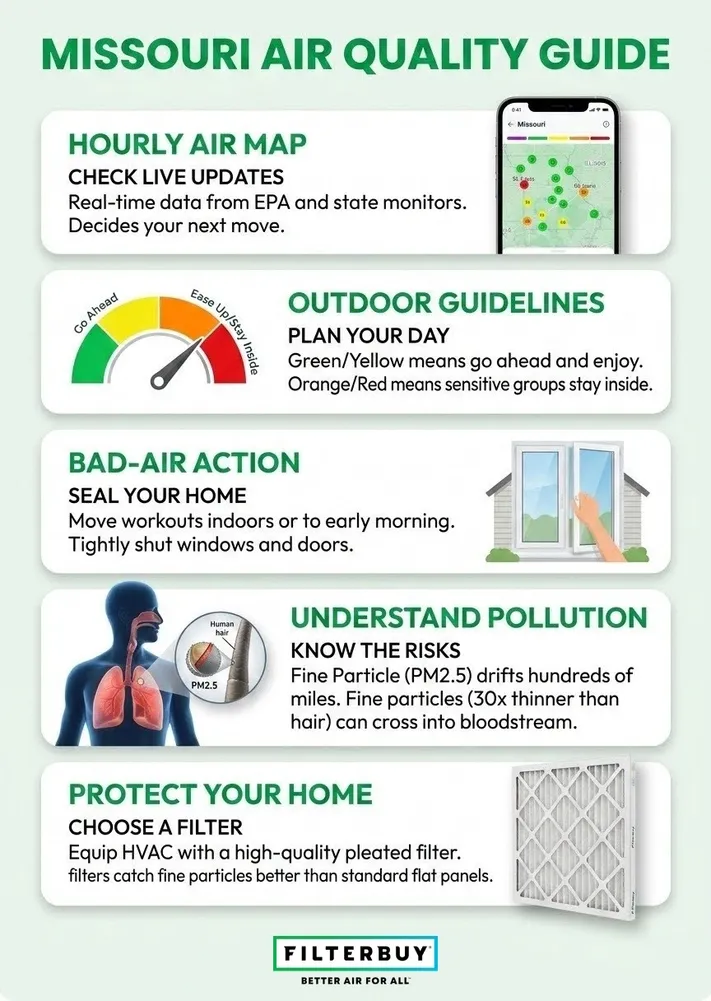
Check the map at the top of this page for current air quality in Missouri. It updates every hour.
Green or yellow, go ahead. Orange or red, sensitive groups should ease up, and higher means everyone should stay in.
Keep an eye on the PM2.5 number, especially in the summer ozone season and during wildfire smoke.
On bad-air days, stay inside, shut the windows, and run a quality filter.
Top Takeaways
The map pulls hourly readings from the EPA's AirNow network and Missouri's own state monitors.
Green or yellow means most plans are fine. Orange and up means sensitive groups should take it easy, and high readings mean everyone should.
Ozone spikes in summer heat, while fine particle pollution can climb in winter or blow in with wildfire smoke.
PM2.5 is the number to watch because those tiny particles reach deep into the lungs and bloodstream.
On bad-air days, head indoors, keep the windows shut, and run a quality filter.
How To Read The Missouri Air Quality Index Map
The reading on the map comes straight from the EPA's AirNow network, fed by monitors that the Missouri Department of Natural Resources runs across the state. It refreshes every hour. So the color you see reflects the air right now, not a stale daily average. If you want the science behind the scale, how the Air Quality Index works lays it out.
The index runs from 0 to 500 and breaks into six color-coded bands. Green and a low number mean the air is clean. As the number climbs through orange and red, the risk climbs with it, and more people start to feel it. Here is what each band means for your household.
| AQI Range | Category | What It Means For Your Family |
|---|---|---|
| 0 to 50 | Good | Air is clean. Outdoor plans are a go for everyone. |
| 51 to 100 | Moderate | Acceptable for most. People who are unusually sensitive should watch how they feel. |
| 101 to 150 | Unhealthy for Sensitive Groups | Kids, older adults, and people with asthma or heart conditions should ease up on long or intense outdoor activity. |
| 151 to 200 | Unhealthy | Anyone can start to feel the effects. Sensitive groups feel them more strongly. |
| 201 to 300 | Very Unhealthy | Health alert. Everyone should limit time outdoors. |
| 301 to 500 | Hazardous | Emergency conditions. Stay indoors with clean air whenever you can. |
What Drives Air Pollution In Missouri Today
Two pollutants drive most of what shows up on the Missouri map. Ground-level ozone is the summer troublemaker. It forms when heat and sunlight cook the emissions off traffic and industry, which is why St. Louis and Kansas City call Ozone Action Days on the hottest stretches from spring into fall.
Fine particle pollution is the other one, and it works year-round. It comes from vehicles, power generation, wood smoke, and dust, and it can settle close to the ground on cold, still winter days. It can also arrive from hundreds of miles away. We saw that in 2023, when Canadian wildfire smoke rolled across the Midwest and pushed Missouri readings into unhealthy territory under skies that looked, to most people, only a little hazy. Checking the map before you head out is how you catch a day like that.
Why PM2.5 In Missouri Matters For Your Family
When you look up the PM2.5 number for Missouri, you are looking at the pollutant that worries air quality scientists most. PM2.5 means particles 2.5 micrometers wide or smaller, roughly thirty times thinner than one of your hairs. Particles that small slip past the body's defenses, settle deep in the lungs, and can cross into the bloodstream.
That is why the EPA tightened its yearly health limit for PM2.5 to 9.0 micrograms per cubic meter in 2024. Kids, older adults, pregnant women, and anyone living with asthma, COPD, or heart disease feel it first. High particle days can leave healthy adults winded and coughing, too. The map turns that invisible risk into a number you can actually act on.
What To Do When Missouri Air Quality Turns Unhealthy
When the map turns orange or red, a few simple moves protect everyone under your roof. Push workouts and playtime to early morning, when ozone tends to run lower, or move them inside. Keep the windows and doors shut so the bad air stays out. Run your system or a portable cleaner so the air indoors keeps cycling through a good filter.
Your filter does the quiet work here. A quality pleated filter built to catch fine particles pulls far more soot and smoke out of your air than a flimsy fiberglass panel ever will, and turning one room into a clean-air space gives sensitive family members somewhere easy to breathe. If someone in your home lives with a lung or heart condition, ask their doctor for a plan that fits the worst days.

After manufacturing air filters in America for over a decade, I’ve learned that people protect what they can see. A live map gives a family in Missouri proof that the air changed today, and that proof is what gets them to close the windows and run a better filter. The map tells you the problem is real. The right filter is how you do something about it inside the four walls where your family actually spends its time.
— Filterbuy HVAC & Indoor Air Quality Specialist
Seven Essential Resources For Tracking Air Quality In Missouri
These seven sources let you go deeper than any single reading. Everyone comes from a government agency or a respected health group, and we checked each link before publishing this page.
AirNow's AQI Basics Guide. The EPA's plain-language explainer for the 0 to 500 scale and what each color means.
Missouri Department of Natural Resources Current Air Quality Readings. The state's own real-time readings and forecasts for the St. Louis, Kansas City, and Springfield areas.
The EPA's Guide to Particulate Matter Basics. What PM2.5 and PM10 are, and why the finest particles carry the most risk.
The CDC's Overview of Common Air Pollutants. How ozone and particle pollution affect health, and who feels the effects first.
NIEHS Research on Air Pollution and Your Health. The federal research institute's rundown of what science knows about long-term exposure.
The National Weather Service Air Quality Forecast Partnership. How NOAA and the EPA forecast ozone and smoke so you can plan a day or two out.
AAFA's Guidance on Air Pollution and Asthma. Practical advice for homes where someone manages asthma when the air turns bad.
Three Supporting Statistics On Air Quality And Your Health
A few numbers put today's reading in context and show why a thirty-second check is worth it.
Nearly half the country, about 152.3 million people, lives in counties that failed at least one air quality grade for ozone or particle pollution in the latest national report. Source: the American Lung Association's 2026 State of the Air report.
Cardiovascular deaths and disability tied to fine-particle pollution climbed by roughly a third worldwide between 1990 and 2019, a reminder that dirty air reaches well past the lungs. Source: American Heart Association News reporting on a global particulate pollution study.
Wildfire smoke can foul the air and cut visibility hundreds of miles from the fire itself, which is how smoke from Canadian fires has shoved Missouri readings into unhealthy ranges in recent years. Source: NOAA's reporting on wildfire smoke and air quality.
Final Thoughts On Protecting Your Family's Air In Missouri
Here is our honest take. The map is the easy part. The change your family actually feels happens at home, on the afternoon you decide to keep the windows shut and let a real filter do its job. We think every Missouri household deserves both halves of that, the knowing and the doing, because breathing cleaner air should never feel like a chore. Watch the number, trust what it tells you, and give the people under your roof a healthier place to breathe.
Your Next Steps For Cleaner Air In Missouri
Start by bookmarking this page so the map sits one tap away whenever you are planning time outside. Build the habit of checking it before a run, a ball game, or a weekend in the yard, and keep an eye on it through summer heat and wildfire season. When the number climbs, close up the house and run a quality filter sized for your system. And when you want the bigger picture beyond Missouri, you can also see the live AQI map for the entire United States.
Frequently Asked Questions
Protect Your Home's Air With Filterbuy Today
You cannot do much about the air outside, but the air inside your home is yours to control. Find the filter that fits your system at Filterbuy, and give every room cleaner air on the days Missouri needs it most. Better air for your family starts with a filter you can trust.