
Saint Paul Real-Time AQI Tracker


Get Alerts For Unhealthy AQI In Your Area
When air quality in your area reaches unhealthy levels, we'll send you a quick alert, along with expert tips on how to reduce your exposure.
What's Actually In Saint Paul Air Today?
What High AQI Means for Your Lungs in Saint Paul
How to Read AQI
The Air Quality Index (AQI) measures how polluted the air is and how it may affect your health.
0–50 (Good): Air quality is satisfactory.
51–100 (Moderate): Acceptable, but some pollutants may pose minor concerns.
101–150 (Unhealthy for Sensitive Groups)
151–200 (Unhealthy)
201–300 (Very Unhealthy)
301+ (Hazardous)
Moderate
Still okay for most, but if you have asthma or allergies, take it easy and avoid long outdoor workouts.
Shop MERV 11 filters→What's the Right Filter for Your AQI Level?

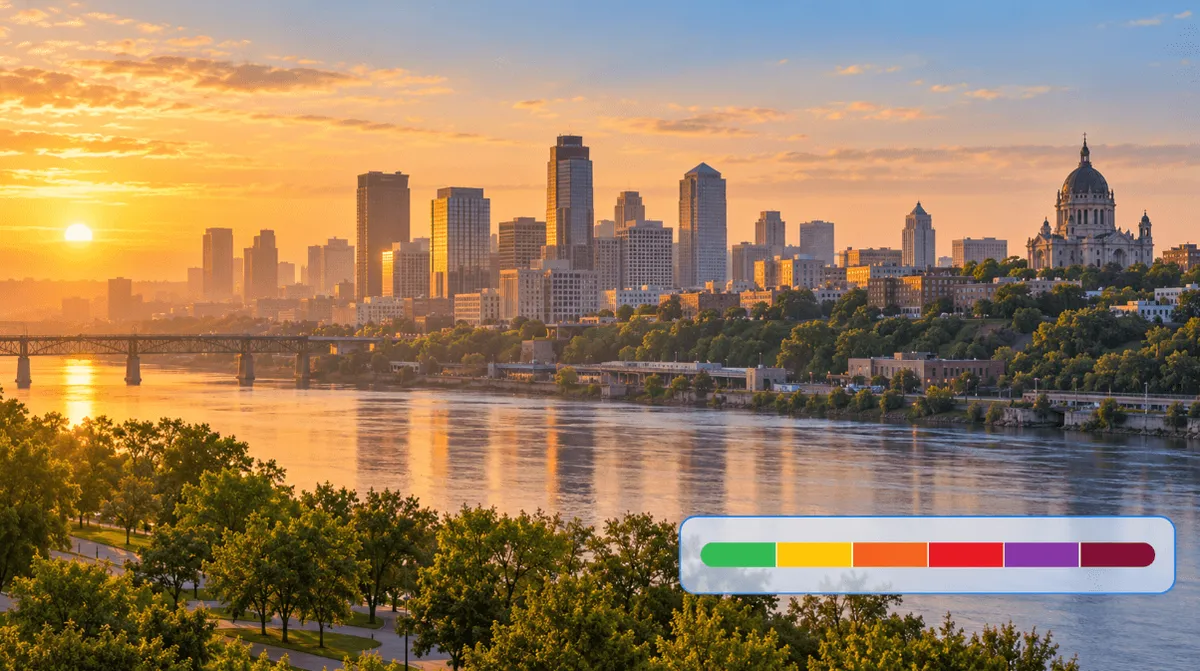
Check Today's Live Real Time Air Quality Index AQI Map in Saint Paul, MN Now
TL;DR:
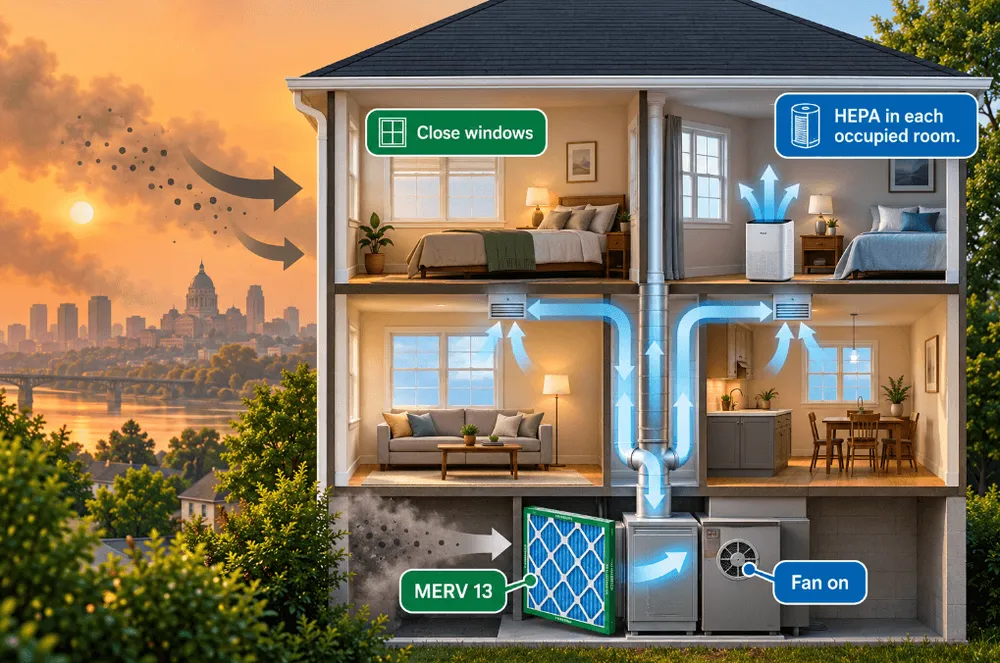
The live map above shows Saint Paul's current Air Quality Index (AQI) and the pollutant behind it. Under 50 is good. At 101 (orange), sensitive groups should ease off outdoors, and at 151 (red) everyone should. Summer smoke and winter inversions cause the biggest swings. When smoke moves in, Filterbuy's rule is to act at AQI 100: MERV 13 in the HVAC, the fan set to On, a portable HEPA air cleaner in each occupied room, and the house closed up.
At Filterbuy, we build pleated HVAC filters in our own U.S. plants and publish live air quality pages for cities across the country. Nearby, compare our Minneapolis AQI map, Minnesota air quality map, or live AQI map for every U.S. city.
How to Read Saint Paul's Live AQI Map Right Now
Look at four things on the map:
Color gives the health category at a glance.
Number shows how far into that category the air is.
Pollutant tells you what to do. Ground-level ozone breaks down quickly indoors, while fine particles (PM2.5) linger until something filters them out.
Timestamp shows how fresh the reading is.
Why the Saint Paul AQI Can Lag Behind What You See
The "current" AQI comes from the EPA's NowCast, which weights up to 12 hours of PM2.5 readings. When Filterbuy ran the EPA formula on a modeled smoke event, NowCast read 42 points low as the plume arrived and 79 points high as it cleared. If it looks hazy but the map shows yellow, trust the hourly PM2.5 trend (more on why AirNow and IQAir rarely match).
Key Takeaways
Orange (101+) on Saint Paul's live map means sensitive groups should cut back.
Smoke causes the worst days; the metro first hit hazardous on July 16, 2026.
At AQI 100, Filterbuy recommends MERV 13 in the HVAC plus a portable HEPA air cleaner in each occupied room.
What Each AQI Color Means for Your Day in Saint Paul
At 101 or higher, at least one pollutant has crossed the national health standard. Filterbuy draws its action line one point earlier, at AQI 100, the top of Moderate. From there, we tell customers to put a MERV 13 filter in the HVAC, set the thermostat fan to On, run a portable HEPA air cleaner in each occupied room (bedrooms first), and close the house up: windows shut, no candles, frying, or smoking indoors.
| AQI | Category | Who should take care | What to do in Saint Paul |
|---|---|---|---|
| 0–50 | Good (green) | No one | Normal routine; enjoy the river trails. |
| 51–100 | Moderate (yellow) | Unusually sensitive people | Install MERV 13 before smoke; keep spares. |
| 101–150 | Unhealthy for Sensitive Groups (orange) | Kids, older adults, pregnant people, people with heart or lung disease | MERV 13, fan On, HEPA in occupied rooms, house closed. |
| 151–200 | Unhealthy (red) | Everyone | Same steps; check the filter more often. |
| 201–300 | Very Unhealthy (purple) | Everyone | Follow AirNow and MPCA guidance; use a clean room. Filtration is one layer. |
| 301+ | Hazardous (maroon) | Everyone | Follow official guidance first, including any order to relocate. |
Category thresholds follow the EPA's AirNow AQI basics.
Thresholds follow the EPA's AirNow AQI basics. For chest tightness or trouble breathing, call your healthcare provider, or 911 in an emergency.
Is the Air Safe to Breathe in Saint Paul Today?
Green and yellow readings are safe for nearly everyone. At orange, sensitive groups should adjust plans; from red up, the Minnesota Pollution Control Agency (MPCA) advises everyone to cut outdoor exertion. If officials tell you to stay in or leave, follow AirNow and MPCA guidance first. With asthma, COPD, or a heart condition, follow your doctor's plan.
What Drives Air Pollution in Saint Paul
Most bad-air days here come down to PM2.5 and ozone. Minnesota did not meet federal PM2.5 standards in 2025 and is close to the ozone limit, largely because of smoke and drought. Each pollutant follows a season.
Filterbuy's Saint Paul Air Quality Calendar: What to Expect and When
| Season | Main driver | Typical pattern | What to do |
|---|---|---|---|
| Winter | Fine particles trapped by inversions | Worst on calm, cold mornings | Fresh furnace filter; no wood fires on alert days |
| March to October | Ground-level ozone | Hot, still afternoons (MPCA ozone forecast season) | Exercise in the morning |
| Late May to August | Wildfire smoke | Multi-day events (2025 had three) | MERV 13 in by May; spares on hand |
| Year-round | Traffic and industry | Higher near I-94, I-35E, and Frogtown | Check the sensor closest to home |
Compiled by Filterbuy from MPCA forecast seasons and Minnesota DNR smoke records.
Winter inversions. Calm, cold nights hold exhaust and wood smoke low. In January 2023, that gave the Twin Cities its worst winter air quality since December 2005. Neighbor's chimney? See our guide to wood smoke from a neighbor's stove.
Traffic corridors. I-94 and I-35E cut through the Midway, Frogtown, Rondo, and downtown. The MPCA found that air quality varies across urban neighborhoods, and low-income residents and people of color more often live where levels run higher.
Industry. Frogtown, an environmental justice area, got a particulate and lead monitor near St. Paul Brass and Aluminum in June 2025, and MPCA-funded and AIRNET sensors now track metals and traffic across Saint Paul.
Wildfire Smoke: Saint Paul's Biggest Bad-Air Risk
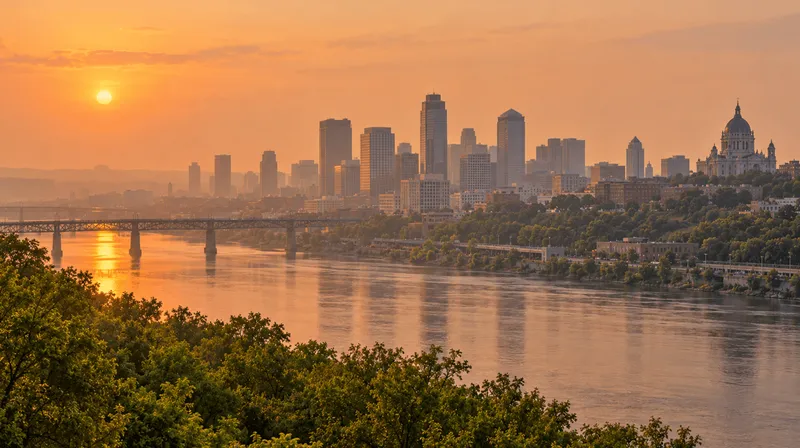
Smoke from Canada and northern Minnesota now causes the worst days.
| Date | What happened in the Twin Cities |
|---|---|
| July 16, 2026 | First "hazardous" (maroon) day on record for the metro; AQI topped 300 (Minnesota Reformer) |
| Summer 2025 | The "Great Minnesota Smokeout," likely the smokiest year in 50+ years (MN DNR) |
| June 14, 2023 | Worst air quality in the country; nearly 50 alerts that year (Minnesota Reformer) |
| January 2023 | Worst winter air since December 2005 (MPR News) |
| 2021 | Smoke pushed parts of Minnesota past AQI 200 for the first time (Minnesota Reformer) |
Sources: Minnesota Reformer (July 17, 2026); Minnesota DNR; MPR News.
Bad years now arrive closer together and escalate fast. On July 15, 2026, Twin Cities alerts climbed from unhealthy to hazardous in a single day, so get the filter in place before an alert goes out.
What a Minnesota Air Quality Alert Means for Your Day
The MPCA issues an alert when it expects orange or worse. Get MPCA forecasts and alerts by email, text, or the AirNow app, or call a forecaster at 651-757-2766. During an alert, skip wood fires and gas yard tools.
What Filterbuy Sees From the Filter Side in Saint Paul
Making filters shapes how we read Saint Paul's numbers:
Two bad-air seasons share one filter slot. Smoke arrives in AC season and inversions in furnace season, so one filter works year-round.
Older houses let more smoke in. EPA says older homes keep outdoor pollution out less effectively, and about 41% of Saint Paul homes were built before 1940.
Preparation matters more than reaction. A filter ordered the morning of an alert arrives after the smoke.
Which Filter Saint Paul's AQI Level Calls For
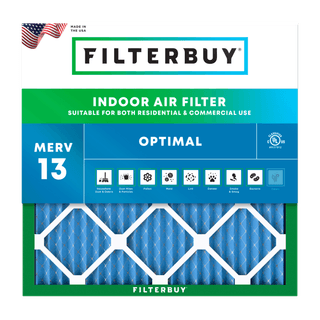
The EPA recommends a filter rated MERV 13 or higher in a central HVAC system during smoke events. It also notes that most furnaces and HVAC systems can accommodate MERV 13 without equipment problems, provided the filter is replaced frequently.
| What the map shows | Our recommendation |
|---|---|
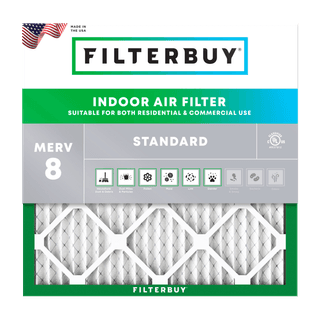
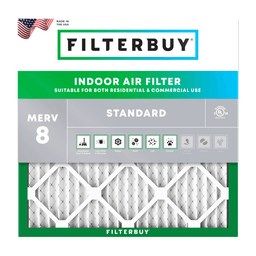
| Mostly green and yellow | MERV 8 handles everyday dust and pollen. |
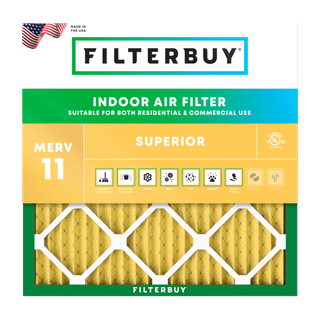
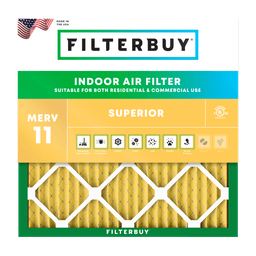
| Allergies or pets at home | MERV 11 traps more fine particles and suits most home systems. |
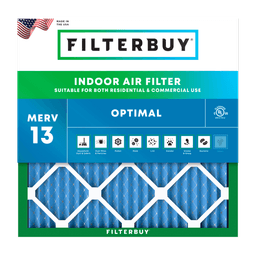
| Smoke in the air, or AQI 100 and above | MERV 13 is the tier Filterbuy recommends for smoke. |
MERV 13 is recommended as a tier; order it in your current filter size.
Fit it like any filter. Order the size printed on your current filter.
Inspect it during smoke. Replace the filter when it looks dark brown or black, which can be well before the normal interval, and keep spares on hand.
See our best MERV filter for wildfire smoke guide. Filterbuy makes MERV 8, MERV 11, and MERV 13 filters in 600+ sizes in the USA and ships them free, with optional auto-delivery.
No Ducts? Many Older Saint Paul Homes Need a Different Plan
Many of Saint Paul's prewar homes (NeighborhoodScout housing data) heat with boilers and radiators. Without ducts there is no filter slot, so portable HEPA air cleaners are your primary defense. We'd rather say so than sell you a filter you can't use.
A portable HEPA air cleaner in each occupied room, bedrooms first. The EPA sizing rule is a smoke CADR of at least two-thirds of the room's square footage, so a 300 sq ft bedroom needs roughly 200. Skip ionizers and ozone generators, since the EPA advises against cleaners that produce ozone.
An EPA-tested DIY box-fan air cleaner: a certified 20-inch box fan from 2012 or newer with a 20x20 MERV 13 filter on the back. Never leave it running unattended. It's a stopgap, not a replacement for a certified air cleaner.
A Corsi-Rosenthal box with four MERV 13 filters, if you want more airflow.
Supporting Statistics
Air pollution played a role in 1 in 10 Twin Cities deaths.
In 2015, that meant roughly 1,600 deaths.
Nearly 500 heart and lung hospital and ER visits were also linked.
Source: Minnesota Dept. of Health and MPCA, Life and Breath: Metro
The Minneapolis-St. Paul metro ranks 39th worst in the U.S. for short-term particle pollution.
It earned an F.
Hennepin County averaged 4.5 unhealthy particle days a year from 2022 to 2024.
Statewide, 723,418 children breathe unhealthy air.
Source: American Lung Association, State of the Air 2026: Minnesota
A closed-up house still lets smoke in.
With windows closed and no air cleaner, indoor smoke typically runs 55% to 60% of outdoor levels.
That share ranges from 30% to 100%, depending on the home.
Newer and air-conditioned homes keep smoke out better than older ones.
Source: U.S. EPA, Strategies to Reduce Exposure Indoors
Frequently Asked Questions
What is the air quality in Saint Paul today?
The live map at the top of this page shows Saint Paul's current AQI and main pollutant, updated throughout the day.
Is the air quality bad in Saint Paul today?
Orange (101 or higher) means unhealthy for sensitive groups. Red (151 or higher) means unhealthy for everyone.
What MERV rating do I need for wildfire smoke in Saint Paul?
MERV 13. The EPA recommends MERV 13 or higher in a central HVAC system during smoke events. Filterbuy tells customers to make the switch once the AQI reaches 100.
Where can I see Saint Paul PM2.5 levels right now?
The live map lists PM2.5 when it leads. For station readings, use the MPCA's Air Quality Index tool or our guide to using the EPA AirNow tool.
When is it safe to open windows after smoke in Saint Paul?
Not the moment the map turns green. Filterbuy's NowCast modeling shows the AQI can read high for hours after smoke clears. Once the hourly PM2.5 trend drops, air out the house, as the EPA advises.
Glossary
AQI (Air Quality Index): The EPA's 0 to 500 air pollution scale.
PM2.5: Fine particles 2.5 micrometers or smaller, found in smoke and soot.
Ozone: A gas that forms when sunlight reacts with exhaust.
NowCast: The EPA's method for estimating current AQI from recent hours.
Temperature inversion: Warm air over cold air that traps pollution near the ground.
MPCA: Minnesota Pollution Control Agency, the state air regulator.
MERV: Minimum Efficiency Reporting Value, a 1 to 16 filter rating.
HEPA: High-efficiency particulate air filtration for portable air cleaners, not HVAC systems; see MERV 13 vs. HEPA.
Air quality alert: An MPCA notice that orange or worse is forecast.