
How To Build A Corsi-Rosenthal Box DIY Air Purifier With MERV 13 Filters For Wildfire Smoke: A Step-By-Step Guide
July 16, 2026
By Michelle Wan, Brand Manager & Air Quality Writer, Filterbuy
Reviewed for technical accuracy by David Clark, Licensed HVAC Technician, Filterbuy, who checked every claim below on MERV ratings, airflow, and box fan safety.
Published July 16, 2026 | Updated July 16, 2026
Disclosure: Filterbuy manufactures and sells the MERV 13 air filters this build uses. We have tried to be straight with you about where a DIY box wins and where it does not, including the cases where you should not build one at all.
How to Build a Corsi-Rosenthal Box for Wildfire Smoke
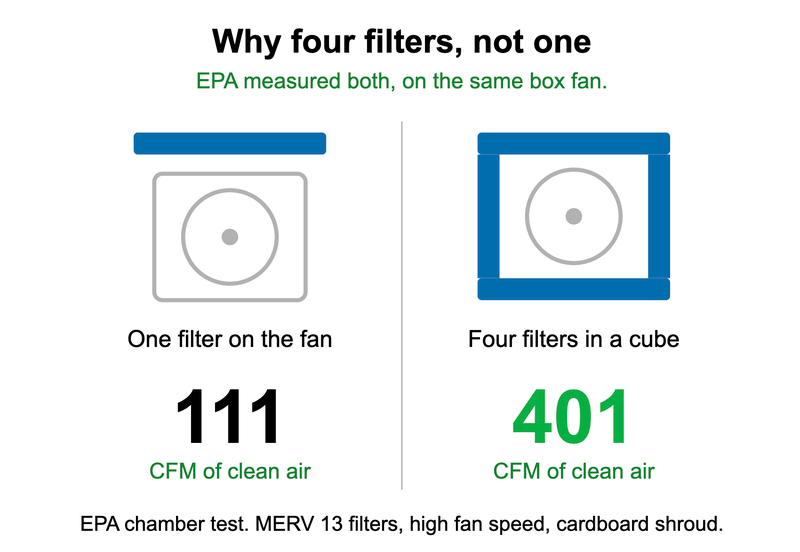
A Corsi-Rosenthal box is four MERV 13 filters taped into a cube with a 20-inch box fan on top, blowing up and out. It takes about 20 minutes to build and $60 to $85 in parts, with no tools past a box cutter. MERV 13 is the rating that captures microscopic particles, and using four filter faces instead of one is the whole idea: EPA measured 401 CFM of clean air from the cube, against 111 CFM from a single filter on the same fan.
EPA tested five designs, and the cube is not always the right one:
Four-filter cube, 401 CFM. The default, for a standard bedroom or living room.
Two-filter wedge, 263 CFM. A middle ground that stands against a wall.
One 4-inch filter, 248 CFM. For small rooms that cannot fit a cube.
Central HVAC? Build nothing. A MERV 13 filter in the return covers the whole house instead of one room.
Not sure which setup your home actually needs? Answer a few quick questions and we will point you to the right one.
TL;DR
A Corsi-Rosenthal box is a DIY air cleaner you build from a 20-inch box fan, four MERV 13 furnace filters, cardboard, and duct tape, for about $70 in parts and 20 minutes of work. It pulls smoky air through four filter faces at once and blows clean air out the top, and published testing shows a well-built one moves clean air at rates competitive with portable purifiers costing several times as much. EPA treats it as a temporary option when a commercial air cleaner is not available or affordable, not a permanent replacement for one.
Key Takeaways
The build is four MERV 13 filters taped into a cube with a box fan on top, airflow arrows pointing inward. Materials run roughly $60-$85 and assembly takes about 20 minutes with no tools beyond a box cutter.
MERV 13 is the floor, not a preference. Wildfire smoke is dominated by fine PM2.5 particles, and EPA specifically recommends MERV 13 for a DIY air cleaner because the MERV rating strongly drives how much clean air the box actually delivers. Dropping to MERV 11 cut EPA's measured clean air delivery by 43%.
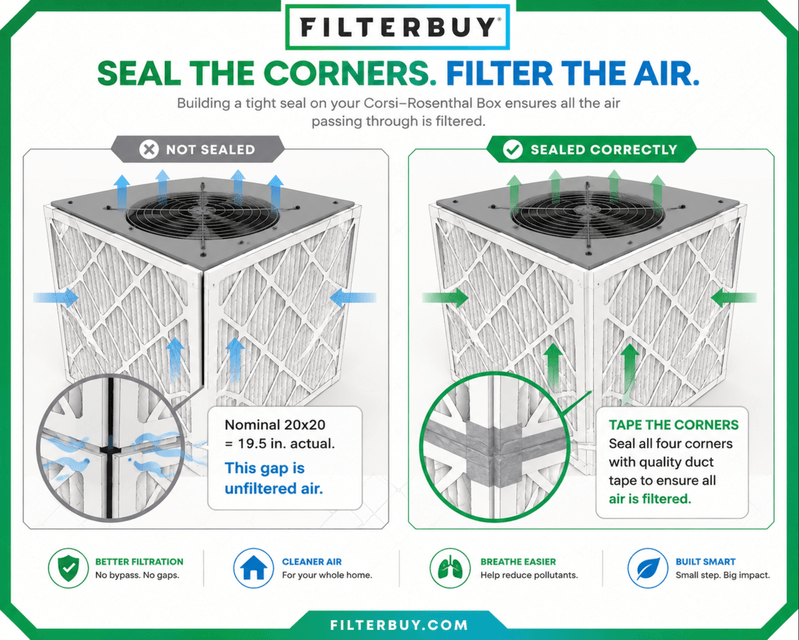
Nominal filter sizes lie, and the gap costs you performance. A "20x20" filter measures about 19.5 inches on a side. Four of them under a 20-inch fan leaves a bypass gap at every seam unless you tape it shut, or size up.
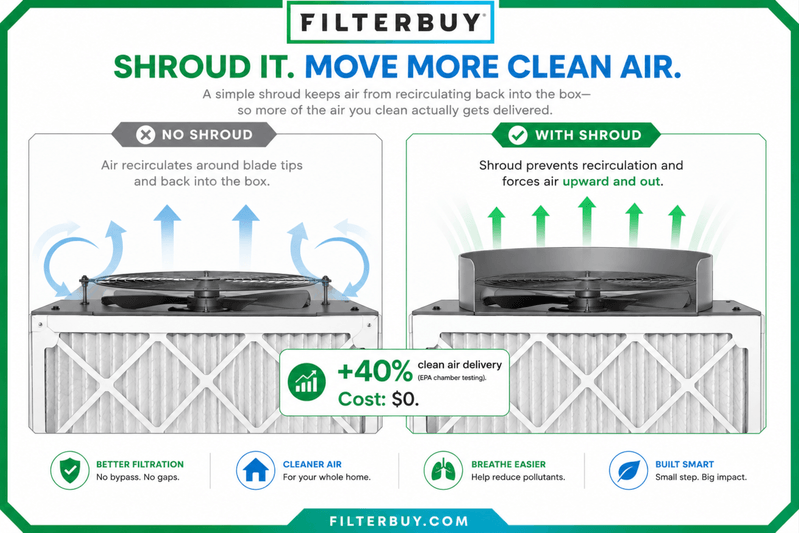
The cardboard shroud is free and it is not optional. In EPA chamber testing, adding a shroud raised clean air delivery from 111 to 156 CFM, a 40% gain at zero cost.
Dirty filters do not just perform worse, they stop working. EPA measured a smoke-loaded filter at 4.3 CFM, down from 111 CFM clean, and the airflow through it barely changed. Check filters daily during a smoke event.
EPA's position is narrower than the internet suggests. EPA treats DIY air cleaners as a stopgap for when commercial units are not available or affordable, not a permanent substitute.
In A Hurry, With Smoke Outside Right Now?
This page is long because the topic has more in it than four filters and some tape. You do not need all of it today.
Buy this: a 20-inch box fan from 2012 or newer, four 20x20 MERV 13 filters, duct tape. The full list is the next section.
Build it: nine steps, about twenty minutes, no tools past a box cutter.
Then do one thing most guides never tell you: look at the filters every day the air is bad, and change them the moment they turn grey or smell like smoke. A smoke-loaded filter keeps blowing air and stops cleaning it.
Everything else here is the why, and it will keep until the air clears.
Why This Guide Comes From A Filter Company
Most Corsi-Rosenthal guides are written by people who have read about filters. We make them. Filterbuy has manufactured air filters in the USA since 2013, out of our factories in Alabama, Florida, Pennsylvania, and Utah, in more than 600 sizes plus custom cuts. That is not a credential we are waving at you. It is the reason this guide contains three things you will not find on the other results for this search.
We can tell you what the filters actually measure, because we cut them. Nominal sizes are rounded. The real numbers are further down, and they are the single most common reason a home-built box underperforms.
We will tell you when not to build one. We sell the filters either way. That frees us to say plainly that if you have central HVAC, a MERV 13 in the return beats a box in one room.
We read the test data rather than quoting the headline. The famous "600 to 850 CFM" figure is real, and it is also the best case from one specific build. We lay the studies side by side instead.
Our point of view, in one line: a Corsi-Rosenthal box is not a clever hack. It is a filter-area problem solved with duct tape, and the two things that decide whether yours works are the seams you tape and the day you change the filters.
I do not want anyone to feel like they need an HVAC license just to pick the right filter. My job is to give you the straight answer, explain why it matters, and let you get back to your day.
Michelle Wan
Brand Manager & Air Quality Writer, Filterbuy
What You Need To Build A Corsi-Rosenthal Box
Everything on this list is available at a hardware store or ships to your door. Total cost runs roughly $60-$85 depending on filter thickness.
Total: roughly $60–$85. Prices are typical U.S. retail as of July 2026.
A note on the fan: the 2012 cutoff is not arbitrary. EPA advises using certified fans from 2012 or newer because those models add fused plugs and thermal cutoffs, and states plainly that fans built before 2012 were not tested and pose known fire risks. If you must use an older one, do not run it unattended or while sleeping.
What Is A Corsi-Rosenthal Box, And Who Invented It?
A Corsi-Rosenthal box is an open-source DIY air cleaner made from a box fan and four or five high-efficiency furnace filters taped into a cube. Air gets pulled in through all four filter faces at once and pushed out the top through the fan. There is no proprietary technology in it. The whole idea is that the design is free and the parts are ordinary.
It came out of the early COVID period. Richard Corsi, an indoor air quality researcher who is now Dean of the College of Engineering at UC Davis, proposed the multi-filter concept publicly. Jim Rosenthal, CEO of the Texas filter manufacturer Tex-Air Filters, built and tested the first prototype in August 2020 and named it after Corsi. UC Davis publishes a build walkthrough Corsi filmed himself, which is worth watching if you like seeing a thing done by the person who thought of it. The Corsi-Rosenthal Foundation keeps free build instructions and classroom lesson plans.
The reason it works is not magic, it is arithmetic. A single filter taped to a box fan chokes the fan, because one filter face is a lot of resistance for a fan designed to blow through open air. Four faces spread that same airflow across four times the media. The fan breathes easier, moves far more air, and cleans a room much faster. That is the entire insight.
What Size Filters Do You Need For A Corsi-Rosenthal Box?
Use four 20x20 MERV 13 filters with a 20-inch box fan. But here is the part almost every guide skips: a filter labeled "20x20x1" is not 20 inches. Nominal sizes are rounded. A Filterbuy 20x20x1 MERV 13 actually measures 19.50 x 19.50 x 0.75 inches. The 20x20x2 measures 19.50 x 19.50 x 1.75. That half-inch gap per side is where unfiltered smoky air sneaks past your filters, and it is the difference between a box that works and a box that mostly makes noise.
This is the part of the build where being a manufacturer stops being a talking point and starts being useful. We know the real numbers because they are our numbers: a Filterbuy 20x20x1 MERV 13 leaves our line at 19.50 x 19.50 x 0.75 inches. That is not a defect, and it is not us cutting corners. Nominal sizing is an industry-wide convention that exists so a filter slides into a slot instead of jamming in it. It is only a problem when you stop putting filters in slots and start building cubes out of them.
Here is what actually fits. If your fan needs a size nobody stocks, we cut filters to custom dimensions, which is the one fix on this page that only a manufacturer can offer you.
Actual dimensions are Filterbuy MERV 13 specifications. Nominal sizes are rounded, so the filter you receive is smaller than the label. That gap is where unfiltered air gets past the media.
On thickness: thicker filters have more media, more media means less resistance, and less resistance means more air moves. EPA chamber testing found that swapping a 1-inch filter for a 4-inch filter on a basic single-filter DIY cleaner raised clean air delivery from 111 to 248 CFM, a 123% gain and a bigger jump than almost any other single change. On a four-filter cube the effect is smaller because you have already solved most of the resistance problem, but 2 inches still beats 1.
On MERV: do not drop below 13. EPA measured a 43% drop in clean air delivery just from swapping a MERV 13 for a MERV 11, with no change in power or noise, because the MERV 11 standard requires only 20% efficiency on particles under 1 micron and wildfire smoke averages around 0.3 microns. Rutgers researchers found a MERV 13 box beat the same box in MERV 8 by 71%, for about 41% more filter cost. If the ratings are new to you, we compare MERV ratings in plain English.
The Part Of The Filter Nobody Thinks About Until The Cube Sags
In a furnace, a filter frame does one job: hold the media still while air goes through it. In a Corsi-Rosenthal box, the frames are the building. Four of them carry a box fan on top, take the tape, and hold square while that fan pulls through them continuously for weeks.
Richard Corsi makes the point himself in the UC Davis walkthrough: when the cube is built right, it does not flex. That is not a cosmetic standard. A frame that bows pulls its own taped seam open, and an open seam is unfiltered air taking the easy route into your fan.
So whatever you buy, look at the frame before the tape comes out:
Beverage board, not thin chipboard. Filterbuy MERV 13 filters use beverage board frames built to resist warping and to hold up to temperatures around 200°F. We build them that way because a filter lives in a hot return. It happens to be the same property that keeps a cube square through August.
Wire backing. Our pleats carry dual wire backing that keeps them evenly spaced under airflow. In a furnace that stops the pleats collapsing on themselves. In your cube it does the same job against a fan that is pulling harder than any furnace return.
Squareness. Set the filters on a flat floor before you tape. If one rocks, it will fight you for the whole build.
We are not going to tell you another brand's filter will not work. Plenty will. We are telling you that in this build the frame stops being packaging and becomes structure, and that is worth thirty seconds of attention before you commit it to duct tape.
Which Design Should You Actually Build?
Almost every guide on this topic, including the first draft of this one, assumes you want the cube. EPA tested five designs, not one, and the cube is not always the right answer.
We are a filter company recommending, in three of the five rows below, that you buy fewer filters than the cube needs. Read that as the point rather than the fine print.
All figures are EPA chamber measurements of simulated wildfire smoke at high fan speed (Holder et al., 2022). Three of these five rows tell you to build something smaller than a cube, or nothing at all. That is deliberate.
If you have central heat and air, start there. A MERV 13 in the return covers the whole house. A box covers one room. Build the box for the bedroom on top of that, not instead of it.
If floor space is the constraint, build the 4-inch single. EPA suggests exactly this for small areas that cannot accommodate a multi-filter design, and it reached 248 CFM, which is more than twice the basic build.
If you want it quiet, build the cube and then run it slow. This is the part that gets missed. EPA notes that the cube's operating cost may be lower than a single-filter unit because the extra filter area lets a lower fan setting clean the same space. More filters buys you more airflow. It also buys you the same airflow at a lower fan speed, which is the version you can sleep next to.
That last point matters more than it sounds. In EPA's field work on the Hoopa Valley Indian Reservation, fan noise was a barrier to people actually using their air cleaners, and the agency concluded that quiet, unobtrusive designs are the ones that get used. A box switched off at bedtime has a clean air delivery rate of zero. Build the one you will leave running.
How To Build A Corsi-Rosenthal Box, Step By Step
About 20 minutes. No tools beyond a box cutter.
Unwrap the filters and find the airflow arrow. Every filter has an arrow printed on the frame showing which way air is supposed to move through it. Check each filter for dents or torn media before you start. A damaged filter is a bypass path.
Stand two filters up, arrows pointing inward, and tape the vertical seam. Get the edges butted together as tightly as you can before the tape goes on. Keep the pleats vertical.
Add the third and fourth filters the same way and close the cube. All four arrows point in toward the center. You now have an open-topped, open-bottomed box.
Tape every seam, inside corners included. This is the step people rush and regret. Any gap you leave is air that reaches the fan without ever passing through filter media. Run tape the full length of each seam. When you are done the cube should feel rigid. If it flexes, you missed a seam.
Cut a cardboard floor and tape it on. Use the fan's shipping box. The floor seals the bottom so the fan can only pull air through the filters.
Cut the shroud. Trace the fan's blade circle onto a square of cardboard the size of the fan face, then cut out just the circle. The leftover cardboard ring is your shroud. It covers the dead corners of the fan face, where air would otherwise circulate back around the blade tips instead of leaving the box.
Set the fan on top, blowing up and out, and tape it down. The arrow on the fan face should point away from the box. Air in through the sides, out through the top. Tape the shroud on the fan's outlet side, then tape the fan to the cube around its full perimeter.
Check your work with a tissue. Hold a tissue against each filter face with the fan running. It should pull flat against the media. Then run it around the seams and the fan edge. Any spot where the tissue flutters or gets pushed instead of pulled is a leak. Tape it.
Run it on high, three feet from any wall. Center of the room is best. High speed moves the most air. If the noise is too much at night, low speed still works, it just works slower.
On the shroud specifically: it is free and it matters more than it looks. EPA testing measured clean air delivery rising from 111 to 156 CFM, a 40% increase, with no change in cost or footprint. Nothing else on this page costs zero dollars and buys 40%. Corsi covers the same trick in his UC Davis build walkthrough, where he also notes the gap that opens between the filters and the fan and patches it with scrap cardboard.
Does A Corsi-Rosenthal Box Actually Work On Wildfire Smoke?
Yes, and the honest answer is more interesting than the number you will see quoted.
Search this topic and you will be told a Corsi-Rosenthal box delivers "600 to 850 CFM." That figure is real. It is also one study's result, for one specific build, measured one specific way, and it is the number every page repeats because it is the biggest one available.
We went and read the studies instead. Published figures for this design span roughly 111 to 850 CFM. They disagree because the studies measured different things, not because anyone got it wrong. Nobody else on this search result puts them side by side, so here they are.
Figures are as published by each study. The spread reflects filter count, thickness, fan speed, shroud, the particle size measured, and the CADR method used, not disagreement about whether the design works. EPA notes that method differences alone can move a reported CADR by 1.5 to 3 times.
What to take from this: a well-built four- or five-filter box with MERV 13 media, running on high with a shroud, delivers somewhere in the several-hundred-CFM range for the fine particles that make up wildfire smoke. That is genuinely competitive with portable air cleaners costing several times more. When EPA costed the designs, the CR box delivered the cheapest clean air of anything tested, about 18 cents per unit of CADR against roughly $1.03 for the small commercial cleaner they benchmarked. In that chamber, the CR box pulled PM2.5 from 80 down to under 10 micrograms per cubic meter in about six minutes.
But if a page quotes you 850 CFM without telling you it came from a five-filter build measured for 1.2-micron particles, it is selling you the best-case number. Your box, built from four filters in your living room, will land lower. That is still a lot of clean air. EPA reached the same conclusion reviewing the literature: reported CADRs for DIY cleaners span 49 to 825 CFM, and the measurement method alone can shift the answer by 1.5 to 3 times.
Filterbuy bench test. Build three boxes (4x 20x20x1, 4x 20x20x2, 4x 21x21x2), each with and without a shroud. Measure PM2.5 decay in a sealed room against a calibrated reference monitor and compute CADR from the decay slope. Publish the table, the methodology, and build photos. This is the asset that makes this page the only source of this data, and the only thing that earns the word "Tested" in the title. Owner: Michelle Wan + David Clark.
Supporting Statistics
Three numbers make the case better than any argument we could write. Each comes from a U.S. government agency or a U.S. non-profit. Each is linked, so you can check it yourself.
Figures are quoted as published. The American Lung Association grades counties using EPA monitoring data; its 2026 edition covers 2022 through 2024.
What If It Is Too Hot To Close The Windows?
This guide has spent 1,500 words telling you to seal the house. There is a situation where that is the wrong advice, and no other build guide we found mentions it.
Closing up the house to keep smoke out also keeps heat in. EPA states the trade-off plainly: in climates where central air is less common, shutting doors and windows during a smoke event traps heat indoors, and households end up choosing between excessive heat exposure and smoke exposure. Fire season and heat season are the same season. That is not a coincidence you can design around with duct tape.
No air conditioning, and it is too warm to stay inside with the windows shut? EPA's guidance is to seek shelter somewhere else. A library, a mall, a cleaner air shelter. That is not the box failing. That is you making the right call.
The pattern that works without AC: close the windows and coverings during the day and run the box. At night, when it is cooler outside, open up and vent the heat. Once the air indoors is cool, close up again and let the box work.
For a long heat event, where nights stay warm or humidity is high, EPA suggests leaving the area or buying an affordable air conditioning unit. A box fan and four filters is not a plan for that week.
We would rather say this out loud than sell you filters for a house you should not be sitting in. Your Corsi-Rosenthal box does not cool anything. It never did. It moves a lot of air, which can feel like cooling, but the air it is moving is the same temperature as the room. If the choice is a sealed 95-degree house with clean air or a cooler building down the road, go down the road, and take the box with you if you can.
Is A Box Fan Air Cleaner A Fire Hazard?
Testing says no, when it is built right with a modern fan. In 2021, UL's Chemical Insights Research Institute, working with EPA, tested five commercial box fan models running the basic DIY design: with clean filters, with filters loaded with smoke and dust, and in a deliberately extreme scenario where both sides of the fan were blocked for seven straight hours. Fire ignition was not achieved in any scenario. Every measured temperature stayed below the limits set by UL 507, the safety standard for electric fans, and the exterior surfaces people actually touch stayed below 36 °C, well under the 47.5 °C threshold for a first-degree burn.
That is a reassuring result, and UL stacked the deck against itself to get it: they tested a single filter, which loads the fan harder than a four-filter cube does. The result still comes with conditions. Follow all of them.
Use a box fan from 2012 or newer with a UL or ETL certification mark. Newer models include fused plugs and thermal cutoffs. EPA is explicit that fans built before 2012 were not tested and pose known fire risks, and that if you use one anyway, you should not leave it unattended or run it while you sleep.
Do not run it on an extension cord. Plug directly into a wall outlet.
Do not use a damaged or malfunctioning fan. No frayed cords, no rattling blades.
Make sure your smoke detectors work. All of them, throughout the house.
Do not leave children unattended around it, and follow the fan manufacturer's instructions, which supersede anything on this page.
Replace dirty filters. Loaded filters are a performance problem before they are anything else, but they are also the condition you least want to leave running for weeks unattended.
The fans are fine. It is the filter people forget. I would rather someone run a 2012 fan with a filter they change than a new fan with a filter they never look at.
David Clark
Licensed HVAC Technician, Filterbuy
How Often Should You Change The Filters?
During an active smoke event, check the filters daily. EPA says that outright, and the reason is the most surprising number in the research.
In EPA's chamber testing, a box fan with a clean MERV 13 filter delivered 111 CFM of clean air. The same setup with a smoke-loaded filter delivered 4.3 CFM. Not 40% worse. Effectively zero.
This is the finding that should change how you think about the box. The smoke-loaded filter was not clogged. EPA measured the airflow through it as largely unchanged, and the pressure drop barely moved: 0.29 inches of water versus 0.27 for a clean filter. The filter carried only about 10 milligrams of smoke. It still stopped working. The researchers attribute this to the electrostatic media: fresh smoke particles carry an electrical charge, and as they deposit they neutralize the charge that was doing the capturing. So the fan still blows. The box still sounds like it is working. It just is not cleaning the air any more. You cannot judge a smoke-loaded filter by feel or by airflow. Judge it by color and smell.
EPA's guidance during smoke events follows directly from that: keep extra filters on hand, check the filter daily during a smoke event, and change it when it looks dark brown or grey or smells like smoke.
Dust behaves differently, which is worth knowing. EPA's dust-loaded filter carried roughly 5,000 times more mass than the smoke-loaded one and still delivered 22.9 CFM. That one really was clogged. Smoke destroys a filter's effectiveness long before it clogs it, which is exactly why smoke-season filter changes cannot run on your normal dust-season schedule.
We want to be straight about where that reading comes from. We did not run that experiment. EPA did, and we have linked it. What we are adding is the practical translation, and we think it is the most important sentence on this page: the test you would naturally use to check your box is the one test that will lie to you. Every instinct says hold your hand up and feel the airflow. Airflow is exactly what a smoke-killed filter preserves. Ninety days of manufacturing intuition about pressure drop is no help here either, which is why we are pointing it out rather than assuming you would work it out.
Practical rules from our side of the business:
Buy your replacements before fire season, not during it. When smoke arrives, filters vanish from shelves. That scarcity is precisely the problem the Corsi-Rosenthal box was invented to solve.
If you can smell smoke coming off the box, the filters are done. A filter that is releasing odor stopped working a while ago.
Do not use airflow as your test. As above, a dead smoke-loaded filter still passes air. Look at it instead.
Outside of smoke events, Filterbuy MERV 13 filters are built for about 90 days of normal HVAC duty. A Corsi-Rosenthal box during a smoke event is not normal duty. Treat 90 days as an outer limit for clean-air months, not a target during fire season.
Set up auto-delivery if you would rather not think about it. Fire season is a bad time to be improvising.
What A Fire Season Actually Costs
Every page about this box quotes the build price. About $65, about $75, a tenth of a HEPA purifier. All true, and all describing a single afternoon.
Nobody costs the season. So we did, and the arithmetic is not flattering to us.
Power draw and weekly operating cost are EPA figures (Holder et al., 2022, at 23.58 cents per kWh). Filter counts assume a heavy season with two to three full changes, at an assumed $12 to $15 per filter in a multi-pack. Confirm current pricing before publishing. EPA's published cost comparison excludes replacement filters entirely, which is exactly why the widely quoted per-CADR figures look so low.
The filters cost roughly twice what the box did. That is the whole finding, and it reframes every cost comparison on this topic. EPA priced the CR box at about 18 cents per unit of clean air, against roughly a dollar for the small commercial unit it tested, and that gap is real. It is also, by EPA's explicit admission, a figure that leaves out the price of replacement filters. The famous ratios, ours included, are build-day numbers.
The honest comparison is filters against filters. A commercial purifier needs its cartridges replaced too, and they usually cost more than a furnace filter. The box still wins. It just wins by less than the internet says.
The cube may stretch its filters further than a single-filter build. EPA reasons that multi-filter designs should last longer because the same air is spread across four faces instead of one. The agency is careful to call this a supposition that needs confirming, and so are we.
Buy the season, not the box. If you are building this in July, you will need more filters in August. A multi-pack is cheaper per filter and, more usefully, means you have them when the sky turns orange rather than when the shelves are already bare. Filterbuy auto-delivery exists for exactly this problem, and we would rather you use it than discover in September that your box has been running on dead media since Labor Day.
Yes, we sell the recurring cost. We are aware of how it reads for a filter company to point out that you will need more filters. The alternative is letting you build a box in July, run it on dead media by September, and conclude the design does not work. It works. It just is not free after the first afternoon, and you deserved to know that before you started rather than after.
Corsi-Rosenthal Box Vs HVAC Filter Vs Commercial Air Purifier
We make air filters, and this section costs us money. We would still rather be the page you trust than the page that sold you four filters you did not need.
EPA positions DIY air cleaners as a temporary alternative, not a permanent replacement for a commercial portable air cleaner.
Two things worth being blunt about.
First, EPA does not treat the Corsi-Rosenthal box as a permanent replacement for a commercial air cleaner, and neither should you. EPA frames it this way: performance depends on the design and how well it is put together, that two builds of the same design can perform differently, and that commercial units are more standardized and therefore more reliably characterised. The DIY box is a brilliant answer to a supply-and-cost problem. It is not a better product.
Second, if you have central heating and air, the highest-leverage move is not building anything. It is putting a MERV 13 filter in the return and setting the system fan to "On" instead of "Auto" so it filters continuously. That covers your whole house instead of one room, and it is the setup we walk through in how to keep wildfire smoke out of your house. Check with an HVAC technician if your system is old or has known airflow issues before going above MERV 8. If you are weighing the room-unit question too, we cover MERV 13 vs HEPA for wildfire smoke separately. The Corsi-Rosenthal box is the right answer for the bedroom you actually sleep in, or for a home with no ductwork at all. Best case, you do both.
Check your local AQI now to see what your household is dealing with today, and the AirNow Fire and Smoke Map for active fires and smoke plumes.
What Size Room Will One Box Handle?
The simplest rule comes from the Association of Home Appliance Manufacturers, which EPA points to: match the CADR number to the room's square footage. A 400 CFM box, roughly what EPA measured for a four-filter build, suits a room of about 400 square feet. For a fuller picture, air changes per hour tells you how fast the box actually turns the room over.
ACH = (CADR x 60) divided by room volume. Researchers generally treat 4–5 air changes per hour as strong protection. Clean air delivery from two boxes adds together, so two units in a large room roughly double the air changes.
Five Mistakes That Quietly Ruin A Build
Untaped seams, and the flexing frames that open them. The most common failure by a wide margin. Air takes the easy path, and a quarter-inch gap is much easier than filter media. Half the seams we would expect to fail do not fail at taping. They fail a week later, when a soft frame bows and quietly pulls the seam apart behind the tape.
Skipping the shroud. It is cardboard you already own, and EPA measured roughly 40% more clean air with it. There is no argument for skipping it.
Arrows pointing out. Filter media is directional. Backwards arrows mean you are filtering on the wrong side of the pleat.
Using MERV 8 because it was on sale. You would be building a dust box. Smoke is fine particulate. MERV 8 lets it through.
Building it once and forgetting it. The box you built in June is not the box you have in September. Loaded filters approach uselessness.
Still open, and only a human can close it: build one. The mistakes above are drawn from EPA's findings and from what we know about how our filters behave, not from a Filterbuy build. That is a real gap. One afternoon, one box, one honest paragraph about what went wrong, and this section stops being informed analysis and starts being first-hand experience. Owner: Michelle Wan.
Frequently Asked Questions
Does a Corsi-Rosenthal box work for wildfire smoke?
Yes. Wildfire smoke is dominated by fine PM2.5 particles, and MERV 13 filters are rated to capture them. EPA states that multiple studies indicate well-built DIY air cleaners can be comparable in effectiveness to commercial air cleaners for reducing airborne particles like those in wildfire smoke, with the caveat that performance depends on the design and the quality of assembly.
How many filters does a Corsi-Rosenthal box need, four or five?
Four is the standard cube. Five-filter versions add a filter as the floor instead of cardboard, which adds a fifth intake face. The UC Davis study that produced the widely quoted 600-850 CFM figure used five 2-inch filters. Four is easier, cheaper, and plenty.
What size filters do I need for a Corsi-Rosenthal box?
Four 20x20 MERV 13 filters for a 20-inch box fan. Remember that "20x20" is a nominal label. The filter actually measures about 19.5 inches per side, so tape your seams carefully or size up.
Is a Corsi-Rosenthal box as good as a HEPA purifier?
For clean air per dollar, it usually wins by a wide margin. MERV 13 media captures a smaller share of the very smallest particles on each pass than HEPA does, but the box moves so much more air that it makes up ground on repeated passes. What HEPA units give you that a DIY box cannot is consistency, lab verification, and quiet.
Is it a fire hazard?
UL and EPA tested five box fan models in the basic DIY configuration, including with both sides blocked for seven hours, and component temperatures stayed below recognized safety limits with no burn or fire risk in any tested condition. Use a certified fan from 2012 or newer, skip the extension cord, and keep working smoke detectors.
How much does a Corsi-Rosenthal box cost to build?
About $60-$85 in 2026: roughly $20-$30 for the fan, $35-$55 for four MERV 13 filters, and a few dollars for duct tape. Corsi puts the materials at about $65 in his UC Davis walkthrough.
Can I use MERV 11 instead of MERV 13?
You can, but you should not for smoke. EPA specifically recommends MERV 13 for a DIY air cleaner because the MERV rating strongly influences clean air delivery, and smoke's fine particles are exactly what lower ratings miss.
How loud is it?
Loud. UC Davis measured 58 dB on low and 67 dB on high, roughly conversation-level at low and closer to a vacuum at high. Low speed still cleans, just more slowly. Many people run it on high while they are out and drop it to low at bedtime. Worth knowing: EPA notes the cube can often run at a lower fan setting than a single-filter build and still clean the same space, because the extra filter area does the work the fan speed would otherwise have to.
How much does it cost to run?
About $1.00 a week. EPA measured the CR box at 76 watts and costed it at 8 hours a day, 7 days a week, at 23.58 cents per kWh. Over a May-to-October fire season that is roughly $26 of electricity. The filters, not the power, are what a season actually costs you.
Do I have to build the four-filter cube?
No, and for some homes you should not. EPA measured a single 4-inch filter with a shroud at 248 CFM and specifically suggests that design for small rooms that cannot fit a cube. A two-filter wedge reached 263 CFM. And if you have central HVAC, a MERV 13 in the return covers the whole house rather than one room. The cube is the best clean air per dollar EPA measured, but best on average is not the same as best for you.
It is too hot to keep the windows closed. What now?
Take the heat seriously. EPA is explicit that sealing a house against smoke traps heat, and that households without air conditioning can end up trading smoke exposure for heat exposure. If it is too warm to stay inside with the windows shut, EPA advises seeking shelter elsewhere. Without AC, the workable pattern is to close up and run the box during the day, vent at night when it is cooler, then close up again. A box fan and four filters does not cool a room.
Glossary
Corsi-Rosenthal box (CR box) - An open-source DIY air cleaner built from a box fan and four or five high-efficiency furnace filters taped into a cube. Named for indoor air researcher Richard Corsi, who proposed the multi-filter concept, and Jim Rosenthal of Tex-Air Filters, who built the first prototype in 2020.
MERV (Minimum Efficiency Reporting Value) - The 1-16 scale defined by ANSI/ASHRAE Standard 52.2 that rates how effectively an air filter captures particles of given sizes. Higher numbers capture more, and smaller, particles.
MERV 13 - The filter rating EPA recommends for DIY air cleaners intended to remove wildfire smoke. Filterbuy MERV 13 filters are rated to capture 98% of airborne particles and are comparable to MPR 1900 and FPR 10.
CADR (Clean Air Delivery Rate) - Cubic feet per minute of particle-free air an air cleaner delivers. It combines airflow and filtration efficiency into one number. The standard AHAM method tops out at 450 CFM, which is why several Corsi-Rosenthal studies used custom room-decay methods instead.
PM2.5 - Fine particulate matter 2.5 micrometers in diameter or smaller. The dominant health-relevant component of wildfire smoke, and small enough to reach deep into the lungs.
ACH (Air Changes per Hour) - How many times per hour a room's full air volume is filtered or replaced. Roughly: CADR x 60 divided by room volume.
Shroud - A cardboard ring taped over the fan's outlet that blocks the dead corners past the blade tips, preventing air from recirculating around the blades. In EPA testing it raised clean air delivery about 40% at no cost.
Nominal vs actual size - Filter sizes are labeled in rounded nominal numbers. A nominal 20x20x1 filter physically measures about 19.5 x 19.5 x 0.75 inches. The difference is where DIY builds leak.
Filter loading - The accumulation of captured particles in filter media over time. Loading raises resistance and cuts airflow. EPA found heavily loaded DIY cleaners were almost completely ineffective.
EPA Wildfire ASPIRE Study - Advancing Science Partnerships for Indoor Reductions of Smoke Exposures. The EPA Office of Research and Development study program that produced much of the DIY air cleaner safety and effectiveness research cited on this page.
Electret (electrostatic) filter media - Filter media carrying a permanent electrical charge that pulls particles onto the fibers, letting a filter capture fine particles without packing the media so tightly that airflow suffers. Most MERV 13 residential filters, Filterbuy's included, use it. It is also why a smoke-loaded filter can stop working while still passing air: charged smoke particles neutralize the charge as they deposit.
Wedge design - A two-filter DIY air cleaner in which the filters lean together into a triangle against the fan, rather than forming a full cube. EPA measured it at 263 CFM, between the single-filter build and the four-filter box.
Beverage board frame - A dense, moisture-resistant paperboard used for filter frames instead of thin chipboard. It resists warping and holds up to temperatures around 200 degrees Fahrenheit, which matters in a hot furnace return and, in a Corsi-Rosenthal box, keeps the cube square.
Dual wire backing - A metal mesh bonded behind the pleats that keeps them evenly spaced under airflow instead of letting them collapse together, which would cut the usable media area.
AHAM (Association of Home Appliance Manufacturers) - The U.S. trade body whose AC-1 protocol is the standard method for certifying an air cleaner's CADR. AHAM's rule of thumb, which EPA points to, is to match the CADR number to the room's square footage.
UL 507 - The Standard for Safety: Electric Fans, the market safety standard UL tested these box fans against. Every temperature measured in the DIY air cleaner testing fell below its limits.
Infiltration - Outdoor air, and whatever it is carrying, leaking into a building through gaps, cracks, windows, and doors. During a smoke event EPA puts indoor PM2.5 at roughly 55 to 60 percent of outdoor levels with the house closed up, which is infiltration at work.
Sources
Every figure on this page traces to one of these. All links verified July 16, 2026.
U.S. EPA, Research on DIY Air Cleaners to Reduce Wildfire Smoke Indoors - the CADR-by-design table, safety tips, and EPA's FAQ.
U.S. EPA, Wildfires and Indoor Air Quality (IAQ) - the stopgap caveat and box fan safety rules.
U.S. EPA, Create a Clean Room to Protect Indoor Air Quality During a Wildfire.
U.S. EPA, Do-It-Yourself Air Cleaners: Making Cleaner Air More Accessible.
U.S. EPA, DIY Air Cleaner to Reduce Wildfire Smoke Indoors infographic (PDF).
Holder, A. L., Halliday, H. S., & Virtaranta, L. (2022). Impact of do-it-yourself air cleaner design on the reduction of simulated wildfire smoke in a controlled chamber environment. Indoor Air, 32(11), e13163. EPA Office of Research and Development. Open access.
Dal Porto, R., Kunz, M. N., Pistochini, T., Corsi, R. L., & Cappa, C. D. (2022). Characterizing the performance of a do-it-yourself (DIY) box fan air filter. Aerosol Science and Technology, 56(6), 564-572.
Baratta, A., Han, T. T., & Mainelis, G. (2025). Not all boxes are equal: parameters affecting PM2.5 particle removal by the Corsi-Rosenthal box. Rutgers University.
Chemical Insights Research Institute of UL (2021). Wildfire Safety Research: An Evaluation of DIY Air Filtration (PDF).
Zeng, Y., Heidarinejad, M., & Stephens, B. (2021). Portable Air Cleaner Test Report: Corsi-Rosenthal Box Fan Air Cleaner with MERV 13 Filters (PDF). Illinois Institute of Technology.
UC Davis College of Engineering, Science in Action: How to Build a Corsi-Rosenthal Box, by Richard L. Corsi.
AirNow Fire and Smoke Map - live fire and smoke conditions, run by EPA and the U.S. Forest Service.
U.S. EPA, Strategies to Reduce Exposure Indoors, from the clinician course Wildfire Smoke and Your Patients' Health - the 55-60% indoor infiltration figure (Barn et al. 2008; Xiang et al. 2021) and the 56%/99% real-home DIY result (May et al. 2021).
American Lung Association, State of the Air 2026: Key Findings - 61.5 million people in counties graded F for short-term particle pollution. 27th annual edition, built on EPA monitoring data for 2022-2024.
U.S. EPA, Wildland Fire Research: Reducing Exposures - the ASPIRE field studies and the 2020 National Emissions Inventory estimate that wildland fires produced 52% of U.S. PM2.5.
ANSI/ASHRAE Standard 52.2 (MERV definitions) and AHAM AC-1 (the CADR test method).
About the author and reviewer
Michelle Wan, Author
is Brand Manager and Air Quality Writer at Filterbuy, where she turns MERV ratings, filtration, and HVAC efficiency into plain-English advice for homeowners, and fronts much of the brand's educational video content (B.A., University of California, Santa Cruz). She works directly with Filterbuy's U.S. manufacturing teams in Alabama, Florida, Pennsylvania, and Utah. Learn more on her author page.
David Clark, Reviewer, Licensed HVAC Technician
This article was technically reviewed by David Clark, a Licensed HVAC Technician, who verified this guide's claims on MERV ratings, airflow, filter compatibility, and box fan safety.
Published by Filterbuy, an American air-filtration company that has manufactured HVAC filters in the U.S. for over a decade and shipped them to millions of households.