
Air Quality in Minnesota
Air quality index (AQI⁺) and PM2.5 air pollution in Minnesota •


Get Alerts For Unhealthy AQI In Your Area
When air quality in your area reaches unhealthy levels, we'll send you a quick alert, along with expert tips on how to reduce your exposure.
Live Air Quality Ratings in Minnesota
Live Most Polluted City Ranking
Real-time most polluted cities in Minnesota
Live Cleanest City Ranking
Real-time cleanest cities in Minnesota
The Right Air Filter For High AQI Days
When outdoor air quality drops, the EPA recommends upgrading to a MERV 13 filter — or the highest-rated filter your HVAC system can handle — to help capture more of the fine particulate (PM2.5) that comes with poor air quality. MERV 13 is the highest rating most residential systems can run without restricting airflow.
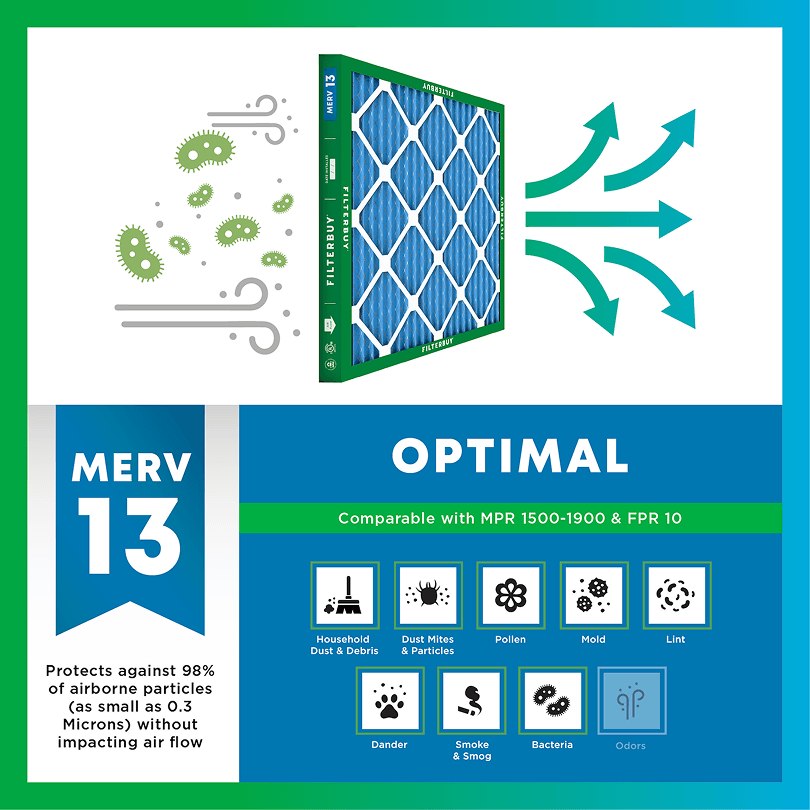
- Captures PM2.5 and other fine particulates
- Filters ash, soot, and smoke particles
- Rated to capture particles as small as 0.3 microns
- Matches the filter rating the EPA suggests during high-AQI and smoke events

AQI FAQs
What is AQI?
AQI stands for Air Quality Index, the EPA's scale for reporting daily air quality. It runs from 0 to 500. The higher the number, the greater the level of air pollution. Values at or below 100 are generally considered satisfactory; values above 100 mean air quality is unhealthy, first for sensitive groups, then for everyone as numbers climb.
What does AQI measure?
The AQI tracks five major pollutants regulated by the Clean Air Act: ground-level ozone, particle pollution (PM2.5 and PM10), carbon monoxide, sulfur dioxide, and nitrogen dioxide. The reported AQI value reflects whichever pollutant is highest at that time — most often ozone or fine particles (PM2.5).
How is AQI calculated?
Monitoring stations measure pollutant concentrations, and the EPA converts each into a standardized 0–500 score using set breakpoints. Each pollutant gets its own sub-index, and the highest sub-index becomes the reported AQI. That's why a single number can represent different pollutants on different days.
What is a good AQI?
An AQI of 0–50 is rated "Good" — air quality poses little or no risk. 51–100 is "Moderate," acceptable for most people though unusually sensitive individuals may want to limit prolonged outdoor exertion. Anything at or below 100 is generally considered satisfactory air quality.
What does an AQI of 100 (or 150) mean?
100 is the dividing line: at or below it, air quality is satisfactory for the general public. From 101–150, air is "Unhealthy for Sensitive Groups" — people with respiratory conditions, older adults, and children. From 151–200, it's "Unhealthy" and everyone may begin to feel effects.
Why is the AQI bad today?
Short-term AQI spikes usually come from wildfire smoke, temperature inversions that trap pollutants near the ground, high-ozone weather (hot, sunny, stagnant days), or heavy traffic and industrial activity. Check a real-time source like the map on this page to see which pollutant is driving today's reading in your area.
What AQI is bad for running or exercise?
Many runners follow the EPA category lines: below 50, no adjustment needed; 51–100, unusually sensitive people may shorten intense workouts; above 100, sensitive groups are advised to reduce prolonged or heavy outdoor exertion; above 150, that advice extends to everyone. Exercise increases how much air you breathe in, which is why thresholds matter more during workouts.
What AQI is safe to open windows?
A common rule of thumb is to keep windows open when the AQI is under 100 and close them when it climbs above, especially during wildfire smoke events when fine particles are elevated. When windows are closed, running your HVAC system with a fresh filter helps capture particles circulating indoors.
Should I wear a mask based on AQI?
Public health agencies generally suggest considering a well-fitted N95-style respirator outdoors when the AQI exceeds 150, particularly during smoke events. Cloth and surgical masks don't filter fine particles effectively. Follow guidance from your local health department, which may adjust recommendations during severe episodes.

Check Today's Live Real Time Air Quality Index AQI Map in Minnesota Now
By Michelle Wan, Brand Manager & Air Quality Writer | Filterbuy · Reviewed by David Clark, Licensed HVAC Technician · Published July 5, 2026 · Updated July 5, 2026
Minnesota's live air quality index (AQI) map below shows real-time conditions across the state, pulled from EPA AirNow and Minnesota Pollution Control Agency (MPCA) monitors. Minnesota's air is usually good, but fine-particle pollution (PM2.5) from Canadian wildfire smoke and summer ozone can push the AQI into unhealthy ranges within hours, especially May through October. Check the map, note your local number, and if it climbs above 100, limit time outdoors and run a MERV 13 filter to protect the air inside your home.
Right now in Minnesota: Use the live map above to find the current AQI for your city. The color and number tell you how clean the air is this moment and whether sensitive groups (kids, older adults, and anyone with asthma or heart disease) should take it easy outside today. Numbers update throughout the day, so it's worth a quick look before a run, a game, or opening the windows. The part most air quality maps skip, and the reason we built this page, is simple: that outdoor number quietly sets the quality of the air inside your home too. As a U.S. filter manufacturer, that's the half of the story Filterbuy knows best.
Key Takeaways
Minnesota's AQI is driven mainly by two pollutants: fine particles (PM2.5), largely from Canadian wildfire smoke, and ground-level ozone in hot summer weather.
AQI runs 0–500 on a six-color scale. At or below 100 is generally satisfactory; above 100 the air is unhealthy first for sensitive groups, then for everyone as the number climbs.
Wildfire smoke can change Minnesota's air fast. The MPCA forecasts an active season for summer 2026 with conditions similar to 2024, expecting roughly 12–16 days of wildfire smoke impacts statewide.
Outdoor AQI is only half the story. Smoke and fine particles seep indoors, where Americans spend about 90% of their time, so protecting your indoor air matters just as much.
A MERV 13 HVAC filter is the EPA-backed indoor move for capturing much of the fine particle pollution that wildfire smoke drives into your home.
How Do I Read Minnesota's Live AQI Map Right Now?
Find your city on the live map above and read two things: the number and the color. The number is the air quality index, a 0–500 scale where lower is cleaner. The color, from green to maroon, is a fast visual cue for how healthy the air is at that monitor this moment. Minnesota's map pulls from EPA AirNow and MPCA monitoring stations, so it reflects official readings, not estimates.
One thing we've learned at Filterbuy, from years of helping homeowners through smoke season: the number usually climbs before the sky looks any different. Faint haze and a slightly “off” smell can trail the actual reading by hours, so on questionable days, trust the map over your eyes.
Each reading also names a dominant pollutant, usually PM2.5 (fine particles) or ozone in Minnesota. That label matters, because the two behave differently. PM2.5 spikes with wildfire smoke and can arrive any time of day; ozone builds on hot, sunny, stagnant afternoons. When you know which one is driving today's number, you know when conditions are likely to improve.
Air quality also varies a lot within Minnesota. A smoke plume drifting down from Saskatchewan or Manitoba can leave Duluth and the Iron Range in the orange while the Twin Cities and Rochester stay green, or the reverse a day later. Always read the monitor closest to you rather than a statewide average.
What Counts as a “Good” AQI in Minnesota Today?
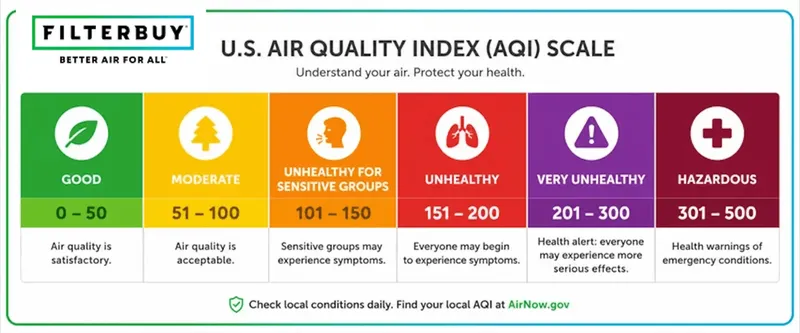
An AQI at or below 50 is “Good” (green) and safe for everyone. From 51–100 the air is “Moderate” (yellow), fine for most people, though unusually sensitive individuals may notice symptoms. Once the AQI passes 100, the air is officially unhealthy: first for sensitive groups (orange), then for the whole population as the number rises. This scale is set by the U.S. EPA and used on every reading in the map above.
The table below shows the six official U.S. AQI categories. Note the EPA tightened the fine-particle scale in May 2024, so the top of the “Good” range now corresponds to a lower PM2.5 concentration (9.0 µg/m³) than it did before, so you may see more yellow “Moderate” readings than in past years for the same air.
Source: U.S. EPA / AirNow, U.S. Air Quality Index (2024 update).
New to the index? Our complete guide to what the Air Quality Index (AQI) is decodes every color category, and you can check your local AQI right now any time. The six-category scale itself is set by the U.S. EPA and AirNow.
What's Actually in Minnesota's Air?
Minnesota's air quality problems come mostly from two sources: fine-particle pollution (PM2.5) from wildfire smoke, and ground-level ozone on hot summer days. On a typical day the state's air is clean, but both pollutants can push the AQI up quickly and are the reason the MPCA issues air quality alerts, which it does whenever the index is forecast to exceed 101.
Wildfire smoke is Minnesota's biggest air quality wildcard. Smoke from fires in Saskatchewan, Manitoba, and Ontario regularly drifts south into the state, carrying PM2.5, particles small enough to reach deep into the lungs and bloodstream. In its summer 2026 air quality outlook, the MPCA predicts an active season similar to 2024, with 12 to 16 days of wildfire smoke impacts expected statewide. MPCA meteorologist Matt Taraldsen has urged residents to stay “air-aware,” since conditions are lining up for several alert days.
Ozone is the summer afternoon problem. Unlike smoke, ground-level ozone forms when heat and sunlight cook pollutants from traffic and industry. It peaks on hot, stagnant days, usually in the afternoon, and eases overnight. It's a common secondary driver of Minnesota's summer AQI alerts.
The table below breaks down what tends to drive Minnesota's air quality season by season, an at-a-glance planner you won't find on a generic national map.
Minnesota-specific synthesis by Filterbuy, based on MPCA alert history and EPA AirNow monitoring.
For a deeper look at the pollutant behind most alerts, read our guide to what PM2.5 is and why fine particles matter.
How to Read Minnesota's Air Quality Where You Live
A single statewide number hides a lot. Minnesota is big, and the same afternoon can read green in Rochester and orange on the North Shore. This section helps you make your local number actually mean something, and tell what kind of bad-air day you're having.
Air Quality by Region
After more than a decade of shipping filters into every corner of the state, this is how we at Filterbuy see Minnesota's air break down region by region:
Twin Cities metro. The busiest roads and the most people put the metro at Minnesota's worst grades for both short-term particle pollution and ozone, per the American Lung Association. Watch your reading before rush hour and on hot, still afternoons.
Duluth & the North Shore. Often first in line for Canadian wildfire smoke sliding down from the northwest, so readings up here can jump while the southern half of the state stays clear.
Rochester & southeastern Minnesota. The state's other summer ozone hot spot, along with the Twin Cities suburbs, on hot and sunny days.
Western & northwestern Minnesota. Fewer monitors mean the map may show no reading right next to you, since the MPCA doesn't estimate current conditions for far northwestern Minnesota. Blowing dust and smoke from the west also reach here first, so lean on the AirNow Fire and Smoke Map when your local dot is blank.
Smoke Day or Ozone Day? How to Tell, and Why It Matters
The live map names the dominant pollutant for each reading, and the two play by different rules. Knowing which one is driving today's number tells you when, or whether, it's safe to be outside.
Smoke (PM2.5): can roll in at any hour and linger for days, with hazy skies and a burnt smell. There's no “safe” time of day, so keep the windows shut and the filter running until the number drops.
Ozone: builds on hot, sunny, stagnant afternoons and eases after sunset. Your cleanest windows are early morning and evening, so plan runs, games, and yard work around them.
Is the Air Quality Bad in Minnesota Today? How to Decide What to Do
Read the number on the live map, then match it to the actions below. The simple rule: at 100 or under, live normally; above 100, sensitive groups should scale back; above 150, everyone should move activity indoors and filter the air they're breathing. When the MPCA issues an air quality alert, treat it as your cue to check on kids, older relatives, and anyone with asthma.
To get ahead of these days, sign up for the MPCA's free air quality alerts and daily forecast (or the EPA AirNow app), and bookmark this page. When conditions turn, our guide to checking your local AQI and acting on it walks through the full checklist.
Why Does Outdoor Air Quality Change the Air Inside Your Home?
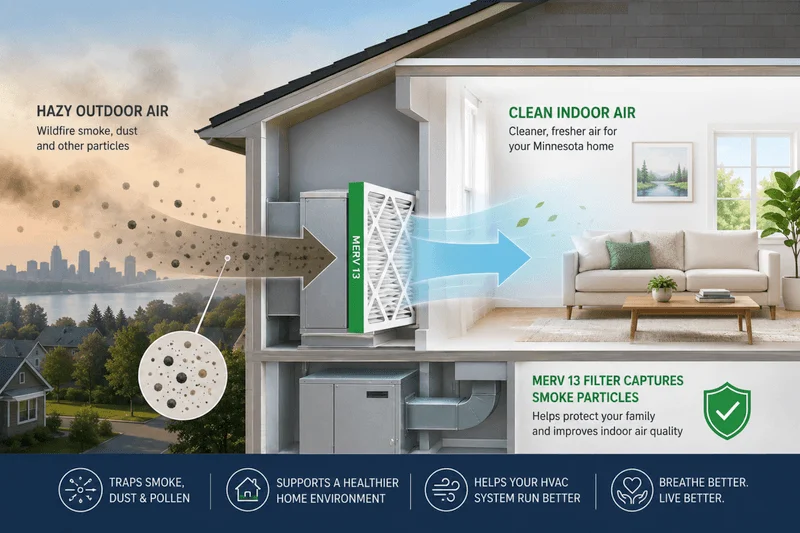
Outdoor pollution doesn't stay outdoors. Fine particles from wildfire smoke are small enough to slip through gaps around windows, doors, and your HVAC system, so when Minnesota's outdoor AQI climbs, indoor levels climb too, often within an hour or two. That matters because people spend roughly 90% of their time indoors, according to the EPA. Your indoor air is the air you actually breathe most of the day.
This is where a good filter earns its keep. Your HVAC system already moves your home's air; a higher-efficiency filter turns that airflow into a whole-home cleanup loop. During smoke events, the EPA specifically recommends running your system with a MERV 13 filter (or the highest rating your system accepts), because MERV 13 is designed to capture a large share of the fine particles, including much of the PM2.5, that smoke drives inside.
At Filterbuy, we've manufactured air filters in the U.S. for over a decade and shipped millions of them to homes across Minnesota and the country. That hands-on experience is why our advice on smoke days is consistent and simple: the filter is the single most controllable thing standing between outdoor smoke and your family's lungs.
After a rough smoke stretch, the filters customers send back to us come back gray and loaded, sometimes in a couple of weeks instead of the usual few months. That's the clearest proof I know that what's happening in the sky ends up in your home. Getting a MERV 13 in place before the haze arrives is the single biggest difference I see between a Minnesota home that rides out smoke season comfortably and one that struggles.
David Clark, Licensed HVAC Technician, Filterbuy
How Can Minnesotans Protect Indoor Air on Smoke and Alert Days?
When the AQI is high, take four steps in order: seal, filter, recirculate, and change. Together they keep outdoor PM2.5 from taking over your indoor air, and they work in any Minnesota home with a central HVAC system.
Seal the house. Close windows and doors, and keep them closed until the AQI drops. Fresh air feels nice, but on a smoke day it's carrying the exact particles you're trying to avoid.
Filter with MERV 13. Run your HVAC system continuously (fan “On,” not “Auto”) with a MERV 13 filter so your home's air is cleaned on a loop. Check that your system supports MERV 13 airflow. Most modern residential systems do.
Recirculate, don't intake. Set your system to recirculate indoor air rather than pull in outside air, and add a portable HEPA air cleaner in the room where you spend the most time.
Change the filter more often. Smoke loads a filter fast. During heavy or prolonged smoke, inspect monthly and swap sooner than usual. A clogged filter can't protect you and strains your system.
The easiest way to never be caught without a clean filter on an alert day is an air filter subscription: your exact size shows up when it's time to change, free and factory-direct. Not sure which filter fits your system? Start with our MERV 13 filters, or see which MERV rating you need for wildfire smoke. You can also track conditions on our live wildfire and smoke map.
Stay ready before the next alert
Check your local AQI on the map above, then set up an air filter subscription so a fresh MERV 13 filter arrives right when you need it, free, factory-direct, and made in the USA. Better Air For All.™
Minnesota Air Quality by the Numbers
The advice on this page is backed by federal and state research. After a decade of making filters at Filterbuy, here are three numbers we keep coming back to:
F grade for particle pollution. The Minneapolis–St. Paul metro ranks 39th worst in the nation, and 723,000+ Minnesota kids breathe unhealthy air. Source: American Lung Association, State of the Air 2026.
52 alert days in one year. Minnesota set a record in 2023: 21 air quality alerts, 16 of them driven by wildfire smoke. Source: Minnesota Pollution Control Agency.
90% of life is spent indoors. Some pollutants run 2–5 times higher inside than out, so your HVAC filter is the air you actually breathe. Source: U.S. EPA.
7 Air Quality Resources We'd Bookmark for Minnesota
We're a little obsessed with clean air around here, so we've spent years sorting out which tools are actually worth your time. These seven are the ones we'd keep one tap away. They're all free, all kept current, and each genuinely useful when Minnesota's air turns hazy. Here's what each one is good for.
1. Check Today's Number Straight From the Source: EPA AirNow
When you want the official read, go to the folks who set the standard. AirNow is the EPA's national system, so you can trust the current AQI for your ZIP code, city, or nearest monitor. Give it a look (or grab the free app) before you head outside.
2. Watch the Smoke Roll In: AirNow Fire and Smoke Map
Minnesota's worst air usually drifts down from Canada, and the Fire and Smoke Map, built by the EPA and U.S. Forest Service, shows you exactly where the smoke and fine particles are. It's the easiest way to see a bad-air day coming instead of guessing.
3. Get Your Neighborhood's Reading: MPCA Current Conditions
Our own state agency runs more than 50 monitors across Minnesota, and its current air quality conditions page gives you the closest, most local read on PM2.5 and ozone, handy on the days the Twin Cities and Duluth aren't breathing the same air.
4. See It Coming a Day Ahead: MPCA Forecast and Free Alerts
Life's busy, so let the forecast do the watching for you. The MPCA air quality forecast predicts tomorrow's AQI for 18 regions and flags alert days above 101. Sign up for free EnviroFlash alerts and you'll get a heads-up before the air turns.
5. Know Who Needs a Little Extra Care: MN Department of Health
If someone under your roof has asthma or a heart condition, or you've got little ones or older parents at home, the Minnesota Department of Health's wildfire smoke guide lays out who's most at risk and what to do at each AQI level, in plain, practical terms, no medical degree required.
6. Turn Your Home Into a Clean-Air Room: EPA Wildfire Guidance
This is where a reading turns into real protection. The EPA's Create a Clean Room guide walks you through sealing up the house, running your fan on “On,” and using a MERV 13 filter or portable HEPA cleaner to keep the smoke outside where it belongs.
7. Match the Right Filter to the Smoke: Filterbuy's MERV Guide
After building filters in the U.S. for over a decade, the one move we've seen matter most is simple: the right filter, in place before the haze arrives. Our guide to the best MERV filter for wildfire smoke breaks down why MERV 13 is the EPA's pick for fine particles, and how often to swap it when the air's rough.
Frequently Asked Questions About Minnesota Air Quality
Glossary
Air Quality Index (AQI): The U.S. EPA's 0–500 scale for reporting outdoor air quality. Lower numbers mean cleaner air; the scale is divided into six color-coded health categories.
PM2.5 (fine particulate matter): Airborne particles 2.5 micrometers or smaller, about 1/30th the width of a human hair. Small enough to reach deep into the lungs and bloodstream; the main pollutant in wildfire smoke.
Ozone (ground-level): A pollutant formed when sunlight and heat react with emissions from traffic and industry. It peaks on hot, stagnant summer afternoons and is a common driver of Minnesota's summer AQI alerts.
MPCA (Minnesota Pollution Control Agency): The state agency that monitors Minnesota's air, issues air quality alerts, and publishes daily forecasts.
EPA AirNow: The U.S. Environmental Protection Agency's national air quality reporting system and app, which supplies the real-time monitor data shown on this page.
EnviroFlash: A free MPCA/EPA email and text service that sends Minnesota air quality forecasts and alerts.
MERV (Minimum Efficiency Reporting Value): A 1–16 scale rating how well an air filter captures particles. Higher MERV captures smaller particles; MERV 13 is the level recommended for wildfire smoke.
Air quality alert: An official MPCA advisory issued when pollution is forecast to reach unhealthy levels, with guidance on who should limit outdoor activity.
About the Author and Reviewer
Michelle Wan is Brand Manager and Air Quality Writer at Filterbuy, where she translates air quality science into practical guidance for homeowners. Read more from Michelle Wan.
Reviewed by David Clark, Licensed HVAC Technician, who verified the filtration and HVAC guidance in this article for technical accuracy.
About Filterbuy: Filterbuy has manufactured air filters in the United States for over a decade, with 600+ standard sizes, custom options, and free, factory-direct shipping. Better Air For All.™