
IQAir vs. AirNow: Why the Numbers Rarely Match
September 15, 2026
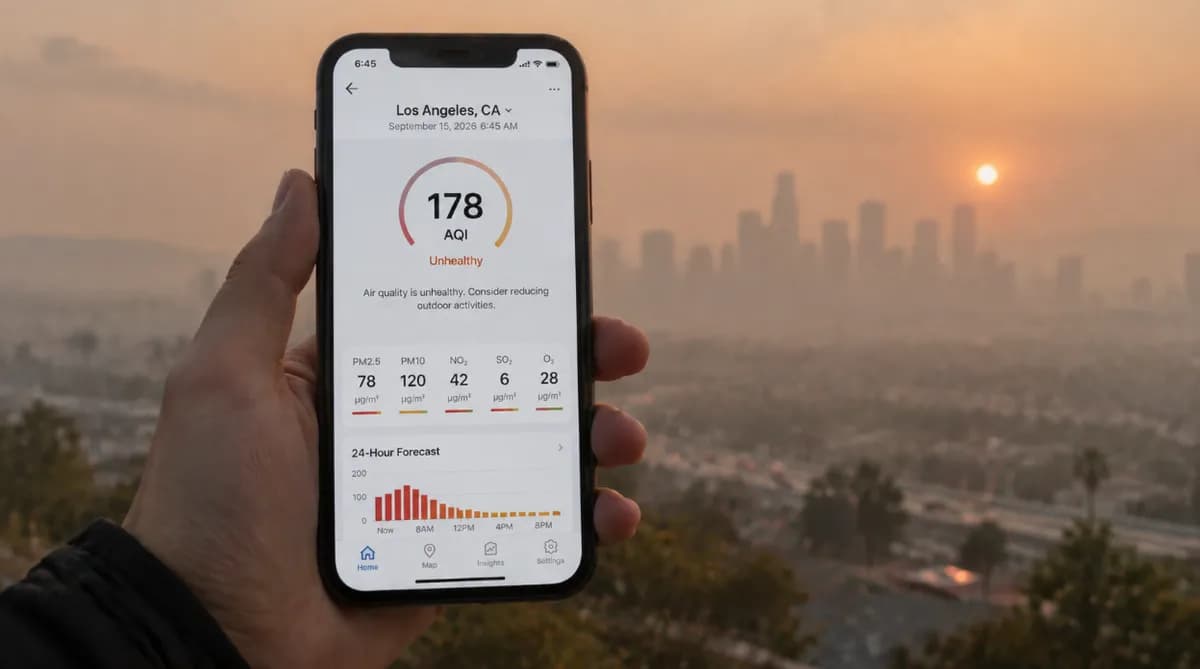
IQAir and AirNow disagree because they average the air over different windows of time. AirNow uses government monitors and weighs up to 12 hours. IQAir adds low-cost sensors and reports only the last hour. So when pollution rises, IQAir moves first and reads higher. Neither app is broken.
- AirNow: the official EPA service. Use it for plans hours or days ahead.
- IQAir: a private Swiss company with 80,000+ locations. Use it for what changed in the last hour.
- When they disagree: act on the more cautious number.
Both apps only track the air outside. For the air inside your home, take the quick filter match quiz below.
Answer a few quick questions and we’ll match you to the right filter for your home.
Already know your filter size? Shop air filters at Filterbuy, made in the USA in over 600 sizes.
TL;DR
IQAir and AirNow disagree because they measure different things over different windows of time. AirNow reports regulatory-grade monitors only, using the EPA’s NowCast average of up to 12 hours, while IQAir blends those same monitors with low-cost sensors and publishes an hourly average it calls AQI+. So when pollution climbs, IQAir moves first and reads higher. Neither app is broken.
Reflects the EPA PM2.5 breakpoints effective May 6, 2024 and IQAir’s AQI+ labeling from October 2024.
Key Takeaways
AirNow reports only regulatory-grade government monitors. IQAir adds low-cost and community sensors across more than 80,000 locations.
The averaging window drives most of the gap. IQAir averages the last hour; AirNow weights up to 12 hours.
Gap size is itself a reading. A small gap means the air is stable; a large one means it is changing fast.
Neither measures your indoor air. Both use the same EPA health categories updated May 6, 2024.
Why Filterbuy Is Writing This
Filterbuy is an American air filter manufacturer. We do not make monitors, we do not sell an app, and we earn nothing whichever of these you open, which is worth saying because most IQAir-versus-AirNow comparisons come from one of the two parties or from sites paid on referrals. After a decade of making filters, the question we care about is not which app wins, but what you do in the ten minutes after you look at the number.
What Is The Difference Between IQAir And AirNow?
AirNow is the official U.S. government air quality service, run by the EPA with state, tribal, and local partners, and it reports regulatory-grade monitors only. IQAir is a private Swiss company whose AirVisual platform layers tens of thousands of low-cost sensors on the same government feeds. Two networks running two calculations give two numbers.
The distinction that matters is purpose rather than accuracy: AirNow is built for consistency and quality control, while IQAir is built for speed and coverage.
AirNow Vs. IQAir At A Glance
Why Does IQAir Read Higher Than AirNow?
IQAir reads higher during a rising pollution event because it publishes the most recent hour while AirNow’s NowCast still carries the cleaner hours behind it. Four separate mechanisms drive the gap. Only the first gets much attention, and the last is often the one actually at work where you live.
1. The averaging window (the big one)
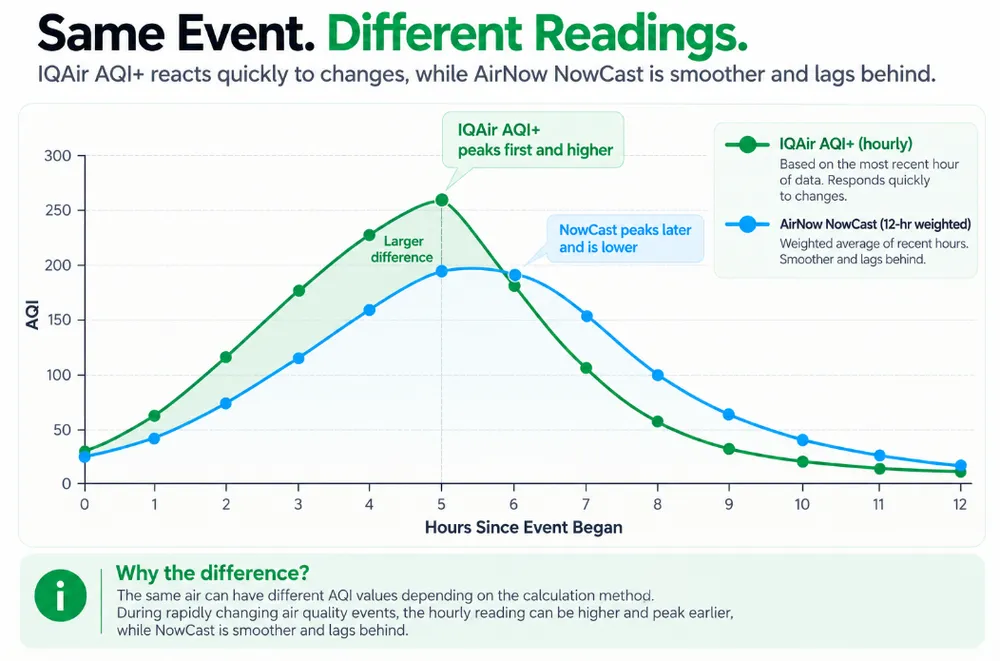
The EPA’s NowCast algorithm averages the previous 12 hours, weighting the most recent ones more heavily when conditions change quickly. IQAir’s AQI+ is built on the previous hour alone.
A worked example
Filterbuy ran the EPA formula on a monitor watching smoke arrive over 12 hours, the latest hour reading 60 micrograms per cubic meter, up from 4.
One Monitor, One Hour, Two Answers
Illustrative calculation using the EPA NowCast method and 2024 PM2.5 breakpoints, with hourly concentrations rising from 4 to 60 µg/m³ across 12 hours.
2. Different Sensors In The Mix
IQAir’s density helps, since pollution varies block to block, but low-cost sensors carry a bias. EPA scientists have found that PurpleAir sensors consistently overpredict fine particles, especially at higher humidity. Rather than discard it, EPA corrects it, which is why the AirNow Fire and Smoke Map can show sensor readings alongside regulatory ones.
EPA is candid about the limits. Asked why the dial can read green on a smoky day, its guidance explains that the main site does not include sensor data and cannot always account for rapidly changing conditions. That is the gap IQAir was built to close.
3. Distance, And The Edges Between Categories
Your IQAir station may sit blocks away while AirNow’s nearest monitor is miles off, which barely matters on a calm day but matters near a highway or a wildfire edge. The AQI is also stepped, so two readings a microgram apart can land in different colors. Our guide to how the AQI is calculated covers the formula, and the AQI color chart covers the bands.
4. Your AirNow Reading May Not Be Measuring Particles At All
Almost nobody mentions this. AirNow ties your ZIP to a reporting area that reports whichever pollutant its monitors measure, so if yours has an ozone monitor but no fine-particle monitor, the dial reports ozone. That is how it reads green on a smoky afternoon while nothing nearby measures PM2.5. EPA confirms that when the dial does not match what you see during a fire, no fine particle monitor may be assigned to your reporting area. Check once which pollutant your area actually reports.
The same split runs inside AirNow: its dial uses regulatory monitors only, while the Fire and Smoke Map adds corrected sensors, so one agency shows two official numbers at once. During smoke, use the map.
Read The Gap, Not Just The Numbers
The gap between IQAir and AirNow is itself a reading, and we have not seen anyone else point this out. NowCast weights recent hours heavily only when readings are volatile, so in stable air it flattens toward a plain 12-hour average and lands near whatever IQAir shows. A small gap means steady air; a large one means something is moving, and its direction tells you which way.
IQAir well above AirNow: the air is worsening now, and AirNow will confirm it shortly.
IQAir well below AirNow: the air is clearing, and AirNow is still carrying the bad hours.
Within a few points: conditions are stable, so stop comparing.
Filterbuy ran the formula forward to see how fast AirNow catches up. It is not symmetric.
How Long AirNow Takes To Agree
Calculated with the EPA NowCast formula and 2024 PM2.5 breakpoints, holding PM2.5 at 60 µg/m3 on arrival and dropping to 5 on clearing.
Is IQAir Accurate And Reliable?
IQAir is reliable for what it is built to do: a fast, local read on changing air. It is not a regulatory instrument and does not claim to be. IQAir trades certainty for speed and coverage; AirNow trades the other way round.
“When two apps disagree, I tell people to stop trying to settle it and go look at the filter instead. Both numbers are telling you the same thing.”
— David Clark, Licensed HVAC Technician
Which Number Should You Act On?
Use AirNow for planning and health decisions spanning hours or days, and IQAir when you need to know what changed in the last hour. For most of these you are picking which question you are asking, not a better app.
Situation-To-Source Guide
When they disagree, act on the more cautious one. Closing a window you did not need to close costs nothing. Our live U.S. AQI map gives you a third reading.
Supporting Statistics
58.8% of U.S. counties, 1,848 of them, have no active air-quality monitoring site.
They cover 40% of U.S. land and 50.7 million people. Roque et al. (2025), PNAS, 122(17). View the study
Raw PurpleAir sensor data overestimate PM2.5 by about 40% in most of the U.S.
EPA compared sensors against federal reference monitors across nearly 12,000 paired measurements, then built the correction now running on the Fire and Smoke Map. Barkjohn et al. (2021). View the EPA record
Indoor PM2.5 runs 55% to 60% of outdoor levels during wildfire smoke, even with windows closed.
EPA puts the range at 30% to 100% by home, and finds a high-efficiency filter running continuously cuts indoor PM2.5 by about 50%, against 24% for a basic filter. Read the EPA guidance
What Both Apps Miss: The Air Inside Your House
Every number here describes the air outside your walls, and at 55% to 60% infiltration a red reading out there is already in your hallway at half strength.
When outdoor PM2.5 climbs, fine particles work their way inside through gaps and ventilation. This is where Filterbuy would push back, because people spend the bad-air day arguing over a 154 versus a 120 when both numbers point at the same action. A MERV 13 filter captures the particulate driving most high-AQI days, and keeping wildfire smoke out of your house covers the rest, while the best MERV rating for wildfire smoke compares the ratings directly.
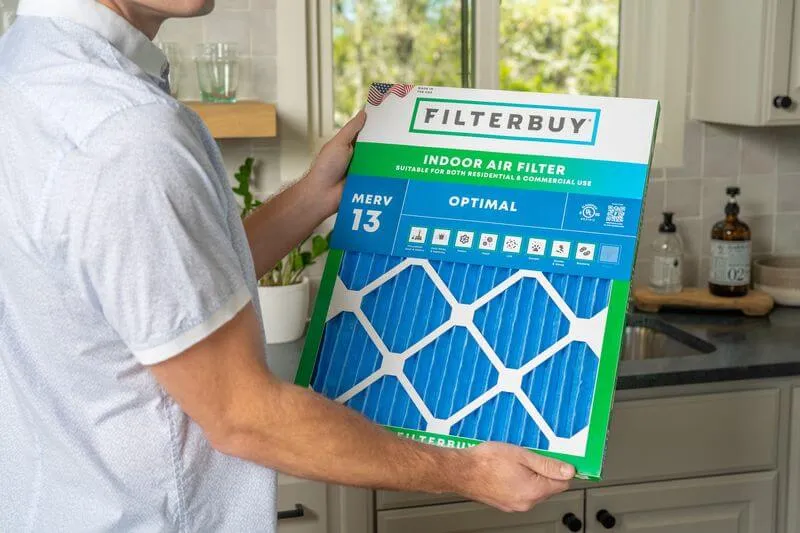
During smoke events, check your filter weekly rather than monthly. Wildfire particulate loads a filter far faster than dust.
Not sure which MERV rating fits? Shop MERV 13 air filters and find your size.
Frequently Asked Questions
Why does IQAir show a higher AQI than AirNow?
IQAir reports the previous hour while AirNow blends up to 12, so IQAir catches a rising spike first. When the air clears, the pattern reverses and IQAir reads lower.
Is IQAir or AirNow more accurate?
AirNow is more accurate as a regulatory-grade measurement, while IQAir is often more accurate about your block right now. Different questions.
Does IQAir use the EPA AQI standard?
Partly. IQAir's AQI+ uses the U.S. AQI categories and breakpoints but calculates them from hourly averages. The scale is EPA's, the math is not.
Is AirVisual the same as IQAir?
Yes. AirVisual is IQAir’s monitoring platform and app, so AirVisual versus AirNow is the same comparison.
My AirNow reading says green but it looks smoky. Why?
Check which pollutant your reporting area reports, because if it has no fine-particle monitor the dial will not reflect smoke. Use the Fire and Smoke Map instead.
Glossary
Filterbuy: An American manufacturer of pleated HVAC filters in over 600 sizes. It does not sell monitors or apps.
AirNow: The official U.S. air quality service, run by the EPA with NOAA, NPS, NASA, the CDC, and state and local agencies.
IQAir / AirVisual: A Swiss air quality technology company and its monitoring platform and app. The two names are used interchangeably.
AQI+: IQAir's standard, applying U.S. AQI categories to hourly pollutant averages. Labeled AQI+ since October 2024.
NowCast: The EPA algorithm estimating current AQI from a weighted average of the past 12 hours.
PM2.5: Fine particulate matter 2.5 micrometers or smaller, which sets the AQI on most high-reading days.
MERV: Minimum Efficiency Reporting Value, the 1-to-16 scale rating how much particulate a filter captures.