
Bloomington Real-Time AQI Tracker


Get Alerts For Unhealthy AQI In Your Area
When air quality in your area reaches unhealthy levels, we'll send you a quick alert, along with expert tips on how to reduce your exposure.
What's Actually In Bloomington Air Today?
What High AQI Means for Your Lungs in Bloomington
How to Read AQI
The Air Quality Index (AQI) measures how polluted the air is and how it may affect your health.
0–50 (Good): Air quality is satisfactory.
51–100 (Moderate): Acceptable, but some pollutants may pose minor concerns.
101–150 (Unhealthy for Sensitive Groups)
151–200 (Unhealthy)
201–300 (Very Unhealthy)
301+ (Hazardous)
Moderate
Still okay for most, but if you have asthma or allergies, take it easy and avoid long outdoor workouts.
Shop MERV 11 filters→What's the Right Filter for Your AQI Level?



Check Today's Live Real Time Air Quality Index AQI Map in Bloomington, MN Now
TL;DR
The live map at the top of this page shows Bloomington, Minnesota's current air quality index (AQI) and the pollutant behind it, color-coded by category. At 100 or below, most people are fine; above 100, sensitive groups should cut back outdoors, and above 150, everyone should. Bloomington's worst readings tend to come from summer wildfire smoke and winter fine particles trapped near the ground.
Key Takeaways
Bloomington has no state air monitor inside city limits, so read the map's nearest reading.
The Minnesota Pollution Control Agency (MPCA) issues alerts when it forecasts the AQI at 101 or higher.
Wildfire smoke is the city's biggest air risk: Minnesota logged a record 22 alerts in 2023, and the Twin Cities saw its first maroon (hazardous) alert in July 2026.
Hennepin County, home to Bloomington, earned an F for short-term particle pollution from the American Lung Association in 2026.
Filterbuy's action line is AQI 100: MERV 13 in the HVAC, the thermostat fan set to On, a portable HEPA air cleaner in each occupied room, and a closed-up house.
How Do I Read Bloomington's Live AQI Map Right Now?
Start with the dot or shaded area closest to your ZIP code (55420, 55425, 55431, 55437, or 55438). Its number and color place the air on the EPA's 0–500 Air Quality Index scale, and the pollutant beside it tells you what to do. Across town? Try checking air quality by ZIP code.
When fine particles (PM2.5) are driving the number, close up the house and filter the air inside. When ground-level ozone is the cause, timing matters more: ozone usually peaks on hot afternoons and eases by evening.
What Does Each AQI Color Mean for Your Bloomington Day?
Each color is an action level: green and yellow suit most plans, orange is the MPCA alert level for sensitive groups, and red or worse calls for everyone to cut back. Sensitive groups include children, adults over 65, pregnant people, outdoor workers, and anyone with asthma, COPD, or heart disease.
For a deeper look at each level, see Filterbuy's AQI color chart.
| AQI | Color and category | What to do in Bloomington |
|---|---|---|
| 0–50 | Green, Good | Enjoy Hyland Lake Park Reserve or the river trails as usual. |
| 51–100 | Yellow, Moderate | Unusually sensitive people may want to shorten long, hard workouts. |
| 101–150 | Orange, Unhealthy for Sensitive Groups | Sensitive groups reduce long or intense outdoor activity. MPCA alert level. |
| 151–200 | Red, Unhealthy | Everyone cuts back; sensitive groups move activity indoors. |
| 201–300 | Purple, Very Unhealthy | Follow AirNow and MPCA guidance; spend time in a clean room. |
| 301+ | Maroon, Hazardous | Follow AirNow and local authorities first; stay indoors. |
Guidance follows the U.S. EPA's AQI health messaging. Check the live map above for Bloomington's current reading.
Filterbuy's action line is AQI 100. That's still the top of the Moderate range, but it's where we tell customers to move: put a MERV 13 filter in the HVAC, set the thermostat fan to On, run a portable HEPA air cleaner in each occupied room (bedrooms first), and close the house up. At 201 and above, follow AirNow and MPCA guidance first; filtration is one layer of the plan.
Why Can Bloomington's AQI Look Wrong or Lag Behind the Sky?
Distance is one reason: the MPCA's 2026 site list has no state monitor inside Bloomington, and the closest sit in Richfield, St. Louis Park, Apple Valley, and Shakopee. Where there's no monitor, the MPCA estimates conditions from the nearest one, which can miss local events.
Timing matters too: the EPA's AirNow "NowCast" blends recent hours of data, so readings can trail fast-moving smoke by an hour or two.
Where Can I Check Bloomington's Air Quality Forecast and Alerts?
Use the MPCA air quality forecast and current conditions map, or get EnviroFlash alert emails.
Does Air Quality Differ Across Bloomington's Neighborhoods?
It does, mostly because of traffic. Interstate 494 crosses the north side of the city, I-35W and U.S. Highway 169 run north to south, and Highway 77 (Cedar Avenue) runs along the east. Homes nearest these roads breathe more exhaust, and the City flags traffic pollution along Old Shakopee Road and 98th Street.
East Bloomington (ZIP 55425) also borders Minneapolis–St. Paul International Airport.
What's Actually in Bloomington's Air?
Two pollutants cause most of Bloomington's poor-air days: fine particles (PM2.5) and ground-level ozone. PM2.5 is the main ingredient in wildfire smoke, and it also builds up in winter when temperature inversions trap it near the ground. Home wood burning produced 51% of Minnesota's direct fine-particle emissions in 2017, according to an MPCA residential wood combustion survey.
Ozone is a summer problem, formed when sunlight cooks vehicle and industrial emissions; the MPCA's 2025 outlook named the Twin Cities suburbs among the highest-risk areas.
Filterbuy built this seasonal calendar from MPCA alert and DNR smoke records:
| Season | What to watch | Home move |
|---|---|---|
| Dec–Feb | Inversions trap wood smoke and exhaust | Skip fire pits on still nights |
| Mar–May | Ozone season starts; smoke arrived by late May in 2025 | Stock MERV 13 spares |
| Jun–Aug | Wildfire smoke and afternoon ozone | MERV 13, fan set to On; inspect during smoke |
| Sep–Nov | Lingering smoke; blowing dust (PM10) | Replace smoke-loaded filters |
Built from MPCA alert patterns and Minnesota DNR smoke records. Check the live map above for current conditions.
How Does Bloomington's Air Compare with the Rest of the Twin Cities?
The American Lung Association's 2026 "State of the Air" report gave Hennepin County an F for short-term particle pollution, averaging 4.5 unhealthy days a year, while passing for year-round levels (American Lung Association). Compare today's readings on the Minneapolis live AQI map or the Minnesota live AQI map.
Wildfire Smoke Is Bloomington's Biggest Air Quality Risk
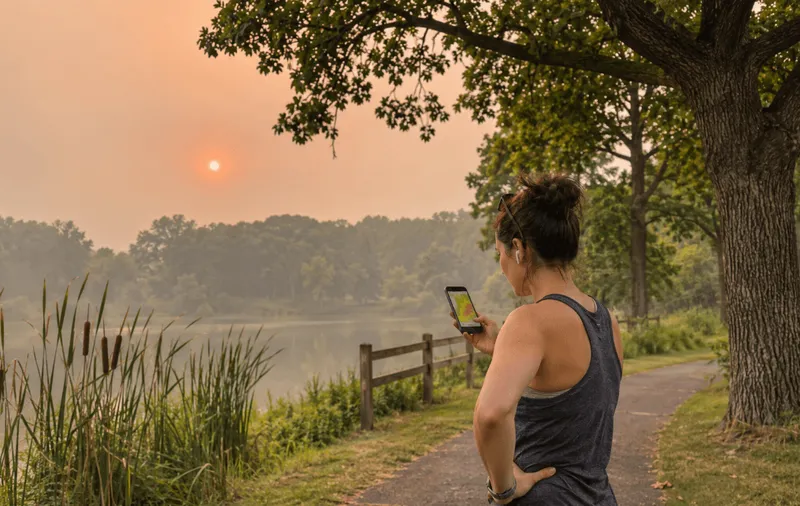
Most bad-air days here come from Canadian and northern Minnesota wildfire smoke. The MPCA issued a record 22 air quality alerts in 2023 (Valley News Live), and the Minnesota State Climatology Office called 2025 likely the smokiest year in five decades or more (Minnesota DNR).
In July 2026, fires near the Boundary Waters pushed the MPCA to issue its first hazardous (maroon) alert for the Twin Cities on July 15, and a sensor in Blaine set a provisional metro record of 342.8 µg/m³ of fine particles (Minnesota DNR). Follow plumes on the AirNow Fire and Smoke Map or Filterbuy's Minneapolis wildfire smoke map.
What Should You Do When an Air Quality Alert Covers Bloomington?
Filterbuy's support team hears it every smoke season: is it too late to do anything? It isn't. Start with the MPCA alert and AirNow guidance for your area. Then, once the AQI reaches 100:
Put a MERV 13 filter in your HVAC system.
Set the thermostat fan to On. Auto only filters while the system heats or cools.
Run a portable HEPA air cleaner in each occupied room, bedrooms first.
Close the house up, and skip candles, frying, smoking, and vacuuming while smoke is in.
Check the filter during the event and replace it once it looks dark brown or black, which EPA says can come well before the normal interval. Keep spares on hand.
People with asthma or heart or lung conditions should follow their doctor's plan. If you own an indoor air monitor, compare it with the map: closed-up homes typically hold 55% to 60% of outdoor PM2.5 (EPA), so a reading close to the outdoor number means smoke is getting in.
What If Your Bloomington Home Has No Central Air?
Apartments, condos, and senior housing make up more than a third of Bloomington's homes, and many of them have no furnace filter slot. For these homes, portable HEPA air cleaners are the primary defense. EPA suggests a unit whose smoke CADR is at least two-thirds of the room's square footage. For a 300-square-foot bedroom, that's a smoke CADR of about 200. EPA also advises against ozone-producing air cleaners, so skip ionizers and ozone generators. See EPA's clean room guidance for setup and our MERV 13 vs. HEPA guide on why HEPA belongs in a portable unit.
If home still can't stay clean, EPA says filtered, air-conditioned public buildings can give a few hours of relief; locally, try a library branch or the Mall of America.
Our Take: Bloomington's Older Homes Make the Filter Choice Matter
The City of Bloomington reports that 82% of its housing was built in the 1950s, 1960s, and 1970s, and that half of its single-family homes are under-insulated. The gaps that leak heat also let smoke in, so the filter matters.
Filterbuy has made pleated filters in the U.S. since 2013, and three lessons apply to homes like these:
The 90-day rating on our own boxes is a dust rating. Smoke loads a filter far faster, so inspect it during smoke events and replace it once it looks dark brown or black.
Airflow won't warn you. EPA research found a smoke-loaded filter can stop cleaning well long before airflow changes, so trust your eyes and nose.
Fit beats rating. Older homes often need odd sizes that big-box stores don't carry, and any gap around the frame lets smoke slip past. That's why Filterbuy stocks 600+ sizes and builds custom filters.
"Bloomington's older ramblers and split-levels let the weather in, so on a smoke day the furnace filter does work the walls can't. Buy your MERV 13 in spring and check it after every alert."
Michelle Wan, Brand Manager & Air Quality Writer, Filterbuy

Which Filter Does Today's Bloomington AQI Call For?
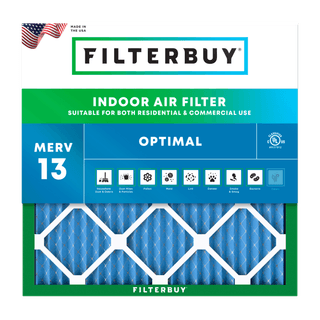
For wildfire smoke, the answer is MERV 13. EPA recommends a filter rated MERV 13 or higher during smoke events, and notes that most systems handle MERV 13 when it's replaced often.
| Live map shows | Filter to use | Why |
|---|---|---|
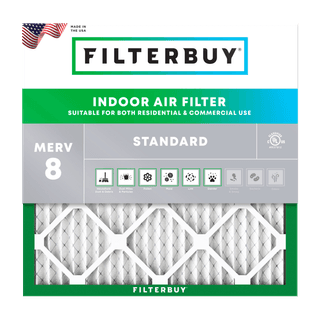
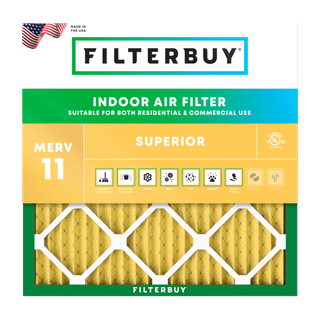
| Below 100, everyday dust and pollen | MERV 8 or MERV 11 | Captures dust, pollen, and pet dander |
| 100 or higher from smoke or PM2.5 | MERV 13 | The tier Filterbuy recommends for smoke |
| 100 or higher from ozone | Your current filter | Particle filters don't remove ozone; close windows during afternoon peaks |
EPA recommends MERV 13 or higher during smoke events. AQI 100 is Filterbuy's action line, not an EPA threshold.
Confirm the size printed on your current filter before you order. See Filterbuy's guide to the best MERV filter for wildfire smoke, or set up air filter auto-delivery before smoke season.
Supporting Statistics Behind This Guidance
9.3% of Minnesota adults and 5.4% of children have asthma. Source: Minnesota Department of Health
Asthma ER visits ran 17% above expected on 2023 U.S. wildfire smoke days. Source: CDC MMWR
EPA says a high-efficiency HVAC filter with the fan running continuously may cut indoor PM2.5 by about 50%. Source: U.S. EPA
Frequently Asked Questions
What is the air quality in Bloomington today?
The live map at the top of this page shows Bloomington's current AQI and the main pollutant behind it.
Is the air quality bad in Bloomington today?
At orange, sensitive groups should cut back outdoors; at red or worse, everyone should.
What does Bloomington's PM2.5 reading mean?
PM2.5 is fine particle pollution, the main ingredient in wildfire smoke and winter haze. When it pushes the AQI to 100 or higher, follow the action steps above.
Where is the nearest air quality monitor to Bloomington?
None inside city limits; the nearest sites appear on the MPCA current conditions map.
What MERV rating do I need for wildfire smoke in Bloomington?
MERV 13. EPA recommends a filter rated MERV 13 or higher during smoke events.
Glossary
Air Quality Index (AQI): The U.S. EPA's 0–500 color scale for daily air pollution and health risk.
PM2.5: Airborne particles 2.5 micrometers wide or smaller; the main component of wildfire smoke.
Ground-level ozone: A lung-irritating gas, or smog, formed when sunlight reacts with emissions.
NowCast: AirNow's method of weighting recent hourly readings into a current AQI.
Minnesota Pollution Control Agency (MPCA): The state agency that monitors Minnesota's air and issues alerts.
Temperature inversion: A warm layer of air that caps cooler air near the ground, trapping pollution.
MERV: Minimum Efficiency Reporting Value, a 1–16 rating of how well an HVAC filter captures particles.
CADR: Clean air delivery rate, the volume of filtered air a portable air cleaner delivers.
HEPA: High-efficiency particulate air filtration, rated to capture at least 99.97% of 0.3-micron particles.