The moment a wildfire starts near you, you'll get an instant alert and simple tips to reduce your smoke exposure.
30xSmaller than a human hair
Fine enough to reach deep into the lungs. A MERV 13 is built to capture it.
It Doesn't Stay Local
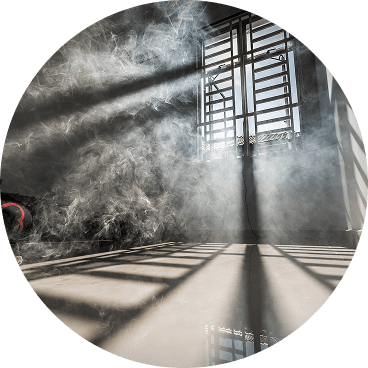
Smoke rides the wind far downwind — you can get smoky air with no fire nearby.
Simple steps to reduce indoor exposure.
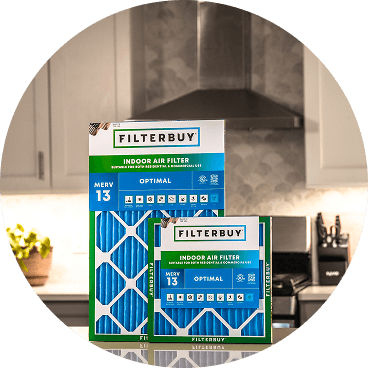
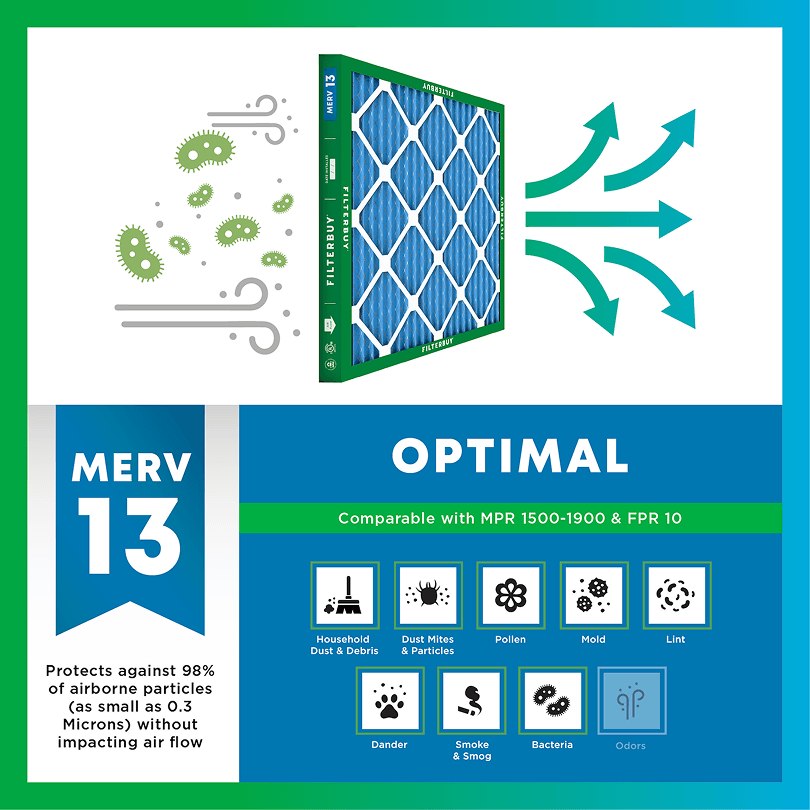
During smoke events, the EPA recommends upgrading to a MERV 13 filter — or the highest-rated filter your system can handle — to help reduce the fine particles smoke brings indoors. MERV 13 is the level most home HVAC systems can run while still capturing PM2.5, the fine particulate that makes up the bulk of wildfire smoke.
Over 70,000 wildfires burn in the U.S. every year.
Wildfire smoke can travel 1,000+ miles, affecting states that aren't even near the blaze.
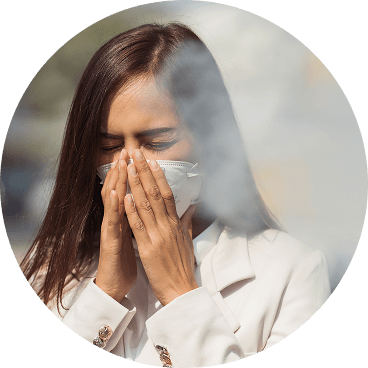
Exposure to wildfire smoke can worsen asthma, trigger heart issues, and lead to ER visits.
Indoor air can hold more fine particles during wildfire events unless it's properly filtered.
The EPA advises using MERV 13 filters or portable HEPA air cleaners during wildfire smoke events.
Use the live wildfire smoke tracker and upgrade your air filters today to protect your lungs and your home.
Shop Filters For Smoke Protection
By Michelle Wan | Reviewed by David Clark, Licensed HVAC Technician | Published July 14, 2026 | Updated July 14, 2026
A clear-looking July afternoon in Minneapolis can still carry an unhealthy dose of PM2.5. That is what makes wildfire smoke different from a thunderstorm: there is often no visible warning, and the fire behind it might be six hundred miles north, across the Canadian border. At Filterbuy, we have manufactured air filters in the United States since 2013, in our own factories in Alabama, Florida, Pennsylvania, and Utah, and we built this page from what we have learned building and testing MERV-rated filters against real smoke, not from a spec sheet alone. Below, we pair that firsthand manufacturing perspective with the live tools a Minneapolis household actually needs on a smoky day.
Minneapolis wildfire and smoke conditions can shift within hours, mostly driven by smoke that drifts south from wildfires in Canada and, at times, the western United States. Check the live AirNow Fire and Smoke Map for today's active fires, smoke plumes, and the current Air Quality Index (AQI) reading for the Twin Cities. When the AQI climbs into the orange, red, or purple category, sensitive groups, and eventually everyone, should cut back on outdoor exertion and run a MERV 13 or higher air filter indoors to keep smoke particles out of the home.
Minneapolis air quality changes by the hour during smoke events, so a fixed number on a page goes stale fast. Check the live map above before heading outside.
The Minnesota Pollution Control Agency (MPCA) is forecasting an active 2026 “air quality season,” with roughly 12 to 16 days of wildfire smoke impact expected statewide this summer.
Most Minneapolis smoke events originate hundreds or thousands of miles away, in Canadian wildfires, and arrive on the wind behind a cold front.
Children, older adults, pregnant people, and anyone with asthma, COPD, or heart disease face the highest risk from wildfire smoke exposure.
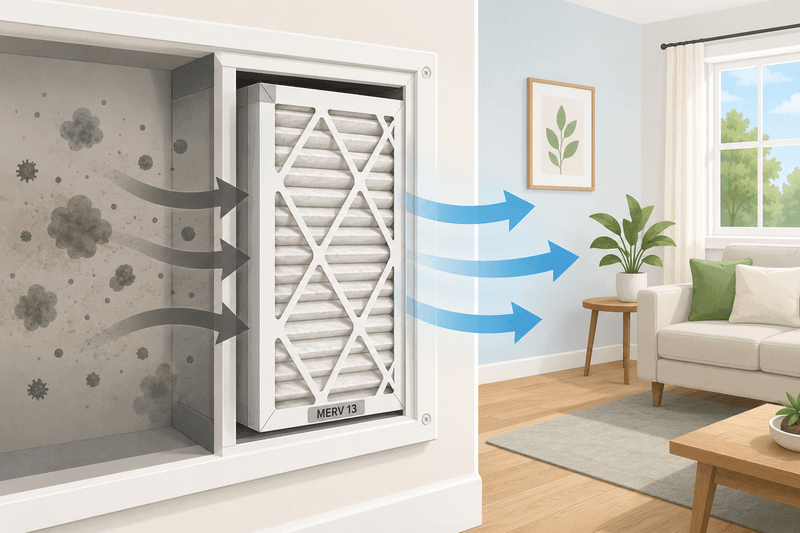
A MERV 13 or higher air filter, run on recirculate with the fresh-air intake closed, is one of the most effective ways to cut indoor smoke particles during a smoke event.
Drought conditions across Minnesota and the wider Midwest are elevating regional fire risk in 2026, which can extend the number of smoky days in the Twin Cities.
The AirNow Fire and Smoke Map is the authoritative live source for Minneapolis wildfire and smoke conditions. Open the map, allow it to find your location or type a Minneapolis ZIP code, then read the colored circle nearest you. Each circle shows a current PM2.5 reading and an Air Quality Index category from a nearby monitor or sensor. Flame icons mark active fire incidents, and shaded areas mark smoke plumes. Conditions update continuously, so refresh the map for the latest reading rather than relying on a number from earlier today.
Because wildfire smoke moves with the wind, a single citywide number can hide neighborhood-to-neighborhood differences. If you live near a highway, industrial corridor, or the flight path of a major smoke plume, your actual exposure may run higher than the citywide average. Hyperlocal sensor networks layered onto the map above can help you check conditions closer to your specific address.
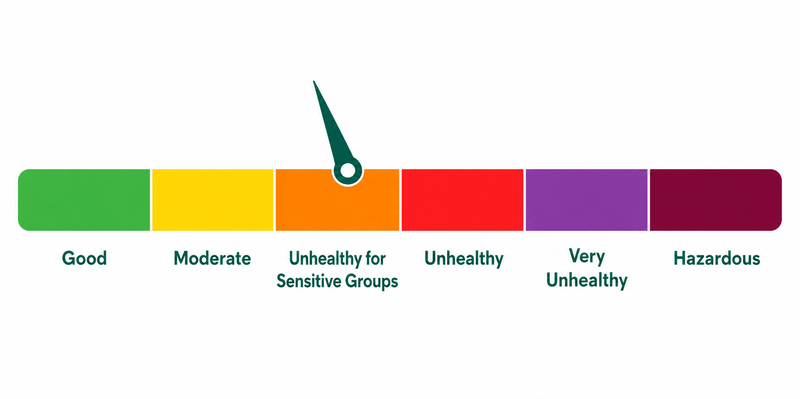
The Air Quality Index (AQI) translates fine particle pollution (PM2.5) and other pollutants into a 0 to 500 scale and a matching color, so residents can gauge health risk at a glance.
Categories reflect the U.S. EPA Air Quality Index scale for PM2.5 and ozone.
Most of the smoke that reaches the Twin Cities does not start in Minnesota. Heavy ground-level smoke typically forms over wildfires burning in central and western Canada, then rides a cold front south into Minnesota, where it can settle over the Minneapolis-St. Paul metro for hours or days at a time.
Minnesota's state climate agency is tracking an active pattern for 2026: warmer, drier conditions tied to a strong El Niño pattern are creating favorable conditions for both wildfire activity and elevated ozone across the state. Drought conditions across parts of Minnesota and the broader Midwest are compounding the risk, since dry vegetation ignites more easily and burns hotter once a fire starts. Nationally, tens of thousands of wildfires and millions of acres burn each year, and even a single large fire cluster in Canada can send smoke drifting over Minnesota, North Dakota, and Iowa for days.
None of this means every day in Minneapolis is smoky. Many summer days remain in the Good or Moderate AQI range. It does mean conditions can change quickly when a smoke plume arrives, which is exactly why a live map, rather than a fixed seasonal average, is the right tool for a same-day decision about outdoor plans. Every summer, Filterbuy's customer support team fields the same question from Minneapolis households once the sky turns hazy: whether it is too late to do anything useful. It rarely is, but the households that fare best are the ones who checked their filter before the smoke arrived, not during it.
Minneapolis has already lived through what a severe smoke season looks like. On June 14 and 15, 2023, the Twin Cities recorded the worst air quality in its history, worse than any reading in the more than four decades since the state began tracking the Air Quality Index in 1980, driven entirely by smoke from fires burning in Quebec and Ontario, more than a thousand miles away. The previous record had stood for less than two years: on July 29, 2021, a monitor in St. Michael, Minnesota recorded an hourly AQI of 308. Minnesota issued 22 separate air quality alerts covering 52 days in 2023 alone, more than the total from the prior decade combined, according to the Minnesota Pollution Control Agency.
Minneapolis is not alone in this pattern. Cities across the Upper Midwest and Great Lakes region, including Milwaukee, WI, see the same long-range Canadian smoke drift affect their air quality most summers.
Wildfire smoke can affect anyone, but some Minneapolis residents face a higher chance of health effects at the same AQI reading:
Symptoms of smoke exposure include coughing, wheezing, chest tightness, shortness of breath, irritated eyes and throat, headache, and fatigue. Anyone with chest pain, trouble breathing, or symptoms of a possible heart attack or stroke should call 911 immediately rather than waiting the symptoms out.
Outdoor air quality is largely out of your hands, but indoor air is not. Filterbuy's own product support team walks Minneapolis customers through the same three steps every smoke season, in the same order. We call it Seal, Filter, Clean Room.
Close windows and doors, and run your HVAC system on recirculate with the fresh-air intake closed.
Upgrade to a MERV 13 or higher air filter sized correctly for your system. A filter that is too restrictive for the blower can reduce airflow rather than improve it.
Check and replace filters more often during heavy smoke weeks. A smoke-loaded filter clogs faster than one working through an ordinary summer.
Run a portable HEPA air cleaner in bedrooms or the room where your family spends the most time.
Skip activities that add to indoor pollution during a smoke event, including frying or broiling food, burning candles, and vacuuming with a non-HEPA vacuum.
If a portable air cleaner is not on hand, a box fan with a pleated filter taped to it is a widely used backup that public health agencies, including MDH, point to for a single room:
Tape one or more MERV 13 filters to the intake side of a box fan, with the airflow arrow printed on the filter pointing toward the fan.
Seal the edges with tape so air is pulled through the filter rather than around it.
Run it only in a room you are actively using, and only with a fan made after roughly 2012. Older motors were not built to run continuously and can overheat.
The same Filterbuy MERV 13 filter built for your furnace works for this job too, so one spare filter covers both your HVAC system and a backup cleaner.
Filterbuy hears from plenty of Minneapolis renters who assume there is nothing they can do because they do not own the HVAC system. That is not true. A landlord or property manager may control the furnace, but a few things are still fully within your control:
Run a portable HEPA air cleaner sized for your bedroom or main living space. It needs no access to shared building systems.
Seal obvious gaps around a window air conditioner with painter's tape during a smoke event, then remove the tape once the air clears so the unit can drain properly.
Ask your property manager whether the building's central filter can be upgraded to MERV 13. Many commercial systems handle a higher rating than a typical single-family furnace.
Keep windows closed and rely on a portable cleaner rather than a window AC unit's fan-only setting, which can pull in outside air.
Dogs and cats breathe the same smoke you do, and they cannot tell you when their eyes or throat are irritated.
Shorten walks and keep off-leash time indoors once the AQI reaches orange or higher.
Watch for coughing, wheezing, or reluctance to move, the same warning signs smoke causes in people.
Run your air cleaner in whatever room your pet spends the most time, not only where people sleep.
Minnesota's schools and childcare programs follow state guidance from the Minnesota Department of Health for exactly this situation, shifting recess, gym class, and outdoor sports practice indoors once the AQI reaches unhealthy levels for sensitive groups. If your child's school or daycare has not shared an air quality policy, it is worth asking for one. Coaches and staff can move a practice indoors or shorten it without waiting for a parent to raise the question first.
A car is not sealed against wildfire smoke by default.
Roll up the windows and set the climate control to recirculate rather than fresh air.
Avoid long stretches of idling with the windows down, especially in traffic, where exhaust adds to the particle load already in the air.
A car's cabin air filter works the same job as a home's furnace filter. If it has not been replaced recently, a smoke event is a good reason to check it.
If you are unsure what your system can handle, Filterbuy's guide on which MERV rating to use breaks the choice down by household and HVAC system, and names wildfire and smoke exposure as a reason to move up to MERV 13.
MERV 13 is the minimum rating Filterbuy recommends during an active wildfire smoke event.
Filterbuy manufactures MERV 8, MERV 11, and MERV 13 residential air filters sized for most standard HVAC systems, along with HEPA-style room air cleaners built for exactly this kind of smoke event. Browse current MERV 13 air filter sizes or set up auto-delivery so a fresh filter arrives before the next smoke day catches your home off guard.
After manufacturing filters for over a decade and serving more than two million households, we've learned that the best defense against a Minneapolis smoke event isn't a bigger air conditioner. It's a properly rated filter already installed before the smoke ever rolls in. A MERV 13 filter, checked monthly and swapped as soon as it looks dirty, does most of the work of keeping wildfire smoke out of the air your family actually breathes.
David Heacock, Founder and CEO, Filterbuy
Source: AQI Basics for Ozone and Particle Pollution (AirNow.gov, U.S. EPA)
Source: Current Air Quality Conditions (Minnesota Pollution Control Agency)
Source: Wildfire Smoke (Minnesota Department of Health)
Source: Who Is at Increased Risk of Health Effects From Wildfire Smoke Exposure (U.S. EPA)
Source: Wildfire Smoke and Lung Health (American Lung Association)
Source: NASA's PACE Mission Studies Smoke, Fires (NASA Science)
Source: Wildfire Smoke Impact on Health: A Review (Aguilera et al., 2021) (PMC, National Library of Medicine)
Three figures below come from separate U.S. government sources. Each shows a different angle on wildfire risk: national scale, regional drought, and local health impact.
77,850 individual wildfires were reported nationwide.
5,131,474 acres burned in total.
Both figures topped the five- and ten-year averages.
Source: Wildland Fire Summary and Statistics Annual Report 2025 (National Interagency Fire Center)
13% of the Midwest region was in Moderate to Extreme Drought (D1–D3) as of mid-June 2026.
Minnesota's coverage reached 38%, the highest of any state in the region.
Drought raises wildfire risk and can extend the length of smoke season.
Source: Drought Status Update: Midwest, June 18, 2026 (Drought.gov, NOAA/NIDIS)
Asthma-related emergency department visits rose 17% higher than expected nationwide.
The spike occurred during 19 days of Canadian wildfire smoke between April and August 2023.
HHS Region 5, which includes Minnesota, was among the three hardest-hit regions.
Source: Asthma-Associated Emergency Department Visits During the Canadian Wildfire Smoke Episodes — United States, April–August 2023 (CDC, Morbidity and Mortality Weekly Report)
Here is the short version of everything above, plus our honest take.
Minneapolis smoke almost always starts in Canada, not Minnesota.
The live map above shows exactly where things stand right now.
The AQI number tells you what that means for your health.
Seal, Filter, and Clean Room cover the three steps that matter, whether you own a furnace, rent an apartment, or just need to keep a pet comfortable.
Our honest opinion, after manufacturing filters in the United States since 2013 and hearing from Minneapolis customers every smoke season:
Most households do not have an information problem. They have a timing problem.
Nearly everyone who calls Filterbuy's support team during a smoke advisory already knows a MERV 13 filter helps.
What they did not do was buy one before the smoke arrived, when filters were easy to find, and there was no rush.
A wildfire a thousand miles away is not something Filterbuy or anyone else can stop. Whether your home is ready before the sky turns hazy is the part you control.
Bookmark the live AirNow Fire and Smoke Map and check it whenever the sky looks hazy, or the air smells like smoke.
Confirm your HVAC system takes a MERV 13 filter, and keep a spare Filterbuy MERV 13 in your system's exact size on hand before smoke season starts.
Choose one room now as your household's clean room, ideally one with few windows and a door that closes.
Sign up for MPCA's daily air quality alerts through EnviroFlash so a warning reaches you before the sky turns hazy.
Active wildfires directly within the Minneapolis metro area are uncommon. Most smoke affecting the city originates from wildfires burning in Canada or, less often, the western United States, then travels hundreds or thousands of miles on the wind. Check the live map above for the nearest active fire detections.
The Minnesota Pollution Control Agency has forecast an active 2026 season, with roughly 12 to 16 smoke-impacted days statewide. Some recent summers have brought well over 20 air quality alert days to the Twin Cities metro, largely tied to Canadian wildfire smoke.
Sensitive groups should scale back prolonged or vigorous outdoor activity once the AQI reaches the orange category (101-150). Once the AQI reaches red (151-200) or higher, this guidance extends to everyone, not just sensitive groups.
Yes, when it is rated MERV 13 or higher, and the system is set to recirculate indoor air rather than draw in outside air. A correctly sized MERV 13 filter captures the fine particulate matter that makes up the bulk of wildfire smoke. Filterbuy manufactures MERV 13 filters made in the USA in more than 600 sizes, so most Minneapolis furnaces and HVAC systems have an exact fit.
The majority arrives from wildfires in central and western Canada, carried south by cold fronts. Western U.S. wildfires can also contribute smoke, though Canadian fires are the more frequent source for Minneapolis specifically.
Most individual smoke events clear within a day or two once the wind shifts, but a bad wildfire season can stack several events back to back. Minnesota's record year, 2023, saw 22 separate air quality alerts covering 52 total days, according to the Minnesota Pollution Control Agency.
A portable HEPA air cleaner, painter's tape around window AC gaps, and a request to your property manager about upgrading the building's central filter to MERV 13 all work without any access to shared systems. See the renter-specific guidance above for the full list.
Once the AQI reaches unhealthy levels for sensitive groups, Minnesota schools and childcare programs are expected to move recess, gym class, and outdoor sports indoors. If a school or coach has not mentioned a smoke-day policy, it is reasonable to ask what it is.
Driving is generally fine. Roll up the windows and set the car's climate control to recirculate so it is not pulling in outside air. Avoid rolling down the windows in stopped traffic, where exhaust adds to the smoke already present.
Wildfire smoke does not wait for a convenient time to arrive. Check the live map above whenever you are planning outdoor time in Minneapolis, and make sure your home is ready before the next alert. Shop Filterbuy's MERV 13 air filters sized for your system, or set up auto-delivery so a fresh filter is always on hand. Traveling or checking conditions outside Minnesota? See the live Air Quality Index map for the USA.
For a general definition of an air filter, see the referenced overview.
Subscribe to wildfire smoke alerts for Minneapolis, MN, to get a heads-up before the next event reaches your area.