
Milwaukee, WI Live Wildfire Smoke Map
Get Alerts For Wildfires In Your Area
The moment a wildfire starts near you, you'll get an instant alert and simple tips to reduce your smoke exposure.
What's In The Smoke
30xSmaller than a human hair
Fine enough to reach deep into the lungs. A MERV 13 is built to capture it.
How Far It Travels


It Doesn't Stay Local
Smoke rides the wind far downwind — you can get smoky air with no fire nearby.
What To Do During A Smoke Event
Simple steps to reduce indoor exposure.
- Stay In, Close UpShut windows and doors to keep smoke out.
- Set Fan To "On"Keeps air cycling through your filter, not just when heating or cooling.
- Recirculate AirSwitch off fresh-air intake so you're not pulling smoke in.
- Run A MERV 13Built to capture the fine PM2.5 in smoke.
- Add A PurifierExtra filtration for the room you use most.
- Wear an N95 if OutsideFits snug to block fine particles — a cloth mask won't.


The Best Air Filter For Wildfire Smoke
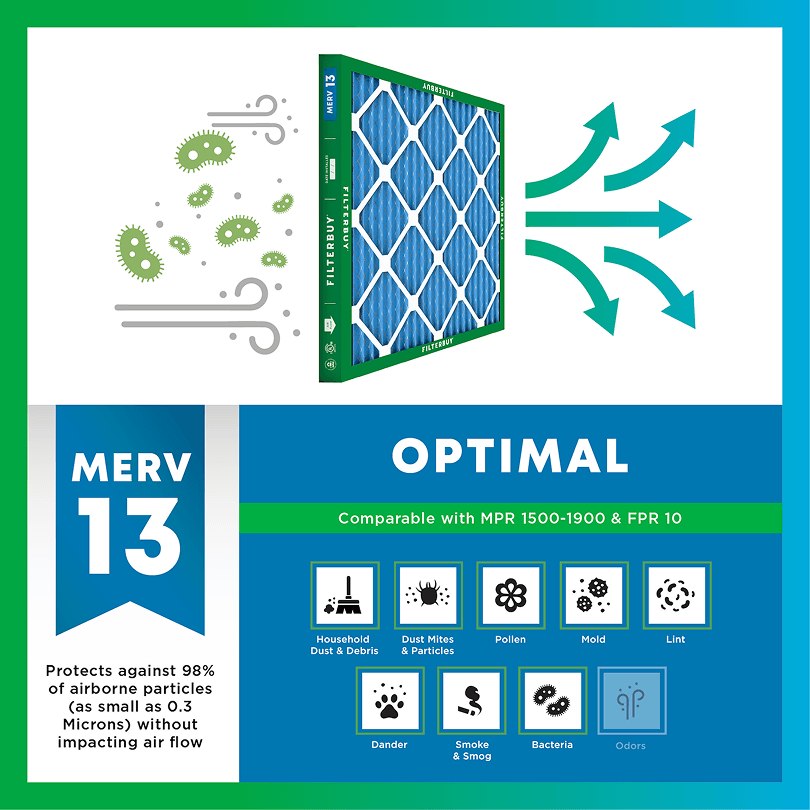
During smoke events, the EPA recommends upgrading to a MERV 13 filter — or the highest-rated filter your system can handle — to help reduce the fine particles smoke brings indoors. MERV 13 is the level most home HVAC systems can run while still capturing PM2.5, the fine particulate that makes up the bulk of wildfire smoke.
- Captures PM2.5 particles
- Blocks ash, soot, and smoke odor
- Keeps your indoor air safe—even when the outdoor air is dangerous
- Meets the EPA's recommended rating for filtering fine wildfire smoke particles.

Wildfire Smoke FAQs
Facts About Wildfires
Over 70,000 wildfires burn in the U.S. every year.
Wildfire smoke can travel 1,000+ miles, affecting states that aren't even near the blaze.
Exposure to wildfire smoke can worsen asthma, trigger heart issues, and lead to ER visits.
Indoor air can hold more fine particles during wildfire events unless it's properly filtered.
The EPA advises using MERV 13 filters or portable HEPA air cleaners during wildfire smoke events.
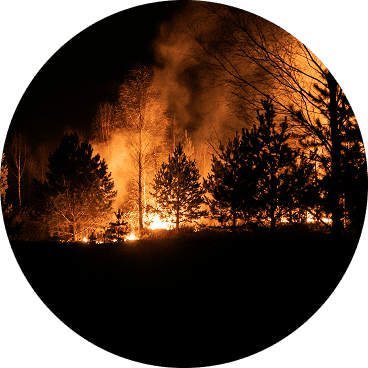
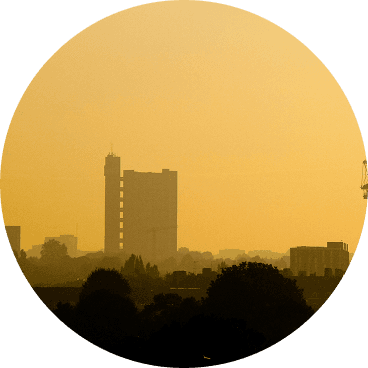
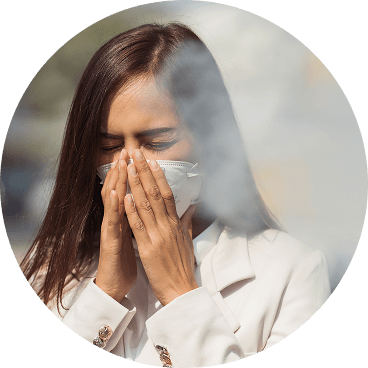
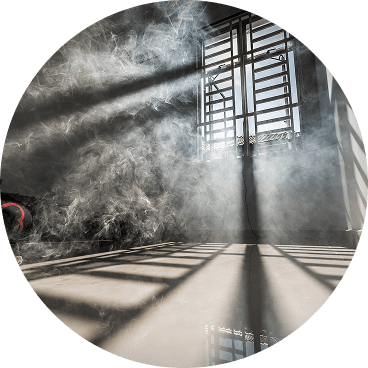
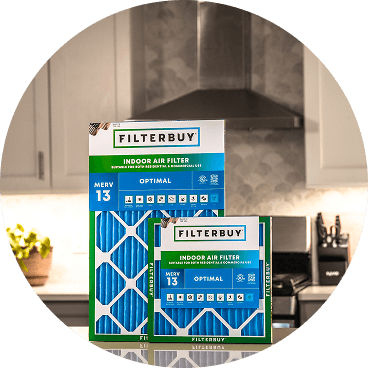
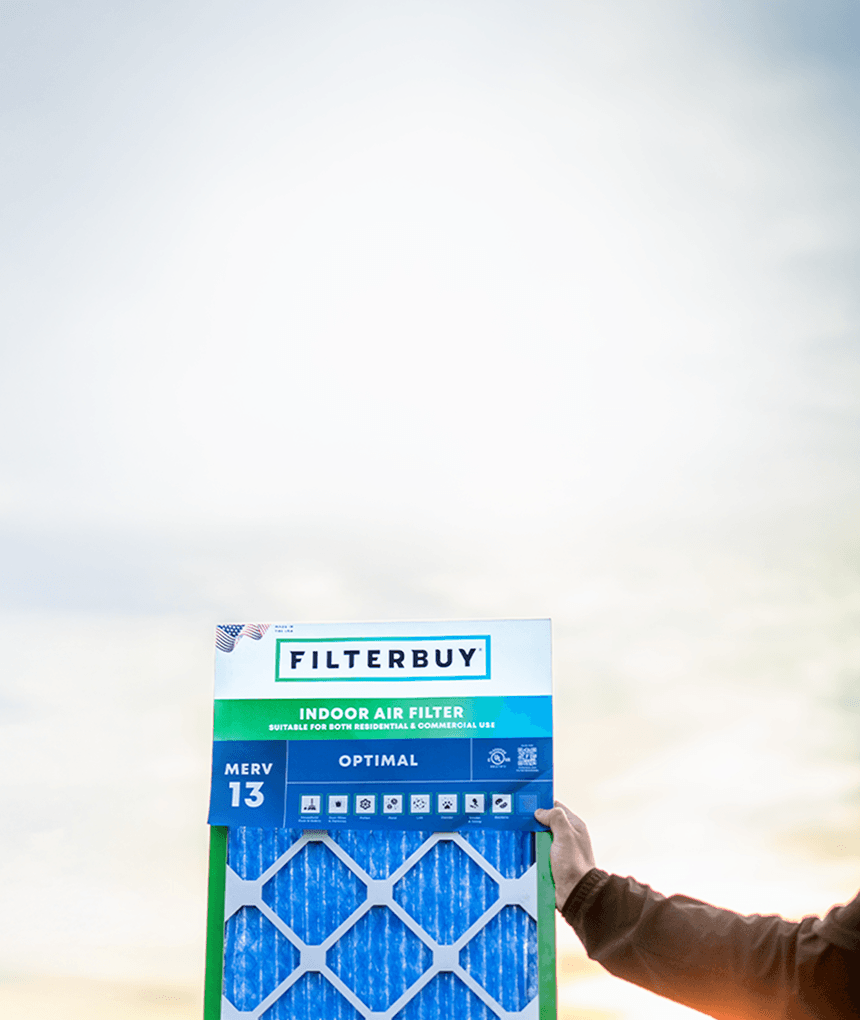
Don't Wait Until The Smoke's Inside.
Use the live wildfire smoke tracker and upgrade your air filters today to protect your lungs and your home.
Shop Filters For Smoke Protection
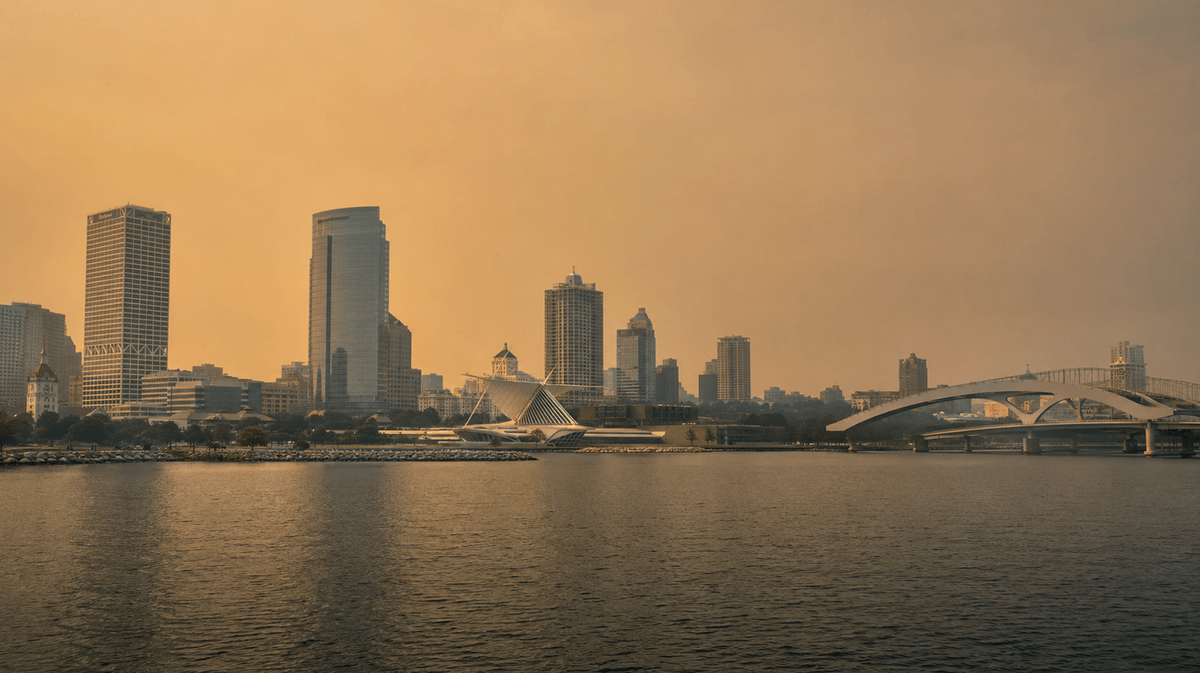
Current Live Forest Wildfire And Smoke Map Today In Milwaukee, WI: Track Nearby Fire Activity, Smoke Drift & Air Quality Alerts Across The Metro Area
Michelle Wan, https://filterbuy.com/author/michelle-wan/
David Clark, Licensed HVAC Technician
July 5, 2026 | Updated: July 5, 2026
Milwaukee Smoke Days Now Arrive Without A Fire In Sight
Some of the worst air quality days Milwaukee has recorded in recent years arrived with no fire burning anywhere in Wisconsin. During the summer of 2023, smoke from Canadian wildfires pushed the Air Quality Index across southeastern Wisconsin into the Unhealthy range, and the Wisconsin Department of Natural Resources issued repeated statewide advisories.
Wildfire smoke travels. A fire burning hundreds or even thousands of miles away can still leave a gray haze over Lake Michigan and push fine particles into a Milwaukee living room. Those particles, called PM2.5, are the part of smoke that reaches deep into the lungs.
This page gives Milwaukee households one place to check current fire and smoke conditions and a clear plan for protecting the home when the air turns unhealthy. It covers the live map, how to read the Air Quality Index, who faces the most risk, and how the right air filter keeps smoke out of the rooms where your family spends the most time.
At Filterbuy, we have manufactured air filters in the United States since 2013, in factories in Alabama, Florida, Pennsylvania, and Utah. The guidance here comes from a company that builds and tests the filters it recommends, so the advice leans on what actually holds up during a smoke event rather than on generic tips.
TL;DR Quick Answers
Milwaukee air quality can move from clear to hazardous within hours when wildfire smoke drifts in from Canada or the western United States. The fastest way to see current conditions is the AirNow Fire and Smoke Map, a free tool from the U.S. Environmental Protection Agency and the U.S. Forest Service that shows live fire locations, smoke plumes, and PM2.5 readings near you. When the Air Quality Index climbs into the orange category or higher, Milwaukee residents should close windows, run the central HVAC system with a clean MERV 13 filter, and limit time outdoors.
Key Takeaways
The AirNow Fire and Smoke Map shows live PM2.5 readings, fire locations, and smoke plumes for Milwaukee and updates continuously from monitors and sensors.
Most Milwaukee smoke events come from long-range transport, most often from Canadian wildfires, so the air can turn unhealthy even when no fire burns in Wisconsin.
An Air Quality Index reading of 101 or higher (orange or worse) is the point at which sensitive groups in Milwaukee should limit outdoor activity.
A clean MERV 13 filter in a central HVAC system captures a large share of fine smoke particles. MERV 13 is not HEPA, and it reduces rather than removes every particle.
Filters load faster during smoke events, so plan to replace the HVAC filter as soon as the smoke clears.
Filterbuy manufactures MERV 13 filters in the United States in more than 600 sizes, so most Milwaukee HVAC and furnace systems have an exact fit.
How To Check Milwaukee’s Live Wildfire And Smoke Map Right Now
The AirNow Fire and Smoke Map is the authoritative live source for Milwaukee wildfire and smoke conditions. Open the map, allow it to find your location or type a Milwaukee ZIP code, then read the colored circle nearest you. Each circle shows a current PM2.5 reading and an Air Quality Index category from a nearby monitor or sensor. Flame icons mark active fire incidents, and shaded areas mark smoke plumes.
Check conditions in the next 60 seconds: open the live AirNow Fire and Smoke Map, let it center on Milwaukee, and tap the circle closest to your neighborhood.
Open the live map and allow location access, or type your Milwaukee ZIP code in the search box.
Read the color of the circle nearest you. Green and yellow are acceptable for most people. Orange, red, purple, and maroon call for action.
Tap the circle to see the current PM2.5 number, the AQI category, and whether the trend is improving or getting worse.
Look for flame icons and shaded smoke areas nearby, then check the smoke outlook for the next day.
Why Wildfire Smoke Reaches Milwaukee Even When No Fire Is Nearby
Wildfire smoke reaches Milwaukee mainly through long-range transport from fires in Canada and the western United States. Upper-level winds carry fine particles across the continent, where they can settle over the Great Lakes region for days. The Wisconsin Department of Natural Resources monitors PM2.5 at 18 sites statewide and issues air quality advisories when smoke pushes readings into unhealthy ranges.
PM2.5 refers to particles 2.5 microns wide or smaller, roughly one-thirtieth the width of a human hair. Particles that small stay aloft for long distances and slip through gaps around windows and doors. That is why a Milwaukee sky can look only slightly hazy while indoor air still carries a real health load.
Wisconsin has issued multiple wildfire smoke advisories in recent seasons, nearly all traced to Canadian fires. The state reports that smoke from larger fires can affect air quality hundreds or even thousands of miles away.
What A Smoke Season Looks Like In Milwaukee
For Milwaukee, the smoke season runs mainly from late spring through summer, when fires across Canada and the northern plains are most active, and the winds that carry their smoke swing over the Great Lakes. The summer of 2023 was the clearest recent example, when Canadian smoke held air quality across southeastern Wisconsin in unhealthy ranges for days at a stretch. Because the source is usually far away, the haze can arrive on a sunny day with no local warning sign, and the first hint many residents get is a faint campfire smell or a milky sky over Lake Michigan.
The Wisconsin Department of Natural Resources tracks fine particle levels at monitoring sites around the state, including the Milwaukee area, and issues air quality advisories when smoke moves in. Subscribing to those advisories is the earliest reliable warning most residents will get, usually ahead of any visible haze.
How To Read The Air Quality Index On Today’s Map
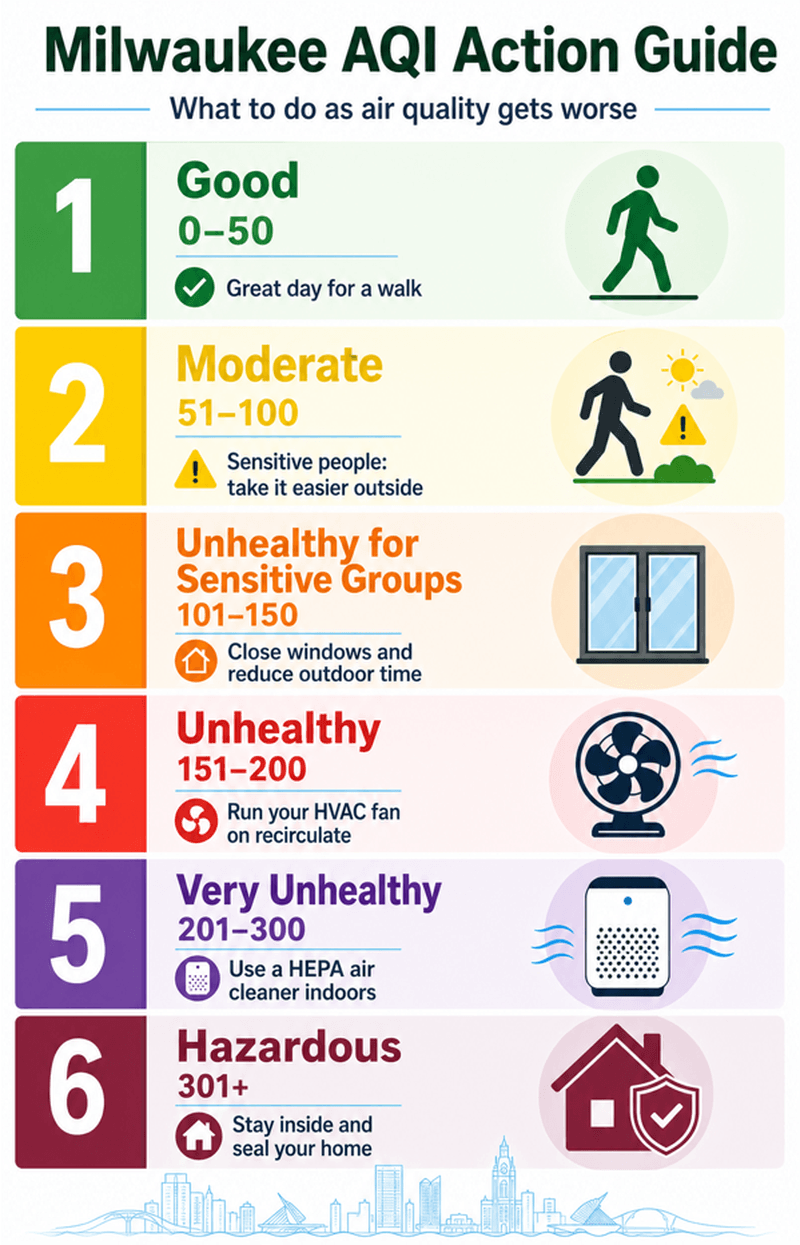
The Air Quality Index, or AQI, converts pollution levels into a 0 to 500 scale with six color-coded categories. On the Fire and Smoke Map, each colored circle reflects the AQI category for particle pollution at that location. Milwaukee residents can use the table below to translate the color they see into a clear sense of risk.
Air Quality Index categories follow the U.S. EPA scale. Check the live AirNow Fire and Smoke Map for current Milwaukee readings.
Who Faces The Greatest Risk From Milwaukee Smoke Events
Wildfire smoke can affect anyone, but several groups face higher risk during a Milwaukee smoke event. The U.S. Centers for Disease Control and Prevention identifies children, older adults, pregnant people, and anyone with asthma, COPD, heart disease, diabetes, or chronic kidney disease as especially sensitive. Outdoor workers also carry higher exposure because they spend long hours in the affected air.
Children, whose lungs are still developing and who breathe more air relative to body size.
Adults over 65, who more often live with heart or lung conditions.
People who are pregnant, for whom smoke exposure is linked to adverse outcomes.
People with asthma, COPD, heart disease, diabetes, or chronic kidney disease.
Outdoor workers and anyone exercising outdoors during a smoke event.
If someone in a sensitive group develops a cough, shortness of breath, or chest discomfort during a smoke event, contact a healthcare provider. This page is educational and does not replace medical advice.
How To Protect Your Home And HVAC System With The Right Air Filter
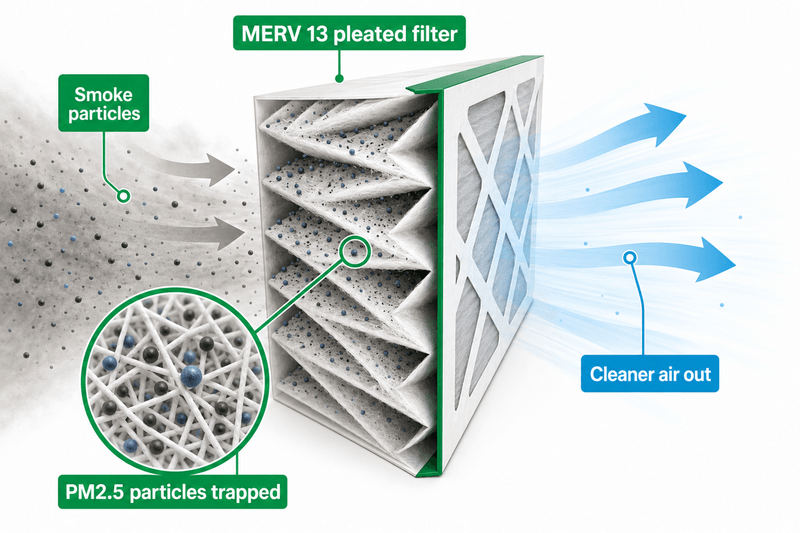
The most effective way to reduce wildfire smoke inside a Milwaukee home is to keep windows closed and run the central HVAC system continuously with a clean, high-efficiency filter rated MERV 13. A MERV 13 filter captures a large share of the fine PM2.5 particles that make up wildfire smoke. MERV 13 is not the same as HEPA, and it reduces rather than removes every particle.
This is the part of a smoke event we know best. We build MERV 13 filters in our United States factories and test them against real-world particles, including wildfire smoke. The lesson that keeps coming back is simple. A high-efficiency filter does little in a house with open windows, but in a closed, recirculating home it does the heavy lifting.
Run The System, Then Seal The Room
Set the HVAC fan to the "On" position rather than "Auto" so air keeps cycling through the filter even when heating or cooling is not running. Close any fresh-air intake and set the system to recirculate so it is not pulling smoky outdoor air inside. The EPA also recommends setting up a clean room, a single room kept as smoke-free as possible, sometimes with a portable air cleaner running.
Why MERV 13 Is The Filtration Sweet Spot For Smoke
MERV stands for Minimum Efficiency Reporting Value, a 1 to 16 scale that rates how well a filter captures airborne particles. Higher MERV numbers capture smaller particles. MERV 13 captures a meaningful share of particles in the PM2.5 range without restricting airflow the way a true HEPA filter would in most residential systems. The American Lung Association recommends replacing an HVAC filter with a MERV 13 or higher rating during smoke events.
If you are unsure what your system can handle, Filterbuy’s guide on which MERV rating to use breaks the choice down by household and HVAC system, and it names wildfire and smoke exposure as a reason to move up to MERV 13.
MERV 13 and HEPA are not interchangeable. HEPA filters belong in portable air cleaners sized for a single room. MERV 13 filters are built for the whole-home airflow of a central HVAC system. A MERV 13 filter in the furnace and a HEPA portable cleaner in a clean room give a Milwaukee home two layers of protection.
During a smoke event, a filter loads with particles quickly and loses airflow, so check it often and plan to install a fresh MERV 13 filter once the smoke clears. A rating higher than your system is built for can restrict airflow, a tradeoff Filterbuy explains in how MERV ratings affect furnace performance. Filterbuy manufactures MERV 13 filters in more than 600 sizes in the United States.
No Air Purifier On Hand? Build A Box-Fan Filter
Portable air cleaners often sell out once a smoke event starts, so it helps to know the backup that public health agencies recommend. A common box fan with a MERV 13 filter taped tightly over the back can pull a large share of fine smoke particles out of the air in one room. The EPA and safety laboratories have tested this setup and found it works well for a single space.
Use a newer box fan, point the arrow on the filter toward the fan so air flows the right way, and seal the edges so air cannot slip around the filter. Run it only while you are awake and in the room, because a box fan made before about 2012 can overheat if it is left unattended. The same MERV 13 filter Filterbuy builds for a furnace fits this job, so one spare filter covers both your HVAC system and a backup cleaner.
When To Act: A Milwaukee Smoke-Day Action Plan By AQI Level
This action plan pairs each Air Quality Index category with a specific step for the outdoors, the HVAC system, and sensitive household members. It turns the color on the map into a decision a Milwaukee family can make in seconds.
This guide is educational and does not replace medical advice. MERV 13 captures and reduces fine smoke particles and is not a HEPA filter.
After manufacturing filters for over a decade and serving more than two million households, we have learned that a smoke day is the hardest test a home filter faces. Wildfire particles are far finer than everyday dust, so a MERV 13 filter in a well-sealed, recirculating home captures a large share of what you would otherwise breathe, and it loads up much faster than in a normal week. My advice to Milwaukee families is to keep a spare on hand and change it the moment the smoke clears, because by then it has already done more work than a filter usually does in a month.
David Heacock, Founder and Chief Executive Officer of Filterbuy
7 Essential Resources
These seven sources give Milwaukee households authoritative, current guidance on wildfire smoke, air quality, and protection at home. Each links to an article-level page from a separate government or nonprofit domain.
1. Source: EPA: Create a Clean Room To Protect Indoor Air Quality During a Wildfire
2. Source: CDC: How To Stay Safe During Wildfire Smoke
3. Source: Wisconsin DNR: Wildfire Smoke and Air Quality
4. Source: American Lung Association: Wildfires and Lung Health
5. Source: Ready.gov: Wildfires Preparedness and Evacuation
6. Source: National Weather Service: Wildfire Ready Safety Guidance
7. Source: OSHA: Wildfires Preparedness for Outdoor Workers
3 Supporting Statistics
All three figures come from United States government agencies or the National Academy of Sciences.
Wildfire smoke is harder on the lungs than everyday pollution. A 10 microgram-per-cubic-meter rise in wildfire PM2.5 was linked to a 1.3 to 10 percent jump in respiratory hospitalizations, compared with 0.67 to 1.3 percent for other PM2.5.
Most smoke starts far from where you breathe it. Researchers traced 87 percent of U.S. smoke PM2.5 to fires in other counties and 60 percent to fires in other states.
Source: Quantifying Fire-Specific Smoke Exposure and Health Impacts (PNAS, 2023)
Wildfires burn millions of acres every year. In 2024, 64,897 U.S. wildfires burned about 8.9 million acres, above the ten-year average.
Source: National Interagency Fire Center: Wildfire Statistics
Final Thoughts And Opinion
Wildfire smoke has become a regular part of Milwaukee summers, and the households that handle it best are the ones that decide what to do before the haze arrives. It takes seconds to check the live map, and a little planning to keep a clean MERV 13 filter on hand. Together they turn a stressful smoke day into a managed one.
At Filterbuy, we build filters because clean indoor air protects the people and the home you care about most. After years of making and testing them, our honest view is that most households treat the filter as an afterthought until a smoke day proves otherwise. A filter cannot stop a fire a thousand miles away, but it can capture and reduce the fine particles that reach your rooms. On a smoke day, that is the part you control.
Next Steps
Bookmark the live AirNow Fire and Smoke Map and check it whenever the sky looks or smells hazy.
Confirm your HVAC system uses a MERV 13 filter, and keep a spare on hand, ideally an American-made Filterbuy MERV 13 in your system’s size.
Choose one room now as your clean room, ideally one with few windows.
Sign up for Wisconsin DNR air quality advisories by email or text so alerts reach you early.
Frequently Asked Questions
Protect Your Milwaukee Home Before The Next Smoke Day
Do not wait for the sky to turn orange. Shop MERV 13 furnace filters from Filterbuy, made in the United States in more than 600 sizes, and keep a clean one ready so your home is set the moment wildfire smoke reaches the metro.
Glossary
Air Quality Index (AQI): A 0 to 500 scale from the EPA that reports how clean or polluted the air is, divided into six color-coded categories from Good to Hazardous.
PM2.5: Fine particulate matter 2.5 microns wide or smaller, the main harmful component of wildfire smoke, small enough to reach deep into the lungs and enter the bloodstream.
MERV: Minimum Efficiency Reporting Value, a 1 to 16 scale rating of how effectively an air filter captures airborne particles.
MERV 13: A high-efficiency rating that captures a large share of PM2.5-range particles in a residential HVAC system. MERV 13 is not HEPA.
HEPA: High-Efficiency Particulate Air, a filter standard used in portable air cleaners for single rooms, not typically installed in residential central HVAC systems.
Fire and Smoke Map: The AirNow Fire and Smoke Map, a live tool from the EPA and U.S. Forest Service showing fire locations, smoke plumes, and PM2.5 readings.
Clean room: A single room kept as smoke-free as possible during a smoke event, with closed windows and often a portable air cleaner running.
HVAC: Heating, ventilation, and air conditioning, the central system that circulates and can filter the air in a home.
N95 respirator: A NIOSH-approved mask that, when correctly fitted, filters most fine particles, including wildfire smoke.
For a general definition of an air filter, see the referenced overview.
Subscribe to wildfire smoke alerts for Milwaukee, WI, to get a heads-up before the next event reaches your area.