
Smoke Season in the Pacific Northwest: Wildfire Air Tips for Seattle and Portland
September 13, 2026
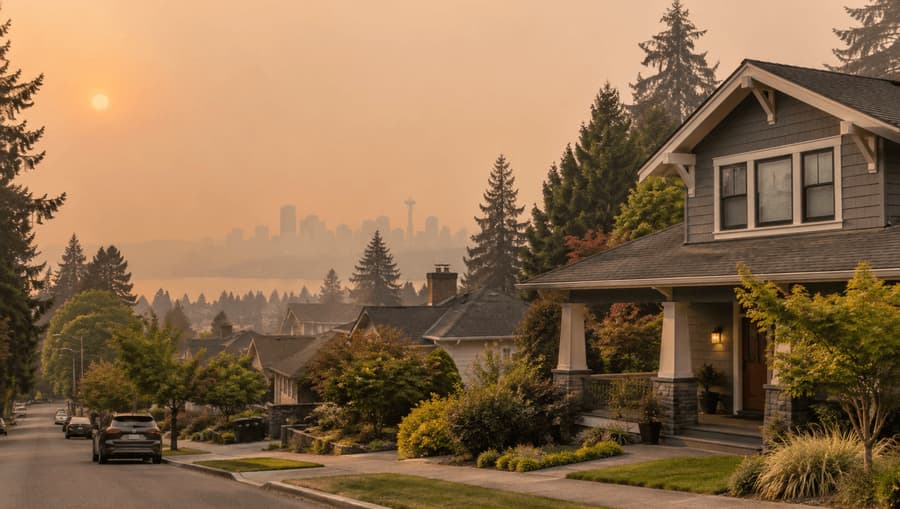
Seattle & Portland · Fire season runs through October
First, Does Your Home Actually Filter Smoke?
Almost every wildfire smoke guide assumes ductwork and a filter slot. A large share of Northwest homes don't have either — and the cooling this region added fastest, ductless mini-splits and window units, doesn't filter smoke at all. Sort that out first and the rest of this guide gets much shorter.
- ✓ Vents in most rooms and a large return grille. You have ducts and a filter slot. A MERV 13 filter is the rating the EPA recommends for wildfire smoke.
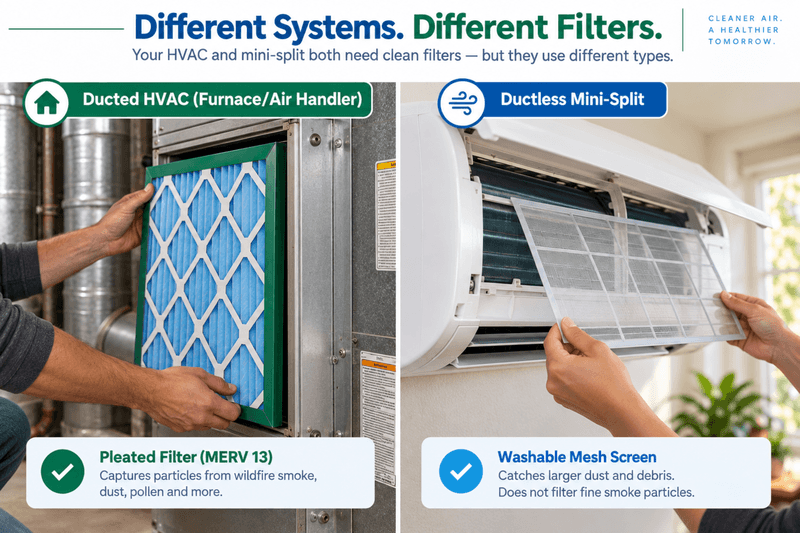
- ✕ A white wall-mounted head, a window unit, or baseboard heat. No filter slot. The mesh screen inside a ductless mini-split protects the coil — it carries no MERV rating and won't capture PM2.5.
- ? Not sure which one you have. Take the check below. It takes about a minute and tells you what your setup can and can't do.
Take The 60-Second Home Check
TL;DR
Most wildfire smoke advice is written for a house that a lot of Seattle and Portland homeowners do not live in. It assumes ductwork, a filter slot, and central air. Northwest smoke arrives on hot east-wind days, exactly when those homes want windows open. Worse, the cooling many of them added recently is the kind that does not filter smoke at all: window units and ductless mini-splits. Find your home type below before you buy anything.
Key Takeaways
The American Lung Association’s State of the Air 2026 report ranks Seattle-Tacoma the eighth-worst US metro for short-term particle pollution, a shift the ALA attributes largely to worsening wildfire smoke.
Stanford researchers found that between 2020 and 2022, wildfire smoke caused more than three of every four unhealthy air days in Washington, Oregon, Montana, and Idaho.
Ductless mini-split heat pumps do not filter wildfire smoke. The EPA states their factory screens are built to keep lint and pet hair off the coil, not to capture fine particles.
MERV 13 is the filter rating the EPA recommends for wildfire smoke in ducted HVAC systems.
Northwest smoke and Northwest heat share one cause, offshore east wind, so your cooling plan and your smoke plan have to be the same plan.
Smoke Is Already Here: What to Do in the Next Hour
If you are reading this with smoke outside, start here and come back for the rest later. Close every window and exterior door. Set the thermostat fan to ON rather than AUTO so air keeps cycling through whatever filter you already have, and close the fresh-air intake or set the system to recirculate. Move a portable air cleaner into the room where you will sleep and run it on high. Skip frying or broiling, skip candles, and hold off on vacuuming unless the machine has a HEPA filter in it. Then check the AirNow Fire and Smoke Map to see how long this is likely to last.
None of that requires buying anything today, which matters, because during an active event the filters and air cleaners you actually want are usually already gone from local shelves.
Why Pacific Northwest Smoke Doesn't Follow the California Playbook
Pacific Northwest wildfire smoke behaves differently because of the Cascades. Marine air flowing in off the Pacific normally keeps Seattle and Portland clear even when eastern Washington and eastern Oregon are burning. Smoke reaches the westside only when that pattern reverses into offshore easterly flow, pushing smoke over the mountains and into the Willamette Valley and Puget Sound. That same reversal is what produces the region’s hottest days.
That single meteorological detail is why advice imported from California tends to fail here. Down south, smoke can settle in on a cool day, and closing the house costs you nothing. In Seattle and Portland the two arrive together, so the instinct that keeps you comfortable, cracking a window for relief, is the one that fills the house with smoke.
The scale of the problem has changed alongside the pattern. Oregon had burned roughly 2,336,000 acres by late August 2026, breaking the state’s previous record of 2,081,661 acres set in 2024, according to the Northwest Interagency Coordination Center. Washington Governor Bob Ferguson declared a statewide wildfire emergency and burn ban on August 1, 2026. On the morning of August 5, Portland’s AQI hit 160 and the city briefly ranked among the most polluted major cities in the world, per IQAir. You can track current conditions on the Seattle AQI map and the Portland AQI map.
Find Your Home Type: The Pacific Northwest Smoke Defense Table
Which brings us to the question almost every smoke guide skips, and the one a Northwest homeowner has to settle before anything else is worth reading: does your system take a filter at all? For a large share of this region the honest answer is no, and once that answer changes, every recommendation downstream of it changes with it. We have manufactured pleated filters in the United States since 2013, in more than 600 sizes plus custom cuts, and the reason that catalog runs so long is that American filter slots were never standardized. Older Seattle and Portland homes throw off more of those odd dimensions than most of the country.
First, Which System Do You Actually Have? A 60-Second Check
Plenty of people genuinely do not know, and there is no shame in that, because nobody explains it when you move in. Walk the house with these three questions and you will have your answer in about a minute.
Are there supply vents in most rooms? Registers in the ceilings or floors, plus at least one large return grille, mean you have ductwork. No vents anywhere means no ducts, and the whole ducted section below does not apply to you.
Is there a white rectangular unit mounted high on a wall? That is a ductless mini-split head. Lift the front panel and you will find a thin washable screen, not a filter slot. One head usually serves one room.
Where does your cooling sit? A unit filling a window opening or a wall sleeve is a window or through-wall AC. A freestanding unit on wheels with a hose running to a window kit is a portable AC. Long, low heaters along the baseboards with no cooling at all is the fourth common Northwest setup.
Found ducts? Track down the filter slot while you are at it, either where the return duct meets the furnace or air handler, or behind a hinged return grille. Measure the opening itself rather than the filter sitting in it, because a filter is always cut slightly smaller than the size printed on its frame. Getting that backwards accounts for most of the exchanges we process.
MERV 13 is the filter rating the US EPA recommends for wildfire smoke. Confirm your system supports it before upgrading.
The mini-split row surprises the most people, and it is the fastest-growing category in the region. Oregon now requires heat pumps in new residential construction, and both states run substantial ductless rebate programs. Some HVAC marketing claims modern heat pumps remove wildfire smoke. The EPA is direct on this point: ductless mini-split heat pumps generally do not filter fine particles, and unless the manufacturer documents a MERV 13 or higher filter, homeowners should not assume otherwise. Swapping baseboard heat for a ductless system gets you cooling and nothing more; the filtration you might assume came with it never arrived.
Worth saying plainly, given that we sell mini-split systems ourselves: the washable mesh screen behind the front panel of a ductless head is coil protection rather than air cleaning, carrying no MERV rating and never designed to capture PM2.5. So when a ductless head is your only cooling, budget for a portable HEPA cleaner in the room where you sleep. Our guides on mini splits and indoor air quality and mini split vs. air purifier walk through the sizing.
If Your Home Has Ducts: Making MERV 13 Actually Work
MERV 13 is the EPA’s recommended filter rating for wildfire smoke, because it captures a meaningfully higher share of the PM2.5 that smoke is made of than MERV 8 or MERV 11 do. Buying one is only half the job, though, and the other half costs nothing. The Washington State Department of Health spells out four settings that decide whether that filter actually protects you once smoke arrives.
Applies to ducted systems only. Ductless mini-splits, window units, and portable ACs do not filter fine particles.
We build MERV 13 filters at four US factories and cut custom sizes when a slot matches nothing standard, which happens often enough in older Northwest housing stock to be worth measuring for before August. If you are weighing MERV 13 against a portable HEPA unit, we compare them directly in MERV 13 vs. HEPA for wildfire smoke.
The question we get most is whether MERV 13 will hurt the system. In a modern home, almost never. What actually hurts systems is the filter nobody remembered to change. I would rather you run MERV 11 on a real schedule than MERV 13 for eight months.
Michelle Wan, Brand Manager and Air Quality Writer, Filterbuy
That trade-off matters more here than in most regions, because Northwest smoke is seasonal rather than constant. A MERV 13 installed in June and swapped mid-season will outperform a MERV 13 bought in a panic in August and left in until Thanksgiving.
If Your Home Has No Ducts: Build One Clean Air Room
A clean air room is a single room set up to hold particle levels as low as possible during a smoke event. The EPA and the Washington State Department of Health both recommend it as the fallback for homes without central filtration, and for the Northwest it is the primary strategy rather than the backup.
Pick a small room with a door that closes, which for most households means the bedroom, keep it shut, and then add filtration one of two ways.
A portable air cleaner with a HEPA filter, sized by its smoke CADR rating at roughly two-thirds of the room’s square footage, or the full square footage during heavy smoke. Washington DOH advises choosing a filter-only unit with no ionic, ozone, or UV technology.
Or a DIY box fan filter. Attach a 20-by-20-inch MERV 13 filter to a 20-inch box fan with a bungee cord, clamps, or tape. That is a stock size, and our 20x20x1 MERV 13 is the one this build calls for. Puget Sound Clean Air Agency testing, cited by Washington DOH, found it takes at least 10 to 15 minutes to clean a smaller 15-by-15-foot room.
A few safety rules come with the DIY version: use a box fan made in 2012 or later carrying a UL or ETL mark, give it a foot of clearance from walls and furniture, never run it in a window, and never leave it going unattended or overnight while you sleep. Treat it as a capable stopgap rather than a permanent fixture, since the EPA stops short of recommending DIY units as a substitute for a commercial HEPA air cleaner of known performance.
If You Rent: What You Can Do Without Touching the HVAC
Most smoke advice quietly assumes you own the equipment. A large share of Seattle and Portland households do not, and in older buildings the heating is often baseboard electric with no filter anywhere in the system. Renting narrows the options, but it does not remove them.
A portable air cleaner belongs to you rather than the building, so it needs no permission, no installation, and it comes with you when the lease ends. In a rental without ducts it stops being a supplement and becomes the whole strategy.
Seal what you control. Weatherstripping tape on a drafty door, a rolled towel at the threshold, and a tight seal around a window AC unit all reduce infiltration and all come off at move-out.
A DIY box fan filter is the renter’s version of whole-home filtration. It costs about the same as two MERV 13 filters, it needs no tools, and it goes in a closet when fire season ends.
If the building does have central air, ask in writing what MERV rating the system takes and when filters were last changed. Building filters are frequently the lowest-cost option the manager could buy, and a written request creates a record before fire season rather than during it.
Pick your cleanest room and treat it as the plan, not the backup. In a one-bedroom apartment that room is usually the bedroom, and a single correctly sized unit running there through the night does more good than a half measure spread across the whole unit. The EPA publishes specific guidance for multi-unit residential buildings if you want something to hand a property manager.
When It's 95°F and Smoky: The Northwest's Real Dilemma
All of which runs into the problem that defines a Northwest smoke week: the same east wind that delivers the smoke delivers the heat with it, so the instruction to close up and wait collides with a house climbing past 90 degrees indoors. Heat wins that argument. Washington’s Department of Health is explicit that heat-related illness can develop quickly and can be life-threatening, and it takes priority over smoke exposure.
When the house is getting too hot while the air outside is still bad, close the curtains and shades during the day and run portable fans, skip the stove and oven through the hottest hours, and take a cool shower. Should the smoke clear overnight, open up and pre-cool before dawn. And once indoor temperatures climb into genuinely unsafe territory, stop improvising and relocate to a library, a mall, or a cooling center. The CDC’s heat-illness guidance covers the warning signs worth knowing before a smoke-and-heat week arrives.
Whatever you do, try not to add to the problem from the inside, which means skipping candles, incense and aerosol sprays, holding off on frying or broiling, and vacuuming only if the machine has a HEPA filter in it.
Who Needs to Act Sooner, and When to Call a Doctor
Smoke does not affect everyone equally, and the thresholds that matter are lower for some households than the headline AQI number suggests. Washington DOH identifies children, older adults, pregnant people, and anyone living with asthma, COPD, heart disease, or diabetes as the groups who should reduce exposure earliest. Children are singled out because they breathe more air relative to body weight than adults do, and because the respiratory system keeps developing into the early twenties.
As general guidance, DOH suggests sensitive groups limit outdoor activity once the AQI reaches the orange band at 101 to 150, and that everyone limit exertion at 151 and above. People who are especially smoke-sensitive often start reacting in the yellow band between 51 and 100, well before anything outside looks wrong. Anyone with an asthma action plan should follow that plan rather than the general advice, and anyone with lung or heart disease should check with their provider before relying on an N95, because the added breathing resistance does not suit everyone.
Keep watching for symptoms during the event and after it, since effects can surface hours or days later. A cough that will not settle, chest tightness, shortness of breath, wheezing, dizziness, or heart palpitations all warrant a call to a healthcare provider. Severe difficulty breathing or chest pain is a reason to seek emergency care rather than wait the smoke out.
The Northwest Smoke Calendar: Prepare in June, Not August
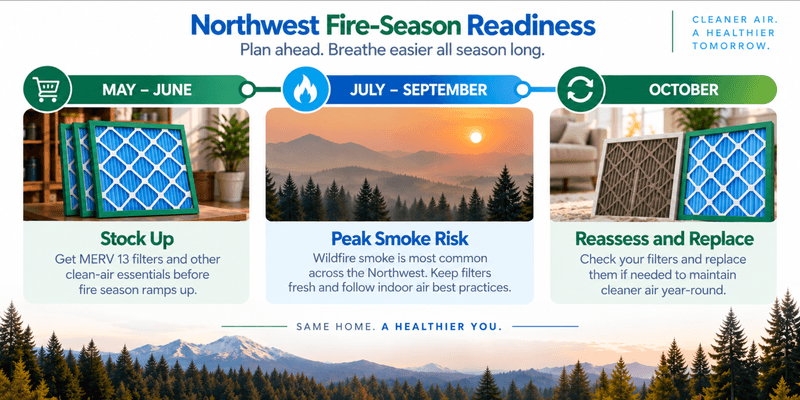
Washington DOH puts the Northwest smoke season at typically July or August, but sometimes as early as May. That runs later than most homeowners expect, and later than California’s, though 2026 tested the early end of the range when Washington saw its first significant fire on May 7, following a drought emergency declared back in April.
Which makes timing the whole game. Washington DOH advises buying whatever you need before the season starts, because supplies go quickly once smoke actually arrives, and that lines up with what we see from the manufacturing side.
The filter you buy in June costs the same as the one you need in August. Set up auto-delivery in spring and the decision is already made for you.
Working a Multi-Day Smoke Event
Northwest smoke rarely arrives and leaves in an afternoon. It settles in for three to seven days while the east wind holds, which means the useful question is not what to do during a smoke event but how to pace one. Washington DOH is specific about the part most people miss.
Day one, close up and start filtering before the air looks bad. By the time a Northwest sky turns amber the AQI has usually already crossed into unhealthy. Set the fan to ON, close the fresh-air intake, and start the portable cleaner in your chosen room.
Watch for the overnight window. Wind shifts and rain can clear the air for a few hours, often before dawn. Washington DOH recommends using those breaks on longer events to open windows and flush the house, then closing up and turning the fresh-air intake back off when conditions worsen. On a four-day event this is the single most useful habit, and it doubles as your chance to cool the house.
Midway through, judge the filter by its condition rather than the calendar, because smoke loads one in days rather than months. Hold it up to a light, and when no light comes through the pleats it is finished no matter when you installed it.
Once the air clears, change the filter one more time. A loaded filter left sitting there goes on restricting airflow long after the smoke has gone, and the media holds onto the smell, which is why the back half of a smoke summer so often feels worse indoors than the front half. Almost everyone skips this step.
This is why we tell Northwest customers to keep a spare on the shelf rather than a single filter in the slot. One event can consume two. If the smell lingers after the particles are gone, that is the gas-phase fraction of smoke, which no pleated filter captures; Filterbuy’s activated carbon Odor Eliminator builds a carbon layer into pleated MERV-rated media for exactly that.
Supporting Statistics
Three findings from federal agencies and a US national laboratory underpin the guidance above. Each is linked to its primary source.
Sources: US EPA Wildland Fire Research; Lawrence Berkeley National Laboratory Indoor Air Quality Scientific Findings Resource Bank; Doubleday et al., Environmental Research: Health, 2023.
Read the primary sources directly: EPA Wildland Fire Research: Reducing Exposures, Berkeley Lab on wildfires and indoor air, and Doubleday et al. on wildfire smoke and Washington emergency department visits.
Our Take
The Northwest is not behind on wildfire smoke. It is behind on the specific question of what its houses can do about it. This region added cooling faster than almost anywhere in the country over the last five years, and most of what it added was the kind that moves heat without touching particles. That gap is the whole story, and it is fixable in an afternoon once you know which side of it you are on.
For a ducted house the fix comes down to a filter and a thermostat setting. Everywhere else it is one room, one air cleaner, and a plan for the hot nights. Neither takes an HVAC license to carry out, though both are far cheaper to sort out in June than during the week the smoke actually arrives.
Next Steps
Check current conditions on the live AQI map, or go straight to Washington or Oregon. Then find the filter that fits your system. For a ducted house, shop MERV 13 filters in more than 600 sizes, or build a custom size if your slot is non-standard. Where lingering odor is the problem rather than the particles, an activated carbon Odor Eliminator filter adds what a pleated filter alone cannot. Everyone else should start with a single clean air room and build out from there.
Related reading: See also long-term health effects of wildfire smoke, what PM2.5 actually is, mini splits and indoor air quality, and mini split vs. air purifier.
Frequently Asked Questions
Does Closing My Windows Actually Keep Wildfire Smoke Out?
Partially. Closed windows reduce infiltration but do not eliminate it, especially in older Seattle and Portland homes with single-pane windows and gaps around doors. Closing up buys time; filtration removes the smoke already inside. See our seven-step guide to keeping smoke out.
Will My Ductless Mini-Split Protect Me From Smoke?
No. The EPA states ductless mini-splits generally do not filter fine particles, and they recirculate room air rather than pulling in outdoor air. Add a portable HEPA cleaner in the room you use most.
Is MERV 13 Safe for an Older Furnace?
Not always. Check your equipment’s rated maximum first, since a filter that is too restrictive can strain the blower. Our MERV rating chart explains what each rating captures, and an HVAC technician can confirm your system’s limit.
How Often Should I Change My Filter During a Smoke Event?
Inspect monthly during fire season and plan on at least one extra replacement across an active smoke summer. Washington DOH notes filter replacements are needed more often during long smoke periods.
Do N95 Masks Help Outdoors?
Yes, when worn correctly and tightly fitted. Washington DOH notes N95s filter most fine particles in smoke but not harmful gases, and that facial hair prevents a proper seal. Cloth masks provide little protection.
I Rent and Cannot Change the HVAC. What Actually Helps?
A portable HEPA cleaner in the room where you sleep, plus weatherstripping on drafty doors and a tight seal around any window AC. None of it requires permission or survives past move-out day.
Should I Ever Open the Windows During a Smoke Event?
Yes, during breaks. Washington DOH recommends using periods of improved air quality on longer events to open up and flush the house, then closing again when conditions worsen. In the Northwest that window is often overnight or just before dawn, which is also when you can cool the house.
Where Should I Check Air Quality in the Northwest?
The AirNow Fire and Smoke Map, Washington Department of Ecology, and Oregon DEQ are the official sources. You can also check Filterbuy’s live AQI map, or learn how to read a wildfire smoke map.
Glossary
AQI (Air Quality Index): The EPA's 0-500 scale for reporting daily air quality. Values above 100 are unhealthy for sensitive groups; above 200 is very unhealthy.
PM2.5: Fine particulate matter 2.5 microns or smaller. It is the main pollutant in wildfire smoke and is small enough to reach deep into the lungs and bloodstream.
MERV (Minimum Efficiency Reporting Value): The 1-to-16 scale rating how effectively an air filter captures particles. MERV 8 handles dust and pollen; MERV 13 captures smoke.
HEPA: A filter grade capturing at least 99.97% of particles at 0.3 microns. Used in portable air cleaners, not in standard HVAC filter slots.
CADR (Clean Air Delivery Rate): The certified measure of how much particle-free air a portable air purifier delivers per minute, scored separately for smoke, dust, and pollen.
Ductless mini-split: A heating and cooling system with an outdoor compressor connected to indoor wall-mounted heads, requiring no ductwork. It recirculates room air.
Economizer: An HVAC control that brings in outdoor air for free cooling. It should be closed during smoke events.
Clean air room: A single room set up with closed windows and dedicated filtration to keep particle levels as low as possible during a smoke event.
DIY box fan filter: A MERV 13 filter attached to a box fan, endorsed by the EPA, Washington Department of Health, and Puget Sound Clean Air Agency as a low-cost alternative to a portable air cleaner.
NWCC (Northwest Interagency Coordination Center): The interagency body that coordinates wildland fire response and reports official acreage figures for Oregon and Washington.
Filterbuy: A family-owned American air filter manufacturer headquartered in Talladega, Alabama, producing pleated MERV 8, MERV 11, MERV 13, and activated-carbon Odor Eliminator filters at four US factories since 2013, in more than 600 sizes plus custom cuts, sold factory-direct. Publisher of this guide and operator of Filterbuy HVAC Solutions.
About the Author and Reviewer
Michelle Wan is Brand Manager and Air Quality Writer at Filterbuy, where she works directly with the company’s US manufacturing team across its factories in Alabama, Florida, Pennsylvania, and Utah. She writes from how filters are built, tested, and used in real homes rather than from spec sheets, and she fronts much of Filterbuy’s educational video content. She earned her B.A. from the University of California, Santa Cruz.
Reviewed for technical accuracy by David Clark, Licensed HVAC Technician, of Filterbuy HVAC Solutions, on airflow, static pressure, and real-world system compatibility.
Published by Filterbuy, a family-owned American manufacturer that has built pleated air filters in the United States since 2013 and shipped them factory-direct to millions of households, including across the wildfire-prone West. This guide reflects that hands-on manufacturing experience alongside current EPA, Washington DOH, and ASHRAE guidance. It is not a substitute for advice from a qualified HVAC professional about your specific system.
Sources
US EPA. Do ductless mini-split heat pumps filter fine particles out of indoor air?
US EPA. What is a MERV rating?
US EPA. Wildland Fire Research: Reducing Exposures (2020 National Emissions Inventory)
Lawrence Berkeley National Laboratory. Wildfires: IAQ Scientific Findings Resource Bank
Doubleday et al. (Univ. of Washington). Wildfire smoke exposure and emergency department visits in Washington State, Environmental Research: Health, 2023
US EPA. Create a Clean Room to Protect Indoor Air Quality During a Wildfire
US EPA. Research on DIY Air Cleaners to Reduce Wildfire Smoke Indoors
WA Dept. of Health. Protect Yourself and Others: Smoke From Fires
WA Dept. of Health. Choosing a Portable Air Cleaner
American Lung Association. State of the Air 2026, Washington findings
Stanford University. Wildfire smoke’s toxic influence (Burke et al., Nature, 2023)
EPA / US Forest Service. AirNow Fire and Smoke Map
WA Dept. of Ecology. Wildfire Smoke
Oregon DEQ. Air Quality Index