
Seattle Real-Time AQI Tracker


Get Alerts For Unhealthy AQI In Your Area
When air quality in your area reaches unhealthy levels, we'll send you a quick alert, along with expert tips on how to reduce your exposure.
What's Actually In Seattle Air Today?
What High AQI Means for Your Lungs in Seattle
How to Read AQI
The Air Quality Index (AQI) measures how polluted the air is and how it may affect your health.
0–50 (Good): Air quality is satisfactory.
51–100 (Moderate): Acceptable, but some pollutants may pose minor concerns.
101–150 (Unhealthy for Sensitive Groups)
151–200 (Unhealthy)
201–300 (Very Unhealthy)
301+ (Hazardous)
Moderate
Still okay for most, but if you have asthma or allergies, take it easy and avoid long outdoor workouts.
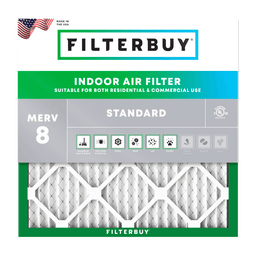
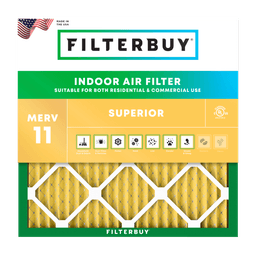
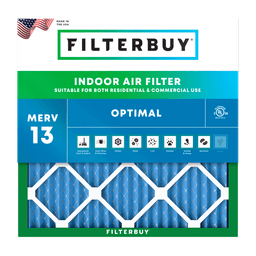
Shop MERV 11 filters→What's the Right Filter for Your AQI Level?

Check Today's Live Real Time Air Quality Index AQI Map in Seattle, WA Now
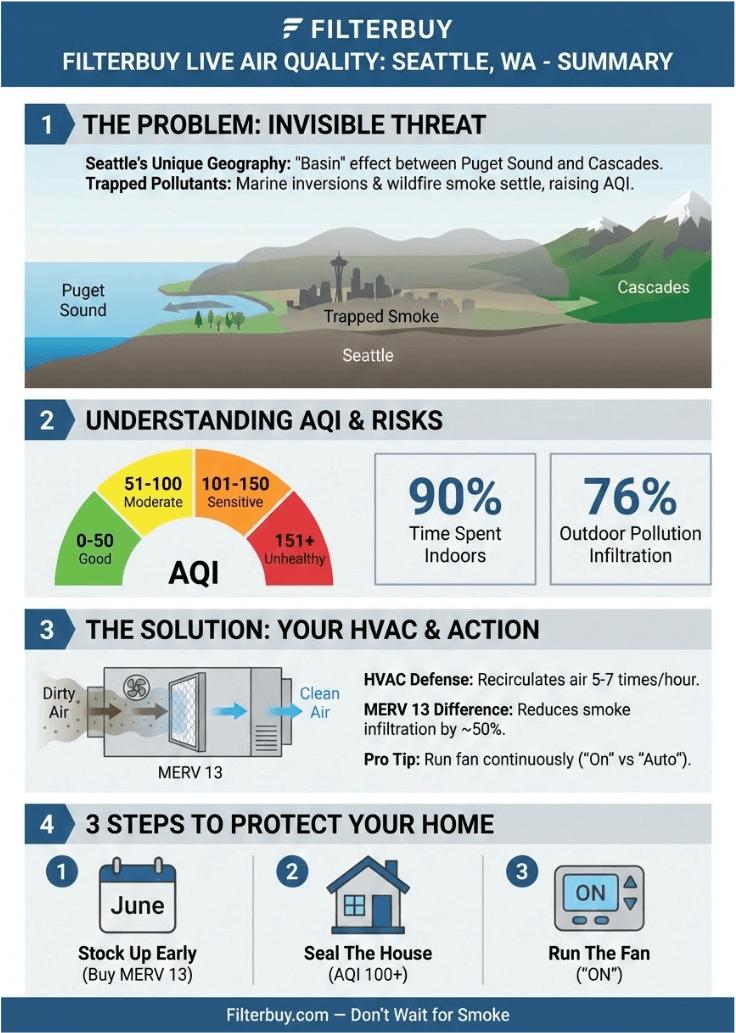
What's really floating through Seattle's air right now? This map reveals what your eyes can't see—from Puget Sound marine layers trapping pollutants to wildfire smoke drifting over the Cascades.
After manufacturing over 10 million air filters and serving more than two million American households since 2013, we've seen firsthand how outdoor air quality directly impacts what families breathe inside their homes. Our data shows that Seattle homeowners often assume their indoor air is cleaner than what's outside—but without proper filtration, your HVAC system can actually circulate and concentrate those same outdoor pollutants throughout every room.
Below you'll find current AQI readings, what each level means for your family's health, and the specific filtration strategies that work best when outdoor conditions turn poor.
TL;DR Quick Answers
Live Air Quality Index AQI Map Now Today in Seattle Washington
Current Seattle AQI: Check real-time readings at EPA AirNow for official government data.
What we've learned serving Pacific Northwest households: Seattle's AQI can shift dramatically within hours—especially during wildfire season when smoke from Eastern Washington and British Columbia settles into the Puget Sound basin.
Key facts:
AQI 0-50: Good – No precautions needed
AQI 51-100: Moderate – Sensitive individuals should monitor
AQI 101-150: Unhealthy for Sensitive Groups – Limit outdoor exertion
AQI 151+: Unhealthy to Hazardous – Take indoor air protection seriously
Critical insight from our experience: Outdoor AQI directly impacts indoor air. Research shows 49-76% of outdoor pollution infiltrates homes without proper filtration. Your HVAC filter is your primary defense—MERV 13 provides optimal protection during Seattle smoke events.
Top 5 Takeaways
Seattle's AQI changes rapidly. Wildfire smoke can push readings from Moderate to Hazardous within hours.
Outdoor pollution infiltrates your home. Closed windows aren't enough. Research shows 49-76% of outdoor PM2.5 enters homes during smoke events.
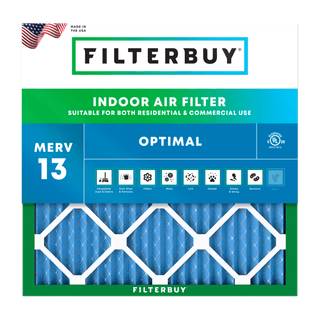
Your HVAC filter is your primary defense. MERV 13 filtration reduces smoke infiltration by approximately 50%. After serving over two million households, we've seen this difference firsthand.
Prepare before fire season. Stock MERV 13 filters by June. Same cost now as in August—but with peace of mind when smoke arrives.
Act early at AQI 75-100. Don't wait for "Unhealthy" warnings. Families with children, elderly members, or respiratory sensitivities should start protection measures sooner.
Understanding Seattle's Current Air Quality Index
The city's location between Puget Sound and the Cascade Range gives the atmosphere certain properties that mean pollutants get close mounded up to ground level at times. Marine air inversions, which are common in the fall and winter months, can trap vehicle emissions, wood smoke, and industrial particles for days.
During last summer and into early fall, wildfire smoke from Eastern Washington, Oregon, and British Columbia regularly puts AQI readings in unhealthy ranges - sometimes more than 150 or higher.

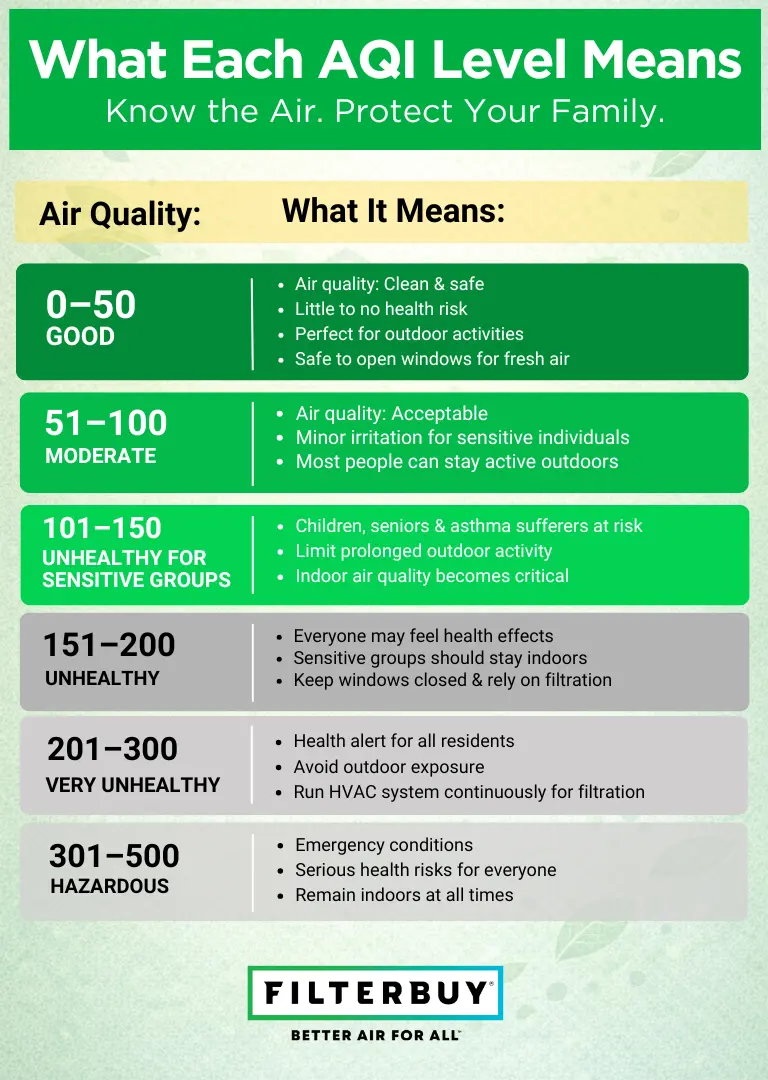
What Each AQI Level Means for Your Health
0-50 (Good): Little to no risk in the air quality. Best conditions for outdoor activities and natural ventilation during open windows.
51-100 (Moderate): Acceptable to most people, but unusually sensitive people may be irritated.
101-150 (Unhealthy for Sensitive Groups): Children, older adults, and those with asthma or heart conditions should limit prolonged outdoor exertion. This is when indoor air quality management is crucial.
151-200 (Unhealthy): Everyone may start to feel the effects of poor health. Sensitive groups should not go outside at all. Why spoil your air conditioning system's performance by opening windows when there is good filtration for your system?
201-300 (Very Unhealthy): Health emergency broadcasting to all residents. Stay indoors with windows and doors shut.
301-500 (Hazardous): Emergency conditions requiring all to stay indoors.
Why Outdoor AQI Directly Impacts Your Indoor Air
Your home isn't sealed. Air seeps in through doors and windows and makes its way into the construction through gaps, most notably, through the fresh air intake of your heating and cooling system.
During poor air quality index days, upgrading to a higher-efficiency filter transforms your HVAC system from part of the problem into your home's primary air cleaning mechanism.
Protecting Your Indoor Air When Seattle's AQI Rises
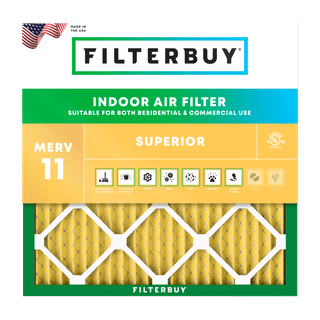
Upgrade your filter's MERV rating. Standard fiberglass filters do not trap over 20% of fine particles. MERV 11 filters are most effective at catching small particles in the air.
Run your HVAC fan continuously. Setting your thermostat fan to "on" rather than "auto" keeps air cycling through your filter even when heating or cooling isn't needed. During smoke events, this single change can noticeably improve indoor air quality within hours.
"Most people don't realize their HVAC system cycles air through their home 5-7 times per hour—which means during poor AQI days, an inadequate filter isn't just failing to help, it's actively redistributing outdoor pollutants into every room your family occupies."
— Filterbuy Air Quality Team
Essential Resources on Live Air Quality Index AQI Map in Seattle, Washington
Don't take Seattle's air quality for granted - What you can't see floating through Puget Sound's marine air could be affecting your family right now.
Here are the top resources we recommend to every Seattle-area household. Bookmark these now, before you need them.
1. EPA AirNow Fire and Smoke Map
This is the gold standard for real-time air quality data, and it's where we point customers when they ask what's actually happening in Seattle's air right now. The interactive map combines official EPA monitoring stations with wildfire locations and smoke plume tracking, giving you both current AQI readings and forecasts up to five days ahead. During wildfire season, this resource becomes essential for planning everything from outdoor activities to filter replacement schedules.
2. Puget Sound Clean Air Agency (PSCAA) Sensor Map
Here's something most Seattle homeowners don't realize: air quality can vary dramatically from neighborhood to neighborhood, sometimes by 50 AQI points or more during smoke events. The Puget Sound Clean Air Agency solved this problem by building a calibrated sensor network across King, Kitsap, Pierce, and Snohomish Counties—over 90% of the four-county population now lives within 5 kilometers of a fine particle sensor. When you need hyperlocal data for your specific area rather than a citywide average, this is where you go.
https://pscleanair.gov/SensorMap
3. Washington Smoke Blog
From July through October, it should be a part of your morning routine to check out this blog, which tells you not only what is going on today, but what's destined for Seattle over the next several days.
4. Washington State Department of Ecology Air Quality Map
This resource makes evidence-based health recommendations - not generic advice, but specific advice about children, pregnant individuals, older people, and people with respiratory or heart conditions.
https://ecology.wa.gov/air-climate/air-quality/smoke-fire/wildfire-smoke
5. Washington State Department of Health Wildfire Smoke Guidance
It offers specific guidance for children, pregnant individuals, older adults, and those with respiratory or heart conditions. It also includes actionable steps for improving indoor air quality, from creating a "clean air room" to understanding when your HVAC filter becomes your primary line of defense.
https://doh.wa.gov/community-and-environment/air-quality/smoke-fires
6. AlertSeattle Emergency Notifications
It delivers real-time notifications via text, email, or phone when levels reach unhealthy situations, giving you time to close windows, run your filtration system, and take protective action before pollutants infiltrate your home. Sign up once, and you'll never be caught off guard by a sudden smoke event again.
7. King County Public Health Wildfire Smoke Preparedness
It provides DIY air filter instructions, cooling center locations for combined heat and smoke events, and specific recommendations for schools and youth activities. When you need guidance that's tailored to King County's unique conditions rather than generic national advice, start here.
Supporting Statistics
What a Decade of Manufacturing Has Taught Us About These Numbers
Statistics tell one story. The filters we see come back from customers tell another story.
After manufacturing over 10 million air filters across our American facilities and serving more than two million households since 2013, we've developed a ground-level perspective on indoor air quality that federal research continues to validate.
The 90% Reality: Why Your HVAC System Works Harder Than You Think
The U.S. Environmental Protection Agency confirms Americans spend approximately 90% of their time indoors—breathing air that's often 2 to 5 times more polluted than outside air.
Source: U.S. Environmental Protection Agency – Indoor Air Quality
What this means for your home:
Your HVAC system cycles your entire home's air volume multiple times daily
Every particle, allergen, and pollutant passes through your filter—or bypasses it entirely if filtration is inadequate
Location doesn't matter: the EPA's TEAM Study found elevated indoor pollution in rural and industrial areas alike
What we've observed firsthand:
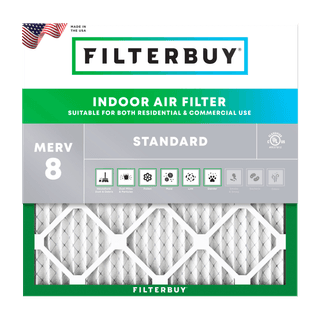
When customers return used filters after 90 days, the difference between MERV 8 and MERV 13 is striking. Higher-rated filters appear darker and denser with trapped particulates. That's not dirt from poor housekeeping—it's the invisible contamination the EPA references, finally made visible. We learned this filter by filter, customer by customer, watching what standard filtration misses.
26.8 Million Reasons Why Filter Selection Isn't About Price
The American Lung Association reports 26.8 million Americans currently live with asthma—roughly 1 in 12 people, including 4.5 million children.
Source: American Lung Association – Asthma Trends Brief
That number represents real families we hear from every week:
The Bellevue mother whose daughter's nighttime coughing decreased after switching to MERV 13
The retired Tacoma teacher who connected chronic congestion to years of builder-grade filters
The West Seattle father who researched filtration after his son's pediatrician asked about home air quality
What these conversations taught us:
For households managing respiratory sensitivities, the filter isn't a maintenance item—it's a health decision. The $4 fiberglass panel and the $15 MERV 13 pleated filter aren't comparable products, even though they fit the same slot. The 26.8 million Americans with asthma deserve to know the difference.
Wildfire Infiltration: The Number That Changed Our West Coast Recommendations
Lawrence Berkeley National Laboratory research revealed data that fundamentally shifted our guidance for Pacific Northwest households.
Source: Lawrence Berkeley National Laboratory – Wildfires and Indoor Air Quality
Final Thoughts and Opinion
Our Take: Seattle's Air Quality Challenge Is Really an Indoor Air Opportunity
After more than a decade of manufacturing air filters and helping over two million households breathe easier, we've developed a perspective on Seattle's air quality situation that might surprise you: the city's AQI challenges are actually creating smarter, more air-aware homeowners.
What We've Witnessed in the Pacific Northwest
When we first started serving Seattle-area customers, most treated air filter changes as an afterthought. That's changed dramatically.
Today, Pacific Northwest households are among our most informed customers:
They understand MERV ratings and what each level actually filters
They recognize the difference between nominal and actual filter dimensions
They know exactly why MERV 13 matters when wildfire smoke arrives
This shift didn't happen because of marketing. It happened because Seattle families experienced poor air quality firsthand and decided to take control of their indoor environment.
Why We're Optimistic About Seattle's Indoor Air Future
The statistics paint a sobering picture:
90% of life spent indoors—often breathing air 2-5x more polluted than outside
26.8 million Americans are managing asthma, where indoor triggers matter enormously
Wildfire smoke infiltrates homes at 49-76% of outdoor concentrations—without intervention
Yet we remain genuinely optimistic. Here's why:
Customers who once ordered the cheapest filter now ask detailed questions about MERV ratings and particle capture efficiency.
Families proactively stock MERV 13 filters before fire season rather than scrambling when smoke arrives.s
Homeowners increasingly view filtration as health infrastructure, not just HVAC maintenance.
We've watched Seattle homeowners respond to these realities with action, not resignation.
Next Steps
Take Control of Your Indoor Air Quality Today
Understanding Seattle's air quality is the first step. Taking action is what actually protects your family.
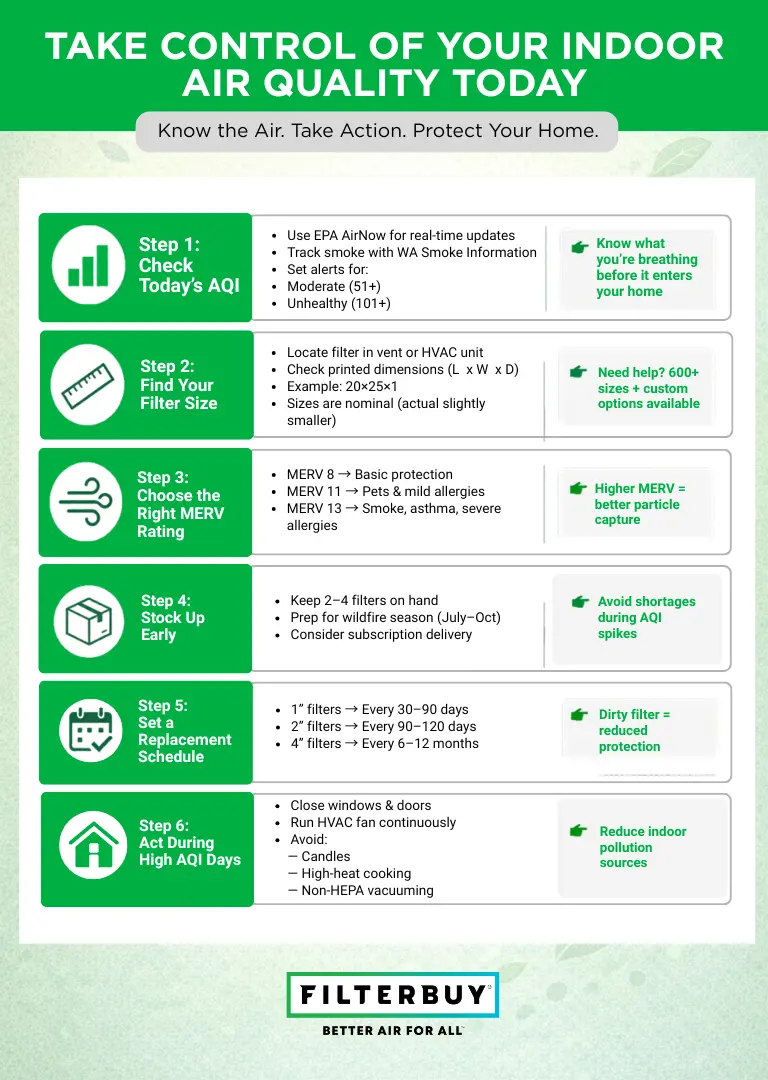
Step 1: Check Today's Seattle AQI
Know what you're dealing with.
EPA AirNow – Seattle – Official real-time AQI data
Washington Smoke Information – Wildfire smoke tracking
Set up smartphone alerts for AQI levels of Moderate (51+) or Unhealthy for Sensitive Groups (101+).
Step 2: Find Your Current Filter Size
How to find your size:
Locate your current filter in the return air vent or HVAC unit
Check the dimensions printed on the filter frame
Note all three measurements: length × width × depth (e.g., 20x25x1)
Note: Printed sizes are nominal. Actual dimensions are typically ¼" to ½" smaller. Match the nominal size when ordering.
Can't find a standard size? We manufacture over 600 sizes and offer custom options.
Step 3: Choose the Right MERV Rating
Match your filter to your household's needs.
Quick guide:
No pets, no allergies: Go for MERV 8
Pets or mild allergies: Go for MERV 11
Asthma, severe allergies, or smoke season: Go for MERV 13
Step 4: Stock Up Before You Need To
Don't wait until AQI spikes to realize you're out of filters.
Seattle household recommendation:
Keep 2-4 replacement filters on hand
Stock MERV 13 before fire season (July–October)
Consider subscription delivery for automatic replenishment
During major smoke events, regional filter demand spikes. Stock up in advance.
Step 5: Set a Replacement Schedule
A clogged filter can't protect you.
Standard replacement timeline:
1-inch filters: Every 30-90 days
2-inch filters: Every 90-120 days
4-inch filters: Every 6-12 months
Step 6: Maximize Protection During Poor AQI Days
When AQI spikes, take immediate action:
Close all windows and exterior doors
Run HVAC fan continuously (switch from "Auto" to "On")
Avoid candles, high-heat cooking, and non-HEPA vacuuming
Frequently Asked Questions
Q: Where can I find the most accurate live AQI map for Seattle right now?
A: After years of helping Pacific Northwest customers navigate air quality concerns, we recommend three reliable sources—each serving a different purpose.
Official AQI Data:
EPA AirNow – Government-operated monitoring stations, real-time readings
Washington Smoke Information – Wildfire smoke tracking and forecasts
What we've learned from customer conversations:
No single source tells the complete story. AirNow might show Moderate conditions while smoke is visibly rolling into your neighborhood.
Q: What AQI level is considered unsafe in Seattle, and when should I be concerned?
A: The EPA provides the official framework. After serving over two million households, we've developed a practical perspective on what these numbers mean for daily decisions.
What we've observed from Seattle-area customers:
The real inflection point is around AQI 100
MERV 13 filter orders increase noticeably at this level
Customer calls about indoor air protection spike
By AQI 150, first-time customers want to understand MERV ratings
Our honest take: If you have children, elderly family members, or anyone with respiratory sensitivities, start paying attention at AQI 75+. Don't wait for "Unhealthy" ratings to take indoor air seriously.
Q: Why does Seattle's AQI change so dramatically, and how often should I check it?
A: Seattle's air quality volatility surprised us when we first started serving Pacific Northwest customers. Conditions shift faster and more dramatically than in most regions.
What makes Seattle unique:
Geographic positioning: Cascades to the east, Olympics to the west, create a basin that traps pollutants
Wildfire smoke: Eastern Washington, Oregon, and British Columbia fires send smoke that settles rather than passes through
Temperature inversions: Cool air trapped beneath warmer layers concentrates pollutants near ground level
Our practical recommendation:
Stable summer conditions: Check once daily
Regional wildfires reported (even hundreds of miles away): Check every few hours
Active smoke event: Check before any outdoor activity
Wind shifts happen without warning. Smoke arrives faster than forecasts predict.
Q: Does poor outdoor AQI in Seattle affect the air inside my home?
A: Yes—and the degree to which outdoor air infiltrates homes shocked us when we first saw the research quantified.
What we learned about homes that fared best:
Upgraded HVAC filtration (MERV 11 minimum, MERV 13 ideal)
Continuous fan operation to keep air cycling through filters
Supplemental portable HEPA purifiers in key rooms
The research confirms: Proper filtration can reduce smoke infiltration by approximately 50%.
This experience changed our recommendations. We no longer present MERV 13 as a premium upgrade for Seattle customers. It's baseline protection for anyone within range of West Coast wildfire smoke.
Q: How can I protect my family's indoor air when Seattle's AQI is unhealthy?
A: After helping thousands of Pacific Northwest families through poor air quality events, we've identified what separates prepared households from those caught off guard.
What prepared families do differently:
Stock MERV 13 filters in June, before fire season begins
Know their filter size without having to check
Identify which rooms feel cleanest during poor air days
Have a plan for where the family will spend most of their time
Immediate actions when AQI spikes:
Close every window and exterior door—even brief openings let in hours' worth of particulates
Switch the HVAC fan from "Auto" to "On" for continuous air cycling
Stop adding indoor pollutants:
No candles
Minimize gas stove use
Skip vacuuming unless you have HEPA filtration
What matters most based on customer feedback:
Your HVAC filter is processing your home's entire air volume multiple times daily. During smoke events, nothing else matters as much as what's installed in that filter slot.
Supplemental protection:
Portable HEPA purifiers work well in bedrooms (6-8 hours of breathing the same air)
They supplement proper HVAC filtration—they don't replace it
The lesson we keep relearning:
Every major smoke event, customers tell us they meant to upgrade but didn't get around to it. They watched AQI climb while running a basic MERV 8—or worse, a fiberglass panel.
The bottom line: The MERV 13 filter you buy in June costs the same as the one you desperately need in August. The difference is peace of mind when smoke appears, and your home is already protected.
Take Control of Your Indoor Air When Seattle's AQI Matters Most
Don't let today's live air quality index reading determine what your family breathes inside your home. Shop MERV 13 filters now from Filterbuy and transform your HVAC system into Seattle's most reliable defense against outdoor pollution.