February 9, 2026
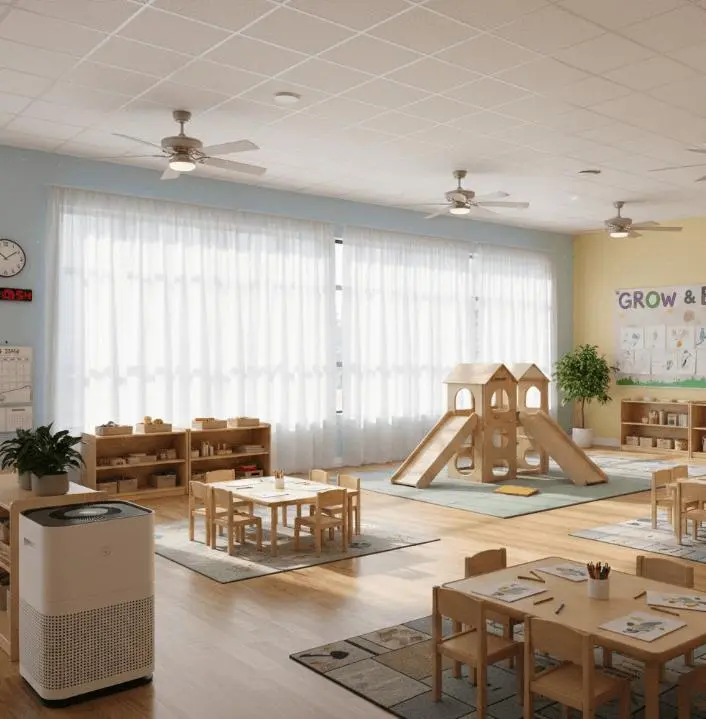
Children spend most of their day indoors at school or daycare, and the air they're breathing is only as clean as the filter protecting their HVAC system. From our experience manufacturing millions of filters for schools and commercial facilities across the U.S., we've seen firsthand how the wrong MERV rating can either leave harmful particles circulating through classrooms or strain an HVAC system that wasn't built to handle high-restriction filters.
The sweet spot matters — and it's different for every building. We work directly with facility managers and daycare operators every day to match the right MERV rating to their specific system, budget, and air quality concerns. Here's what we've learned about which filters actually perform best in educational environments, what each MERV level captures, and how to avoid the costly mistakes we see most often.
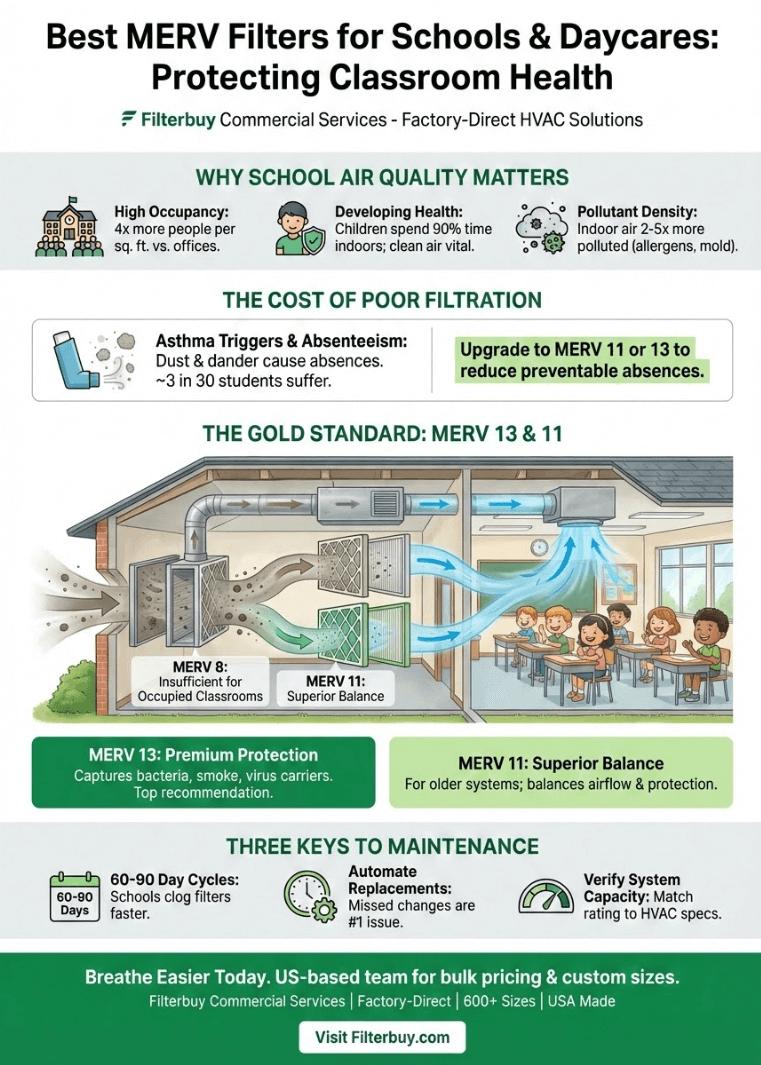
Short answer: MERV 13 is the best choice. MERV 11 is the minimum we recommend.
Here's why—based on our experience supplying filters to schools and daycares nationwide:
MERV 13 captures bacteria, mold spores, pollen, dander, and some virus carriers. It's the highest rating most school HVAC systems can handle.
MERV 11 is a strong alternative when HVAC systems can't support MERV 13. It still captures the most common classroom triggers.
MERV 8 is not enough for occupied classrooms. It misses the finer particles that affect student health and attendance.
Three things that matter just as much as the rating:
Replace air filters every 60–90 days. Schools clog filters faster than other buildings.
Verify your HVAC system's capacity. The best air filter is one that your system can run efficiently.
Automate replacements. Missed filter changes are the #1 air quality problem we see in schools.
Filterbuy manufactures MERV 8, 11, and 13 filters in the USA across 600+ sizes—with custom sizing, bulk pricing, and auto-delivery built for schools. Filters ship fast, free, and factory-direct.
Go with MERV 11 or MERV 13. They capture what lower-rated filters miss—mold spores, dander, bacteria. Choose based on your HVAC system's capacity.
School air is often 2–5x more polluted than outdoor air. More kids per square foot means more airborne particles. Your filters need to keep up.
A dirty filter is worse than a lower-rated clean one. Don't skip replacements. Change every 60–90 days during the school year.
Set it and forget it with auto-delivery. Filters show up on schedule. No missed changes. No last-minute scrambling.
We ship factory-direct with 600+ sizes and custom options. American-made quality. No middlemen. Our team helps you find the right fit.
Schools and daycares aren't like offices or retail spaces. You're dealing with higher occupant density, developing immune systems, and a constant cycle of seasonal illnesses moving through classrooms. Add in art supplies, cleaning chemicals, outdoor allergens tracked in on shoes, and pet dander from homes, and the air inside a school can carry significantly more contaminants than a typical commercial space.
A properly rated MERV filter is the first line of defense. MERV stands for Minimum Efficiency Reporting Value, and it tells you how effectively a filter captures airborne particles of different sizes. The higher the rating, the smaller the particles it traps. But higher isn't always better — it depends entirely on what your HVAC system can handle.
Based on our work with educational facilities nationwide, here's how the most common MERV levels perform in school environments:
MERV 8 captures dust, pollen, and lint — the basics. It's a reasonable baseline for buildings with newer HVAC systems and low occupancy, but for most schools and daycares, it leaves too many smaller particles unfiltered. We typically recommend this only as a minimum starting point for facilities with tight budgets and lower-risk environments.
MERV 11 is where we see the biggest improvement for most school settings. It captures mold spores, pet dander, dust mite debris, and finer particulate matter that MERV 8 misses. For daycares and elementary schools, especially, this is often the best balance between effective filtration and system compatibility. Most standard commercial HVAC units handle MERV 11 without airflow issues.
MERV 13 is what we recommend for facilities prioritizing the highest level of filtration their system can support. It captures bacteria, tobacco smoke particles, and even some virus carriers. Many school districts upgraded to MERV 13 in recent years for health and safety reasons, and we've helped hundreds of them make that transition. The key consideration is confirming your HVAC system can maintain proper airflow at this level — something our team can help you evaluate.
The most common issue we encounter with schools isn't choosing the wrong MERV level — it's not changing filters frequently enough. Higher-occupancy buildings generate more airborne debris, and filters clog faster than they would in a residential setting. A MERV 13 filter that's three months overdue for replacement can actually perform worse than a fresh MERV 8.
For most schools and daycares, we recommend filter changes every 60 to 90 days during the school year, and checking them monthly during peak allergy seasons or when outdoor air quality is poor. Our auto-delivery program makes this easy for facility teams — filters show up on schedule, so nothing gets forgotten during a busy semester.
Selecting the best MERV filter for a school or daycare comes down to three things:
Your HVAC system's capacity. Not every system can handle MERV 13. Check your unit's specifications or consult with your HVAC technician. If you're unsure, our team can walk you through it.
Your building's specific air quality challenges. Facilities near highways, in high-pollen regions, or with known mold concerns may benefit from a higher MERV rating. Daycares with infants and toddlers often prioritize the strongest filtration their system allows.
Your replacement schedule. The best filter in the world doesn't help if it's clogged. Factor in realistic maintenance routines — and build in a system that keeps filter changes on track.
We manufacture every filter in our U.S. facilities and ship factory-direct, which means schools and daycares get commercial-grade quality without the commercial markup. With over 600 standard sizes and the ability to build custom filters for older or non-standard HVAC units, we've become a go-to partner for school districts and childcare facilities that need reliable filters delivered on a predictable schedule.
Our team is available to help you identify the right size, the right MERV rating, and the right delivery frequency for your building — so your staff can focus on the kids, not the filters.
"After working with hundreds of schools and daycares across the country, the single biggest air quality improvement we see isn't upgrading to the highest MERV rating — it's matching the right rating to the building's HVAC capacity and then actually staying on schedule with replacements. That combination consistently outperforms a higher-rated filter that's been sitting in the system three months too long."
— Filterbuy Team
We talk to facility managers and school administrators every day, and one thing comes up consistently — there's a lot of confusing, overly technical information out there about air filtration in educational settings. These seven resources are the ones we actually point people to. They're free, they're from trusted authorities, and they'll help you make a confident MERV filter decision without needing an engineering degree.
EPA IAQ Tools for Schools Action Kit. If you only bookmark one resource, make it this one. The EPA built this kit specifically for school teams — it includes walkthrough checklists, a coordinator's guide, and a preventive maintenance framework that makes it easy to set up a filtration schedule and stick with it. We've seen facilities go from reactive filter changes to a proactive system in a matter of weeks using this toolkit.
EPA Reference Guide for Indoor Air Quality in Schools. Stuffy classrooms, lingering odors, dust that keeps coming back no matter what — sound familiar? This guide helps you pinpoint the specific contaminants driving those problems, so you can match the right MERV rating to what your building actually needs rather than guessing.
CDC Ventilation in Schools and Childcare Programs. The CDC's school-specific guidance breaks down how MERV-rated filters and portable air cleaners work together to reduce what's circulating through your classrooms. It's especially helpful for daycares and older school buildings where HVAC systems may need a layered approach to get air quality where it should be.
ASHRAE Standard 62.1 — Ventilation for Acceptable Indoor Air Quality.y This is the industry standard your HVAC technician references when evaluating airflow and ventilation capacity. Before upgrading to MERV 11 or MERV 13, it's worth confirming your system meets these benchmarks — and if you're not sure where to start, our team can help you work through it.
ASHRAE Design Guidance for Education Facilities. Unlike generic commercial HVAC resources, this free guide focuses entirely on educational settings — covering recommended filtration levels, classroom air cleaning strategies, and system design considerations. It's one of the most useful documents we've come across for facility teams planning a filter upgrade or evaluating a new installation.
EPA HVAC Systems — Design Tools for Schools Jumping from MERV 8 to MERV 13 sounds like a no-brainer — but it affects airflow, energy costs, and system wear. This EPA resource explains how filter selection, HVAC design, and maintenance practices all connect, so you can upgrade with confidence instead of creating new problems.
U.S. Department of Education — Improving Ventilation in Schools. The budget is one of the biggest barriers we hear about from schools considering a MERV upgrade. This Department of Education resource outlines federal funding programs — including ESSER and GEER — that can cover MERV 13 filters, HVAC improvements, and air quality monitoring equipment. It also includes practical advice on communicating those upgrades to parents and your school community.
Better air in schools starts with better information. These HVAC resources give you the foundation — and when you're ready to put a plan into action, our team is here to help you find the right filters, the right MERV rating, and the right delivery schedule for your facility.
The data is clear—indoor air quality in schools and daycares deserves serious attention. Here are three stats every administrator, facility manager, and parent should know.
Most people don't realize what's happening inside school buildings.
Indoor air pollutant levels can be 2 to 5 times higher than outdoor levels—sometimes more.
Kids spend the majority of their day breathing that air.
A quality MERV 13 filter captures the fine particles, driving those elevated levels.
Source: U.S. Environmental Protection Agency (EPA) – "Why Indoor Air Quality Is Important to Schools" (epa.gov)
Airborne triggers don't just cause discomfort—they keep kids out of the classroom.
13.8 million school days are lost annually to asthma among children ages 5–17.
In an average classroom of 30 kids, about 3 have asthma.
Dust, pollen, mold spores, and dander circulating through under-filtered HVAC systems are common triggers.
Upgrading MERV ratings is one of the simplest steps schools can take to reduce those triggers.
Source: Centers for Disease Control and Prevention (CDC) – "Asthma-Related Missed School Days" (cdc.gov) and "Managing Asthma in Schools" (cdc.gov)
More people in less space means more strain on your air.
Schools pack roughly 4 times as many people per square foot compared to typical offices.
That means higher CO₂ levels, more airborne particles, and harder-working HVAC systems.
Bargain-bin fiberglass panels can't keep up. Commercial-grade pleated filters rated MERV 11 or higher are built for the job.
Source: American Lung Association – "Schools Indoor Air Quality FAQs" (lung.org)
After years of manufacturing filters for school districts and daycares across the country, we've seen firsthand what a difference the right MERV filter makes—and what happens when air quality gets ignored.
Here's what the data tells us:
Indoor air in schools can be 2–5x more polluted than outdoor air.
Roughly 3 kids per classroom have asthma—and airborne triggers keep them home.
Schools pack 4x more people per square foot than offices, straining HVAC systems harder than most buildings.
The wrong filter rating—or a missed replacement—makes all of it worse.
Our honest take:
Most schools we work with don't have a knowledge problem. They have a follow-through problem.
Administrators know air quality matters. Facility teams know filters need changing. But between tight budgets, stretched maintenance staff, and a hundred other daily priorities, filters end up at the bottom of the list.
We've walked through buildings where MERV 13 filters hadn't been swapped in six months. At that point, a clogged MERV 13 performs worse than a fresh MERV 8.
What actually works:
The best filtration strategy isn't just about picking the highest MERV rating. It's about building a system you can actually maintain.
Choose the right MERV level for your HVAC system. For most schools, that's MERV 11 or MERV 13.
Commit to 60- to 90-day replacement cycles during the school year.
Make it automatic. Don't rely on someone remembering—build it into the schedule.
That's exactly why we created our auto-delivery program. After seeing too many schools fall behind on changes, we knew "set it and forget it" was the only approach that consistently works in real-world school environments.
The bottom line:
Clean air in schools isn't a luxury. It's a basic part of keeping kids healthy, focused, and in their seats.
The right MERV filter, changed on schedule, is one of the most cost-effective investments a school or daycare can make. If you're not sure where to start, we're here to help—no pressure, no jargon, just real answers from a team that's done this thousands of times.
Ready to improve your school's air quality? Follow these five steps.
Find your unit's maximum MERV rating in the manufacturer's documentation.
Note your current filter size (length x width x depth).
Not sure? Our team can help. Just ask.
MERV 8 — Basics: dust, pollen, lint. Budget-friendly starting point.
MERV 11 — Best fit for most schools. Adds mold spores, dander, and finer particles.
MERV 13 — Highest standard filtration. Captures bacteria and some virus carriers.
Search 600+ standard sizes at filterbuy.com.
Need a non-standard size? Our custom filter team builds to your exact specs.
The step most schools skip—and the one that matters most.
Select a 60- to 90-day cycle during the school year.
Filters arrive on schedule. No chasing purchase orders. No forgotten replacements.
Adjust, pause, or cancel anytime.
Need help choosing? Our U.S.-based team walks you through size, rating, and schedule.
Ordering in bulk? Request volume pricing for your school or district.
Non-standard units? We manufacture custom filters to fit.
Clean air starts with the right filter. The right filter starts with a plan. Let's build yours.
A: MERV 11 is the recommended minimum. MERV 13 is ideal.
MERV 11 captures mold spores, dander, and fine dust—the most common airborne issues in schools.
MERV 13 adds bacteria and some virus carriers.
We've helped hundreds of schools make this upgrade. The key is confirming your HVAC system supports the rating you choose.
Our team walks schools through this every day. Just ask.
A: Every 60 to 90 days during the school year.
Schools clog filters faster than homes or offices due to higher occupancy.
During allergy season or poor air quality events, inspect filters monthly.
We've seen schools try to stretch filters to six months—it backfires every time.
Schools on consistent replacement schedules report fewer air quality complaints and fewer HVAC service calls.
A: Most modern commercial systems can. Older systems may not.
Always check your system's specifications before upgrading.
Older buildings with outdated ductwork or blower motors may experience restricted airflow with MERV 13.
If MERV 13 isn't a fit, MERV 11 still provides excellent protection without straining equipment.
Not sure? We help schools find the highest rating their system can handle comfortably.
A: Each level captures progressively smaller and more harmful particles.
MERV 8 — Dust, pollen, lint. Basic protection. Not enough for occupied classrooms.
MERV 11 — Adds mold spores, pet dander, and finer particulate matter. Best balance for most schools.
MERV 13 — Adds bacteria, smoke particles, and some virus carriers. Highest level for standard school HVAC systems.
From thousands of school orders, we've seen MERV 11 deliver the biggest jump in air quality over MERV 8. MERV 13 adds another layer for facilities that can support it.
A: Yes. Both are available and designed specifically for schools.
Bulk pricing helps districts stretch maintenance budgets further.
Auto-delivery ships filters on a recurring schedule—no forgotten replacements, no gaps in protection.
All filters are manufactured in U.S. facilities and shipped factory-direct.
Custom sizes available for older or non-standard HVAC units.
No middlemen. No commercial markup. Just reliable filters on your schedule.
Protecting your students and staff starts with the right filter—and we make it easy to get exactly what you need. Browse our full selection at filterbuy.com or call our team for help choosing the right MERV rating, size, and delivery schedule for your facility.
