May 5, 2026

We spend a lot of time thinking about the cleanliness of our homes, from scrubbing countertops to vacuuming floors. But what about the air we breathe? Indoor air can contain invisible particles, including bacteria, that impact our health. This has led many homeowners to ask a crucial question: can the filters in my HVAC system actually capture these tiny invaders?
The good news is that the right air filter can make a significant difference in your home's indoor air quality. As a trusted source for high-quality filters, Filterbuy is here to explain how MERV-rated filters work and which ones are best for keeping your indoor air clean and healthy.
MERV filters are designed to capture airborne particles and are effective against many types of bacteria.
For most homes, pleated filters with a MERV rating of 8–13 provide the best balance of high-efficiency filtration and healthy airflow.
Filterbuy offers American-made, top-quality pleated filters in a wide range of sizes to help you improve your indoor air quality.
Your HVAC system's air filter is your first line of defense against airborne contaminants. To help consumers understand a filter's effectiveness, the industry uses the Minimum Efficiency Reporting Value, or MERV rating. This standardized scale, which runs from 1 to 20, measures how well a filter captures particles of different sizes.
Think of it like a sieve. A low-MERV filter has larger openings, allowing smaller particles like bacteria and viruses to pass through easily. A high-MERV filter has a much finer mesh, trapping a greater number of these microscopic contaminants.
Low-MERV filters (1-4): These are typically basic, flat-panel fiberglass filters. They protect your HVAC system from large particles like dust and lint but do little to improve indoor air quality.
High-MERV filters (13-20): These are highly efficient filters capable of capturing the smallest particles, including most bacteria and viruses. However, filters rated MERV 16 and above are generally designed for sterile environments like hospitals and are not recommended for most residential systems.
A key factor in a filter's performance is its design. Pleated filters, like those offered by Filterbuy, have a much larger surface area than flat filters. This increased surface area allows them to capture more particles without restricting airflow, making them more efficient and longer-lasting.
Yes, the right MERV filters are effective at removing bacteria from your indoor air. The key is understanding the relationship between a particle's size and a filter's efficiency. Bacteria typically range in size from 0.3 to 10 microns.
According to the Environmental Protection Agency (EPA), filters with higher MERV ratings are more effective at capturing airborne particles. For removing bacteria, this means a mid-to-high-range MERV filter is necessary.
A MERV 13 filter, for example, is highly effective at capturing particles as small as 0.3 microns. This makes it a great choice for homeowners concerned about bacteria. However, even a MERV 8 filter can capture a significant portion of larger bacteria. For most residential HVAC systems, a MERV 8–13 filter provides an ideal balance, capturing a high percentage of airborne bacteria without overworking your system.
When it comes to protecting your home from bacteria and viruses, a higher MERV rating is generally better—but there's a limit. As noted by home wellness experts at HouseFresh, filtration is only one part of the equation.
The EPA suggests that MERV 11 to MERV 13 filters are effective for capturing many common airborne bacteria and viruses. These filters trap a high percentage of microscopic particles without putting excessive strain on a typical residential HVAC system.
It can be tempting to reach for the highest MERV rating available, like a MERV 16 filter. However, these filters are so dense that they can severely restrict airflow in a standard home HVAC unit. This can lead to reduced efficiency, higher energy bills, and even damage to your system. That's why sticking to the manufacturer-recommended MERV rating, usually in the 8 to 13 range, is the smartest choice.
At Filterbuy, we specialize in creating high-quality pleated filters designed to improve your home's air quality and protect your family's health. Here's why our filters are a superior choice:
Improved Efficiency: The pleated design of our filters offers a larger surface area to trap more particles, including bacteria, dust, and pollen.
American-Made Quality: All our filters are manufactured in the USA, ensuring they meet the highest standards of quality and performance.
Custom Sizing: Finding the right filter size can be a challenge. We offer the widest selection of standard and custom-sized air filters to fit any HVAC system perfectly.
Optimal MERV Options: We offer filters in MERV 8, MERV 11, and MERV 13 ratings, so you can choose the right level of filtration for your home's specific needs.
Choosing the right air filter is essential for maintaining a healthy and comfortable living environment. With our wide selection, unbeatable quality, and customizable options, we make it simple to find the perfect filter for your home's unique needs. Trust Filterbuy to help you breathe easier every day.
The biggest issue with using a filter with too high of a MERV rating is airflow restriction. Your HVAC system is designed to push a certain volume of air through the filter. A very dense filter, like one rated MERV 16 or higher, acts like a roadblock.
When airflow is restricted, your system's fan motor has to work harder to circulate air. This can lead to:
Increased energy consumption and higher utility bills.
Reduced heating and cooling performance.
Extra strain on the system, potentially causing premature breakdowns.
For this reason, MERV 8–13 pleated filters are the safe and effective choice for most homes. They capture the majority of airborne contaminants, including many types of bacteria, without compromising your HVAC system's performance.
Using the right filter is a great start, but here are a few other steps you can take to maintain clean indoor air:
Replace Your Filters Regularly: It's recommended to change your pleated air filters every 2–3 months to ensure they remain effective.
Maintain Your HVAC System: Schedule regular professional maintenance to keep your system running efficiently.
Ensure Good Ventilation: Open windows when possible to let fresh air circulate, especially after activities like cooking or cleaning.
By taking these steps, you can significantly improve the quality of air in your home, creating a healthier and more comfortable living environment for you and your family. Remember, consistent maintenance and small changes can go a long way in ensuring clean indoor air.
MERV filters can be a powerful tool in your fight against indoor bacteria. By choosing the right filter from Filterbuy, you can significantly improve your home's air quality and create a healthier living environment. For most homeowners, a pleated filter with a MERV rating between 8 and 13 offers the perfect combination of powerful filtration and optimal airflow.
Ready to breathe cleaner air? Protect your family's indoor air quality with the best filters for the job.
Shop Filterbuy's collection of MERV 8, 11, and 13 pleated filters today.
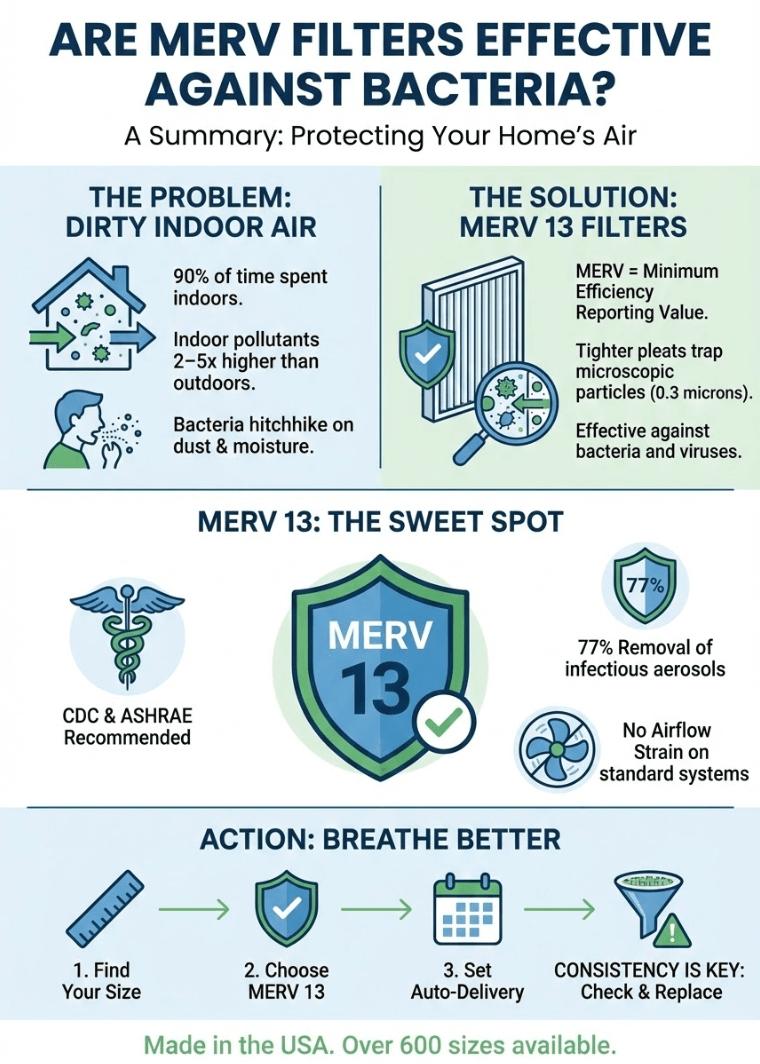
Yes, a MERV 13 filter is highly effective at capturing a wide range of airborne bacteria. It can trap particles as small as 0.3 microns, which includes most common bacteria found indoors.
The main drawback is restricted airflow. A filter with a MERV rating that is too high for a standard residential HVAC system can strain the fan motor, reduce energy efficiency, and potentially cause damage to the unit over time.
Viruses are even smaller than bacteria, but they often travel on larger particles like respiratory droplets. MERV 13 filters can capture many of these virus-carrying particles, offering an enhanced level of protection.
No, standard MERV filters, including MERV 11, are not designed to filter volatile organic compounds (VOCs). VOCs are gases and require a filter with activated carbon for effective removal.
