
Nest vs. Ecobee: How the Two Most Popular Smart Thermostats Compare
November 24, 2026
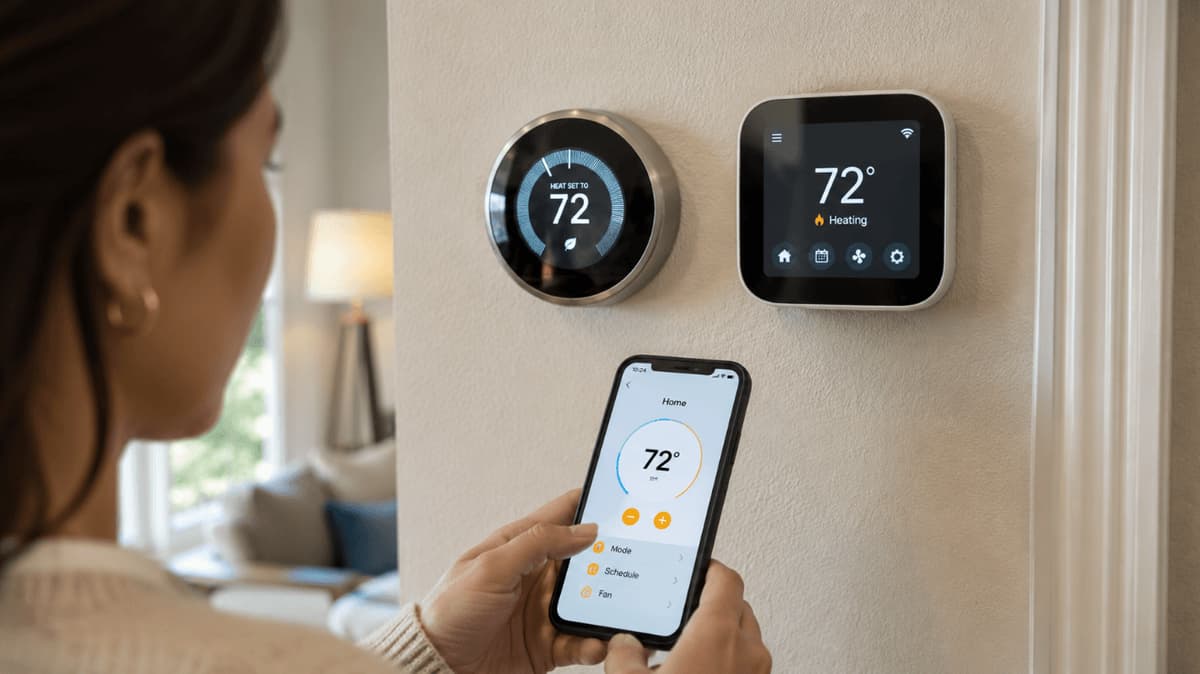
Still torn between the two? Start with the hardest room in your home to heat or cool. If one room never feels right, ecobee's occupancy sensors give you more control. If every room feels fine and you'd rather set it and forget it in Google Home, Nest keeps things simple.
Both share one gap. Neither measures the particles your air filter catches, and neither knows how deep your filter is. Whichever you choose, set its filter reminder for the filter you own.
Compare the two flagships below. Then take the match quiz, or shop air filters at Filterbuy.
Nest vs. ecobee at a glance
Nest learns your routine. Ecobee senses your rooms.
WHAT NEITHER ONE MEASURES
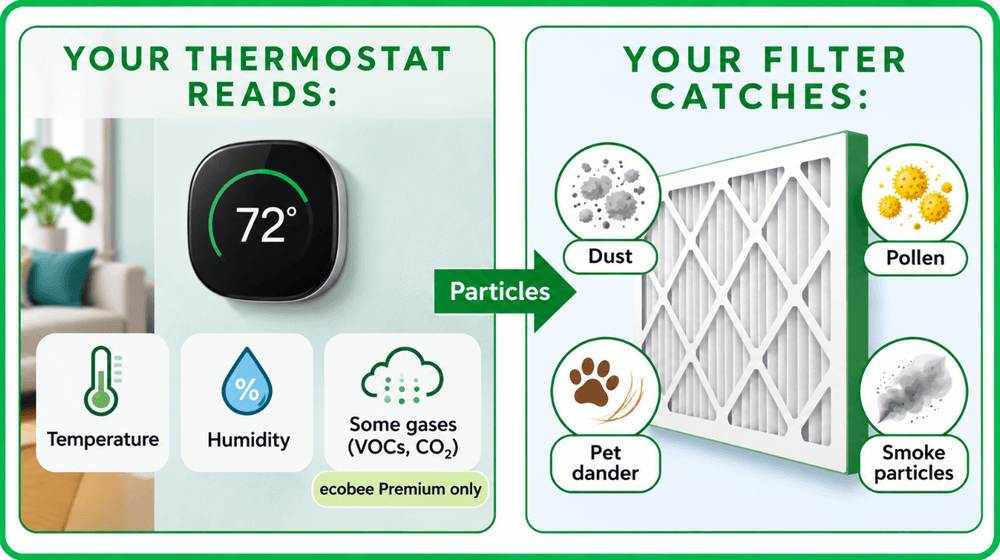
Your thermostat reads the air. Your filter catches the particles in it.
Dust, pollen and pet dander don't show up on either screen. A pleated HVAC air filter is what traps them as air moves through your system.
U.S. list prices from Google Store and ecobee.com, November 23, 2026. Filterbuy isn't affiliated with Google or ecobee.
Picked your thermostat? Now match your filter.
A smart thermostat tells your HVAC system when to run. Your air filter keeps dust and debris out of it while it does. Answer a few quick questions and we'll match you to the right filter for your home.
Already know your size?
TL;DR
Nest vs. ecobee comes down to your home's layout and smart home system. The Google Nest Learning Thermostat is the easy pick for Google Home households that want a thermostat to learn their routine. The ecobee Smart Thermostat Premium suits uneven rooms, Apple Home users and anyone who wants an air quality reading. As a filter maker, Filterbuy notes one shared gap: neither measures the particles an air filter catches.
Key Takeaways
Room sensors: ecobee SmartSensors detect temperature and occupancy (up to 32). Nest sensors read temperature only (up to six extra).
Cost: By Filterbuy's math, covering three rooms runs from $239.98 (ecobee Essential) to $319.98 (Nest Learning) at list price.
Air quality: Only the ecobee Premium has a monitor (VOCs, estimated CO2, humidity). Neither brand measures particles such as dust or pollen.
Wiring: Nest rarely needs a C wire, and the ecobee Premium and Enhanced include an adapter for homes without one.
Filter reminders: Nest counts runtime, while ecobee uses an interval you choose. Neither knows how deep your filter is, so set the reminder yourself.
Nest vs. Ecobee at a Glance: Current Models Compared
In late 2026, Nest vs. ecobee mostly means the $279.99 Nest Learning Thermostat (4th gen) against the $259.99 ecobee Smart Thermostat Premium. Each includes one room sensor, and they differ on sensing, air quality, voice control and wiring.
U.S. list prices from Google Store and ecobee.com, November 23, 2026.
Which Smart Thermostat Is Best for Your Home?
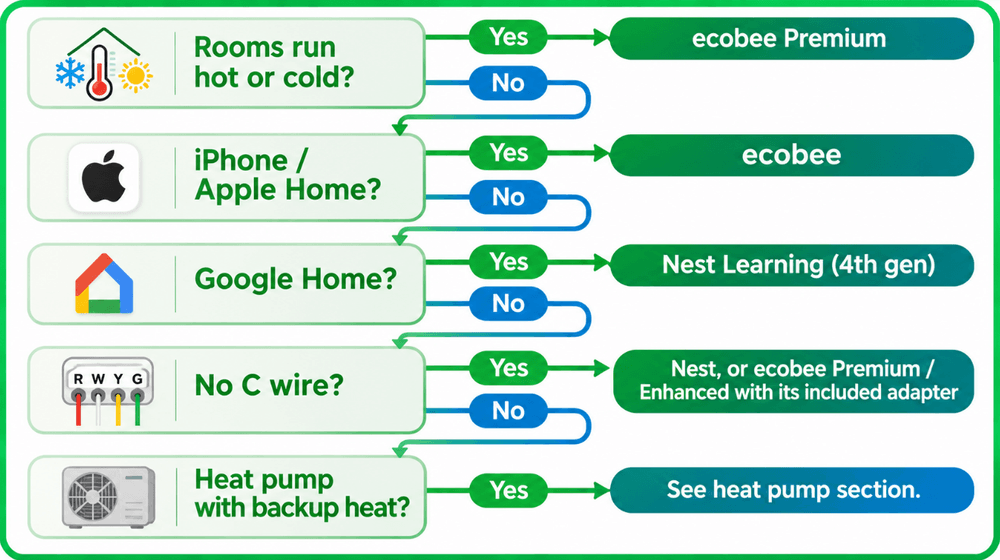
The best smart thermostat is the one built for the home it goes in: the layout, the wiring, the HVAC equipment and the phone you carry. Filterbuy's Fit Check puts comfort first on purpose, because a thermostat that can't fix your worst room isn't worth the upgrade. Stop at the first clear answer.
Do some rooms run hot or cold? Go with the ecobee Premium. Its SmartSensor knows when a room is occupied, so the thermostat favors the rooms you're using.
Which phone and assistant do you use? On iPhone, ecobee joins Apple Home through HomeKit, and the Premium has Siri built in with a compatible Apple home hub. Google Home households fit Nest; Alexa homes fit the Premium.
Do you have a C wire? If not, Google says the Nest Learning Thermostat doesn't need a C wire in most homes. ecobee's Premium and Enhanced include a Power Extender Kit, but the Essential needs one bought separately. Filterbuy's C wire guide compares both adapters, and the thermostat wiring colors guide helps you identify each wire.
Do you have a heat pump with backup heat? See the heat pump section below.
Ecobee Premium vs. Nest Learning Thermostat: How the Flagships Differ
The Nest Learning Thermostat (4th gen) and ecobee Smart Thermostat Premium take different paths to comfort. Nest leans on learning and builds a schedule from your adjustments, while ecobee leans on sensing, with occupancy-aware room sensors, an air quality monitor and a built-in smart speaker.
Nest's System Health Monitor watches for HVAC problems, and starting in December 2026, Google's Home update adds estimated savings and third-party room sensors for Nest owners. The ecobee Premium answers with a 4-inch touchscreen, radar occupancy sensing and a choice of Alexa or Siri.
Filterbuy's take: if one bedroom never feels right, the ecobee Premium will do more for you. If you'd rather set it and forget it inside Google Home, choose Nest.
Savings claims can't be compared head to head, either. Google says Nest can save up to 31%, while ecobee claims up to 26% against holding 72°F all day. As a neutral benchmark, ENERGY STAR puts average smart thermostat savings at about 8% of heating and cooling bills.
Ecobee Room Sensors vs. Nest: Which Handles Hot and Cold Rooms Better?
In ecobee room sensors vs. Nest, ecobee wins for most multi-room homes. Its SmartSensors pick up temperature and occupancy, so the thermostat follows you from room to room. Nest sensors read temperature only, and you choose which one leads at each time of day.
The Nest Thermostat can't use room sensors. Sensor prices are in the cost table below.
Still, a sensor can report a cold room, not push more air into it. That's why Filterbuy's troubleshooting guides start with airflow and name a clogged filter as the most common reason an AC misses its setpoint. Check the filter and registers first, then see why your thermostat reads the wrong temperature or why heat won't reach the set temperature or AC won't reach the set temperature.
What Does It Cost to Cover Three Rooms?
Covering three rooms costs $239.98 to $319.98 at list price, depending on the system. Filterbuy priced the same job on each: the thermostat's room plus two more. The ecobee Premium setup costs $359.98 but covers four, because ecobee sells SmartSensors in pairs.
U.S. list prices, November 23, 2026: Nest Temperature Sensor $39.99, Honeywell T9 sensor $41.99, ecobee SmartSensor 2-pack $99.99. Rooms include the thermostat's own room. The Nest Thermostat can't use room sensors. Filterbuy calculation.
The cheapest room-by-room setup isn't a flagship. An ecobee Essential with a SmartSensor 2-pack costs $80 less than the Nest Learning setup, and its sensors detect occupancy too. You give up the Premium's air quality monitor and speaker.
Nest vs. Ecobee Air Quality: What Each Thermostat Measures
In Nest vs. ecobee air quality, only the ecobee Smart Thermostat Premium has a true monitor. According to ecobee's Smart Thermostat Premium announcement, it tracks volatile organic compounds (VOCs, gases from paints and cleaners), estimated CO2 and humidity, with app alerts when air quality drops. Nest measures humidity only.
Neither thermostat measures particles such as dust, pollen, pet dander and wildfire smoke, a blind spot Filterbuy wants every shopper to see, since particles are exactly what a pleated filter catches. Gases are a different problem: the U.S. EPA's Guide to Air Cleaners in the Home notes that most filters target either particles or gases, so a high VOC reading calls for ventilation rather than a new filter.
"A thermostat's air quality screen is a good start, but it doesn't see particles. The filter is still where most of the dust in your air gets caught."
– Michelle Wan, Brand Manager & Air Quality Writer, Filterbuy
For particles, choose a filter by MERV rating, which tells you how fine its media is.
Ecobee vs. Nest Filter Reminder: How Each One Tracks Filter Life
In ecobee vs. Nest filter reminders, neither thermostat can see your filter. Nest bases its reminder on how long your system has run, while ecobee lets you set the interval. Either way, reset it every time you change the filter.
Filterbuy cuts, pleats and frames made-to-order filters in its U.S. plants in 1-, 2-, 4- and 5-inch depths, and a 4-inch filter holds far more media than a 1-inch one, yet a default reminder treats them the same. Start with the interval for your depth in how often to change your air filter, then adjust based on how the old filter looks.
Filterbuy's guide on how to reset the filter reminder on your thermostat covers Nest and ecobee, and thermostat fan Auto vs. On explains why running the fan On fills a filter faster. Filterbuy Auto Delivery can then ship your size on that schedule.
"Pick your thermostat for your rooms and your phone. Then set its filter reminder for the filter you actually own, because no thermostat knows that part."
– Filterbuy Indoor Air Quality Team
Nest vs. Ecobee for Heat Pump Systems
For a heat pump, Nest vs. ecobee comes down to automation versus control. Both run heat pumps with auxiliary heat, the backup electric or gas heat for cold snaps. Nest decides when to use that costly aux heat, while ecobee leaves the outdoor temperature settings in your hands.
On Nest, Google's Heat Pump Balance settings are Max Comfort (the default), Balanced and Max Savings, or you can switch it off and set the lockout yourself. Dual fuel systems (a heat pump plus a gas furnace) must be set up that way.
ecobee uses a Compressor Min Outdoor Temperature, below which the compressor won't run, and an Aux Heat Max Outdoor Temperature, above which aux heat won't run. Set the compressor limit too high, and backup heat starts sooner than it needs to.
Check with your technician before changing lockouts. Because heat pump blowers run long cycles, Filterbuy also recommends checking the filter at least as often as the reminder suggests.
Nest vs. Ecobee vs. Honeywell: Where the T9 Fits
In a Nest vs. ecobee vs. Honeywell comparison, the Honeywell Home T9 from Resideo is the budget pick for room sensors. It costs around $199.99 with one Smart Room Sensor, supports up to 20 sensors per Honeywell Home and works with Alexa, Google Assistant and Apple HomeKit, but has no air quality monitor.
Supporting Statistics
Many VOCs run up to 10 times higher indoors than outdoors.
Why it matters: an ecobee Premium VOC alert is worth acting on.
Source: U.S. EPA, Volatile Organic Compounds' Impact on Indoor Air Quality
HVAC systems usually run less than 25% of the time during heating and cooling seasons.
Why it matters: filters only work while the system runs, so runtime reminders beat a calendar.
A heat pump can reduce electricity use for heating by approximately 65% compared with electric resistance heating.
Frequently Asked Questions
Does Nest Work With Apple Home?
Yes, through Matter. The Nest Learning Thermostat (4th gen) is Matter-certified, so it can join Apple Home and other Matter platforms without HomeKit support.
Can I Use Ecobee Sensors With a Nest Thermostat?
No. Ecobee SmartSensors work only with ecobee thermostats. Starting in December 2026, Google says the Nest Learning Thermostat (4th gen) can use compatible third-party room sensors.
Does Ecobee Need a Subscription?
Not for heating, cooling or room sensors. ecobee requires its paid Smart Security subscription only for some home monitoring and security options.
Can I Install Nest or Ecobee Myself?
Usually, yes. Google and ecobee both design their thermostats for DIY installs and run online compatibility checkers. Call a licensed technician for line-voltage, zoned or multi-stage systems.
Do Smart Thermostats Change How Often I Replace My Air Filter?
They can. Running the fan On or on a circulation schedule moves more air through the filter, so it loads faster. Check the filter at every reminder.
Glossary
Filterbuy: A U.S. maker of 1- to 5-inch HVAC air filters, the company behind Auto Delivery
HVAC: Heating, ventilation and air conditioning.
Aux heat: Backup heat a heat pump uses in cold weather.
C wire (common wire): The thermostat wire that supplies steady 24-volt power.
Matter: A smart home standard that works across Google, Apple, Amazon and Samsung.
VOCs: Volatile organic compounds, gases released by paints, cleaners and furnishings.
MERV: Minimum Efficiency Reporting Value, a 1–16 filter efficiency scale.