
What Is a C Wire, and Does Your Smart Thermostat Need One?
November 19, 2026
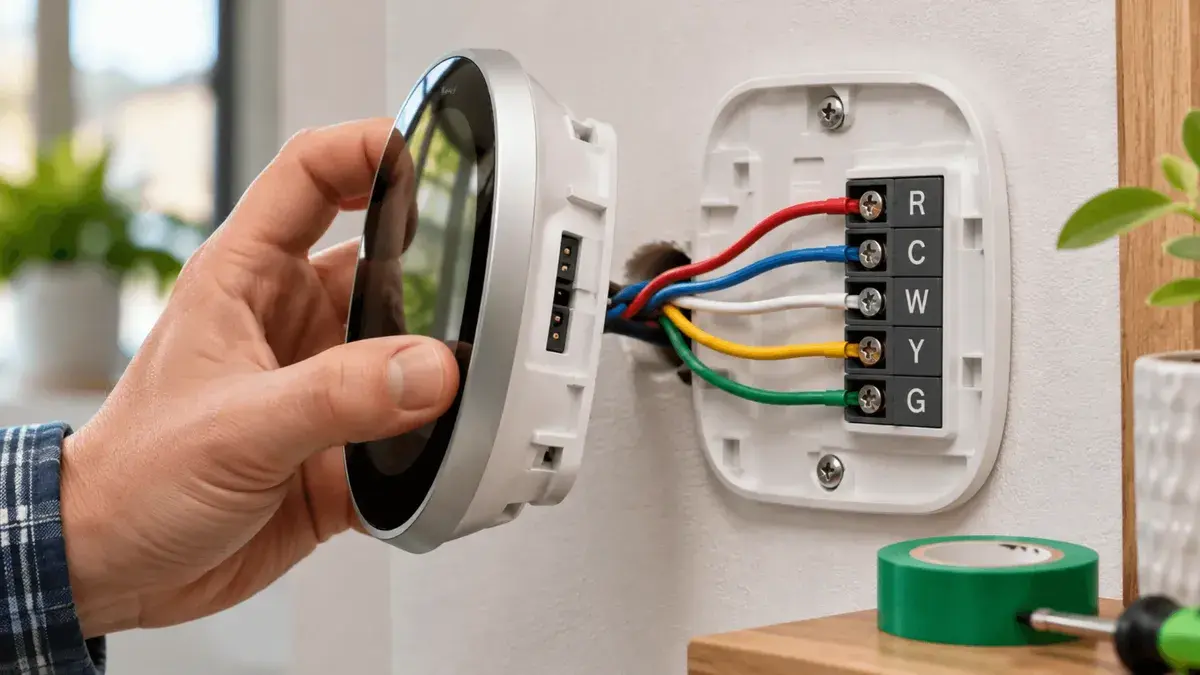
A C-wire, or "common" wire, is the low-voltage wire that gives your thermostat a steady supply of 24-volt power from your HVAC system. It completes the power loop with the R wire, so a smart thermostat's screen and Wi-Fi stay on.
Many older thermostats never needed one, so plenty of homes don't have a C-wire hooked up. Without steady power, a smart thermostat may reboot, drop its Wi-Fi, or drain its battery.
Check yours before you buy. The quick visual below shows where to look and what to do if the C terminal is empty. Then take the match quiz, or shop air filters at Filterbuy.
C-wire at a glance
The C-wire closes the power loop, so your thermostat never runs out of juice.
1 · HOW THE LOOP WORKS
HVAC control board
Furnace or air handler, with a 24V transformer
R wire → sends 24V power to the thermostat
← C-wire carries it back to complete the loop
Thermostat
Steady power for the screen and Wi-Fi
2 · WHAT YOU'LL SEE BEHIND THE FACEPLATE
R
Power
W
Heat
Y
Cooling
G
Fan
C
Common (C-wire)
The C-wire is often blue or black, but colors aren't standardized. Go by the terminal letter, not the wire color. No wire on C at the thermostat? Check the C terminal on your furnace or air handler's control board, too.
3 · WHAT TO DO NEXT
A wire is on C
You have a C-wire and steady power at the wall.
You're set for most smart thermostats
C is empty
You still have options:
- Use an unused wire tucked behind the plate, if it's also connected at the control board
- Add a C-wire adapter kit
- Pick a thermostat that runs without one
- Have an HVAC pro run a new wire
Safety first: Turn off power to your HVAC system before removing the faceplate. Unsure which wire is which? Call a qualified technician.
Smart thermostat ready? Make sure your filter is, too.
Your C terminal lives on the same furnace or air handler that holds your air filter. Answer a few quick questions and we'll match you to the right filter for your home.
Already know your size?
A C wire, short for common wire, is the return path of the 24-volt circuit between your HVAC equipment and thermostat. The R wire brings 24 volts up from the transformer in your furnace or air handler, and the C wire carries that current back. With both connected, your thermostat has constant power for its screen and Wi-Fi radio.
TL;DR
The C wire completes your thermostat's 24-volt circuit so a smart thermostat runs on steady power. Check for it behind the thermostat and on your furnace control board. If you come up empty, a spare conductor, your brand's adapter, or a new cable solves it.
Key Takeaways
The C (common) wire doesn't tell your system to heat or cool. Its job is to close the 24-volt loop.
Wire colors vary by installer, so trust the terminal letter at both ends.
A multimeter reading of about 24 volts AC between R and C confirms a working C wire.
Filterbuy ranks the G wire last among C wire fixes, because losing fan-only mode cuts filtration time.
Use the C wire adapter made for your thermostat brand rather than a third-party one.
What Is A C Wire On A Thermostat?
A C wire is the common conductor in your thermostat's low-voltage control circuit. Picture a loop: R carries 24 volts AC (alternating current) up from the transformer, and C brings it back, so the thermostat can draw power around the clock.
In a common wire thermostat setup, the other wires work like switches. A heat call connects R to W, and a cooling call connects R to Y, usually with R to G for the blower. The C wire stays out of those decisions.
Thermostat Terminal Letters At A Glance
Why Does A Smart Thermostat Need A C Wire?
A smart thermostat needs a C wire because its Wi-Fi radio and touchscreen stay on day and night. Without that supply, some models borrow power from the control wires and others won't install. Honeywell Home states that its Resideo Wi-Fi thermostats require a C wire or its C-Wire Adapter.
How Does Nest Power Stealing Work?
Nest power stealing, also called power sharing, lets many Nest thermostats keep their battery charged with small amounts of current drawn through the heating and cooling wires. When that falls short, Google says you may notice:
Fast battery drain or a blank display
Wi-Fi that drops now and then
Unexpected on and off cycling or clicking noises
A "Delayed" message or codes such as E297, N260, or N410
Filterbuy's take: fix the thermostat's power before you troubleshoot the furnace.
Do I Have A C Wire? How To Check At The Wall And The Furnace
You have a usable C wire only when the same conductor lands on the C terminal at both ends, behind the thermostat and on your furnace or air handler control board. Before you open anything, turn off HVAC power and look over these DIY electrical safety tips from the Electrical Safety Foundation International.
Shut off power at the furnace service switch or breaker.
Photograph the wiring behind the thermostat faceplate before you touch anything.
Look for a wire on C or an unused wire folded back into the wall. A printed 18/5 on the cable jacket means five 18-gauge wires, so if only four are in use, you have a spare.
Open the equipment panel and find the terminal strip marked R, C (or COM), W, Y, and G.
Match the same cable by its jacket and colors. If a wire sits on C at the board but is cut short at the wall, you can usually connect it.
Confirm with a meter. With power back on and a multimeter set to AC volts, R to C should read about 24 volts. Roughly 24 to 28 is normal.
Some older equipment marks common as B, while many heat pumps use B for the reversing valve (the part that switches between heating and cooling), so follow the wiring diagram inside your panel door.
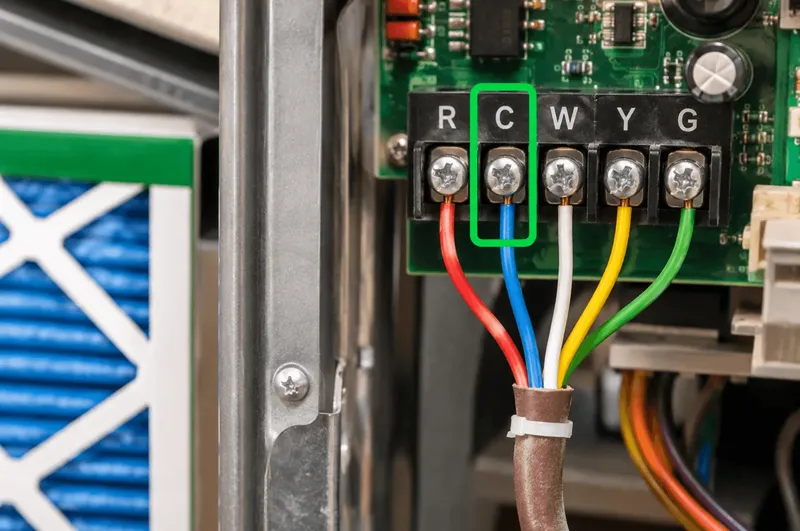
Filterbuy's Two-Ends Check
Filterbuy Pro Tip: Your C wire and your air filter often share the same cabinet. While the panel is open, read the size on the filter frame and swap in a fresh one before restoring power. Our guide shows how to choose the right HVAC filter size.
Thermostat Without A C Wire: Six Ways To Power A Smart Thermostat
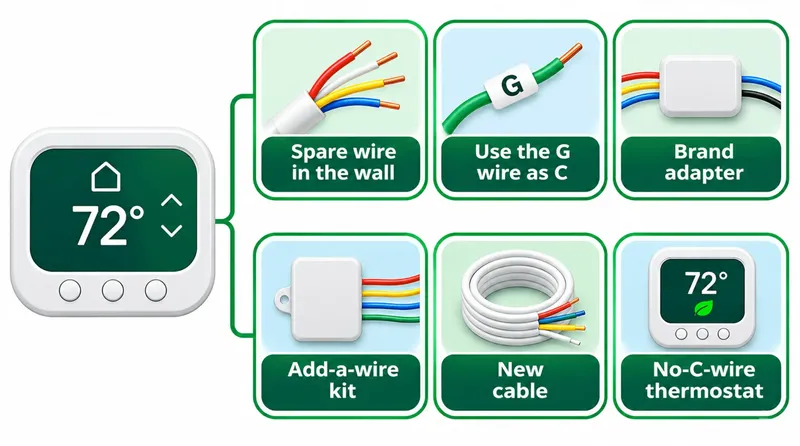
A thermostat without a C wire can still run a smart model. At Filterbuy, we rank the fixes: spare wire, brand adapter, new cable, then add-a-wire kit. The G wire comes last, because it's the only fix that cuts the hours your air filter gets to work.
No C Wire? Compare Your Options
C Wire Adapter For Nest: The Nest Power Connector
The Nest Power Connector is the C wire adapter Google makes for Nest. It works with the Nest Thermostat, Nest Thermostat E, and Nest Learning Thermostat (3rd and 4th gen) on 24-volt systems, and it installs at the furnace or air handler, or at a zone controller. Google warns that some third-party adapters can damage a Nest thermostat even when they claim compatibility.
Power Extender Kit Thermostat Setups For ecobee
The ecobee Power Extender Kit (PEK) mounts at the furnace and lets four thermostat wires do the job of five. It comes with most ecobee smart thermostats and is sold separately for the Essential and Lite. ecobee notes that the PEK works only with its own thermostats and not with millivolt, high-voltage, dual-transformer, or communicating systems.
Add-A-Wire Kit Thermostat Option
An add-a-wire kit, such as the Venstar Add-A-Wire, uses diodes (one-way electrical valves) to send two signals over one conductor, freeing a wire for C. It works across thermostat brands, but one wiring mistake can stop your cooling, so hand this job to a technician.
Can I Use The G Wire As A C Wire?
Yes, you can use the G wire as a C wire on many single-stage (one-speed) systems by moving the green conductor to C at both the thermostat and the control board. Heat keeps working because most furnaces start their own blower on a heat call. Cooling usually needs a Y-to-G jumper, a short wire linking those terminals on the board, so the blower still starts with the compressor.
The price is fan control. You give up fan-only and circulate settings, and some variable-speed blowers need their own G signal to run. As a filter maker, Filterbuy puts extra weight on this, because your filter only cleans air while the blower runs. If you count on extra circulation, read our guide to thermostat fan Auto vs. On settings first.
Which Smart Thermostats Work Without A C Wire?
Most Nest models can run on power sharing in conventional systems. ecobee and Honeywell Home Wi-Fi models need a C wire or the brand's adapter, so run the maker's compatibility checker before you buy.
Once powered, Filterbuy's guide to thermostat modes for heat, cool, and auto covers setup, and our first-run heating checklist preps you for the first cold night.
When Is A Smart Thermostat The Wrong Fit?
A 24-volt smart thermostat is the wrong fit for millivolt systems, such as gas fireplaces and many wall furnaces, and for 120 or 240-volt baseboard heaters. Google says connecting a Nest to a millivolt or proprietary system can damage it.
Expert Quote
"My advice is simple: check the C wire before you blame the thermostat. If you're tempted to borrow the G wire, remember that your air filter only works when the fan runs. And if the furnace cabinet feels out of your comfort zone, call a licensed HVAC technician." Michelle Wan, Brand Manager and Air Quality Writer, Filterbuy
Supporting Statistics
12.8 million homes have a smart thermostat
That's out of 109.5 million U.S. homes with a thermostat (2020).
Another 44.1 million still use a non-programmable model.
For those homes, the first upgrade question is simple: is there a C wire?
Source: 2020 Residential Energy Consumption Survey, Table HC6.1
About 8% saved, or $50 a year
That's the average for ENERGY STAR certified smart thermostats.
Filterbuy's view: savings depend on a thermostat that stays powered and online.
Up to 10% saved each year
Turn your thermostat back 7 to 10 degrees F for 8 hours a day.
That schedule only runs on time with steady power.
Source: Thermostats, DOE Energy Saver
Frequently Asked Questions
Does A Nest Thermostat Need A C Wire?
Not always. Many Nest thermostats get enough power from the heating and cooling wires. Google says heat-only, cool-only, zoned, and heat pump systems need a C wire or compatible power accessory.
What Color Is The C Wire?
Blue is most common, followed by black and brown. Colors vary, so confirm the C wire by its terminal letter.
Why Is My Thermostat Dead After Connecting The C Wire?
The furnace blower door must be fully closed, because its safety switch cuts power to the control board. Next, look at the board's low-voltage fuse, often a 3-amp automotive-style blade. A wire that brushes the cabinet during install can blow it, so replace it with the same rating and never a higher one.
Can A Missing C Wire Cause Short Cycling?
It can. Google lists unexpected on and off cycling as a sign that a Nest thermostat is short on power.
Can I Install A C Wire Myself?
You can connect an existing spare wire yourself with the power off. Google notes that running a new one generally requires a pro. the Air Conditioning Contractors of America explains how to find the right HVAC contractor.
Keep Your Air Clean While You Upgrade
At Filterbuy, we cut, pleat, and frame MERV 8, MERV 11, and MERV 13 air filters to order in our own US plants. Choose from hundreds of standard and custom sizes, with fast and free 2-day delivery to most US states. Find your size in the Filterbuy air filter shop, check your HVAC manual for its supported MERV rating, and browse our smart thermostat resource library for more help.
Filterbuy is not affiliated with or endorsed by Google, ecobee, Honeywell Home, Resideo, or Venstar.
Glossary
C Wire (Common Wire): The conductor that returns 24-volt power to the transformer so the thermostat has continuous power.
O/B Terminal: The heat pump terminal that controls the reversing valve. Learn more in how a heat pump heater works step by step.
Nest Power Connector: Google's C wire adapter for compatible Nest thermostats.
Power Extender Kit (PEK): ecobee's adapter that powers an ecobee thermostat over four existing wires.