
Why Your AC Won't Reach the Temperature on Your Thermostat
November 20, 2026
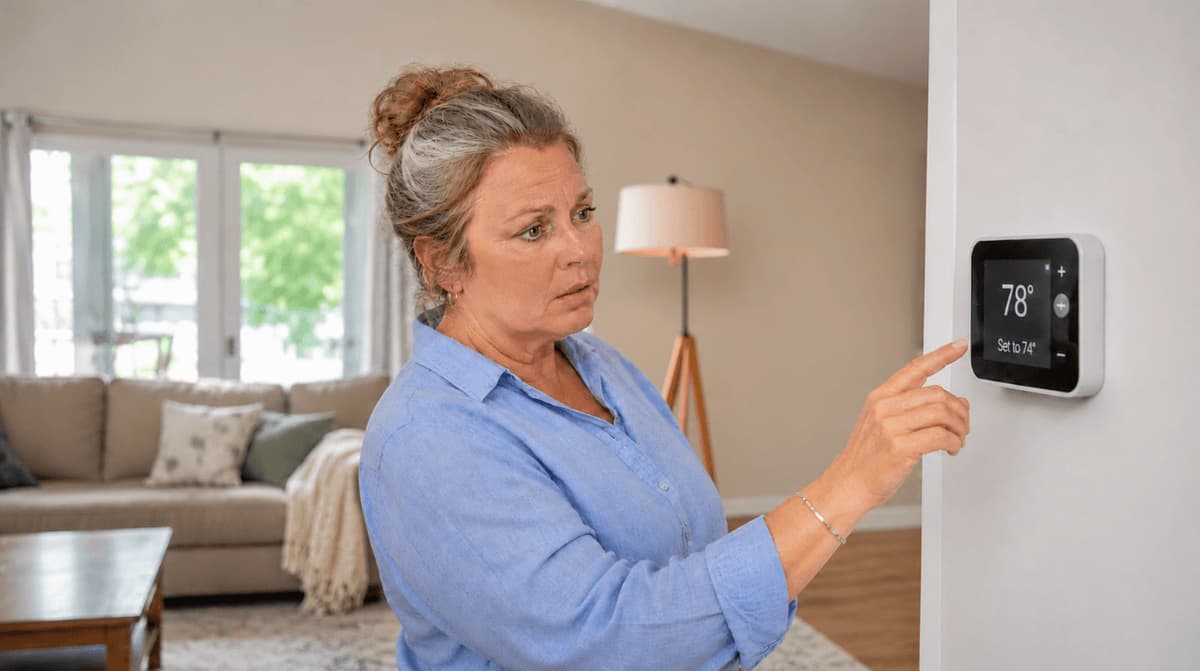
On the hottest afternoons, it's normal for your home to run 2°F to 4°F above the setpoint and catch up after sunset. If the gap shows up on mild days or at midnight, tops 4°F, or grows day by day, something is holding your AC back.
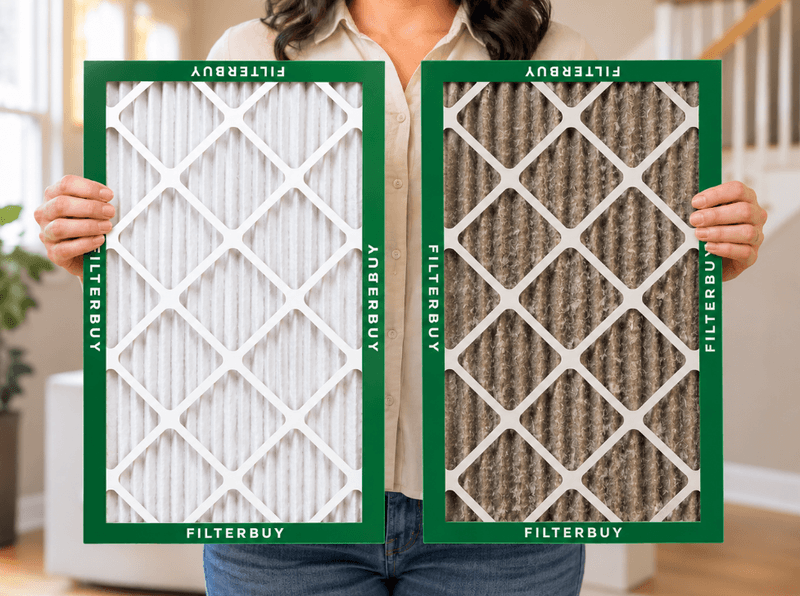
Start with the air filter. A clogged filter is the most common reason an AC won't cool to setpoint, because less airflow means less heat removed. Hold it up to a light. If light doesn't pass through, replace it.
Not sure which filter fits your system? Take the quick filter match quiz below, or shop air filters at Filterbuy.
Read the gap
Normal lag or a real problem? When the gap shows up tells you.
NORMAL LAG
2°F to 4°F behind on the hottest afternoons
The house catches back up after sunset.
Example: 99°F outside, setpoint 74°F
74°F
Setpoint
77°F
4 p.m.
74°F
9 p.m.
Back to setpoint by evening
LIKELY PROBLEM
Any of these signs means it's time to check
A gap on mild days or at midnight
More than 4°F, or growing every day
Never reaches setpoint overnight
Weak or lukewarm air from the vents
Call a pro now: ice, hissing, buzzing, or a tripped breaker
Check these first, in this order
1. Thermostat
Cool mode, fan on Auto, fresh batteries
2. Air filter · Most common
No light through it? Replace it.
3. Ice on the lines
System Off, fan On, about 2 hours
4. Outdoor unit
Clear 2 feet around it, rinse the fins
5. Temperature split
Return vs. supply: about 15°F to 20°F
Give your AC the airflow it needs to keep up
Answer a few quick questions and we'll match you to the right filter for your home.
Already know your size?
TL;DR
If your AC runs a few degrees above the setpoint on the hottest afternoons, it's often doing what it was built to do, since most systems are sized for a typical hot day. A gap on mild days, or one that never closes overnight, means something is holding the system back. Start with the air filter, then look at the coils, refrigerant, ducts and thermostat.
Key Takeaways
Central ACs are usually sized to hold about 75°F indoors, so a little lag during a heat wave is normal.
A healthy AC cools the air crossing its indoor coil by about 15°F to 20°F.
The U.S. Department of Energy says replacing a clogged filter can cut AC energy use by 5% to 15%.
Low refrigerant usually means a leak, which takes an EPA-certified technician to fix.
In Filterbuy's experience, the most common filter problem is simply leaving one in too long.
Is It Normal for Your AC Not to Reach the Set Temperature?
Sometimes, yes. Contractors size home air conditioners with ACCA Manual J, which assumes 75°F indoors and an outdoor "1% design temperature," a heat level your area passes only about 1% of the hours in a year. Beyond it, even a correctly sized AC can run nonstop and sit a few degrees above the setpoint until evening.
Energy Vanguard's analysis of cooling load above design temperature, by building scientist Allison Bailes, found that 10°F past design raises a home's cooling load by about 27%. Your AC's capacity doesn't grow to match. On those days, closing blinds on sunny windows and skipping the oven lightens the load.
How Can You Tell Normal Lag From a Real Problem?
Telling normal AC lag from a real problem comes down to a Filterbuy weather test: normal lag follows the weather, while a real problem follows the equipment.
Say your thermostat is set to 74°F. On a 99°F afternoon, the house reads 77°F at 4 p.m. and drifts back to 74°F by 9 p.m. That's normal. The same 77°F on an 86°F day, or at midnight, means the equipment needs a closer look.
What Are the Most Common Reasons an AC Can't Keep Up?
When an AC runs constantly but never reaches the set temperature, the usual causes are a clogged filter, dirty coils, a refrigerant leak, leaky ducts, thermostat errors, or an undersized system.
Dirty Air Filter: Why It Stops Your AC From Cooling
A dirty air filter is the most common reason an AC won't cool to the thermostat setting. As it clogs, less air reaches the indoor coil, so less heat leaves your home. If airflow drops far enough, the coil can freeze and stop cooling almost entirely.
The Department of Energy's air conditioner maintenance guide notes that replacing a clogged filter can cut AC energy use by 5% to 15%. Filters load fastest in summer, and at Filterbuy, a filter left in too long is the frozen-coil cause we see most.
Dirty Condenser or Evaporator Coil
Dirt or overgrown shrubs around the outdoor condenser coil trap the heat it should release. Indoors, dust insulates the evaporator coil so it absorbs less heat.
Low Refrigerant From a Leak
Refrigerant moves through a sealed loop and doesn't get used up, so a low charge usually means a leak. Signs include hissing, ice on the larger copper line, and vent air that feels cool rather than cold. Refrigerant work requires EPA Section 608 technician certification, so ask your technician to repair the leak, not just top off the system.
Leaky Ducts and Blocked Vents
According to ENERGY STAR's duct sealing guidance, a typical house loses about 20% to 30% of the air moving through its ducts to leaks and poor connections.
Supporting Statistics: What the Research Shows
What Should You Check Before Calling a Technician?
These five checks narrow down the cause before a service call. Before touching the outdoor unit, turn off the power at the breaker and the outdoor disconnect.
Confirm the thermostat settings. Cool mode, fan on Auto, setpoint a few degrees below room temperature, and fresh batteries.
Check the air filter. Hold it up to a light. If light can't get through, replace it with the correct filter size. Filterbuy's manufacturing team sees depth ordered wrong most often, so double-check the third number (the 1 in 16x25x1). See how often to change your AC filter and the signs of a clogged air filter.
Look for ice. If you see frost on the copper line or indoor coil, set the thermostat to Off and the fan to On for about two hours. Running a frozen system can damage the compressor.
Clear and rinse the outdoor unit. Trim plants back at least 2 feet, as the Department of Energy recommends, then rinse the fins with a garden hose, never a pressure washer.
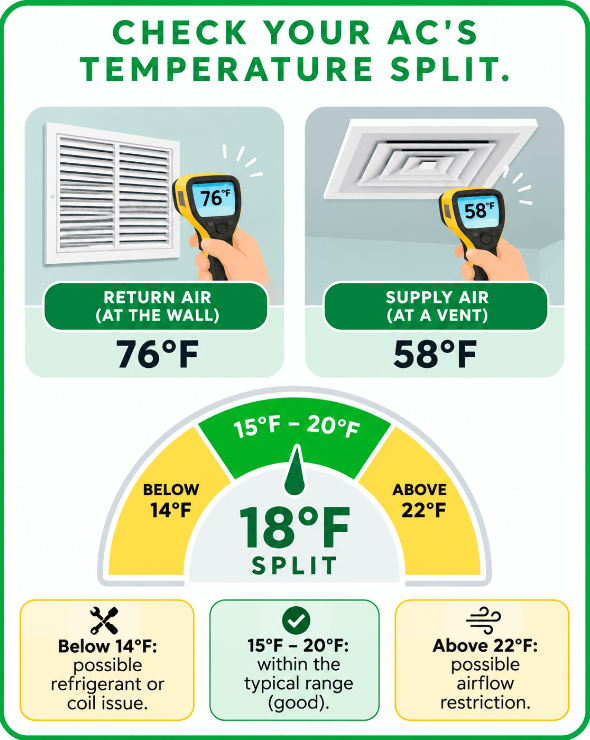
Measure the temperature split. After 15 minutes of running, hold a kitchen thermometer at the return grille, then at the nearest supply vent. Roughly 15°F to 20°F is typical. Under about 14°F suggests a refrigerant or coil problem, while over about 22°F usually means restricted airflow. ACCA notes that manufacturer data sets your system's exact target.
When Should You Call an HVAC Professional?
If the gap is still there a day after you've changed the filter and cleaned the outdoor unit, call a licensed HVAC technician. Call right away for repeated icing, hissing, loud buzzing, a burning smell, or a breaker that keeps tripping. If it falls behind every summer, ask for a Manual J load calculation.
What to Write Down Before the Technician Arrives
A Filterbuy tip: a few notes turn "my AC can't keep up" into numbers a technician can use.
The setpoint, indoor temperature, and outdoor temperature at the hottest point of the day
Whether the house catches up overnight
Your temperature split from step 5
The date of your last filter change, plus any ice, hissing, or tripped breakers
“The most common cause I find is a clogged filter choking off airflow, sometimes to the point the indoor coil has iced over. I check the filter first, then measure the temperature split to see whether the system is actually moving heat.”
– David Clark, Licensed HVAC Technician
Other symptoms? See our guides to an AC running but not blowing air and common home air conditioning problems. Ductless? Read mini split not cooling.
How Do You Keep Your AC From Falling Behind Next Summer?
Check your filter monthly in summer, book a tune-up each spring, keep 2 feet clear around the outdoor unit, and leave vents open.
A higher MERV rating can't make up for a filter that stays in too long. Check which MERV rating your system can handle, then keep a schedule.
"I would rather you run MERV 11 on a real schedule than MERV 13 for eight months."
– Michelle Wan, Brand Manager and Air Quality Writer, Filterbuy
Filterbuy makes filters in the USA in more than 600 sizes. Shop air filters by size or set up Filterbuy Auto Delivery, and a new filter will arrive before the old one clogs.
Frequently Asked Questions
Why Is My AC Running but Not Cooling to the Thermostat Setting?
Usually it isn't moving enough air or heat. Check the filter, outdoor coil and copper line for ice, and confirm the thermostat isn't on Fan. Then have a technician test for a leak.
Why Won't My House Cool Below 75 Degrees?
Many central ACs are designed to hold about 75°F on typical hot days. If yours won't drop below 75°F on mild days, start with the filter, then have a pro check the coils and ducts.
How Often Should I Change My AC Filter in Summer?
Check it monthly and replace it when dirty. In hot climates, plan on every 30 to 60 days.
Will Setting the Thermostat Lower Make My AC Cool Faster?
No. The U.S. Department of Energy says a central AC cools at the same rate whatever the setting, so going lower only makes it run longer.
Is the "20-Degree Rule" for Air Conditioners Real?
It describes how much air cools crossing the indoor coil, typically 15°F to 20°F. It doesn't cap how much cooler your house can be than outdoors.
Glossary
Filterbuy: A U.S. manufacturer of pleated home air filters, made in American factories since 2013 in more than 600 sizes.
Setpoint: The temperature you set on the thermostat.
MERV: Minimum Efficiency Reporting Value, a 1 to 16 air filter efficiency rating.
Return grille: The vent that pulls room air back to the AC.
Manual J: The Air Conditioning Contractors of America (ACCA) sizing method.
Design temperature: The outdoor temperature an AC is sized for.
Evaporator coil: The indoor coil that absorbs heat and moisture from your air.
Condenser coil: The outdoor coil that releases your home's heat.
Temperature split (Delta T): Return air temperature minus supply vent temperature.
EPA Section 608: The U.S. Environmental Protection Agency certification for handling refrigerants.
Sources
Energy Vanguard: Cooling Load Variation With Changing Temperatures
NIST: Energy Efficiency of HVAC Equipment Suffers Due to Poor Installation
U.S. EIA: How Much Electricity Is Used for Air Conditioning?
Pure Comfort Heating & Air: Why Your AC Struggles in Extreme Heat
U.S. Department of Energy: Air Conditioner Maintenance