
Hazel Pollen: Winter Season, Hazelnut Trees, and How to Spot It
October 2, 2026
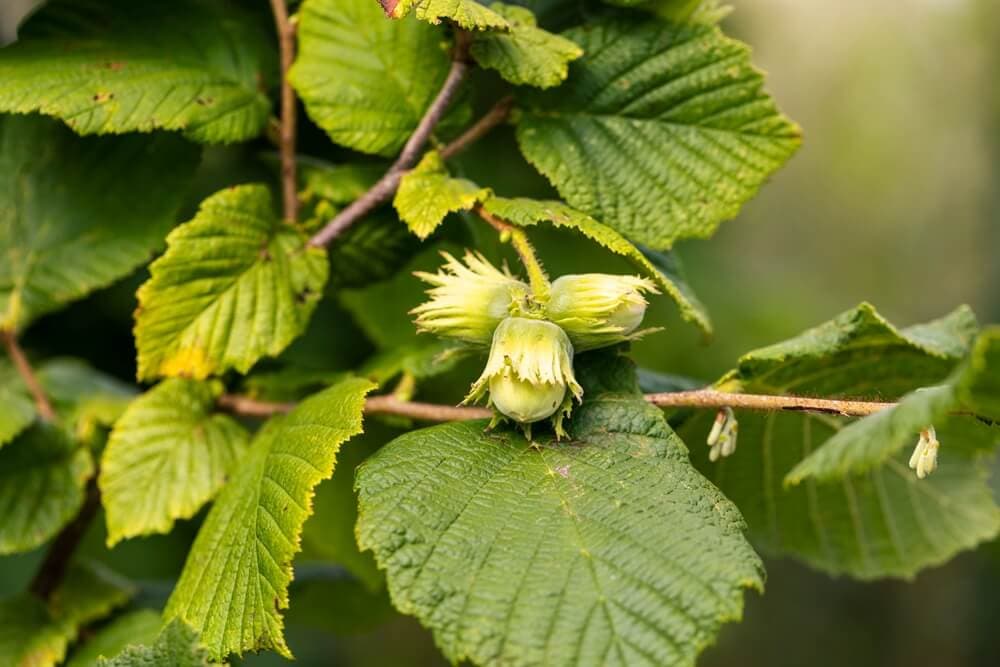
Hazel trees and shrubs belong to the genus Corylus, part of the birch family, Betulaceae. What makes them stand out is timing: hazels bloom in winter, when most plants are bare and dormant (USDA Climate Hubs). Long male catkins dangle from the branches and release wind-borne pollen, while the female flowers show only tiny red stigmas that are easy to miss (NC State Extension).
Hazels are also the plants behind Oregon's commercial hazelnut, or filbert, orchards. The Willamette Valley grows 99% of U.S. hazelnuts (USDA Climate Hubs). But keep two ideas separate: those orchards grow cultivated European hazel, while native hazel species grow wild across much of the U.S.
Hazel Pollen Quick Facts
| Field | Detail |
|---|---|
| Type | Deciduous shrub or small tree, depending on species |
| Scientific name | Corylus, birch family (Betulaceae) |
| Common names | Hazel, hazelnut, filbert (Pollen.com) |
| Pollination method | Wind-pollinated (Oregon State University Extension) |
| Pollen grain size | About 20 to 28 micrometers (Pollen.com) |
| Typical season | Winter to early spring, depending on species and location |
| Time of day | No universal hazel-specific peak hour. Weather changes daily counts. |
| U.S. regions | Commercial orchards in Oregon's Willamette Valley; wild hazels from Maine to Florida and west to Oregon and California (Pollen.com) |
| Commonly cross-reacts with | Birch, alder, hornbeam, and hop-hornbeam pollen (see Cross-Reactions) |
Is Hazel Pollen High Near You Today?
Hazel pollen won't show up in your local Air Quality Index. Intact pollen grains are too large for the PM2.5 and PM10 monitors the AQI relies on, which we explain in How Pollen Affects Air Quality Readings. For daily tree pollen counts, check the certified station nearest you on the AAAAI National Allergy Bureau pollen map. To see air quality where you live, use Filterbuy's Live Air Quality Index Map.
How to Identify Hazel Pollen at the Source: Catkins, Red Flowers, and Nuts
Hazels have a few reliable clues once you know what to look for:
- Leaves. Oval to elliptical, up to about 5 inches long, with doubly toothed edges on American hazel (NC State Extension).
- Male catkins. These are the pollen source. On American hazel, they are 2 to 4 inches long and yellow to yellow-brown, blooming in winter and early spring (NC State Extension). Look for them dangling from bare branches.
- Tiny red female flowers. Look closely at the twigs near the catkins for small red tufts. These are the female flowers that catch pollen (NC State Extension).
- Both flower types on one plant. Hazel is monoecious, with separate male and female flowers on the same tree (Oregon State University Extension). You don't need separate male and female trees.
Species differ, too. European hazel (Corylus avellana) is the main commercial crop (USDA Climate Hubs). American hazel (Corylus americana) and beaked hazel (Corylus cornuta) grow wild. The nut husks help tell them apart: American hazel nuts sit inside two leafy bracts (NC State Extension), while beaked hazel has a hairy husk that stretches at least an inch past the nut to form a beak (NC State Extension).
Pollen dust on a surface can't identify a species. Hazel grains are microscopic, about 20 to 28 micrometers (Pollen.com), so settled powder never confirms which plant produced it.
Hazel Pollen Look-Alikes: Alder and Birch
Alder
Alder is in the same family and also produces catkins in late winter, which makes the two easy to confuse. The difference shows up in the fruit. Hazel forms husked nuts, while alder develops small, woody, cone-like seed heads that stay on the tree through winter (NC State Extension). If you see small woody "cones," you are looking at alder, not hazel.
Birch
Birch is also a birch-family member with catkins. Compare the leaves, bark, and fruit of the specific birch species rather than relying on a general impression. Not all birches have white or peeling bark. River birch, for example, has salmon to rust-colored bark (NC State Extension), so bark color is a weak stand-alone clue.
| Feature | Hazel | Alder | Birch |
|---|---|---|---|
| Family | Birch family (Betulaceae) | Birch family (Betulaceae) | Birch family (Betulaceae) |
| Female flowers | Tiny red tufts on twigs | Small catkins that become woody cones | Small catkins |
| Fruit | Nuts in leafy or beaked husks | Woody cone-like seed heads that persist | No persistent woody cones |
A resemblance between catkins doesn't tell you which pollen is actually in the air. Use several features together, and confirm the species before assuming anything about its pollen.
When Is Hazel Pollen Season? Winter Timing by Region
Hazel timing depends on species, weather, and location. It helps to separate catkin appearance, pollen shedding, and any measured airborne peak. The entries below are flowering and pollination windows from named sources.
| Species and Region | Typical Window |
|---|---|
| European hazel, Oregon's Willamette Valley orchards | Late November to early March; peak pollination January to February |
| American hazel, North Carolina | Winter and early spring |
| Beaked hazel, North Carolina Piedmont and mountains | February to April |
Orchard pollination windows are not measured airborne peaks. Check your nearest National Allergy Bureau station for the current year.
In the Pacific Northwest? Check current conditions for Portland, Salem, and Seattle, or find your city on the Live Air Quality Index Map. Our seasonal allergy calendar shows what follows hazel into spring.
Hazel Pollen by the Numbers
- More than 1 million pollen grains per catkin. That is Oregon State's figure for a single male catkin on commercial hazelnut trees (Oregon State University Extension).
- 99% of U.S. hazelnuts. Oregon's Willamette Valley grows nearly the entire domestic crop (USDA Climate Hubs).
- 4 to 5 months from pollination to fertilization. After pollen lands in winter, hazelnut fertilization doesn't happen for 4 to 5 months, a far longer gap than most plants (Oregon State University Extension).
- 50 feet. In orchards, nut set drops when pollinizer trees are more than 50 feet from the trees they pollinate (Oregon State University Extension).
- About 1 inch. Beaked hazel's husk extends at least an inch past the nut to form its namesake beak (NC State Extension).
Hazel Pollen Myths vs. Facts
MYTHTree pollen only starts in spring.
FACTHazelnut orchard pollination peaks in January and February in Oregon (Oregon State University Extension). Hazel is one of the earliest pollen producers in its range.
MYTHEvery dangling catkin is hazel.
FACTAlder and birch also produce catkins and share the birch family. Hazel's red female flowers and husked nuts, or alder's woody cone-like seed heads, tell them apart (NC State Extension).
MYTHA hazel tree can pollinate itself.
FACTHazel has both male and female flowers on the same tree, but it is self-incompatible. Orchards need compatible pollinizer varieties with early, mid, and late bloom to set nuts (Oregon State University Extension).
MYTHBeing sensitive to hazel pollen automatically means a hazelnut food allergy.
FACTPollen sensitivity and food allergy are separate questions, and shared proteins alone do not diagnose anyone. For personal concerns, ask a qualified professional, such as an allergist.
Hazel Pollen Cross-Reactions and the Nut Connection
This section is descriptive only and is not medical advice.
Pollen. Hazel pollen cross-reacts with birch, alder, hornbeam, and hop-hornbeam pollen (Pollen.com). Its major allergen, Cor a 1, is related to birch's major allergen, Bet v 1 (Thermo Fisher Scientific). Thermo Fisher also reports that about 92% of people sensitized to birch are sensitized to alder and hazel pollen too (Thermo Fisher Scientific).
The nut connection. Hazelnut contains a birch-related protein as well, and Thermo Fisher links the Cor a 1 and Bet v 1 pair to pollen-related reactions to hazelnut. But other hazelnut proteins, including storage proteins such as Cor a 9 and Cor a 14, are tied to a separate, primary food allergy pattern (Thermo Fisher Scientific). So not all hazelnut food allergy is pollen-related, and hazel pollen exposure does not predict whether eating nuts is safe.
For questions about symptoms or diagnosis, speak with a board-certified allergist.
How to Keep Hazel Pollen Out of Your Home
Because hazel can release pollen in the middle of winter, it often shows up while the heat is still running. A few steps help:
- Check local counts in winter. Use your nearest National Allergy Bureau station once you see catkins lengthening.
- Keep windows and doors closed during active release. Open windows and doors are one of the main ways pollen gets indoors (2023 scientific review, PMC).
- Leave pollen at the door. Wipe down entry surfaces and sills, change clothes after time outdoors, and wipe pets down when they come in. Our spring allergy prep guide has a full room-by-room checklist.
- Match your HVAC filter to your household. MERV ratings measure how well a filter captures particles between 0.3 and 10 micrometers. A MERV 8 filter must capture at least 70% of particles in the 3 to 10 micrometer range, and a MERV 11 filter at least 85% (EPA). Intact hazel pollen grains, at roughly 20 to 28 micrometers, are larger than anything in that test. For most homes, MERV 8 is the standard choice. For households with allergies or pets, step up to MERV 11. Our MERV 8 vs. MERV 11 guide breaks down the difference.
- Change filters on schedule. Standard 1-inch filters are typically replaced about every 90 days. Filterbuy 4-inch filters last 6 to 12 months.
These steps reduce how much pollen circulates indoors. They are not a substitute for medical care, and no specific symptom outcome is claimed.
Since hazel season can start before the new year, a fresh filter in early winter is a good head start. Filterbuy makes MERV 8 and MERV 11 filters in more than 600 standard sizes, plus custom sizes, so it's easy to find one that fits your system before the catkins open.
Shop MERV 8 Filters Shop MERV 11 FiltersFrequently Asked Questions
When is hazel pollen season?
Hazel releases pollen in winter to early spring, depending on species and location. In Oregon's hazelnut orchards, pollination peaks in January and February (Oregon State University Extension), while beaked hazel blooms from February to April (NC State Extension).
Is filbert pollen the same as hazelnut pollen?
Yes. Filbert and hazelnut are two names for plants in the same genus, Corylus (Pollen.com).
Why does hazel flower in winter?
Hazel is one of a few plants that bloom in winter, releasing pollen while branches are still bare (USDA Climate Hubs). That early timing makes the catkins easy to see, but it also leaves blooms vulnerable to late frost after warm spells.
How do I recognize hazel catkins?
Look for long, dangling yellow catkins on bare winter branches, with tiny red female flowers nearby (NC State Extension). Alder and birch have catkins too, so check the fruit before deciding.
What are the tiny red flowers on hazel?
They are hazel's female flowers, the parts that catch pollen. They are small and easy to miss (NC State Extension).
Where are most U.S. hazelnuts grown?
Oregon's Willamette Valley produces 99% of U.S. hazelnuts (USDA Climate Hubs).
Are American and beaked hazel the same as orchard hazelnuts?
No. Orchards grow European hazel (C. avellana) (USDA Climate Hubs). American hazel and beaked hazel are wild species with different husks: two leafy bracts on American hazel (NC State Extension) and a long beak on beaked hazel (NC State Extension).
Does hazel pollen sensitivity mean I have a hazelnut food allergy?
Not necessarily. Pollen sensitivity and food allergy are separate questions, and some hazelnut proteins are tied to a food allergy pattern unrelated to pollen (Thermo Fisher Scientific). For questions about symptoms or diagnosis, ask a qualified professional, such as an allergist.
What air filter should I use during hazel season?
It depends on your household. MERV 8 is the standard choice for most homes. For households with allergies or pets, MERV 11 captures a higher share of larger airborne particles (EPA). See our MERV 8 vs. MERV 11 guide to compare.