
Elm Pollen: Spring and Fall Seasons, Where It Grows, and How to Spot It
September 28, 2026
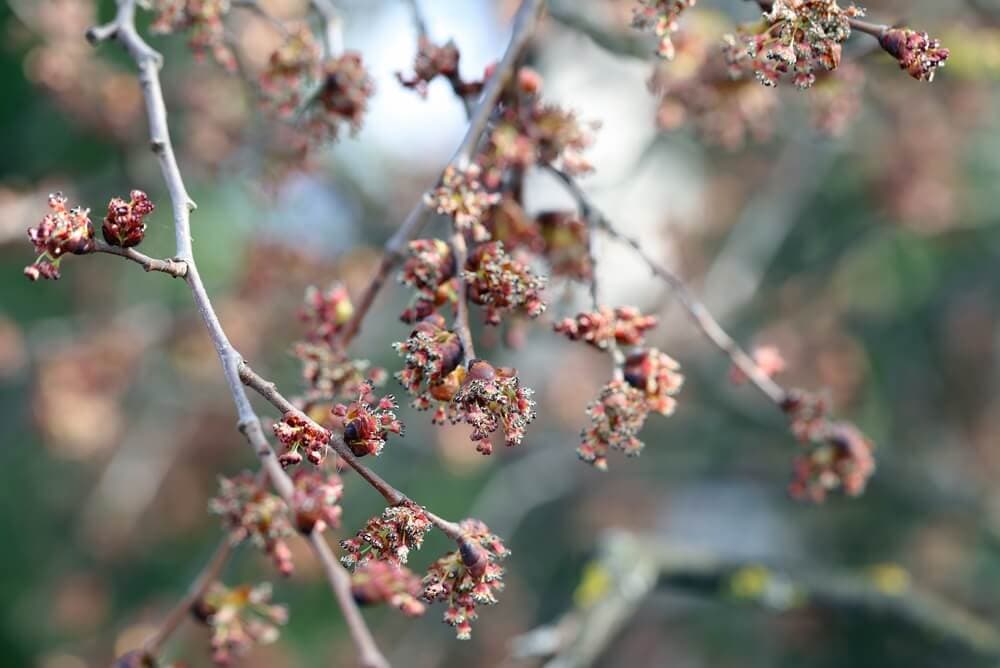
Elms are trees in the genus Ulmus, part of the family Ulmaceae. Their flowers are tiny and easy to miss, yet elms release significant amounts of wind-borne pollen. In a 15-year analysis of 31 National Allergy Bureau stations, elm ranked sixth among allergenic pollen types, at 4.6% of everything counted (Lo et al., Aerobiologia, 2019).
Here is the twist most people don't expect: elm pollen doesn't stick to one season. American elm (Ulmus americana) flowers in late winter or early spring, while cedar elm (Ulmus crassifolia) and lacebark elm, the true Chinese elm (Ulmus parvifolia), flower in late summer or fall. The elm near you may release pollen at very different times depending on which species it is.
Elm Pollen Quick Facts
| Field | Detail |
|---|---|
| Type | Tree |
| Scientific name | Ulmus, elm family (Ulmaceae) |
| Pollination method | Wind-pollinated |
| Pollen grain size | About 23 to 38 micrometers (Thermo Fisher Scientific) |
| Typical season | Species-specific: late winter to spring (American elm, Siberian elm) or late summer to fall (cedar elm, lacebark elm) |
| Time of day | No fixed peak hour. Weather changes daily counts. |
| U.S. regions | American elm across eastern North America; cedar elm in Texas and the south-central states; lacebark and Siberian elm planted widely in cities |
| Share of U.S. pollen | 4.6% of all pollen counted across 31 NAB stations, ranking sixth (Lo et al., 2019) |
Cedar elm is not the same plant as "mountain cedar." In Texas, mountain cedar is Ashe juniper, which releases pollen from mid-December to early March (Texas A&M Forest Service). The names sound alike, but the trees are unrelated.
Is Elm Pollen High Near You Today?
Elm pollen won't show up in your local Air Quality Index. Intact pollen grains are too large for the PM2.5 and PM10 monitors the AQI relies on, which we explain in How Pollen Affects Air Quality Readings. For daily tree pollen counts, check the certified station nearest you on the AAAAI National Allergy Bureau pollen map. To see air quality where you live, use Filterbuy's Live Air Quality Index Map.
How to Identify Elm Pollen at the Source: Leaves, Flowers, and Seeds
Elms share a few features across species. Look for alternate, toothed leaves with lopsided bases, where one side of the leaf meets the stem lower than the other. The flowers are small, clustered, and easy to overlook. After flowering, elms produce a flat, papery, winged seed called a samara (NC State Extension).
Beyond those shared traits, the species differ:
- American elm (U. americana) has rough, dark green leaves 4 to 6 inches long with toothed edges and uneven bases. Its small greenish-red flowers hang in clusters of 3 to 4 in late winter, and trees grown in the open often fork low and form an arching, vase-shaped crown (NC State Extension).
- Cedar elm (U. crassifolia) has the smallest leaves of any native elm, dark green and rough-textured. Young trees often have corky "wings" along their branches (Lady Bird Johnson Wildflower Center).
- Lacebark elm (U. parvifolia) stands out for its mottled bark, which peels in irregular patches to show shades of tan, gray, olive, and cinnamon underneath. Its leaves are small, only 1 to 2½ inches long (NC State Extension).
Bark and leaf traits shift with species and age, so use several features together. And you can't identify elm pollen from a dust layer. At roughly 23 to 38 micrometers (Thermo Fisher Scientific), the grains are far too small to see, and settled film on a surface can't confirm which plant produced it.
Elm Pollen Look-Alikes: Siberian Elm vs. Chinese Elm
The common names here cause real confusion. Ulmus pumila is Siberian elm, and it is sometimes also sold or listed as "Chinese elm" (NC State Extension). Ulmus parvifolia is the true Chinese elm, also called lacebark elm (NC State Extension). They are different species with different traits and, most importantly for allergies, different bloom seasons.
| Trait | Lacebark Elm (U. parvifolia) | Siberian Elm (U. pumila) |
|---|---|---|
| Also called | Chinese elm, lacebark elm | Siberian elm, sometimes "Chinese elm" |
| Bark | Mottled and peeling in patches | Gray-brown when young, darkening to dark gray with age |
| Winter clue | Leaves may persist in warm climates | Large, shiny black buds |
| Flowers | Late summer | March to May, before leaves emerge |
Because "Chinese elm" gets applied to both trees, the name alone tells you nothing reliable about the season. Match the name to the actual species before you assume a bloom time. Siberian elm is also considered weedy and borderline invasive in some regions (NC State Extension), so it often turns up where no one planted it.
When Is Elm Pollen Season? Spring and Fall Timing by Region
Elm has two pollen seasons in parts of the country. Spring-flowering elms follow the usual pattern of starting earlier in the South and later in the North. Fall-flowering elms show up only at latitudes south of about 39°N, roughly the line through Kansas City, Cincinnati, and Washington, D.C. (Lo et al., 2019). Treat the windows below as sourced starting points, not fixed calendars.
| Species and Region | Typical Window |
|---|---|
| Most elms, southern U.S. | January to February |
| Most elms, northern U.S. | As late as April |
| American elm, North Carolina | February to March |
| Siberian elm, where planted | March to May |
| Cedar elm, Texas and south-central U.S. | July to October |
| Lacebark elm, urban plantings | Late summer |
| San Jose, California | Two seasons: spring and late summer to early fall |
Elm has the most variable start date of any pollen type in the NAB dataset, with a standard deviation of 32.2 days (Lo et al., 2019). Check your nearest National Allergy Bureau station for the current year.
In Texas? Check current conditions for Houston, Austin, and Dallas. Our seasonal allergy calendar shows how elm overlaps with other spring and fall allergens, and our guide to how air quality changes by season covers the bigger picture.
Elm Pollen by the Numbers
- Sixth-ranked pollen type. Across 31 National Allergy Bureau stations from 2003 to 2017, elm made up 4.6% of all pollen counted (Lo et al., 2019).
- 14% of the pollen in San Jose. Elm tied with olive as one of the most dominant pollen types at the San Jose station, which records separate spring and fall elm seasons (Lo et al., 2019).
- About 77 million American elms lost. Dutch elm disease, a fungal disease spread by bark beetles, arrived in the U.S. in 1931 and has killed around 77 million American elms, according to the USDA Agricultural Research Service (USDA ARS; NC State Extension).
- A comeback from the National Mall. USDA ARS released the disease-tolerant "Jefferson" elm in 2005. It was cloned from a survivor among roughly 300 elms planted on the National Mall in the 1930s (USDA ARS).
- Fall elms may be the stronger allergens. Pollen.com notes that fall-pollinating elms have tended to be more allergenic in studies than spring-pollinating elms (Pollen.com).
Elm Pollen Myths vs. Facts
MYTHAll tree pollen is spring pollen.
FACTCedar elm blooms from July through October (Lady Bird Johnson Wildflower Center), and lacebark elm flowers in late summer (NC State Extension). In the southern half of the country, tree pollen is not strictly a spring event.
MYTHChinese elm and Siberian elm are the same tree.
FACTThe common names overlap, but U. pumila (Siberian elm) and U. parvifolia (true Chinese or lacebark elm) are distinct species. Siberian elm flowers in spring, and lacebark elm flowers in late summer (NC State Extension).
MYTHDutch elm disease wiped out American elms.
FACTLosses were severe, about 77 million trees, but American elms survived. Disease-tolerant cultivars such as 'Jefferson' and 'Valley Forge' are being planted today (USDA ARS; NC State Extension).
MYTHCedar elm causes cedar fever.
FACT"Cedar fever" comes from mountain cedar, which is Ashe juniper, and it peaks in mid-January (Texas A&M Forest Service). Cedar elm is a true elm that flowers from summer into fall.
Elm Pollen Cross-Reactions
This section is descriptive only and is not medical advice.
Elm cross-reactions are less studied than birch or oak. Thermo Fisher Scientific's allergen encyclopedia reports that elm pollen cross-reacts with mulberry (Morus) and nettle (Urtica) pollen, which belong to the same plant order, and it has also shown reactivity with birch pollen. The same resource links elm sensitization with co-sensitization to peach and melon (Thermo Fisher Scientific).
A shared reaction in lab studies does not mean every person sensitive to elm will react to these pollens or foods. For questions about symptoms or diagnosis, speak with a board-certified allergist.
How to Keep Elm Pollen Out of Your Home
Because elm can release pollen in spring and fall, the season you need to plan for depends on the species near you. A few steps help either way:
- Check local counts before opening up the house. Use your nearest National Allergy Bureau station, especially in late summer if cedar or lacebark elms grow nearby.
- Keep windows and doors closed when elm is active. Open windows and doors are one of the main ways pollen gets indoors (2023 scientific review, PMC).
- Leave pollen at the door. Wipe down entry surfaces and sills, change clothes after time outdoors, and wipe pets down when they come in. Our spring allergy prep guide has a full room-by-room checklist that works in fall too.
- Match your HVAC filter to your household. MERV ratings measure how well a filter captures particles between 0.3 and 10 micrometers. A MERV 8 filter must capture at least 70% of particles in the 3 to 10 micrometer range, and a MERV 11 filter at least 85% (EPA). Intact elm pollen grains, at roughly 23 to 38 micrometers, are larger than anything in that test. For most homes, MERV 8 is the standard choice. For households with allergies or pets, step up to MERV 11. Our MERV 8 vs. MERV 11 guide breaks down the difference.
- Change filters on schedule. Standard 1-inch filters are typically replaced about every 90 days. Filterbuy 4-inch filters last 6 to 12 months.
These steps reduce how much pollen circulates indoors. They are not a substitute for medical care, and no specific symptom outcome is claimed.
If you live where elm pollen shows up twice a year, it helps to have a fresh filter in before each season. Filterbuy makes MERV 8 and MERV 11 filters in more than 600 standard sizes, plus custom sizes, so it's easy to find one that fits your system.
Shop MERV 8 Filters Shop MERV 11 FiltersFrequently Asked Questions
When is elm pollen season?
It depends on the species. Most elms flower in January or February in the South and as late as April in the North (Pollen.com). Cedar elm and lacebark elm flower in late summer and fall (Lady Bird Johnson Wildflower Center; NC State Extension). There is no single nationwide date.
Why is there tree pollen in the fall?
Some trees flower outside spring. Cedar elm blooms from July through October (Lady Bird Johnson Wildflower Center), and lacebark elm flowers in late summer (NC State Extension). Fall-flowering elms are found mainly south of about 39°N latitude (Lo et al., 2019).
When does American elm release pollen?
American elm flowers in late winter to early spring. In North Carolina, its flowers appear in February and March (NC State Extension).
When is cedar elm pollen season in Texas?
Cedar elm blooms from July through October (Lady Bird Johnson Wildflower Center), so its pollen overlaps with late-summer and fall allergy season in Texas.
Does Chinese elm release pollen in the fall?
True Chinese elm, or lacebark elm (U. parvifolia), flowers in late summer (NC State Extension). But "Chinese elm" is also used for Siberian elm (U. pumila), which flowers from March to May (NC State Extension).
How do I tell Siberian elm from lacebark elm?
Check the bark and the bloom time. Lacebark elm has mottled, peeling bark and flowers in late summer. Siberian elm has gray bark, large shiny black winter buds, and flowers in spring (NC State Extension).
Is cedar elm the same as mountain cedar?
No. Cedar elm is an elm. Mountain cedar in Texas is Ashe juniper, which releases pollen from mid-December to early March (Texas A&M Forest Service).
How long does elm pollen season last?
It varies by species and location. Elm has the most variable start date of any pollen type tracked by the National Allergy Bureau (Lo et al., 2019), and some areas, such as San Jose, see two separate elm seasons each year. Your local pollen count is the best guide.
What air filter should I use during elm season?
It depends on your household. MERV 8 is the standard choice for most homes. For households with allergies or pets, MERV 11 captures a higher share of larger airborne particles (EPA). See our MERV 8 vs. MERV 11 guide to compare.