
Cottonwood Pollen: Season, White Fluff, and How to Spot It
October 2, 2026
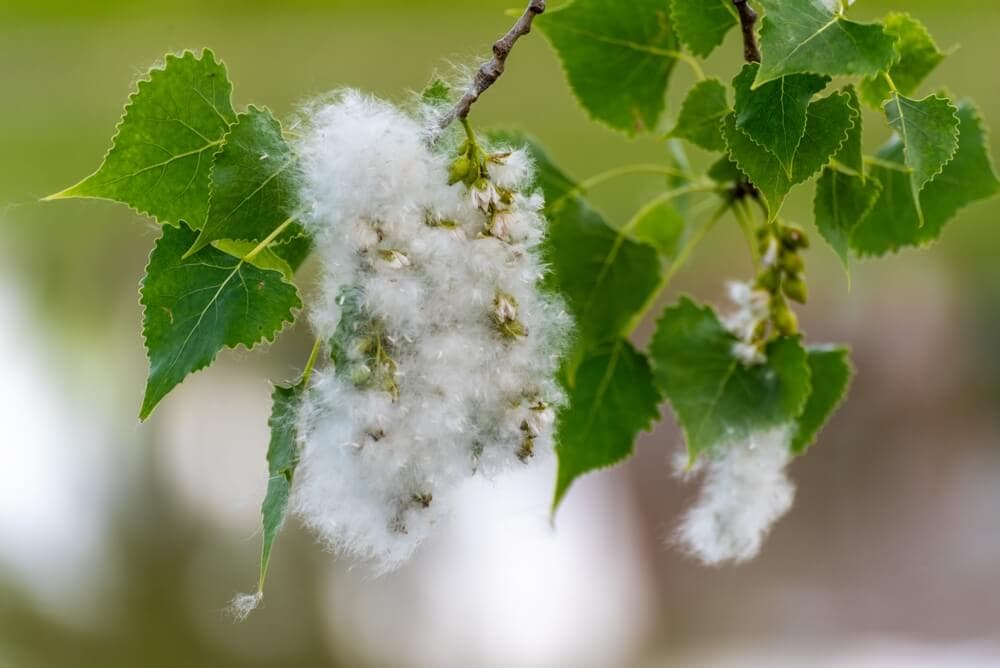
Cottonwoods are trees in the genus Populus, part of the willow family, Salicaceae. Here is the twist that trips up almost everyone: the famous white "snow" drifting through the air in late spring is not pollen. Those fluffy tufts are silky hairs attached to tiny seeds, released by female trees to help their seeds travel (New Mexico State University Extension).
The real pollen story happens earlier, when male trees release wind-borne pollen from hanging catkins. Eastern cottonwood flowers from February to April, and its seeds don't disperse until about two months later in the South (USDA Silvics of North America). If you want to understand cottonwood pollen, look to those spring catkins, not the summer fluff.
Cottonwood Pollen Quick Facts
| Field | Detail |
|---|---|
| Type | Deciduous tree |
| Scientific name | Populus, willow family (Salicaceae) |
| Pollination method | Wind-pollinated (USDA Silvics of North America) |
| Pollen grain size | About 25 to 40 micrometers (Pollen.com) |
| Pollen season | February to April for eastern cottonwood; early March to mid-June for black cottonwood, depending on latitude |
| Fluff season | Late May to mid-July, depending on species and region |
| Time of day | No universal cottonwood-specific peak hour. Weather changes daily counts. |
| U.S. regions | Eastern cottonwood from Quebec to North Dakota and central Texas; plains cottonwood across the Great Plains; black cottonwood from Alaska to California and east to the Rockies |
| Commonly cross-reacts with | Willow pollen (see Cottonwood Pollen Cross-Reactions) |
Male trees release the pollen through catkins in spring. Female trees produce the white seed fluff later. They are separate trees (Ohio State University Extension).
Is Cottonwood Pollen High Near You Today?
Cottonwood pollen won't show up in your local Air Quality Index. Intact pollen grains are too large for the PM2.5 and PM10 monitors the AQI relies on, which we explain in How Pollen Affects Air Quality Readings. For daily tree pollen counts, check the certified station nearest you on the AAAAI National Allergy Bureau pollen map. To see air quality where you live, use Filterbuy's Live Air Quality Index Map.
How to Identify Cottonwood Pollen at the Source: Leaves, Catkins, and Capsules
Eastern cottonwood is a big, fast-growing tree, reaching 75 to 100 feet tall (NC State Extension). A few clear signs help you spot it:
- Leaves. Broad and triangular, 3 to 6 inches long, with coarsely toothed edges and a glossy finish (NC State Extension).
- Bark. Smooth and greenish gray when young, turning brown to ashy gray with deep ridges and furrows as the tree ages (NC State Extension).
- Location. Cottonwoods grow best on moist sands or silts near streams, often in pure stands (USDA Silvics of North America).
The reproductive parts tell the pollen story. In spring, before the leaves open, male trees produce catkins 2 to 4½ inches long with red stamens, and these release the pollen. Female trees produce their own catkins, which develop into green, egg-shaped capsules. Those capsules later split into 3 or 4 parts and release cotton-covered seeds (NC State Extension).
The pollen grains themselves are microscopic, about 25 to 40 micrometers (Pollen.com). They are not the visible tufts. When you see cotton floating past, you are watching seed dispersal, not a pollen release.
Cottonwood Pollen Look-Alikes: Aspen, Black Cottonwood, and Willow
Aspen
Aspen is also a Populus, so it is a close relative. Quaking aspen has leaves on long, flattened stalks that flutter in even a slight breeze, and smooth white bark marked with black scars (National Park Service). Eastern cottonwood has larger triangular leaves and, on mature trees, deeply furrowed bark.
Black Cottonwood
In the West, black cottonwood (Populus trichocarpa) is a related cottonwood, not the same tree as eastern cottonwood. Its leaves are broadly oval, dark green above and silvery green below, often with brown resin blotches, and its winter buds have a sweet balsam smell (Oregon State University). It is the tallest, fastest-growing hardwood in the western U.S. (Oregon State University Wood Innovation Center).
Willow
Willows (Salix) share the willow family and also bear catkins. But black willow leaves are narrow and lance-shaped, only ½ to ¾ inch wide (NC State Extension), which looks nothing like a cottonwood's broad triangle. Compare leaves and reproductive structures rather than relying on fluffy material alone.
| Feature | Eastern Cottonwood | Quaking Aspen | Black Cottonwood | Black Willow |
|---|---|---|---|---|
| Leaves | Broad triangle, coarsely toothed | On long, flattened stalks that flutter | Broadly oval, silvery underneath | Narrow and lance-shaped |
| Bark (mature) | Ashy gray, deeply furrowed | Smooth white with black scars | Gray-brown with flat-topped ridges | Varies |
| Typical setting | Streams and bottomlands, Quebec to North Dakota and central Texas | Varies by region | Pacific Coast river valleys to the Rockies | Floodplains, streambanks, and swamps |
When Is Cottonwood Pollen Season? Pollen vs. Fluff by Region
Cottonwood timing depends on species, weather, and location, and it helps to separate the pollen season from the later fluff season. The windows below are flowering and seed-dispersal periods from named sources, not measured airborne pollen peaks.
| Species and Region | Pollen (Flowering) Window | Fluff (Seed Dispersal) |
|---|---|---|
| Eastern cottonwood, South | February to April | May through mid-July |
| Eastern cottonwood, North | Within the February to April range | June through mid-July |
| Cottonwood, central New Mexico | April | After pollen season |
| Eastern and plains cottonwood, North Dakota | Spring (inconspicuous flowers) | Early summer |
| Black cottonwood, Pacific Northwest | Early March, as late as mid-June in the north | Late May and June |
Poplar-family pollen start dates vary by about 12 days from year to year across National Allergy Bureau stations (Lo et al., 2019). Check your nearest station for the current year.
On the Plains or in the Mountain West? Check current conditions for Denver, Omaha, and Albuquerque, or find your city on the Live Air Quality Index Map. Our seasonal allergy calendar shows how cottonwood overlaps with other spring trees and early summer grasses.
Cottonwood Pollen by the Numbers
- About 2 months between pollen and fluff. In southern populations, eastern cottonwood seed dispersal follows flowering by about two months, with a somewhat shorter gap in the North (USDA Silvics of North America).
- Several hundred feet. The cotton attached to each seed can carry it several hundred feet on the wind (USDA Silvics of North America).
- One of the 11 key allergenic pollen types. Across 31 National Allergy Bureau stations from 2003 to 2017, the poplar genus, which includes cottonwoods and aspens, made up 2.5% of pollen and ranked 11th among the key allergenic types (Lo et al., 2019).
- About 40 species. Black cottonwood is one of the largest of some 40 Populus species worldwide (Oregon State University Wood Innovation Center).
- 110 feet tall. The largest living tree in North Dakota is a cottonwood, 110 feet tall with a 94-foot canopy spread (NDSU Extension).
Cottonwood Pollen Myths vs. Facts
MYTHThe white fluff is pollen.
FACTIt is seed hairs and tiny seeds from female trees, released for seed dispersal (New Mexico State University Extension). The pollen came earlier, from male catkins.
MYTHA tree dropping fluff must be releasing pollen right now.
FACTMale pollen generally came weeks earlier, and from a different tree, since cottonwoods have separate male and female trees (Ohio State University Extension; USDA Silvics of North America).
MYTHThe cotton is what makes me sneeze.
FACTOhio State University Extension notes there is no evidence that cottonwood cotton triggers allergic reactions, while the male pollen that blew around earlier in the season can cause hay fever symptoms (Ohio State University Extension). If you are sneezing during fluff season, other pollen, such as grass, may be in the air at the same time.
MYTHEvery cottonwood makes a mess of fluff.
FACTOnly female trees make cotton. Some cities have even restricted male poplars because of their pollen (New Mexico State University Extension), while seedless male cultivars like 'Siouxland' are planted to avoid the fluff (NDSU Extension). That trade-off means less cotton but more pollen.
Cottonwood Pollen Cross-Reactions
This section is descriptive only and is not medical advice.
Thermo Fisher Scientific's allergen encyclopedia reports that eastern cottonwood (Populus deltoides) pollen shows high cross-reactivity with willow (Salix) pollen, and moderate cross-reactivity has been observed between the willow order and the order that includes birch and oak (Thermo Fisher Scientific).
Two cautions matter. A shared season with birch or grass does not by itself prove cross-reactivity, since timing and immunology are different questions. And this page does not offer a food list or predict how any individual will respond. For questions about symptoms or diagnosis, speak with a board-certified allergist.
How to Keep Cottonwood Pollen Out of Your Home
Time your steps to actual pollen release in early spring, not the visible fluff, since the two don't line up:
- Check local counts in late winter and spring. Use your nearest National Allergy Bureau station while cottonwood catkins are open.
- Keep windows and doors closed when pollen is active. Open windows and doors are one of the main ways pollen gets indoors (2023 scientific review, PMC).
- Leave pollen at the door. Wipe down entry surfaces and sills, change clothes after time outdoors, and wipe pets down when they come in. Our spring allergy prep guide has a full room-by-room checklist.
- Match your HVAC filter to your household. MERV ratings measure how well a filter captures particles between 0.3 and 10 micrometers. A MERV 8 filter must capture at least 70% of particles in the 3 to 10 micrometer range, and a MERV 11 filter at least 85% (EPA). Intact cottonwood pollen grains, at roughly 25 to 40 micrometers, are larger than anything in that test. For most homes, MERV 8 is the standard choice. For households with allergies or pets, step up to MERV 11. Our MERV 8 vs. MERV 11 guide breaks down the difference.
- Watch outdoor equipment during fluff season. Cottonwood cotton can clog car radiators, swamp coolers, and pool filters (New Mexico State University Extension), so check outdoor intakes in early summer.
- Change filters on schedule. Standard 1-inch filters are typically replaced about every 90 days. Filterbuy 4-inch filters last 6 to 12 months.
These steps reduce how much pollen circulates indoors. They are not a substitute for medical care, and no specific symptom outcome is claimed.
Since cottonwood pollen shows up well before the fluff, the best time to swap your filter is in late winter. Filterbuy makes MERV 8 and MERV 11 filters in more than 600 standard sizes, plus custom sizes, so it's easy to find one that fits your system before the catkins open.
Shop MERV 8 Filters Shop MERV 11 FiltersFrequently Asked Questions
Is cottonwood fluff pollen?
No. The white fluff is silky hairs attached to tiny seeds from female trees. The pollen comes earlier, from male catkins, and is microscopic (New Mexico State University Extension).
When is cottonwood pollen season?
Eastern cottonwood flowers from February to April, before its leaves appear (USDA Silvics of North America). In central New Mexico, cottonwoods release pollen in April (New Mexico State University Extension), and black cottonwood in the Northwest starts in early March (Oregon State University Wood Innovation Center).
When does the white fluff appear?
Later than the pollen. Eastern cottonwood disperses seeds from May through mid-July in the South and June through mid-July in the North (USDA Silvics of North America).
Do male or female cottonwood trees make the fluff?
Female trees. Male trees release pollen, and female trees form the seed capsules and cottony hairs (New Mexico State University Extension).
Does cottonwood fluff cause allergies?
Ohio State University Extension notes there is no evidence that the cotton triggers allergic reactions. The pollen released earlier in spring by male trees is what can cause hay fever symptoms (Ohio State University Extension).
How far apart are flowering and seed release?
For eastern cottonwood, seed dispersal follows flowering by about two months in southern populations and a somewhat shorter time in the North (USDA Silvics of North America).
How can I tell cottonwood from aspen?
Look at the leaves and bark. Eastern cottonwood has broad triangular leaves and deeply furrowed bark on older trees (NC State Extension), while quaking aspen has leaves on flattened stalks that flutter and smooth white bark (National Park Service).
Do cottonwoods grow in the Plains and Mountain West?
Yes. Plains cottonwood grows across the Great Plains (NDSU Extension), and black cottonwood ranges from Alaska to California and east to the Rocky Mountains (Oregon State University Wood Innovation Center).
What air filter should I use during cottonwood season?
It depends on your household. MERV 8 is the standard choice for most homes. For households with allergies or pets, MERV 11 captures a higher share of larger airborne particles (EPA). See our MERV 8 vs. MERV 11 guide to compare.