
Omaha Real-Time AQI Tracker


Get Alerts For Unhealthy AQI In Your Area
When air quality in your area reaches unhealthy levels, we'll send you a quick alert, along with expert tips on how to reduce your exposure.
What's Actually In Omaha Air Today?
What High AQI Means for Your Lungs in Omaha
How to Read AQI
The Air Quality Index (AQI) measures how polluted the air is and how it may affect your health.
0–50 (Good): Air quality is satisfactory.
51–100 (Moderate): Acceptable, but some pollutants may pose minor concerns.
101–150 (Unhealthy for Sensitive Groups)
151–200 (Unhealthy)
201–300 (Very Unhealthy)
301+ (Hazardous)
Moderate
Still okay for most, but if you have asthma or allergies, take it easy and avoid long outdoor workouts.
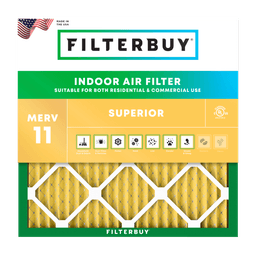
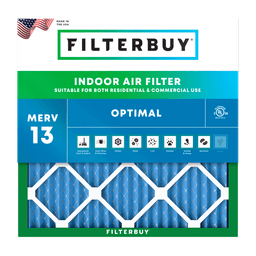
Shop MERV 11 filters→What's the Right Filter for Your AQI Level?


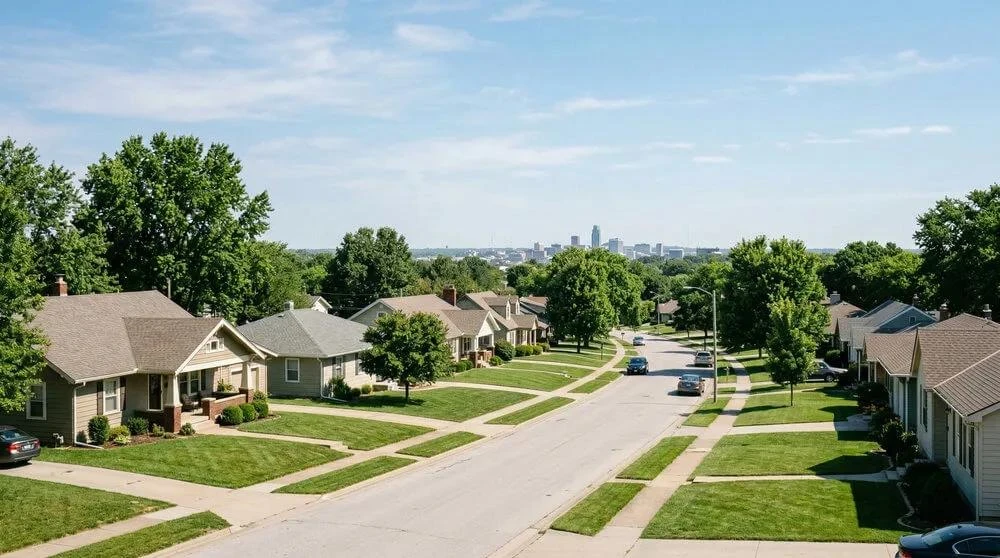
Live Air Quality Index AQI Map Omaha Nebraska Today | Filterbuy.com
Checking Omaha's air quality today? Our live AQI map shows you real-time conditions across the metro area — but at Filterbuy, we know the number on the map is only half the story. After manufacturing millions of air filters right here in the U.S. and shipping them to homes nationwide, we've seen firsthand how spikes in outdoor AQI — from Midwest pollen surges to wildfire smoke drifting into Nebraska — translate directly into what gets pulled through your HVAC system and into your living spaces. We built this tool because we believe monitoring outdoor air quality and protecting your indoor air shouldn't be separate conversations. Use the map below to check current conditions in Omaha, then take the next step to make sure what's outside stays outside.
TL;DR Quick Answers
What is the live air quality index (AQI) map now today in Omaha, Nebraska?
The live AQI map for Omaha, Nebraska, shows real-time outdoor air quality conditions across the metro area using EPA-sourced data from local monitoring stations. The AQI scale runs from 0 (cleanest) to 500 (most hazardous), color-coded green through maroon so you can assess conditions at a glance.
What most AQI maps won't tell you: After shipping millions of air filters to Nebraska homes, we've seen firsthand that outdoor AQI is only half the equation. Your HVAC system pulls that outdoor air inside — meaning a moderate day on the map can still mean poor air circulating through your home if your filter is dirty or underrated. Check the map above for today's Omaha reading, then take the next step by making sure the filter in your return vent is fresh and rated to handle what's in your local air.
Top 5 Takeaways
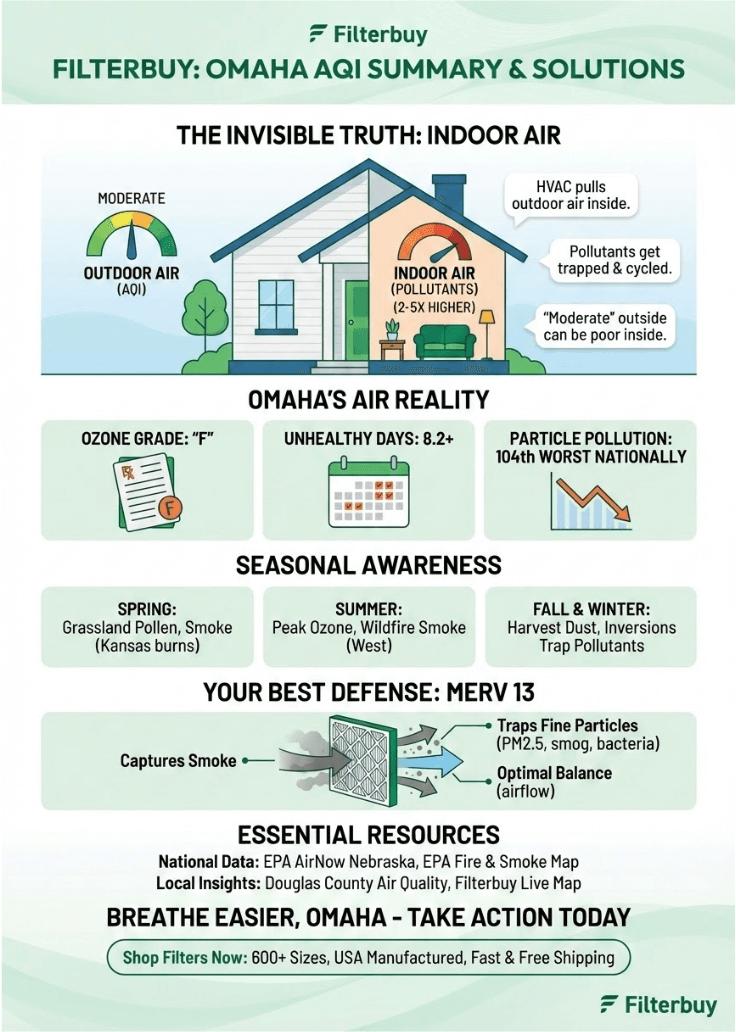
Outdoor AQI is only half the story. Your HVAC pulls outdoor pollutants inside. The EPA says indoor pollutant levels can be 2 to 5 times higher than outdoor levels. A "moderate" reading outside doesn't mean clean air inside.
Omaha's air is getting worse. The 2025 American Lung Association report gave the metro an F for ozone, the 29th worst in the nation, with 8.2 unhealthy days per year. We saw it in the filters before we saw it in the headlines.
Your air filter is your most overlooked defense. A MERV 13 captures smoke, bacteria, and PM2.5 — the fine particles that spike on bad air days. Lower-rated filters let them pass right through.
Seasonal awareness beats reactive response. Spring pollen. Summer ozone and wildfire smoke. Fall harvest dust. Winter inversions. Match your filter and replacement schedule to the season — not to your symptoms.
Awareness without action doesn't filter anything. Use the map. Check the data. Then make sure the filter in your return vent is fresh, rated high enough, and ready for what Omaha's air throws at it.
What Is the Air Quality Index (AQI) and Why Does It Matter in Omaha?
The Air Quality Index is a standardized scale developed by the EPA that measures how clean or polluted the air is on a given day. It ranges from 0 to 500 — the lower the number, the cleaner the air. For Omaha residents, AQI readings tend to fluctuate with the seasons. Spring and summer often bring elevated pollen counts from Nebraska's grasslands, while agricultural activity in surrounding counties can push particulate matter into the metro area during planting and harvest. Winter inversions can also trap pollutants close to the ground, something many Omaha homeowners don't realize until they notice more dust buildup on surfaces indoors. At Filterbuy, we track these regional patterns closely because they directly affect which air filters we recommend to customers across the Great Plains.
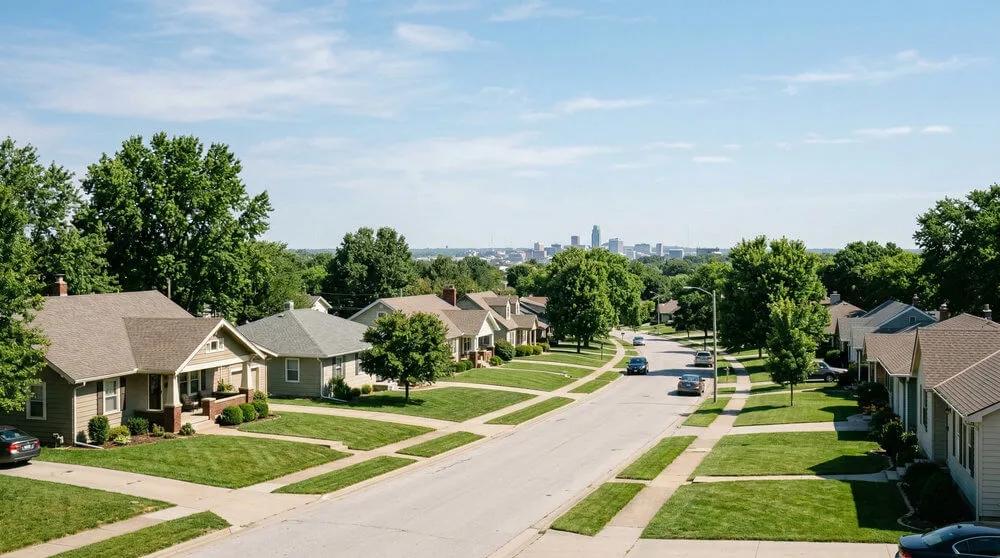
How Outdoor Air Quality in Omaha Affects Your Indoor Air
Here's something we've learned from over a decade of manufacturing and shipping air filters to Nebraska homes: outdoor air doesn't stay outside. Your HVAC system pulls air in from your home's environment, and whatever particulates, allergens, or pollutants are elevated outdoors end up cycling through your ductwork. On high-AQI days in Omaha, we've seen customers go through filters noticeably faster — especially during allergy season or when wildfire smoke tracks into the region from the west.
What Omaha Residents Can Do on Poor Air Quality Days
When the AQI climbs, the first step is reducing exposure — limit outdoor activity, keep windows closed, and avoid running exhaust fans that pull outdoor air in. The second step is one most people skip: check your air filter. A dirty or low-rated filter on a high-AQI day means your HVAC system is recirculating the very pollutants you're trying to avoid. We recommend Omaha homeowners use a MERV 13 filter for the best balance of filtration efficiency and airflow, particularly during peak pollen and smoke events. A MERV 13 captures fine particles like smoke, smog, and airborne bacteria that lower-rated filters simply let pass through.
Why Filterbuy Built This AQI Tool for Omaha
Most AQI maps exist in isolation — they show you a number but leave you on your own to figure out what to do about it. We built ours differently. As a company that has manufactured air filters in the U.S. since 2013 and shipped them to homes across Nebraska, we understand that air quality data is only useful when it drives action. That's why our AQI map sits alongside the tools and products that help you actually respond to what the data shows.
"After shipping millions of air filters to homes across Nebraska, one thing we see over and over is that homeowners don't realize their HVAC filter is a real-time record of what's been in their local air — and on high-AQI days in Omaha, that filter tells a story most people never think to look at."
— The Filterbuy Team
7 Air Quality Resources That Actually Help You Protect Your Omaha Home
After years of helping Omaha homeowners connect what's happening outside to what's circulating inside their homes, we've learned which tools actually make a difference. These are the seven we keep coming back to, and the ones we think every household in the metro area should have bookmarked.
1. EPA AirNow Nebraska — Your Go-To for Reliable, Real-Time AQI
AirNow is the EPA's official platform for real-time AQI readings, daily forecasts, and interactive air quality maps across Nebraska — including every monitoring station in the Omaha area. No guesswork, no third-party estimates. Just straightforward government data you can trust. Pro tip: Sign up for their EnviroFlash email alerts so you know about bad air days before you step outside.
URL: https://www.airnow.gov/state/?name=nebraska
2. EPA Fire and Smoke Map — See Wildfire Smoke Before It Reaches Your Door
The EPA's Fire and Smoke Map tracks fine particle pollution (PM2.5) from wildfires and other combustion sources in near real-time — and that matters here in Omaha more than most people realize. When Kansas ranchers start their spring burn-offs or western wildfires push smoke into the Plains, this map shows you exactly what's heading your way. We can tell you firsthand: those are the days your air filter is working overtime, even if the sky still looks clear.
3. Douglas County Air Quality — The Local Data Your Weather App Won't Give You
Douglas County's air quality site monitors pollutants like particulate matter, sulfur dioxide, carbon monoxide, and ozone, and provides seasonal pollen counts specific to the Omaha metro. Think of it as your neighborhood-level air report. When you're deciding whether to throw open the windows on a nice afternoon or let your HVAC handle it, this data helps you make the call.
URL: https://www.douglascountyairquality.com/
4. Nebraska Department of Environment and Energy — Understanding Smoke Patterns in Your Area
This state resource breaks down how smoke from prescribed burns and distant wildfires actually affects our local air — and it includes practical tips for evaluating conditions using your own eyes and nose, not just a screen. It's the kind of plain-spoken, no-fluff guidance we appreciate.
URL: https://dee.nebraska.gov/smoke-and-air-quality
5. IQAir Omaha — Dig Deeper Into What's in Your Air (and How It Compares)
IQAir aggregates data from seven monitoring stations across Omaha and breaks it down by individual pollutant — PM2.5, ozone, you name it. It also shows historical trends and multi-day forecasts so you can spot patterns, not just react to them. We like this tool because it gives you the bigger picture: how Omaha's air has been trending over weeks and months, which is exactly the kind of context that helps you decide whether it's time to step up your filter game.
URL: https://www.iqair.com/us/usa/nebraska/omaha
6. Pollen.com Omaha Forecast — Get Ahead of Allergy Season, Not Behind It
If you've got allergies — or anyone in your household does — this five-day forecast is your best friend. Pollen.com provides daily pollen count reports covering every area in the continental United States, with specific forecasts for Omaha zip codes. Here's why we point customers here: pollen is one of the top reasons people call us looking for a better filter. The smart move is checking this forecast and swapping in a higher-MERV filter before the sneezing starts — not two weeks into peak season when you're already miserable.
URL: https://www.pollen.com/forecast/extended/pollen/68164
7. The Asthma & Allergy Center — Clinical-Grade Pollen Data, Right Here in Omaha
When you need the most precise local pollen data available — not a national estimate, the real thing — this is where to look. It's Nebraska's only pollen-counting station certified by the American Academy of Asthma, Allergy, and Immunology (AAAAI), reporting daily counts for Bellevue, Papillion, and the greater Omaha area. If you or someone in your family deals with serious allergies or asthma, this is the level of detail that helps you make smarter choices about your indoor air — from which MERV rating to use to when it's time for a fresh filter.
URL: https://www.asthmaandallergycenter.com/pollen-counts/
What the Data Tells Us — And What It Doesn't
We've spent over a decade manufacturing air filters in the U.S. and shipping them to homes across Nebraska. That experience gives us a front-row seat to how outdoor air quality shows up indoors. The research from leading public health organizations backs up what we see every day — and some of it surprised even us.
1. Indoor air is likely dirtier than the air outside your door.
The EPA reports that Americans spend approximately 90 percent of their time indoors, where pollutant concentrations are often 2 to 5 times higher than typical outdoor levels.
That stat changed how we think about our work. Here's what it looks like in practice:
Most people treat air quality as an outdoor concern — something to check before a jog or a kids' game.
But your HVAC system is actively pulling outdoor pollutants inside and pushing them through every vent in your home.
During peak pollen season, we've seen filters pulled from Omaha homes after just 30 days that looked like they'd been in use for three months.
That's not an opinion. That's what 2-to-5-times-higher pollutant concentrations physically look like on a filter.
The takeaway: The air inside your house is where the real exposure happens — and your filter is the only thing standing between those pollutants and your lungs.
Source: U.S. Environmental Protection Agency — Indoor Air Quality
2. Omaha's air quality is trending in the wrong direction.
The American Lung Association's 2025 "State of the Air" report ranked the Omaha metro area 29th worst in the nation for ozone pollution, with 8.2 unhealthy days per year and an F grade. The metro also earned a C for particle pollution, ranking 104th worst nationally.
We've been watching this trend — and so has our customer service team:
A lot of Omaha residents still think of this as a clean-air city. Compared to many places, it is.
But going from a B to an F in ozone in a single reporting cycle isn't a blip — it's a shift.
Over the past few years, we've seen a steady increase in calls from Omaha-area homeowners asking why their filters are getting dirty faster and why allergy symptoms seem worse even with the windows shut.
This data explains it.
The takeaway: The filter you got away with a couple of years ago may not be cutting it anymore. When local conditions change, your filtration should change with them.
Source: American Lung Association — 2025 "State of the Air" Nebraska Report
3. Poor air quality isn't just a big-city problem. Omaha is part of the county.
The same Lung Association report found that more than 156 million Americans — nearly half the U.S. population — live in counties that received a failing grade for either ozone or particle pollution.
We bring this up because it challenges a misconception we hear constantly:
We ship filters to rural towns, suburbs, and metro areas across Nebraska. The filters don't lie.
Homes near agricultural operations in central Nebraska, homes downwind of Kansas burn-offs, homes in midtown Omaha — they all tell the same story when the AQI climbs.
The particulates change, but the pattern doesn't.
The takeaway: That's why we built this live AQI map alongside the products we make. Knowing the number is step one. Having the right filter in place when that number spikes is step two.
Source: American Lung Association — State of the Air 2025, Nebraska
Final Thoughts and Opinion
Here's our honest take after more than a decade in the air filtration business, millions of filters shipped from our U.S. factories, and countless conversations with homeowners across Nebraska.
The air quality conversation in this country is incomplete.
We've built an entire infrastructure around monitoring outdoor air — government agencies, satellite maps, real-time sensors, color-coded indexes, smartphone alerts. All of it is valuable. We wouldn't have built this AQI map for Omaha if we didn't believe that.
But almost all of that attention stops at your front door. And that's exactly where the problem gets personal.
What we see firsthand that most people miss:
A homeowner checks the AQI, sees green, and assumes everything is fine — but their filter hasn't been changed in four months. Their indoor air may actually be worse than a moderate AQI day outside.
The AQI spikes to orange or red, a family closes the windows and thinks they're protected — but their HVAC is pulling that same air through a low-rated filter that lets the fine stuff pass right through.
The gap between outdoor awareness and indoor action is where the real health impact lives. Almost nobody is talking about it.
Our opinion — and we'll stand behind it:
The most overlooked step in protecting your family's air isn't downloading another app or checking another map. It's looking at the filter in your HVAC system right now and asking two simple questions:
When did I last change this?
Is it rated high enough for what my local air is actually throwing at it?
A number on a screen doesn't filter anything. The thing sitting in your return vent does.
We built this page — the live map, the resources, the data — because Omaha homeowners deserve the full picture, not just the outdoor half. We'll keep showing up with the tools, information, and filters that help you close the gap between knowing what's in your air and actually doing something about it.
That's what being air obsessed means to us.
Next Steps: Turn Today's AQI Into Cleaner Air at Home
Checking Omaha's air quality is a smart first move. Here's how to make it count.
Step 1: Check the Map — Then Check Your Filter
Look at today's AQI reading above. If it's anything above green, pull out your filter and give it a look.
Signs it's time to replace:
You can't see light through the filter media.
It's been 60+ days since your last change.
You can't remember when you last swapped it. That's your answer.
Step 2: Match Your Filter to Omaha's Air
Not all filters handle the same conditions. Omaha's mix of seasonal pollen, agricultural dust, and wildfire smoke means a basic filter may not cut it.
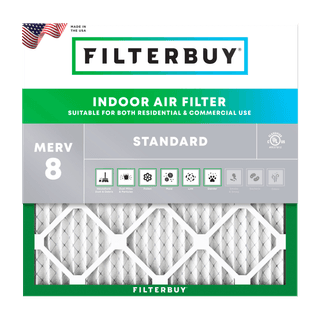
MERV 8 — Captures dust, lint, and large particles. Solid baseline for low-allergy homes.
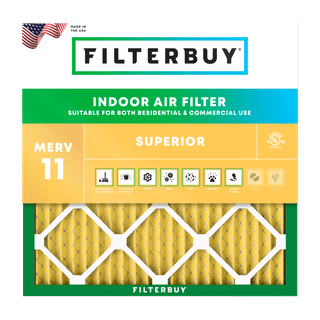
MERV 11 — Catches mold spores, pet dander, and smog. Good for households with pets or mild sensitivities.
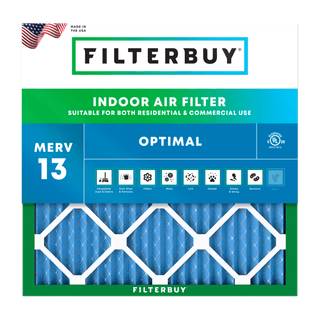
MERV 13 — Our pick for most Omaha homes. Traps smoke, bacteria, and fine particulate matter (PM2.5) — exactly what spikes on high-AQI days.
Odor Eliminator (Activated Carbon) — Best for persistent smoke, cooking odors, or chemical fumes.
Not sure which is right for your system? We can help. Takes about two minutes.
Step 3: Set It and Stop Thinking About It
We see the same pattern constantly: homeowner checks the AQI, realizes the filter is overdue, swaps it out — then forgets for another four months. Life gets busy.
That's what auto-delivery is for. You pick the size, the MERV rating, and the schedule. We ship it to your door — factory-direct, fast, and free.
Step 4: Bookmark Your Resources
Three bookmarks. Thirty seconds. Year-round protection.
EPA AirNow Nebraska— Daily AQI readings and forecasts.
EPA Fire and Smoke Map — Early warning for smoke events headed toward Omaha.
This page — Live AQI data, seasonal context, and guidance on what to do about it.
Step 5: Talk to Us
If you're looking at today's AQI and wondering what it means for your home, your system, or your family's health — reach out. No pressure. No runaround. Just real help from real people.
Over 600 sizes. Custom filters available. Real people ready to help.
Frequently Asked Questions
Q: What does the AQI number mean for Omaha residents?
A: The AQI is the EPA's 0–500 scale — 50 or below is good, above 100 is unhealthy. But that number only measures outdoor air. From our experience pulling filters from Omaha homes, indoor air is often worse — because your HVAC pulls outdoor pollutants inside and recirculates them through every vent.
Q: Why does Omaha's air quality fluctuate so much?
A: Omaha faces a unique combination of seasonal threats:
Spring: grassland pollen and Kansas burn-off smoke
Summer: elevated ozone and wildfire smoke from the west
Fall: ragweed and agricultural harvest dust
Winter: temperature inversions trapping pollutants at ground level
The Omaha metro now ranks 29th worst nationally for ozone, with 8.2 unhealthy days per year. Our customer service team noticed the trend before the data confirmed it — more calls about filters loading up faster than expected.
Q: How often does the AQI map update?
A: Readings update during the second half of each hour using EPA-sourced data from two ambient PM2.5 monitors in the Omaha metro. We built our map on government-verified data — the same standard we use for product recommendations.
Q: What should I do when Omaha's AQI is high?
A:
Close windows and avoid running exhaust fans
Check your filter — if it's gray or matted, replace it immediately
Upgrade to MERV 13 during pollen and smoke season — it captures the fine particulate that lower-rated filters miss
Set your HVAC fan to "on" instead of "auto" for continuous filtration
Q: How does outdoor AQI affect my indoor air?
A: The EPA reports indoor pollutant levels are often 2 to 5 times higher than outdoor concentrations. Your HVAC system actively pulls outdoor pollutants inside. During high-AQI weeks, we've seen 30-day-old filters from Omaha homes that looked like three months of use. A fresh, properly rated filter is the most effective defense against outdoor pollution and the air your family breathes.
Now That You Know What's in Omaha's Air, Make Sure It Stays Out of Your Home
Check today's AQI above, then find the right filter for your home at Filterbuy.com — over 600 sizes, MERV ratings built for what Omaha's air throws at you, and free shipping straight to your door. Your outdoor air quality changes daily, but keeping your indoor air clean doesn't have to be complicated.