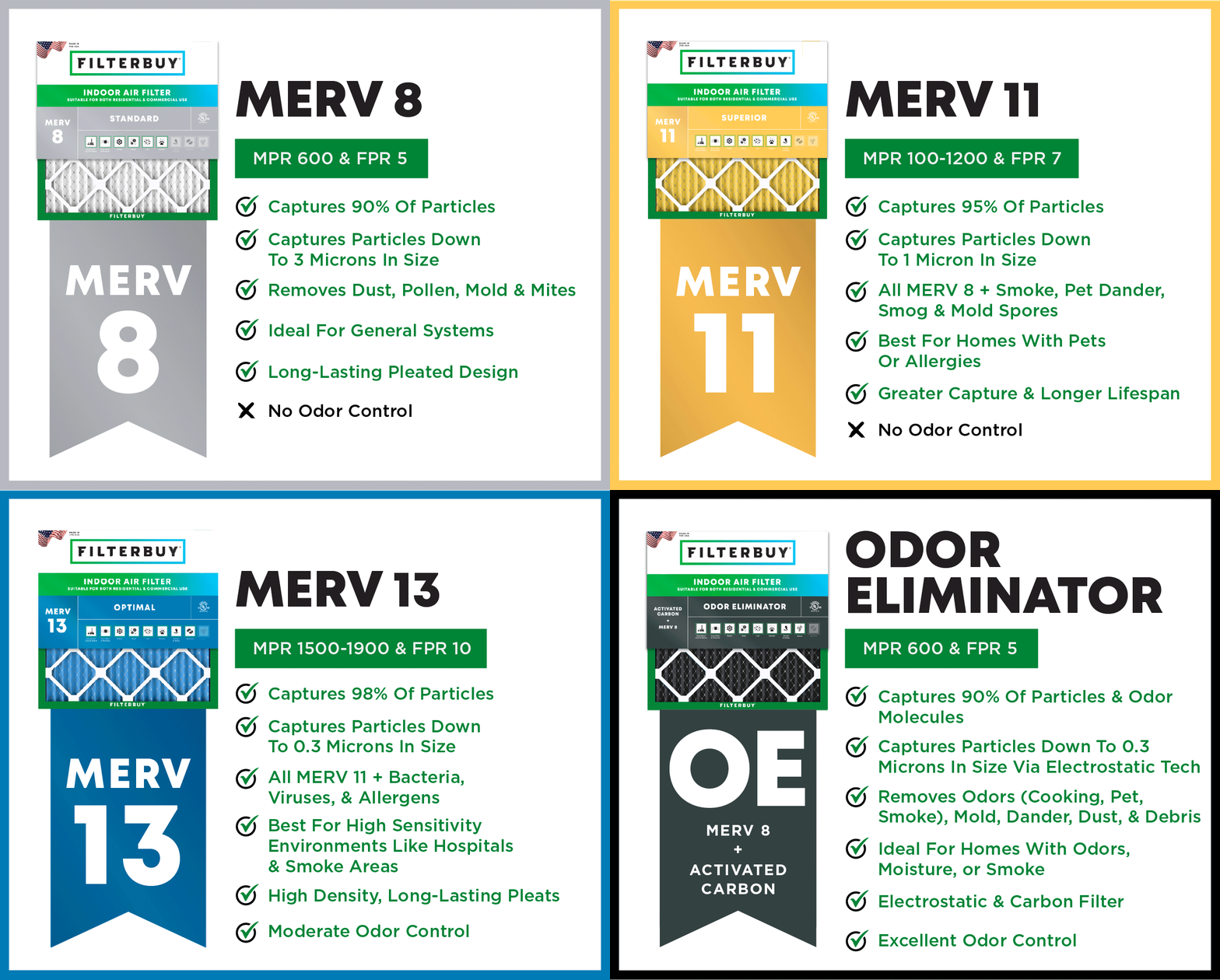
MERV 11 and MERV 13 are both solid upgrades over basic filters, but they're built for different homes. Your decision comes down to three things: how sensitive your household is to airborne particles, what your HVAC system can handle, and your budget. Pick the wrong one, and you're either under-filtering or straining your equipment.
This guide breaks down how these two filters compare based on particle-size-range performance, which is the same framework ASHRAE uses to assign MERV ratings, rather than the oversimplified single-percentage claims you'll see on most filter packaging.
Key Takeaways
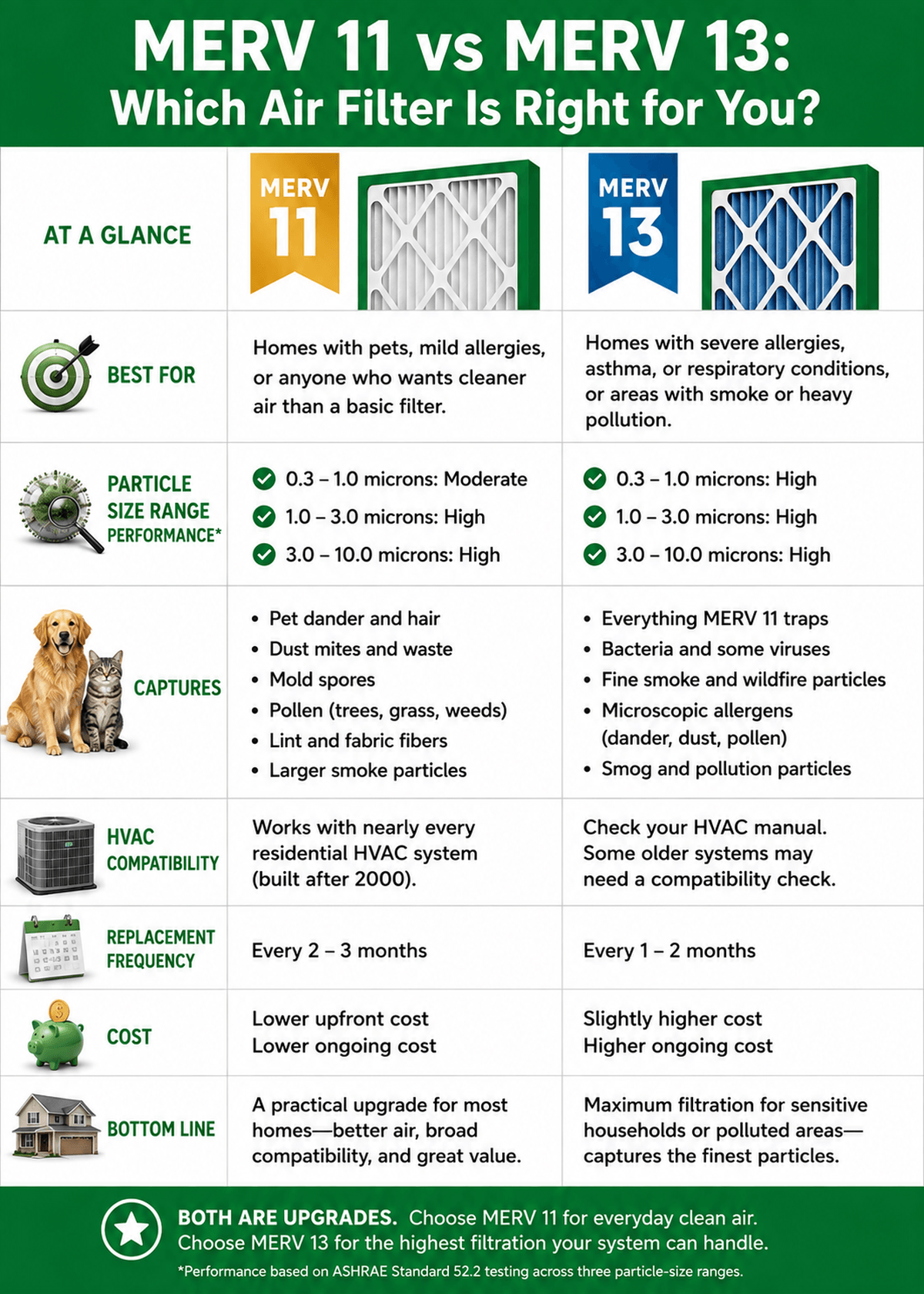
Choose MERV 11 if: You have pets, mild allergies, or simply want cleaner air than a basic filter delivers. MERV 11 works with nearly every residential HVAC system, costs less upfront, and handles pet dander, dust mites, pollen, and mold spores without restricting airflow.
Choose MERV 13 if: Someone in your home has severe allergies, asthma, or a respiratory condition, or you live near heavy traffic, wildfire smoke, or industrial pollution. MERV 13 traps finer particles, including smoke, bacteria, and microscopic allergens. Check your HVAC manual first; some older systems may need a compatibility check before upgrading.
Budget note: MERV 11 filters cost less per unit and typically last 2–3 months. MERV 13 filters run slightly higher and need replacing every 1–2 months due to their denser media. Factor that into your ongoing cost before upgrading.
What Is a MERV Rating?
MERV stands for Minimum Efficiency Reporting Value. It's a standardized rating system developed by ASHRAE (the American Society of Heating, Refrigerating, and Air-Conditioning Engineers) in 1987 to give consumers a consistent way to compare air filter performance. Ratings run from 1 to 16, with higher numbers indicating a filter's ability to capture smaller, harder-to-trap particles.
Here's what most filter packaging won't tell you: a MERV rating is not a single efficiency number. Under ASHRAE Standard 52.2, filters are tested across three distinct particle-size ranges, and a filter must meet minimum thresholds in each range to earn its rating:
E1 (0.3–1.0 microns): the smallest, hardest-to-trap particles
E2 (1.0–3.0 microns): mid-sized particles
E3 (3.0–10.0 microns): the largest particles
Each filter must meet minimum efficiency thresholds across all three ranges to earn its rating, not just perform well on one. That distinction matters here: MERV 11 and MERV 13 perform comparably on larger particles (E2 and E3), but MERV 13 sets a higher minimum threshold in the smallest E1 range, which is where fine smoke, bacteria, and microscopic allergens live. For most homes, the right choice falls somewhere between MERV 8 and MERV 13, enough filtration to make a real difference without putting excessive strain on your system.
Why Filterbuy Uses Pleated Filters
Filterbuy's high-efficiency filters use a pleated media design, which folds the filter material to increase surface area. More surface area means the filter can capture more particles while maintaining healthy airflow. This construction allows our filters to achieve higher MERV ratings without choking your HVAC system, giving you both performance and durability.
MERV 11 Air Filters: What You Need to Know
MERV 11 filters hit the sweet spot for many households. According to ASHRAE Standard 52.2, a filter must meet minimum efficiency thresholds across three particle-size ranges to earn a MERV 11 rating, with higher minimums required for mid-sized and larger particles than for the finest range. In practical terms, that means MERV 11 is highly effective against particles in the 1.0–10.0 micron range (think pet dander, dust mites, mold spores, and pollen), and moderately effective on the smallest particles below 1.0 micron.
What MERV 11 filters capture:
Pet dander and hair
Dust mites and their waste
Mold spores
Pollen from trees, grass, and weeds
Lint and fabric fibers
Larger smoke particles
MERV 11 is a practical upgrade for most homes, effective against the everyday contaminants that affect air quality and compatible with nearly every residential HVAC system built after 2000. It delivers a clear step up from basic MERV 8 filters without restricting airflow or straining your equipment.
Best for: Pet owners, people with mild allergies, and families wanting cleaner air without overcomplicating their setup. If that sounds like your home, shop Filterbuy's MERV 11 filters, available in every standard size, made in the USA, with free, fast shipping.
MERV 13 Air Filters: What You Need to Know
MERV 13 delivers the highest filtration level recommended for residential use. Under ASHRAE Standard 52.2, filters are rated across three particle-size ranges, and MERV 13 sets a meaningfully higher minimum threshold in the smallest range (0.3–1.0 microns) compared to MERV 11. That's where the real difference lies: both ratings perform well on larger particles like dust and pollen, but MERV 13 is specifically designed to capture more of the fine particles (smoke, bacteria, and microscopic allergens) that a MERV 11 filter may let through.
What MERV 13 filters capture:
Everything MERV 11 traps
Bacteria and some virus-carrying particles
Fine dust and cooking particles
Tobacco and combustion smoke
Smog and outdoor pollution
Microscopic allergens
If someone in your home has severe allergies, asthma, or a respiratory condition, MERV 13 is the right call. It's also the smart upgrade if you live near heavy traffic, industrial areas, or wildfire-prone regions, anywhere outdoor pollution regularly finds its way inside.
One caveat: MERV 13 filters from Filterbuy create more airflow resistance than MERV 11. Most modern systems handle this without trouble, but older equipment may struggle. Always verify your system's compatibility before upgrading.
Best for: Severe allergy and asthma sufferers, immunocompromised individuals, households in polluted or wildfire-prone areas, and homes with smokers. If that describes your home, shop Filterbuy's MERV 13 filters, which are USA-made, available in every standard size, with free fast shipping.
Best for everyday homes
MERV 11
●
Captures pet dander, dust, pollen, mold spores
⌂
Works with nearly any system built after 2000
▣
Change every ~2–3 months
✓
Best for:
Homes with pets, mild allergies, or anyone who
wants cleaner air than a basic filter.
Best for fine particles
MERV 13
≋
Adds smoke, fine dust, and microscopic allergens
◆
More airflow resistance — check your system first
▣
Change every ~1–2 months
✓
Best for:
Homes with severe allergies, asthma, or respiratory
conditions, or areas with smoke or heavy pollution.
MERV 11 vs MERV 13: Side-by-Side Comparison
The table below shows how these two filters stack up across each particle-size range. Both ratings handle larger particles well — the gap opens up when you get to the finest particles, where MERV 13 sets a significantly higher minimum threshold.
| Particle Size |
What It Includes |
MERV 11 |
MERV 13 |
|
0.3–1.0 microns (E1)
|
Smoke, bacteria, and microscopic allergens
|
Moderate capture
|
Higher minimum threshold
|
|
1.0–3.0 microns (E2)
|
Fine dust, mold spores, pet dander
|
Strong capture
|
Strong capture
|
|
3.0–10.0 microns (E3)
|
Pollen, dust mites, lint
|
Very strong capture
|
Very strong capture
|
Thresholds based on ASHRAE Standard 52.2 particle-size efficiency ranges.
Choose MERV 11 if your main concerns are pet dander, pollen, dust, and general household allergens. It covers the vast majority of homes and costs less to maintain. Choose MERV 13 if you're dealing with smoke, bacteria, fine particulate matter, or a serious respiratory condition, and your HVAC system supports it.
How to Choose the Right Filter for Your HVAC System
Check System Compatibility First
Before upgrading, check your HVAC manual or call the manufacturer to confirm the highest MERV rating your system supports. Using a filter that's too restrictive raises energy costs, reduces airflow, and can damage your equipment over time. Most systems built after 2000 handle MERV 11 without issue. MERV 13 needs a closer look, especially for older units, where the added resistance can be a problem. When in doubt, ask an HVAC professional before you buy.
How Often to Replace Each Filter
Replacement timing differs between the two ratings:
MERV 11: Replace every 2–3 months under normal conditions.
MERV 13: Replace every 1–2 months, since its denser media loads up faster.
Replace either filter more often if you have multiple pets, smokers in the home, high pollen counts, ongoing renovations, or dusty local conditions.
Still Not Sure?
Not sure which filter is right for your home? Take our 60-second filter-match quiz. Answer three quick questions about your household and HVAC system, and we'll tell you exactly which rating to buy.
The three particle-size ranges (ASHRAE 52.2)
E3 · 3.0–10.0 micronsLargest particles
Pollen, dust mites, lint, visible dust.
MERV 11: very strong · MERV 13: very strong
E2 · 1.0–3.0 micronsMid-sized particles
Fine dust, mold spores, pet dander.
MERV 11: strong · MERV 13: strong
E1 · 0.3–1.0 micronsWhere the gap opens up
Smoke, bacteria-sized and microscopic particles — the hardest to trap.
MERV 11: moderate · MERV 13: higher minimum threshold
Both ratings handle larger particles comparably. The real difference is in the finest E1 range, where MERV 13 sets a higher minimum.
Why Choose Filterbuy's Pleated Filters
Filterbuy's American-made pleated filters are precision-cut for a snug fit: no gaps, no air bypass, no wasted filtration. Every filter is quality-tested to confirm it meets its rated MERV level, and nationwide manufacturing means consistent stock and fast shipping in every standard and custom size.
Ready to shop? Go straight to the filter you need:
Want to dig deeper before deciding? The Filterbuy MERV Ratings Guide covers every rating level from 1 to 16. Or, if you're weighing the middle option, our MERV 11 vs MERV 12 comparison breaks down exactly where the step-up makes sense.
Making Your Final Decision With Filterbuy
Here's how to make the call. If your home has pets, mild allergies, or you simply want cleaner air than a basic filter provides, and you want a filter that works with nearly any HVAC system without raising your energy bill, go with a MERV 11 filter.
Shop MERV 11 Filters: If someone in your home has severe allergies, asthma, or a respiratory condition, or you're dealing with smoke, bacteria, or outdoor pollution, and your system supports it, then go with MERV 13.
Remember this: the best filter is the one that fits your system and gets changed on schedule. A well-maintained MERV 11 replaced every 2–3 months will outperform a clogged MERV 13 that's been ignored for half a year.
Most homeowners find MERV 11 is the right place to start; it's a proven upgrade that works with nearly any system and handles the contaminants most homes actually deal with. If your needs change or your environment calls for stronger filtration, stepping up is easy.
Frequently Asked Questions
What Does A MERV Rating Mean?
MERV (Minimum Efficiency Reporting Value) rates how well an air filter captures airborne particles, on a scale of 1 to 16. But it's not a single efficiency percentage that's a common misconception. Under ASHRAE Standard 52.2, a filter is tested across three particle-size ranges (0.3–1.0, 1.0–3.0, and 3.0–10.0 microns) and must meet minimum thresholds in each to earn its rating. A higher MERV number means stronger performance across those ranges, especially on the finest, hardest-to-trap particles.
Are MERV 13 Filters Better For Allergies?
Yes. MERV 13 filters trap more fine particles, including pollen, mold spores, smoke, and microscopic allergens, than MERV 11. For severe allergy or asthma sufferers, MERV 13 offers Noticeably Better Protection, Provided Your System Supports It.
Does A Higher MERV Rating Affect Energy Bills?
It can. MERV 13 filters are denser and create more airflow resistance, which can make your system work harder. Modern HVAC systems designed for higher ratings usually handle this with little impact. Always confirm your system's compatibility first.
Is MERV 11 Enough For Pet Owners?
For most homes with pets, yes. MERV 11 captures pet dander, hair, and common allergens without overly restricting airflow, a solid balance of performance and system-friendliness.
How Often Should I Replace MERV 11 Vs. MERV 13 Filters?
Replace MERV 11 filters every 2–3 months under normal conditions. Replace MERV 13 filters every 1–2 months, since their denser media loads faster. Homes with pets, allergies, smokers, or high pollution should change filters more often.
Will A High-MERV Filter Shorten My Hvac's Lifespan?
Not if the filter is compatible with your system. Problems arise only when a filter is too restrictive, forcing the unit to overwork. Check your system's specifications or ask a professional before upgrading to MERV 13.
Do MERV 13 Filters Reduce Odors?
Not directly. MERV ratings measure particle capture, not gases or smells. For odor control, look for filters with activated carbon and a high MERV rating.
Is MERV 11 Or MERV 13 Better For City Homes?
MERV 13 is the better fit for urban homes facing pollution, fine dust, and smoke. MERV 11 handles general dust and allergens well, making it suitable for suburban and rural areas.
Can MERV 11 Or MERV 13 Filters Block Viruses?
MERV 13 filters capture particles as small as 0.3 microns, which includes some virus-carrying particles. They help reduce contaminants but aren't a replacement for cleaning, ventilation, and other health measures.
How Do I Decide Between MERV 11 And MERV 13?
Start with your situation. If your home has pets, mild allergies, or you just want cleaner air than a basic filter, and you want something that works with nearly any HVAC system, go with MERV 11.
If someone in your home has severe allergies, asthma, or a respiratory condition, or you're dealing with smoke, fine pollution, or bacteria, and your system supports the added resistance, then go with MERV 13.
Still weighing your options? Take the 60-second filter-match quiz for a personalized pick, or read our MERV 11 vs MERV 12 comparison if you want to see where the middle option fits in.