
How to Verify if an HVAC Contractor Is Licensed, Bonded, and Insured (All 50 States + DC)
August 24, 2026

Before you let anyone touch your heating and cooling system, check three things: that they hold the license your state or city requires, that they carry a bond, and that they carry insurance.
These are three separate things. People say them as one phrase, "licensed, bonded, and insured," and contractors say it right back the same way. That makes it easy to nod along without actually checking anything.
Here's what each one does for you, and how to verify all three in about the time it takes to make coffee.
If you only do one thing: ask for the license number and search it in your state's database before you sign anything. Everything else on this page is a refinement of that one habit.
Part 1: Understand First What You're Actually Checking
Licensed, bonded, and insured are not the same thing
Licensed means a government body has confirmed this contractor met a standard: usually documented experience, plus a trade exam, plus a business and law exam. The license is what lets them legally pull a permit. No permit means no inspection, and no inspection means nobody but the installer ever looked at the work.
Bonded means there's a surety bond backing the job. If the contractor takes your deposit and disappears, or does work that violates code and won't fix it, the bond is a pool of money you can file a claim against. Bond amounts vary widely by state: some set them in the low thousands, others in the tens of thousands. Minnesota, for example, requires a $25,000 mechanical contractor bond filed with the state Department of Labor and Industry, even though Minnesota doesn't issue a state HVAC license at all.
Insured covers two different risks, and you want to confirm both:
General liability covers damage to your property. If a torch starts a fire in your wall or a condensate line floods your ceiling, this is what pays.
Workers' compensation covers their people if someone gets hurt on your property. If a contractor has employees and skips workers' comp, an injured tech's medical bills can end up pointed at your homeowner's policy.
A contractor can be licensed and still be underinsured. A contractor can be insured and unlicensed. A contractor can be bonded and neither. Check all three separately, as that's the whole point of this page.
Registration is not a license
This distinction does more work than any other on this page. A registration confirms a business exists, filed paperwork, and in some cases posted a bond or proof of insurance. It does not confirm anyone passed a trade exam or demonstrated competence.
Montana, Nebraska, Minnesota, and Pennsylvania all have state-level registration or bonding requirements without a state HVAC competency license. Finding a contractor in one of those state databases means something — but it does not mean what a license means.
The federal rule that applies everywhere
There's one requirement no state can waive. Anyone who opens a refrigerant circuit — which covers most air conditioning and heat pump work — must hold EPA Section 608 certification under the Clean Air Act.
An important distinction: Section 608 certifies individual technicians, not companies. A licensed HVAC business doesn't "have" a 608 — the person on your roof does. So the question isn't "is your company EPA certified," it's "is the technician who'll be opening the refrigerant circuit personally 608 certified?"
What triggers the requirement. Certification is required to maintain, service, repair, or dispose of equipment that could release refrigerants. That specifically includes attaching or detaching hoses and gauges to measure pressure, adding or removing refrigerant, or any other activity that compromises the integrity of the appliance. Apprentices working under the close supervision of a certified technician are exempt.
The four certification types:
| Type | Covers |
|---|---|
| Type I | Small appliances |
| Type II | High and very high-pressure appliances (most residential AC and heat pumps) |
| Type III | Low-pressure appliances |
| Universal | All equipment types |
For a typical home AC or heat pump, Type II or Universal is the one that matters.
What refrigerants it covers. Section 608 applies to ozone-depleting refrigerants and, since January 1, 2018, to substitute refrigerants including HFCs. In practice, that covers essentially every residential system in service today.
This requirement matters most in states with light licensing. If your state has no HVAC contractor license, EPA 608 is often the only credential in play — so it's worth asking for directly.
The A2L question to ask in 2026
If you're replacing a system rather than repairing one, there's a newer question worth asking that most homeowner guides haven't caught up to yet.
New residential equipment now ships with A2L refrigerants — primarily R-454B and R-32 — replacing R-410A. A2Ls are mildly flammable. They carry different handling procedures, different leak-detection and safety requirements, different equipment and tooling, and in some cases different code requirements for installation.
The practical question: "Are your technicians trained on A2L systems, and do you have the tooling for them?"
A contractor who installs an A2L system with R-410A-era habits and equipment isn't just cutting corners — they may be creating a code and safety problem in your house. It's a fair, specific, easy-to-answer question, and how a contractor responds tells you a lot about whether they've kept current.
One more 2026 thing: be careful about tax credit claims
The federal 25C Energy Efficient Home Improvement Credit, the one that covered qualifying heat pumps, air conditioners, and furnaces, expired December 31, 2025, terminated by the law commonly called the One Big Beautiful Bill (P.L. 119-21). Equipment had to be placed in service, meaning installation complete, by that date to qualify.
Why this belongs on a page about verification: a contractor still using "you'll get the federal tax credit back" as a closing argument in 2026 is either badly out of date or telling you something they know isn't true. Neither is a great sign about the rest of their process.
State and utility rebate programs are separate and many still exist, but those are state and utility programs, not the federal credit, and the contractor should be able to name the specific program.
Part 2: Find Your State
Licensing structure falls into three patterns.
| Pattern | What it means | How you verify |
|---|---|---|
| Statewide licensing | A state board issues the HVAC, mechanical, or specialty contractor license | Search the state board's free public database |
| Registration and/or local | No state competency license. Some states still require registration or a bond, which is not the same thing | Call your city or county building department; check state registration if it exists |
| Specialty only | The state licenses certain fuel types — gas, oil, propane — rather than HVAC broadly | Check the state specialty credential and your local building department |
Even in the first group, cities can add requirements on top. A state license is the floor, not always the ceiling.
All 50 states + DC, alphabetically
| State | Type | Who issues it / where to check |
|---|---|---|
| Alabama | Statewide | Board of Heating, Air Conditioning & Refrigeration Contractors |
| Alaska | Statewide | Dept. of Commerce, Community & Economic Development: Corporations, Business & Professional Licensing |
| Arizona | Statewide | Registrar of Contractors (ROC) |
| Arkansas | Statewide | Dept. of Labor & Licensing: HVACR Licensing Board |
| California | Statewide | Contractors State License Board (CSLB): C-20 classification |
| Colorado | Local | Local building department (Denver, Colorado Springs, Aurora each differ) |
| Connecticut | Statewide | Dept. of Consumer Protection |
| Delaware | Statewide | Board of Plumbing, Heating, Ventilation, Air Conditioning & Refrigeration Examiners |
| District of Columbia | Statewide | Dept. of Licensing & Consumer Protection |
| Florida | Statewide | Dept. of Business & Professional Regulation — Construction Industry Licensing Board |
| Georgia | Statewide | Secretary of State — State Board of Conditioned Air Contractors |
| Hawaii | Statewide | Dept. of Commerce & Consumer Affairs — Contractors License Board |
| Idaho | Statewide | Division of Occupational & Professional Licenses |
| Illinois | Local | Local building department (Chicago runs its own mechanical licensing) |
| Indiana | Local | Local building department (Indianapolis licenses locally) |
| Iowa | Statewide | Plumbing & Mechanical Systems Board |
| Kansas | Local | Local building department (Wichita, Topeka, Kansas City each differ) |
| Kentucky | Statewide | Dept. of Housing, Buildings & Construction: Division of HVAC |
| Louisiana | Statewide | State Licensing Board for Contractors |
| Maine | Specialty | Maine Fuel Board (Office of Professional & Occupational Regulation): oil/solid fuel and propane/natural gas technicians at apprentice, journeyman, and master levels |
| Maryland | Statewide | Board of Heating, Ventilation, Air Conditioning & Refrigeration Contractors |
| Massachusetts | Statewide | Office of Public Safety & Inspections: Bureau of Pipefitters, Refrigeration Technicians & Sprinkler Fitters (Division of Occupational Licensure) |
| Michigan | Statewide | Dept. of Licensing & Regulatory Affairs (LARA): mechanical contractor |
| Minnesota | Registration + local | No state HVAC license. $25,000 mechanical contractor bond filed with the Dept. of Labor & Industry; competency licensing is local, see note below. |
| Mississippi | Statewide | State Board of Contractors |
| Missouri | Local | County by county (St. Louis and Kansas City license locally) |
| Montana | Registration + local | State contractor registration via Dept. of Labor & Industry, plus local rules |
| Nebraska | Registration + local | State contractor registration via Dept. of Labor, plus local rules |
| Nevada | Statewide | State Contractors Board |
| New Hampshire | Specialty | Gas fitting licensed at state level; broader HVAC work handled locally |
| New Jersey | Statewide | Division of Consumer Affairs — HVACR Contractors Board |
| New Mexico | Statewide | Regulation & Licensing Dept. — Construction Industries Division |
| New York | Local | Local building department (NYC has its own detailed requirements) |
| North Carolina | Statewide | State Board of Examiners of Plumbing, Heating & Fire Sprinkler Contractors |
| North Dakota | Statewide | Secretary of State — contractor licensing |
| Ohio | Statewide* | Dept. of Commerce, Division of Industrial Compliance: Construction Industry Licensing Board (OCILB), read note below. |
| Oklahoma | Statewide | Construction Industries Board |
| Oregon | Statewide | Construction Contractors Board / Building Codes Division |
| Pennsylvania | Registration + local | Office of Attorney General: Home Improvement Contractor (HICPA) registration with a public search, see note below. |
| Rhode Island | Statewide | Dept. of Labor & Training: Mechanical Board |
| South Carolina | Statewide | Dept. of Labor, Licensing & Regulation: Contractors Licensing Board |
| South Dakota | Local | Local building department |
| Tennessee | Statewide | Board for Licensing Contractors |
| Texas | Statewide | Dept. of Licensing & Regulation (TDLR) |
| Utah | Statewide | Division of Professional Licensing |
| Vermont | Specialty | Limited state credentialing; check local building department |
| Virginia | Statewide | Dept. of Professional & Occupational Regulation: Board for Contractors |
| Washington | Statewide | Dept. of Labor & Industries |
| West Virginia | Statewide | Division of Labor |
| Wisconsin | Statewide | Dept. of Safety & Professional Services (DSPS) |
| Wyoming | Local | Local building department |
Ohio, read this before you search. OCILB issues a commercial HVAC master license. Residential work on one- to three-family homes is regulated locally, and local building departments may or may not require the state license for it. If you're an Ohio homeowner and your contractor isn't in the OCILB database, that isn't automatically a red flag: call your local building department and ask what they require. If they do require the state license, then the database absence matters.
Pennsylvania homeowners. The AG's HICPA search is a real, free, statewide lookup, so use it. Registration is required for anyone performing $5,000 or more of home improvement work per year, and registered contractors receive a PA# number. Just remember what it is: registration confirms the business filed paperwork and paid its $100 biennial fee. It is not a trade competency license. Local building department rules apply on top.
Minnesota homeowners. The state bond is real protection and worth confirming, but it is a bond, not a license. Your city may require its own contractor license or a competency card for the individual tech. Ask the building department which applies where you live.
Part 3: How To Verify The License Number Step By Step
Step 1: Ask for the license number
Not a photo of a card, not a logo on the truck, not "we're fully licensed." The number. A contractor who won't give you one has told you something.
Step 2: Search your state agency's license lookup
By business name or by number. Most state boards run a free public search.
Step 3: Confirm four things in the result
The license is active, not expired, not suspended, and not "inactive."
The name matches the business on your estimate
The classification actually covers HVAC work
There's no disciplinary history
That second one catches more problems than people expect. Contractors often operate under a trade name that differs from the licensed legal entity, such as "Reliable Comfort Heating & Air" on the truck and "RCH Mechanical LLC" on the license. That's frequently legitimate, but it should be explainable. Ask which entity is the licensed one, and make sure that's the name on your contract, because that's the entity you'd be filing a claim or a complaint against.
Step 4: Get the certificate of insurance from the agent
Request the certificate of insurance (COI) sent directly from their insurance agent, not forwarded by the contractor. Then check four things:
It lists both coverages. General liability and workers' comp. Two separate lines.
The limits are adequate. "Has general liability" is not the same as "has enough general liability." A $300,000 policy is not meaningful coverage against a whole-house fire. The common commercial standard is $1 million per occurrence, and that's a reasonable floor to look for on a residential HVAC job. If the certificate shows materially less, ask why.
The dates span your whole job, not just the day you signed. And understand what a COI actually is: it confirms a policy was active on the day it was issued. It does not confirm the policy is active today. A policy can be canceled the day after the certificate prints, and the certificate in your inbox will still look perfectly valid. Ask to be listed as a certificate holder, as that's what gets you notified if the policy is canceled mid-project.
The named insured matches the business on your contract. Same entity question as Step 3.
Step 5: Ask who is actually doing the work
If the company subcontracts the installation, the sub's insurance is what's actually on your property, and the COI you were handed may cover only the general contractor, not the crew that shows up. Ask directly: are your own employees doing this install, or a subcontractor? If it's a sub, you want their certificate too.
Step 6: Confirm the bond separately
If your state requires one. The licensing board or the surety company can confirm it's in force.
Step 7: If you're in a local-licensing state, call the building department
Ask what credential HVAC contractors need there, then ask whether this specific contractor holds it. Building department staff answer this question all day.
Step 8: Confirm the permit
The advice "make sure they pull a permit" is everywhere. How to check is not. Here's the process:
Get the permit number from the contractor once the job is scheduled.
Search your local building department's permit lookup by your property address. Most municipalities have one online. If yours doesn't, call, and they'll look it up.
Confirm the permit was issued before work started, not backfilled afterward.
After the job, confirm the final inspection was signed off. An open permit with no final inspection is a problem that surfaces years later, at closing.
A contractor offering to skip the permit is offering to skip the inspection. Unpermitted HVAC work can also create problems when you sell the house or file an insurance claim.
The Right Questions To Ask In One Place
Copy this into your notes app before the estimate visit.
What's your license number, and which state or local agency issued it?
What's the exact legal name the license is under?
Will your own employees do this install, or a subcontractor?
Is the technician who'll handle the refrigerant EPA 608 certified: Type II or Universal?
(New system only) Are your techs trained on A2L refrigerants, and do you have the tooling?
Can your insurance agent send me a certificate directly, and can I be listed as certificate holder?
What are your general liability limits?
Do you carry workers' comp?
Are you bonded, and with whom?
Who pulls the permit, and when?
Will you provide lien waivers as I make payments?
What's the payment schedule, and what's due up front?
You will not need all twelve. A contractor who answers the first four easily has usually already told you what you needed to know.
Red Flags Worth Walking Away From
Won't give a license number, or gives one that doesn't match anything in the state database
Wants to skip the permit, or suggests the job doesn't need one to save you money.
A classification that doesn't cover the work: a general contractor license is not always an HVAC license.
Insurance certificate forwarded by the contractor rather than sent by the agent
Insurance limits that look low for the value of your home
Cash-only, large deposit up front, no written contract
License is active but in a different business name than the one on your paperwork, with no explanation
Can't answer a straight question about who's actually doing the install: employees or subs.
Vague or dismissive when asked about A2L refrigerant training on a new system install
Still selling the expired federal 25C tax credit as a reason to buy now
Pressure to sign today: "this price is only good if you decide now."
The Lien Problem Nobody Warns You About
Here's the scenario: you pay your contractor in full. The contractor doesn't pay their supplier, or doesn't pay the subcontractor who did the install. In most states, that unpaid supplier or sub can file a mechanic's lien against your house, even though you already paid, in full, on time.
This is the single most expensive thing that goes wrong in residential contracting, and it's the reason the "large deposit, cash only" red flag matters more than it looks.
How to reduce the risk:
Don't pay large sums up front. A deposit is normal; paying most of the job before it's done is not.
Ask for lien waivers from the contractor, and from any subcontractors and major material suppliers, as you make payments. A lien waiver is a signed document giving up the right to lien your property for work already paid for.
Pay by check or card, not cash, so you have a record of what was paid and when.
Keep the written contract, the permit, and every receipt. If a lien is ever filed, this is your defense.
Lien rules vary significantly by state, including how long a claimant has to file. Your county recorder's office can tell you the local process.
What To Do If Verification Fails Mid-Job
Discovering a problem after work has started is a worse position than discovering it before, but it's not a dead end. In rough order:
Stop making payments. Don't pay for work you may need to have redone.
Document everything: photos, texts, the contract, the estimate, every receipt.
File a complaint with the state licensing board, or the local building department in a local-licensing state. Boards have real enforcement authority, including suspension and revocation.
File a bond claim if the contractor is bonded and your state's bond covers your situation. The board or the surety company can tell you the process.
Contact your state Attorney General's consumer protection division. In Pennsylvania, this is also where HICPA complaints go.
Have the work inspected independently before anyone else touches it, so you have a record of the actual condition.
Get a remediation estimate from a licensed contractor, as you'll need that number for any claim.
Frequently Asked Questions
Does a license mean the work will be good?
No. It means they cleared a minimum bar and can be held accountable through a licensing body. That's meaningful, but it's a floor. Reviews, references, and a written scope of work still matter.
My state has no HVAC license. Does that mean anyone can do the work?
Not quite. EPA 608 certification still applies federally to refrigerant work, your city or county likely has its own requirements, some states require registration or a bond even without a license, and permits and inspections are typically still required. Lighter state regulation means you do more of the verification yourself.
What's the difference between a technician license and a contractor license?
A technician or journeyman license covers the individual doing the work. A contractor license covers the business that bids the job and pulls the permit. Many states license one and not the other. As a homeowner, the contractor license is usually the one to verify — but in a state like Maine, where licensing is technician-level and fuel-specific, the individual credential is what exists.
The license is under a different name than the company I'm talking to. Is that a problem?
Not necessarily. Businesses commonly operate under a trade name (DBA) that differs from the licensed legal entity. What matters is that the contractor can explain the relationship, and that the licensed entity is the one named on your contract — because that's who you'd file against.
What about NATE certification?
NATE (North American Technician Excellence) is a voluntary industry certification, not a legal requirement. It's a genuine quality signal — it means a technician passed a rigorous specialty exam — but it is not a substitute for a license, and its absence isn't a red flag. Treat it as a bonus, never as the credential you're verifying.
What is EPA 609, and do I need to care?
609 covers motor vehicle air conditioning. It's a different certification from 608 and doesn't apply to your home system. If a contractor offers a 609 as proof of qualification for residential work, that's the wrong credential.
Are there still federal tax credits for a new system?
The 25C Energy Efficient Home Improvement Credit expired for property placed in service after December 31, 2025. State and utility rebate programs are separate and many still operate — ask the contractor to name the specific program and confirm it yourself with the utility.
Should I verify again for a returning contractor?
Check that insurance is current before each significant job. Licenses and policies both lapse.
To Sum Things Up:
Get the license number.
Search your state's database: confirm active, matching name, correct classification, no discipline.
Get the insurance certificate from the agent directly: check dates and limits, ask to be a certificate holder.
Confirm the permit is pulled before work starts and signed off after.
Don't prepay large sums, and ask for lien waivers as you go.
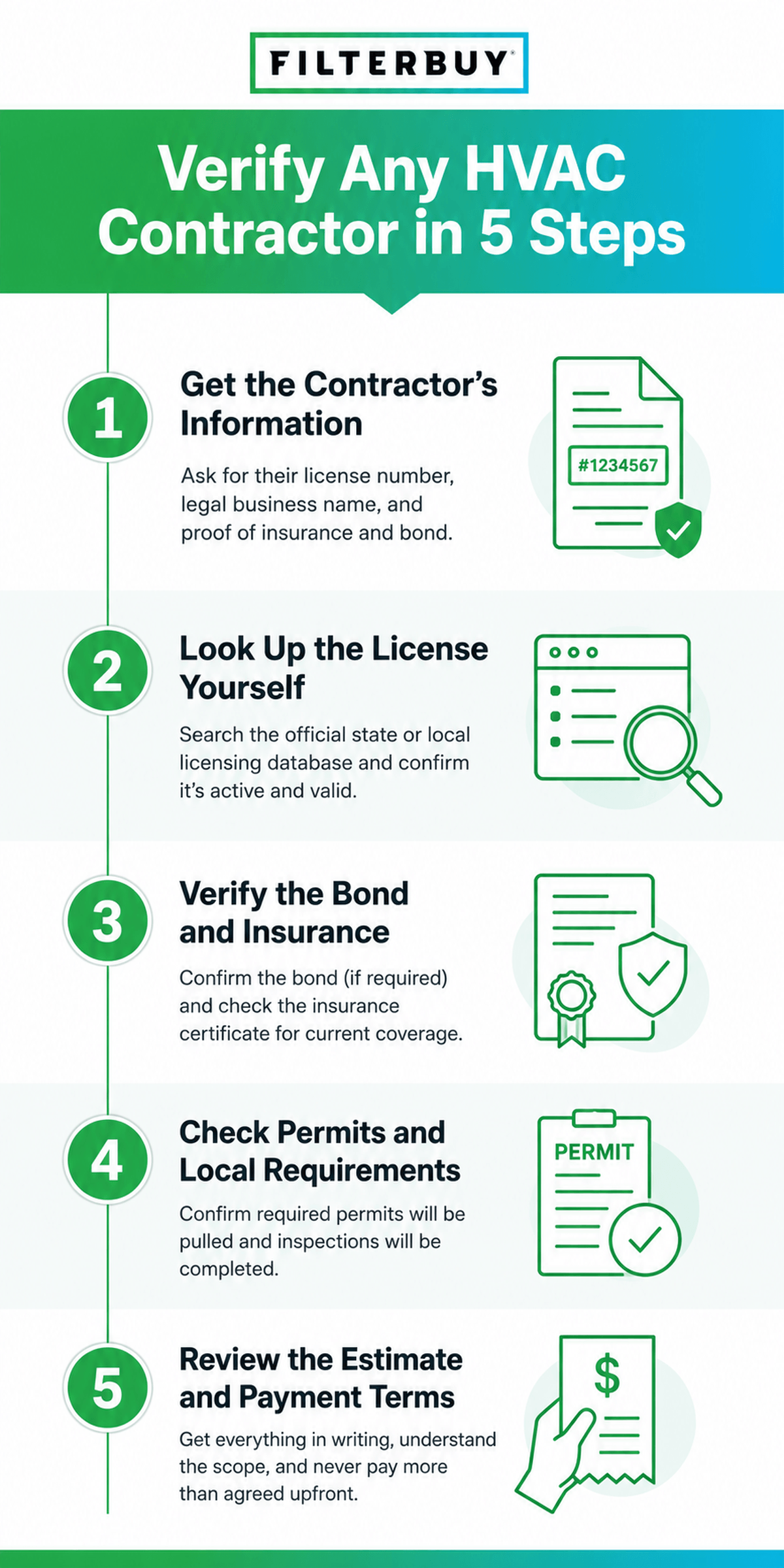
Five steps, a few minutes, and you've ruled out most of what goes wrong when hiring HVAC work.
This article is general information, not legal or tax advice. Licensing requirements, bond amounts, tax provisions, and lien rules vary by state and change over time. Verify current requirements with your state licensing board, local building department, or a qualified professional before hiring.