Window Heat Pump vs. Mini Split: Which Heats a Room Better in Winter?
November 5, 2026
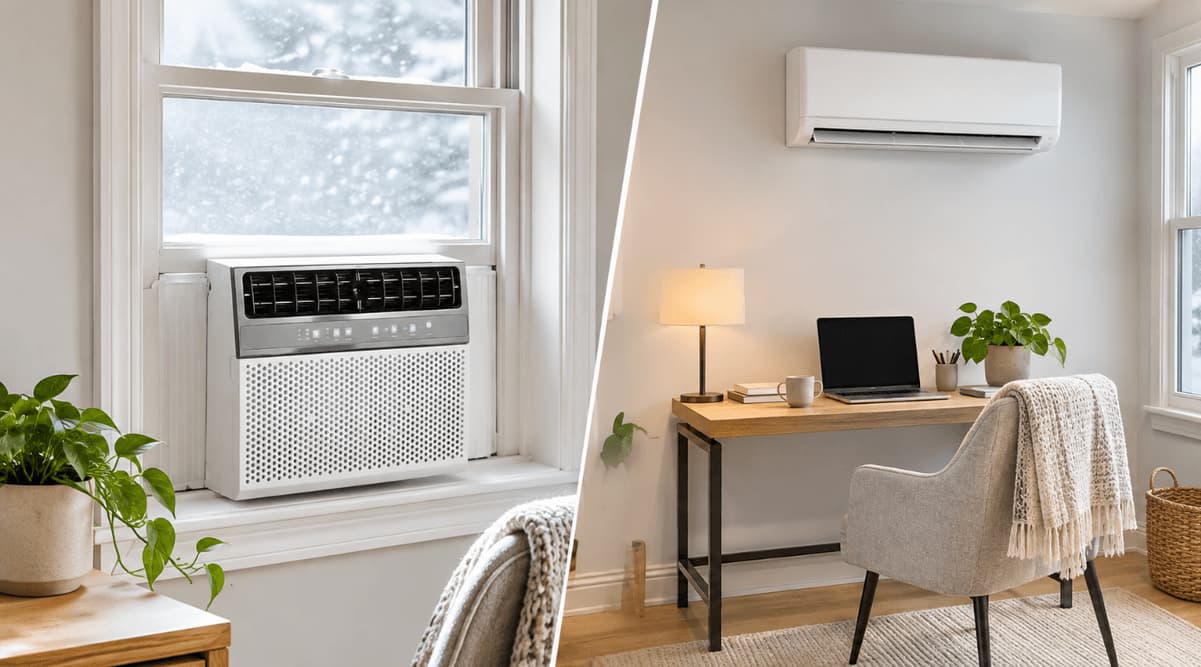
A ductless mini split heats a room better through a real winter. It brings more heating capacity and a quieter indoor unit. A cold-climate window heat pump makes more sense if you rent or can’t drill through a wall. It plugs into a standard outlet and keeps heating one room down to −13°F.
- Mini split: 12,000 to 24,000 BTU/h (Filterbuy), heats to 5°F (−13°F or lower for hyper-heat), professional install.
- Cold-climate window heat pump: about 9,000 BTU/h, heats to −13°F, plugs into a 120V outlet.
- Standard window unit “with heat”: many stop heating near 41°F outside.
Ready for steady winter heat? Browse Filterbuy mini split systems, or take the quick quiz below to find your fit.
How cold can each one keep heating?
Longer bar means more of winter covered.
Black line marks 32°F (freezing).
How much heat each one delivers
Enough for one small or medium room.
Lighter section shows the range of larger sizes.
Both can heat below freezing. The mini split brings more heat; the window unit skips the drilling.
Sources: Gradient and Midea specifications, NYSERDA Clean Heat for All measurement report, Mitsubishi H2i catalog, and Filterbuy mini split specs.
Which one fits your room this winter?
Answer a few quick questions and we’ll match you to the right way to heat your space.
TL;DR
A ductless mini split heats a room better through a real winter. It has more capacity and a quieter indoor unit, and hyper-heat models hold full output down to 5°F. A cold-climate window heat pump, such as the Gradient All-Weather 120V or the Midea Packaged Window Heat Pump, makes more sense if you rent or can't drill through a wall and still want efficient heat in one room this season.
Key Takeaways
Many window units sold "with heat" stop heating near 41°F outside; cold-climate window heat pumps keep going to −13°F.
A cold-climate window heat pump tops out around 9,000 BTU/h, enough for one small or medium room.
A single-zone mini split typically costs $2,000 to $6,000 installed, while a window heat pump plugs into a standard outlet.
Window Heat Pump vs. Mini Split: The Short Answer
For most rooms, a mini split is the stronger winter heater. It's a ductless heat pump with an outdoor compressor and an indoor wall unit, linked by refrigerant lines a licensed pro installs. A window heat pump runs the same reversible cycle inside one box that straddles your windowsill and plugs into the wall, trading some capacity for speed and portability.
Because both are heat pumps, both move heat rather than create it. If the technology is new to you, start with how a heat pump works.
| Factor | Cold-Climate Window Heat Pump | Single-Zone Ductless Mini Split |
|---|---|---|
| Max heating output | About 9,000 BTU/h | 12,000 to 24,000 BTU/h (Filterbuy); other brands vary |
| Lowest heating temperature | −13°F (cold-climate models); about 41°F for many standard window heat pumps | 5°F for standard models like Filterbuy's; −13°F or lower for hyper-heat |
| Power | Standard 120V, 15A outlet | Dedicated 115V or 230V circuit, hardwired |
| Installation | Two people, no refrigerant lines | Professional install required; self-install voids Filterbuy's warranty |
| Indoor noise | 38 to 47 dB(A) (Gradient) | As low as 28 dB in Mute Mode (Filterbuy) |
| Upfront cost | About $3,800 reported for Gradient | $2,000 to $6,000 installed |
| Renter-friendly | Yes, removable | Usually needs landlord approval |
Not All "Window Units With Heat" Are Heat Pumps
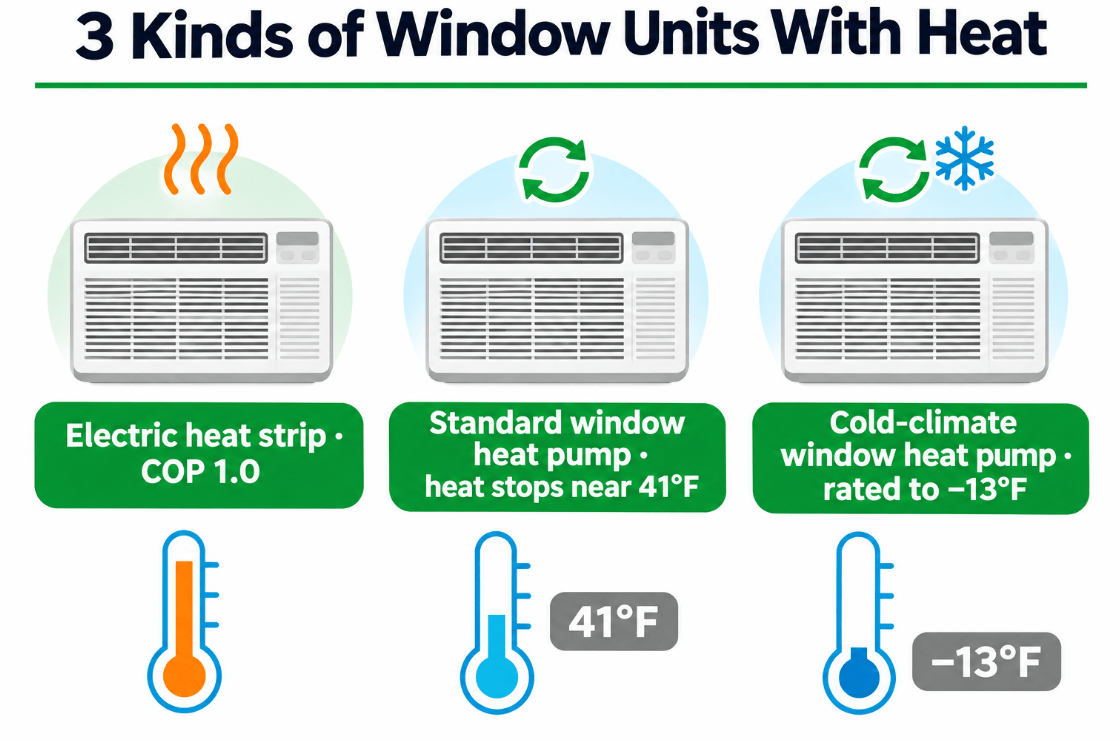
Retailers use "window unit with heat" for three very different machines, and the type matters more than the brand.
Window AC with an electric heat strip. This one heats with a resistive coil, like a space heater, so every unit of electricity becomes exactly one unit of heat.
Standard window heat pump. These run efficiently in mild weather, but many shut off heat pump mode once it turns cold. Costco's listing for Midea's 12,000 BTU inverter window AC with heat says the heat pump only works when it's above 41°F outside.
Cold-climate packaged window heat pump. The All-Weather 120V from San Francisco startup Gradient and the Midea Packaged Window Heat Pump (MAH09H1AGR) both came out of New York's Clean Heat for All Challenge, a 2022 program for New York City public housing. According to NYSERDA's Clean Heat for All measurement report, both makers report heating down to −13°F.
Pro Tip: When the Filterbuy team lined up the spec sheets, the number that mattered most wasn't BTUs but the minimum heating temperature. A unit that quits at 41°F is a shoulder-season heater, not a winter one.
How Much Heat Each One Delivers When It's Cold
Cold-climate window heat pumps hold steady through the 20s, then taper, while hyper-heat mini splits keep full output at lower temperatures and come in larger sizes.
Published testing shows how the two window heat pumps compare:
| Outdoor Temperature | Gradient All-Weather 120V | Midea Packaged Window Heat Pump |
|---|---|---|
| 47°F | 9,000 BTU/h (COP 4.04) | 9,256 BTU/h (COP 4.01) |
| 17°F | 9,000 BTU/h (COP 2.37) | 9,152 BTU/h (COP 2.50) |
| 5°F | 7,200 BTU/h (COP 2.06) | 9,620 BTU/h (COP 2.10) |
| −13°F | 7,026 BTU/h (COP 1.59) | 5,050 BTU/h (COP 1.41) |
Sources: Gradient All-Weather 120V specifications; Midea figures from Intertek lab testing published in NYSERDA Report 25-21.
Sources: Gradient's All-Weather 120V specifications; Midea figures from Intertek lab testing published in NYSERDA's Clean Heat for All measurement report.
What stood out to Filterbuy's team was the crossover: Midea holds more heat at 5°F, while Gradient holds more at −13°F. If your winters rarely dip below zero, that difference barely matters.
Hyper-heat mini splits go further: Mitsubishi's Hyper-Heating INVERTER (H2i) models are rated for 100% heating capacity at 5°F and guaranteed operation down to −13°F.
For perspective, 9,000 BTU/h is about 2,640 watts of heat, or roughly what 1.75 plug-in space heaters put out. Our mini split sizing guide starts at 20 to 25 BTU per square foot, so a room that needs more than 9,000 BTU/h calls for a bigger system or backup heat.
Cost: Upfront and Running
A mini split costs more to install, but you get more capacity and an expected lifespan of 15 to 20 years.
Gradient All-Weather 120V: Gradient now sells by quote instead of posting a price, and third-party reviews put it at about $3,800 per unit.
Midea Packaged Window Heat Pump: Midea's U.S. consumer site no longer lists it; it has mostly sold through multifamily programs.
Single-zone mini split: Filterbuy's 12,000 BTU system is $749 with free 2-day delivery on in-stock systems and a 7-year compressor warranty. Professional installation is extra and required; self-installing voids the warranty. See our mini split cost breakdown.
Don't count on a federal tax break. The federal Energy Efficient Home Improvement Credit (25C) was terminated for systems placed in service after December 31, 2025. Confirm any incentive with a tax professional, and ask your utility about rebates.
Filterbuy ran the numbers on what it takes to deliver 10,000 BTU of heat, using each tested COP and the 2026 U.S. average residential rate of 18.16¢ per kWh from the U.S. Energy Information Administration.
| Outdoor Temperature | Gradient All-Weather 120V | Midea Packaged Window Heat Pump | Electric Resistance Heater |
|---|---|---|---|
| 47°F | 13¢ | 13¢ | 53¢ |
| 17°F | 23¢ | 21¢ | 53¢ |
| 5°F | 26¢ | 25¢ | 53¢ |
| −13°F | 34¢ | 38¢ | 53¢ |
Filterbuy calculation: 10,000 BTU ÷ 3,412 ÷ COP × $0.1816 per kWh. Even at 17°F, either window heat pump heats a room for less than half of what a space heater costs.
What a 72-Unit Field Test Revealed That Spec Sheets Don't
New York's Clean Heat for All pilot put 72 Gradient and Midea window heat pumps into 24 occupied public housing apartments. NYSERDA's measurement report is the best real-world data Filterbuy has found on these units, so we read it cover to cover.
Give it its own circuit. Peak draw hit 1.79 kW for a Midea unit and 1.31 kW for Gradient, close to the 1.8 kW a 15-amp, 120V circuit can carry, so keep space heaters and microwaves off that circuit.
Expect more noise than the rating. On high fan, field readings averaged 48 dB for Midea and 54 dB for Gradient. Filterbuy's 12,000 BTU 115V mini split runs as low as 28 dB in Mute Mode because its compressor sits outside.
Seal it carefully. Depending on the install, some windows got tighter and others leakier.
Filterbuy's take: Treat a window heat pump like a room heater. Most residents turned their units up when they walked into a room and down when they left, and NYSERDA's early data suggests that habit may save energy, pending more study.
Filtration and Upkeep: The Part Most Comparisons Skip
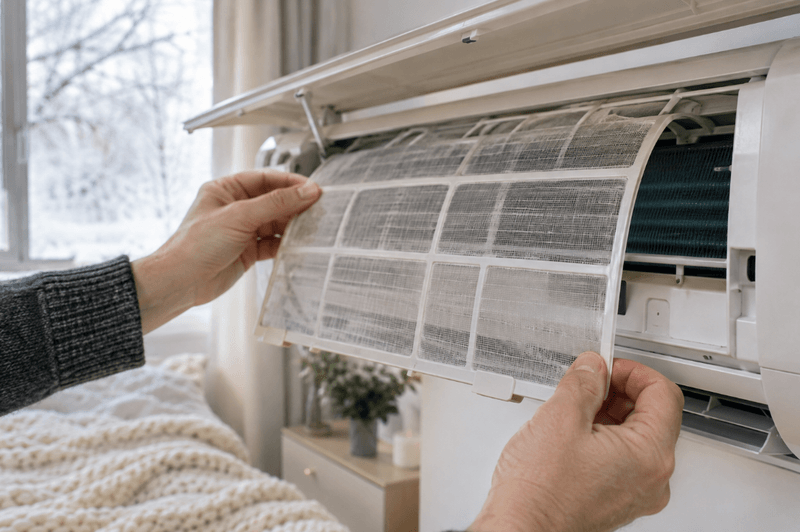
This is where Filterbuy's background in filters shapes our view. Gradient sells two filters for the All-Weather 120V: a basic MERV 2 mesh and a MERV 13 upgrade. As makers of MERV 13 filters at Filterbuy, we'd choose the upgrade. According to the EPA, a MERV 13 filter captures at least 50% of particles between 0.3 and 1.0 microns, and the agency advises going only as high as your system's fan and filter slot can handle. Mini splits work differently: the multi-layer pre-filter mainly protects the coil, and if your home has central HVAC, its filter does the heavy lifting for air quality. Our mini split air quality guide recommends rinsing the pre-filter every two to four weeks during heavy use.
"People shop for heaters by BTUs and price, but the filter is what keeps any unit running well all winter. Whichever one you pick, put the filter cleaning schedule on your calendar on day one," said Michelle Wan, Brand Manager at Filterbuy.
Which Should You Choose? A 5-Question Winter Fit Check
Do you rent or need a no-drill install? Then a cold-climate window heat pump is probably your best path.
How cold does your area get? If winter nights regularly drop below about 0°F, a hyper-heat mini split gives you more margin. Standard models, including Filterbuy's 12,000 BTU, heat down to 5°F; learn how mini splits handle cold weather.
How much heat does the room need? A large or drafty room can outgrow a 9,000 BTU/h ceiling, and mini splits come in bigger sizes.
Do you have the right window and outlet? Gradient needs a single- or double-hung window at least 26 inches wide (27 for Midea), plus a nearby 120V outlet.
Will you stay five years or more? A mini split's longer life usually pays off.
For summer cooling, see our mini split vs. window AC comparison.
Supporting Statistics
42% of U.S. households heated mainly with electricity in 2024, according to EIA's residential heating fuel analysis.
ENERGY STAR certified mini splits use up to 60% less energy than standard electric radiators, according to the EPA's ENERGY STAR mini split heat pump fact sheet.
81% of residents were satisfied with their packaged window heat pumps, and only 2% were dissatisfied, in New York's field test of 72 Gradient and Midea units across 24 public housing apartments, according to NYSERDA's Clean Heat for All measurement report. Apartments averaged 74.5°F, though the first test winter was mild.
Frequently Asked Questions
Is a window heat pump as efficient as a mini split?
For its size, yes. Both cold-climate models test near a COP of 4.0 at 47°F, though mini splits come in a wider range of sizes and efficiency levels.
Can a window heat pump heat a room below freezing?
Yes, if it's a cold-climate model. Both the Gradient and Midea units are rated to −13°F.
Gradient or Midea window heat pump vs. mini split: which is better?
Either window model suits renters and quick, no-drill installs, with Midea holding more heat at 5°F and Gradient more at −13°F. For larger rooms and the coldest climates, choose a mini split.
Do I need an electrician for either one?
A window heat pump plugs into a standard 120V outlet, ideally on a circuit of its own. A mini split, even a 115V model, needs a dedicated hardwired circuit installed by a licensed electrician, and Filterbuy's units require professional installation to keep the warranty. See our mini split electrical requirements guide.
Ready to Heat Smarter This Winter?
You're the one who keeps your household comfortable. If a professionally installed mini split fits your room, answer three quick questions and Filterbuy will match you to the right mini split size. Prefer to run the numbers first? Our mini split sizing guide walks through the BTU math room by room.
Glossary
BTU/h (British thermal units per hour): how much heat a system moves into a room each hour.
COP (coefficient of performance): units of heat delivered per unit of electricity. A COP of 2.0 means twice as much heat as electricity.
Ductless mini split: a heat pump with an outdoor compressor and indoor wall units joined by refrigerant lines.
Packaged window heat pump (PWHP): a cold-climate window heat pump that straddles the sill so the window still opens.
Hyper-heat (cold-climate) heat pump: a heat pump built to keep strong output below freezing.
MERV: a 1–16 rating of how well an air filter captures particles; higher catches finer particles.