How Much Does a Mini Split Cost in 2026?
Complete Price Breakdown
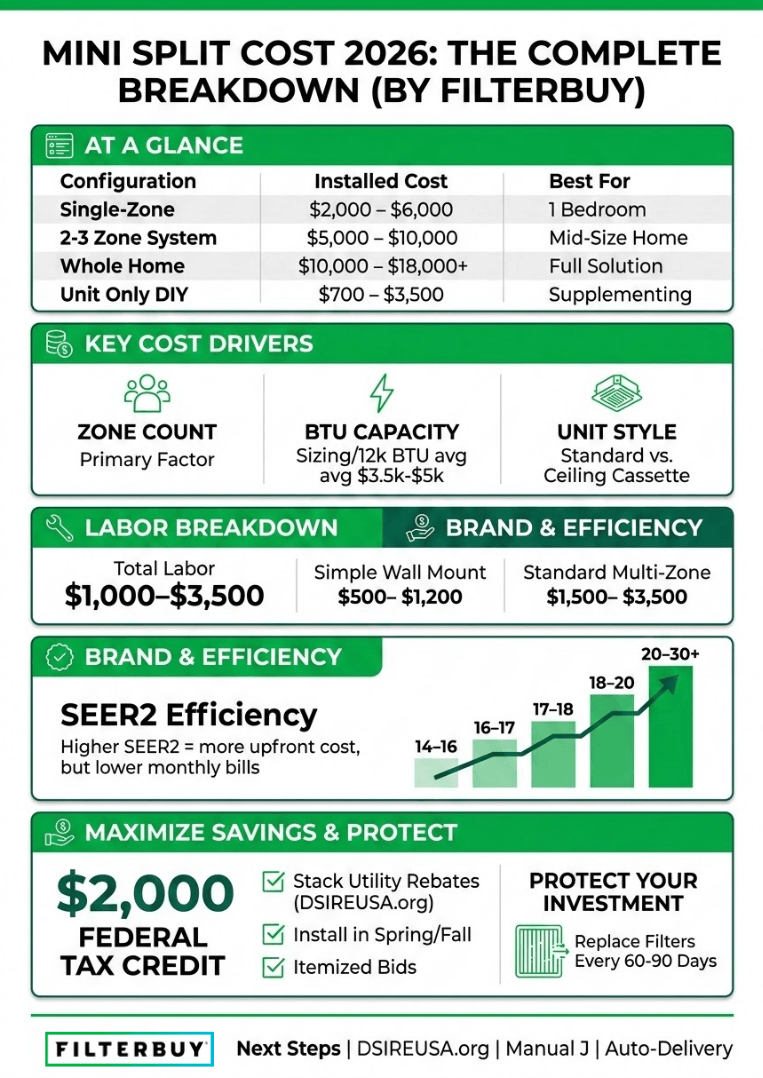
A mini split system costs $2,000 to $18,000 installed in 2026, depending on zone count, BTU size, brand, and local labor rates. A single-zone setup for one room averages $2,000 to $6,000 installed; a whole-home system runs higher.
What to expect by configuration:
- Unit only, no install: $700 to $3,500
- Single zone, installed: $2,000 to $6,000
- 2 to 3 zones, installed: $5,000 to $10,000
- Whole home, 4+ zones: $10,000 to $18,000+
Not sure which setup fits your home? The quick match below points you to the right system.

Answer a few quick questions and we'll match you to the right mini split system.
Prefer to browse first? Shop Filterbuy mini split systems →
Here's what the online price guides won't tell you: a $700 mini split unit and an $18,000 installed system are both real numbers — and neither one tells you what you'll actually pay.
After manufacturing air filters for over a decade and serving more than two million households, our Filterbuy HVAC Solutions team has reviewed real installation invoices across brands, configurations, and climates. Zone count, BTU size, labor rates, electrical requirements — these are the variables that move your quote, and most contractors won't walk you through them without prompting. We will.
Mini split cost in 2026 runs from $2,000 to $18,000 installed, depending on what you're buying and where you live. The breakdown below tells you exactly why.
TL;DR Quick Answers
How much does a mini split cost?
A mini split system costs $2,000 to $18,000 installed in 2026, depending on zone count, BTU capacity, brand, and local labor rates. Single-zone systems average $2,000 to $6,000 installed.
What is the mini split installation cost?
Mini split installation cost ranges from $1,000 to $3,500 for labor alone, plus equipment. A complete single-zone system averages $2,000 to $6,000 installed. Multi-zone systems average $5,000 to $18,000 installed, depending on zone count.
What is the mini split cost per room?
Mini split cost per room runs $2,000 to $7,000 per zone installed. Each zone requires one indoor air handler, refrigerant lines, mounting hardware, and labor.
How much does a ductless mini split price differ by brand?
Entry-level brands like MRCOOL start around $700 to $5,900 installed. Mid-tier brands, including Daikin, LG, and Fujitsu, run $900 to $8,300. Premium brands such as Mitsubishi and Panasonic range from $1,200 to $7,800 or more per zone.
What is the mini split replacement cost?
Mini split replacement cost runs $2,000 to $5,500 for a like-for-like single-zone swap. Multi-zone replacement projects cost $5,000 to $12,000. Compressor-only replacement on an older system runs $800 to $2,800.
Top Takeaways
Mini split cost runs $2,000 to $18,000+ installed in 2026, depending on zone count, BTU size, brand, and local labor rates.
Single-zone systems average $2,000 to $6,000 installed. Budget $2,000 to $7,000 per additional zone.
Labor accounts for $1,000 to $3,500 of most professional installations. Always get an itemized quote.
Qualifying ENERGY STAR-certified mini split heat pumps may receive a federal tax credit of up to $2,000 under the Inflation Reduction Act.
Ductless systems cut the 30%+ energy loss that occurs through ductwork in traditional central forced-air systems.
Clean or replace mini split filters every 60 to 90 days. It's the lowest-cost step available to protect performance, efficiency, and compressor life.
Mini Split Cost at a Glance
Where you land in that range depends on zone count, system size, and installation complexity. Here's what to expect by configuration:
Unit only (no installation): $700 – $3,500 Best for: supplementing an existing system in one room, or a straightforward DIY-eligible setup in certain states.
Single-zone installed: $2,000 – $6,000. Best for: one bedroom, an addition, a garage, a bonus room, or a problem room your central system can't reach.
2–3 zone system installed: $5,000 – $10,000 Best for: mid-size homes, older homes without ductwork, or homeowners who want room-by-room temperature control.
Whole-home (4+ zones) installed: $10,000 – $18,000+ Best for: full ductless home comfort where adding traditional ductwork is impractical or cost-prohibitive.
What Affects Mini Split Price?
No two mini split quotes look alike. The variables below explain why, and knowing each one puts you in control of your budget before the first contractor arrives.
Number of Zones
Zone count drives more of your total cost than any other single factor. Each zone needs its own indoor air handler, refrigerant line set, and installation labor. A basic single-zone system — one outdoor condenser matched to one indoor head — runs $2,000 to $6,000 installed. A second zone typically pushes the total to $5,000 to $8,000. Three zones land around $7,000 to $12,000. Whole-home systems with four or more indoor heads can reach $10,000 to $18,000 or more.
The payoff: you only condition the rooms you're actually using. That zone-by-zone control is one of the strongest long-term cost arguments for ductless over central AC.
BTU Size and Home Square Footage
BTU capacity determines which unit fits your space and directly affects the unit price. A working guide for 2026:
6,000–9,000 BTU (150–400 sq ft, e.g., a kitchen or small bedroom): $2,500–$4,200 installed
12,000 BTU (450–550 sq ft, e.g., a standard bedroom or home office): $3,500–$5,000 installed
18,000 BTU (600–1,000 sq ft, e.g., a garage or medium living room): $4,500–$6,500 installed
24,000+ BTU (1,000+ sq ft open-plan spaces): $5,500–$9,000 installed
Proper sizing requires a Manual J load calculation, not a rule-of-thumb estimate. Oversized units short-cycle, wasting energy and killing humidity control. Undersized units run continuously and wear out faster. Require a load calculation with every quote you receive.
Brand and SEER2 Efficiency Rating
Brand selection shapes both your upfront cost and your monthly energy bill for years afterward. Entry-level brands like MRCOOL typically run $700 to $5,900 installed. Mid-tier brands, Daikin, LG, Fujitsu, and Rheem, range from $900 to $8,300 depending on the model and configuration. Premium brands like Mitsubishi and Panasonic start around $1,200 and can reach $7,800 or more per zone.
Efficiency runs on two ratings: SEER2 (cooling) and HSPF2 (heating). Entry-level 2026 systems sit at SEER2 16–20. Mainstream models reach SEER2 20–26. Premium single-zone systems hit SEER2 26–30 or higher. Higher efficiency costs more upfront and pays back through lower monthly bills, and higher-efficiency models are more likely to qualify for federal tax credits and utility rebates under the Inflation Reduction Act.
Mini Split Installation Cost and Labor
Labor accounts for $1,000 to $3,500 of your total installed cost, though the number shifts by market, job complexity, and line set length. The breakdown by scenario:
Simple single-zone wall mount with short line run: $500–$1,200 in labor
Standard single-zone with longer refrigerant line set or complex routing: $800–$1,800
Multi-zone installation with three or more indoor heads: $1,500–$3,500
HVAC contractors charge $75–$150 per hour, depending on your region
Electricians bill $50–$150 per hour for dedicated circuit or panel work, billed separately from the HVAC quote
Always request an itemized quote that separates equipment from labor. A lump-sum number tells you nothing about where the money is going or where you might be overpaying.
Indoor Unit Style
The type of indoor unit affects aesthetics and installation complexity, and your final number. Wall-mounted units are the most common choice, running $2,500 to $5,000 per zone installed. Ceiling cassettes offer a more discreet look, require ceiling work, and cost $1,200 to $12,000 per unit. Floor-mounted units, common in spaces with limited wall area, range from $1,300 to $3,800. Concealed ducted mini-splits are the most discreet option and carry the highest installed cost due to additional framing, ducting, and labor.
Permits, Electrical Upgrades, and Code Compliance
Most mini split installations require a permit, adding $100 to $400 to your project, depending on local codes. Homes without a dedicated circuit need an electrical panel upgrade — expect $500 to $2,000 or more on top of the HVAC quote. Most new mini splits also use low-GWP A2L refrigerants such as R-32 or R-454B, which require installer certification under updated codes. Before hiring, confirm the contractor holds current refrigerant certification. This affects both safety and your ability to claim warranties.
Mini Split Replacement Cost
Replacing an existing system costs less than a first-time installation because the infrastructure is already in place. In 2026, here's what to budget:
Like-for-like single-zone replacement: $2,000–$5,500
Upgrading from single-zone to multi-zone: $5,000–$12,000
Compressor-only replacement on an existing system: $800–$2,800
One rule our service team applies consistently: if your mini split is 12 to 15 years old and the compressor repair exceeds $800, a full replacement almost always makes more financial sense, especially with current federal tax credits and utility rebates in play. Multiply the repair cost by the system's age in years. If that number tops $5,000, replace.
How to Save on Mini Split Cost
The sticker price is rarely what you actually pay. Here are five ways to reduce your out-of-pocket costs without compromising on system quality.
Claim the federal tax credit. Under the Inflation Reduction Act, ENERGY STAR-certified mini split heat pumps installed by a licensed contractor qualify for a federal tax credit of 30% of the project cost, up to $2,000. Verify your specific model meets the SEER2 and HSPF2 thresholds at energystar.gov/about/federal-tax-credits before you buy.
Stack state and utility rebates. Many states and utility companies offer rebates on top of the federal credit. Search dsireusa.org by ZIP code to identify every incentive available in your area before talking to a contractor. Knowing what's on the table changes how you evaluate every quote.
Get competing quotes, and make them itemized. Require a line-by-line breakdown and a Manual J load calculation with every bid. A low lump-sum number without itemization is not a competitive quote. It's a blank check.
Time your installation off-peak. HVAC contractors are busiest in midsummer and midwinter. Spring and fall installations frequently come with lower labor costs and faster scheduling.
Protect the investment with consistent filter maintenance. Most homeowners skip this, and it's the most expensive mistake you can make after installation. Mini split systems depend on clean filtration to maintain airflow, humidity control, and compressor health. A clogged filter forces the compressor to overwork, raises monthly energy costs, and accelerates wear. Filterbuy carries replacement filters for the most common mini split sizes. Set up auto-delivery so maintenance never becomes an afterthought.
"The highest hidden cost in any mini split install is the one homeowners stop thinking about the moment the technician drives away — filter maintenance. After hundreds of service calls, the systems we see underperforming or failing early almost always have the same thing in common: a filter that's been left in place for 12 or 18 months. That's not a unit problem. That's an airflow problem. And airflow problems are expensive ones. The compressor doesn't know why it's working twice as hard. It just does — until it can't."
Essential Resources
Our team uses only government and accredited sources when advising homeowners on system selection, efficiency ratings, and available incentives. These seven are the ones we go back to consistently. Bookmark them before your first contractor call.
Ductless Mini-Split Heat Pumps — U.S. Department of Energy
The DOE's overview of how mini split systems work, where they perform best, and what homeowners should know before buying. Covers efficiency advantages, sizing guidance, and installation considerations.
Source: https://www.energy.gov/energysaver/ductless-minisplit-heat-pumps
Ductless Mini-Split Air Conditioners — U.S. Department of Energy
DOE's dedicated resource for the cooling-specific use case, covering room additions, multifamily housing, and high-performance homes, with an honest look at cost and aesthetic trade-offs.
Source: https://www.energy.gov/energysaver/ductless-mini-split-air-conditioners
Ductless Heating and Cooling — ENERGY STAR
Use this to confirm a specific model's certification status, compare efficiency ratings, and find rebate opportunities through the ENERGY STAR Rebate Finder.
Source: https://www.energystar.gov/products/ductless_heating_cooling
Federal Tax Credits for Energy Efficiency — ENERGY STAR
The guide to claiming the Inflation Reduction Act tax credit for mini split heat pumps. Covers eligible product requirements, credit amounts up to $2,000, IRS Form 5695 instructions, and the manufacturer PIN requirement.
Source: https://www.energystar.gov/about/federal-tax-credits
Air Source Heat Pumps Tax Credit — ENERGY STAR
Verify that a specific model meets the efficiency thresholds required to qualify before purchasing. Don't skip this step.
Source: https://www.energystar.gov/about/federal-tax-credits/air-source-heat-pumps
DSIRE — Database of State Incentives for Renewables and Efficiency
Managed by NC State University, DSIRE is the most complete database of state, local, and utility incentives for energy-efficient HVAC in the U.S. Enter your ZIP code before you talk to a single contractor.
Source: https://dsireusa.org/
Heat Pump Systems — U.S. Department of Energy
A broader overview of heat pump technology, ductless mini splits, air-source, and geothermal. Useful context for homeowners still deciding between system types before committing to an installation budget.
Source: https://www.energy.gov/energysaver/heat-pump-systems
Supporting Statistics
Every figure below comes from a U.S. government or accredited source. These are the numbers our team cites when advising homeowners on which system makes sense, and why.
30%+ Duct losses account for more than 30% of energy consumption in a typical home with central forced-air systems, particularly when ducts run through unconditioned spaces like attics. Mini splits deliver conditioned air directly to the room, eliminating that loss entirely.
Source: U.S. Department of Energy — energy.gov/energysaver/ductless-minisplit-heat-pumps
Up to 60% Less Energy ENERGY STAR-certified mini splits use up to 60% less energy than standard home electric radiators and baseboard heaters. They transfer heat rather than generate it, which is why ductless systems reach efficiency levels that no combustion or resistance heating system can match. For context, heating and cooling account for nearly half of the average household's annual energy bill, around $1,900 per year.
Source: ENERGY STAR — energystar.gov/products/ductless_heating_cooling
Up to $2,000 Federal Tax Credit Homeowners who install an ENERGY STAR-certified mini split heat pump through a licensed contractor can claim a federal tax credit of 30% of project costs, up to $2,000 per year. Combine that with up to $1,200 in additional credits for other qualifying home energy improvements in the same tax year, and 2026 is a strong time to act.
Source: ENERGY STAR — energystar.gov/about/federal-tax-credits
Final Thoughts and Opinion
Mini split cost is not one number, and the homeowners who feel confident about their investment understand that going in. After a decade manufacturing the filters that keep these systems running, and thousands of service calls through Filterbuy HVAC Solutions, we've seen both outcomes up close.
The homeowners who feel good about what they spent compared itemized quotes. They checked rebate eligibility before signing anything. They knew their zone count before the first contractor showed up. And they set up a filter replacement schedule from day one because someone explained how much a neglected filter actually costs over time.
The ones who feel burned almost always bought on a single number without knowing what it included. They skipped the load calculation. They never stacked the available incentives. And they left the filter in place for two years because no one told them what that does to a compressor.
In our opinion, a properly sized, professionally installed mini split heat pump is one of the smartest HVAC investments a homeowner can make in 2026, especially for older homes without ductwork, room additions, and multi-zone applications. The efficiency advantages are real. The tax credits are substantial. And the long-term operating cost, when the system is maintained correctly, beats most alternatives.
That last part matters most. The filter is not a footnote. It's the most accessible, lowest-cost maintenance step available, and it has an outsized effect on compressor life, energy efficiency, and indoor air quality. Filterbuy exists because protecting that investment shouldn't require a second job. We stock the sizes that fit and deliver on a schedule so you never have to think about it.
Next Steps
Six actions, in order. Do these before you call a contractor.
Check your rebate eligibility first. Visit dsireusa.org and enter your ZIP code. Know what state, utility, and federal incentives are available before you talk to anyone. This changes how you evaluate every quote you receive.
Figure out how many zones you actually need. Walk your home. Note which rooms run too hot, too cold, or fall outside your existing system's reach. Each zone is a separate cost line.
Get at least three quotes, itemized, with a load calculation. If a contractor gives you a lump sum without a Manual J calculation, walk away. You have no way to compare that number against anything.
Verify your model's ENERGY STAR certification and tax credit eligibility before purchasing. Go to energystar.gov/about/federal-tax-credits/air-source-heat-pumps and confirm the specific model. Get the AHRI certificate in writing.
Schedule off-peak if you can. Spring and fall installations typically come with lower labor costs and faster scheduling. Midsummer and midwinter are the worst times to shop for an HVAC contractor.
Set up your filter replacement schedule before the technician leaves. Mini split filters need cleaning or replacement every 60 to 90 days. Set up Filterbuy auto-delivery in the right size before the system's first startup, so maintenance runs on a schedule, not on memory.
Frequently Asked Questions
Ready to Take the Next Step?
Get a no-pressure mini split quote from Filterbuy HVAC Solutions.
Our EPA-certified technicians serve homeowners across Florida and beyond. We give you honest, itemized quotes with no lump sums and no surprises. Every consultation includes a load calculation recommendation so you know you're getting the right system for your home, not the easiest one to install.
And if you already own a mini split, shop Filterbuy's full selection of replacement filters. We stock the sizes that fit, at the quality your system deserves, with auto-delivery so maintenance stays on schedule.