What Size Mini Split Do You Need?
(BTU Sizing Chart + Calculator Guide)
Multiply your room's square footage by 20 to 25 to get the BTUs you need, then match that number to one of the three sizes Filterbuy builds: 12,000 BTU for 300 to 550 sq ft, 18,000 BTU for 700 to 900 sq ft, or 24,000 BTU for 1,000 to 1,200 sq ft. Use 20 BTU per square foot in mild, well-insulated rooms and 25 in hot, humid, or sun-soaked ones.
How To Land On The Right Size
- Start with the room math. Square footage times 20 to 25 gives your baseline BTU target.
- Adjust for the room's quirks. Add capacity for high ceilings, west or south sun, weak insulation, kitchen appliances, and rooms that host more than two people.
- Round to the nearest standard size. If your adjusted number sits between two tiers, size up rather than down, especially in hot climates.
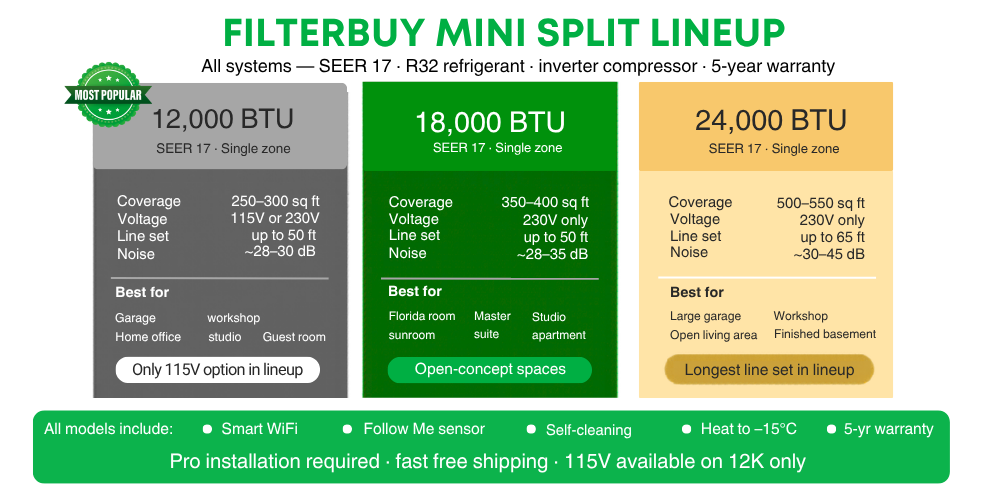
The ladder below maps room size to the three sizes Filterbuy sells, so you can see where your space lands at a glance.

Shop Filterbuy Mini Split Systems
Answer a few quick questions and we'll match you to the right mini split size for your space.
Deciding on a ductless system is a great first step for better climate control in your home. But before you can buy one, you need to answer a critical question: What size mini split do I need?
Choosing the right size is essential for your comfort and energy savings. A unit that’s too small will struggle to cool your room, while one that’s too large will cycle on and off too frequently, wasting energy and failing to dehumidify the space properly. You want to find the “Goldilocks” size that's just right.
This guide will walk you through everything you need to know about mini split sizing. We'll cover the formulas, charts, and key factors to consider, so you can calculate the perfect size for your room and purchase your new unit with confidence.
Key Takeaways:
A mini split's power is measured in British Thermal Units (BTUs). A higher BTU rating means more cooling power.
The general rule for sizing is 20 BTUs per square foot of space, but this is just a starting point.
Factors like ceiling height, climate, insulation, and sun exposure can significantly impact the BTU capacity you'll need.
Oversizing a mini split is just as bad as undersizing it, leading to inefficiency and poor performance.
Mini Split Sizing Basics (BTU Explained)
Before you can choose the right capacity, it helps to understand how air conditioners are measured. Mini split power is rated in BTUs, which stands for British Thermal Units.
In simple terms, a BTU measures how much heat an air conditioner can remove from a room in one hour. A higher BTU rating means the unit has more cooling power.
Based on general HVAC industry standards, the basic rule of thumb for mini split AC sizing is to provide 20 to 25 BTUs per square foot of living space.
Using this rule, calculating a baseline is easy. If you have a 500-square-foot room, you will need a unit that produces roughly 10,000 to 12,000 BTUs to properly cool or heat the space.
Mini Split AC Sizing Chart (By Room Size)
To make things easy, we have put together a mini split ac sizing chart. Use this scannable table to quickly find the recommended BTU capacity based on your room's square footage.
Recommended AC BTU by Room Size
Use this quick guide to match your room size with a recommended BTU range for better comfort and more efficient cooling.
| Room Size (sq ft) | Recommended BTU | Best For |
|---|---|---|
| Up to 150 | 6,000 | Small office |
| 150–250 | 9,000 | Bedroom |
| 250–300 | 12,000 | Large bedroom |
| 300–400 | 12,000–18,000 | Living room |
| 400–550 | 18,000 | Open living space |
| 550–700 | 24,000 | Large rooms |
This chart assumes your home has standard eight-foot ceilings and average insulation. If your space features unique layouts or challenging climates, you will need to adjust these baseline numbers slightly.
Mini Split BTU Per Square Foot (Simple Formula)
If you prefer to run the exact numbers yourself, you can calculate the ideal mini split BTU per square foot using a very simple formula:
Square footage × 20 to 25 = Required BTUs
You might be wondering when to multiply by 20 and when to multiply by 25.
Use 20 if you live in a mild climate with moderate summer temperatures and your room has good insulation.
Use 25 if you live in hot, humid climates (like Florida or Texas), or if the room gets blasted by direct afternoon sun.
12,000 vs 18,000 vs 24,000 BTU (Which One Do You Need?)
When shopping for systems, you will quickly notice that units come in standard size tiers. Understanding the difference between 12,000 vs 18,000 vs 24,000 BTU systems will help you match the hardware to your home's layout.
12,000 BTU Mini Split
A 12,000 BTU unit (often referred to as a one-ton unit) is incredibly popular for standard residential cooling. This size comfortably covers roughly 250 to 450 square feet. It is best for:
Primary bedrooms
Home offices
Small apartments or studio layouts
If you have a standard single-zone space to cool, browse our 12,000 BTU mini splits at Filterbuy. We offer a 5-year compressor / 1-year parts , making it easier than ever to get high-quality climate control delivered directly to your door.
18,000 BTU Mini Split
Stepping up to an 18,000 BTU system gives you enough power to cover approximately 400 to 700 square feet. This tier is the workhorse for family-oriented areas. It is best for:
Living rooms
Medium open-concept layouts
Basement bonus rooms
24,000 BTU Mini Split
A 24,000 BTU system (a two-ton unit) is a heavy-duty option designed to manage roughly 700 to 1,000+ square feet of space. It pushes a massive amount of air. It is best for:
Large open-concept homes
Large studio apartments
Multi-room zones that flow together without walls
Key Factors That Affect Mini Split Sizing
Square footage is just the starting point. Real-world rooms have quirks that impact how hard an air conditioner has to work. To get your sizing perfectly dialed in, you must adjust your base BTU calculation for these specific environmental factors:
Ceiling height: If your ceilings are higher than standard 8-foot heights, increase your BTU calculation by 10% to 20%. Taller rooms hold more air volume.
Sun exposure: Rooms facing west or south that get heavy afternoon sunshine require roughly 10% more cooling power.
Poor insulation: If you are installing the unit in an uninsulated garage or an older home with drafty windows, increase your capacity by at least 20%.
Hot climates: Homes in consistently sweltering regions (like the American Southwest or Deep South) naturally require a slight BTU bump to handle extreme peak summer days.
Kitchen heat: If the mini split is cooling a kitchen with heat-generating appliances like ovens and stoves, add an extra 4,000 BTUs.
Occupancy: If the room regularly hosts more than two people, add 600 BTUs for each additional person. Human bodies generate a surprising amount of ambient heat.
What Happens If You Choose the Wrong Size?
Many homeowners assume that buying the biggest unit possible is the safest bet. Others try to save money upfront by purchasing a smaller unit. Both strategies lead to frustrating, uncomfortable outcomes.
Undersized Unit
When a mini split is too small for the room, it runs constantly in a desperate attempt to reach the thermostat setting. It will struggle to cool the space on hot days, leaving you sweating on the couch. Because the compressor never gets a break, your energy bills will skyrocket, and the equipment will suffer from premature wear and tear.
Oversized Unit
Installing a massive unit in a tiny room causes a problem known as "short cycling." The system blasts the room with freezing air, hits the target temperature in minutes, and shuts off immediately. Because it does not run long enough to dehumidify the air, the room will feel cold but uncomfortably clammy. This constant on-and-off cycling also spikes your electricity usage and damages the unit's motor.
Mini Split Size Calculator (How to Get It Right)
To eliminate the guesswork entirely, we always recommend using a mini split ac size calculator before you check out. A good online calculator will ask you for a few specific inputs to generate a highly accurate recommendation. Make sure you gather the following information before you calculate:
The exact length and width of your room
Your ceiling height
The quality of your insulation
The room's primary sun exposure
Treat a sizing calculator as your final validation step. Once the calculator confirms your math, you are ready to make your purchase.
When to Talk to an HVAC Professional
While sizing a single-zone mini split for a bedroom or garage is highly manageable for the average homeowner, some projects require a professional touch.
You should absolutely consult a licensed HVAC professional if you are planning to install a multi-zone system with three or more indoor air handlers connected to one outdoor condenser. Complex open layouts and split-level homes can also have strange airflow dynamics that an expert needs to evaluate. Furthermore, a professional can check your home's electrical panel to ensure you have the correct voltage and amperage to support your new system safely.
Final Thoughts: Choosing the Right Mini Split Size
Figuring out what size mini split you need does not have to be a stressful math test. Start with your room's exact square footage, apply the rule of 20 to 25 BTUs per square foot, and adjust for real-world factors like high ceilings and sun exposure. By staying out of the extremes, you will secure an air conditioner that runs efficiently, maintains perfect humidity, and keeps your monthly utility bills low.
Shop the right mini split size today and enjoy fast, free shipping from Filterbuy.
Frequently Asked Questions