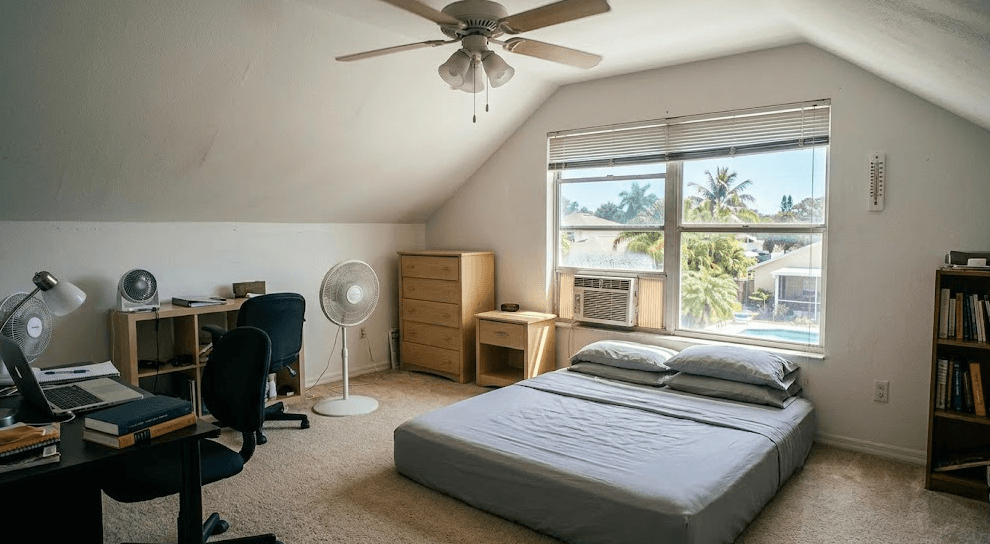
Why Is My Upstairs Always Hot? (And How to Fix It Fast)
Your upstairs stays hot because warm air rises and collects on the second floor while a single downstairs thermostat shuts the AC off before the upstairs ever cools. The stack effect alone can leave your second floor 8–10°F warmer than your first.
Leaky ducts add to it — according to ENERGY STAR, the average home loses 20–30% of its conditioned air through duct leaks before it reaches upstairs rooms. A ductless mini split fixes this by cooling the hot room directly, with no ducts to lose air through.
Answer 3 quick questions below and we'll match you to the right mini split for your space.

Answer 3 quick questions and we'll match you to your perfect mini split.
Prefer to browse? Shop Filterbuy mini split systems.
Walking up the stairs in the summer can feel like you're entering a different climate zone. Your downstairs is cool and comfortable, but your bedroom is a sauna. This isn't just frustrating, it leads to poor sleep, thermostat battles, and high energy bills.
If this sounds familiar, you're not alone. Uneven cooling is a common issue in two-story homes. So, why is your upstairs always hot? While it's true that heat rises, that's only part of the story. The main culprits are often poor airflow, leaky ductwork, and HVAC systems that aren't set up to cool multiple floors effectively.
The good news is you don't have to live with it. By understanding what's causing the problem, you can finally find a solution.
Key Takeaways
Uneven Temperatures Are Common: Many two-story homes struggle with a hot upstairs and a cold downstairs.
It's More Than Just "Heat Rises": The real issues often involve poor airflow, leaky ducts, and an improperly balanced HVAC system.
Solutions Are Available: You can fix the problem with a combination of quick adjustments and long-term solutions like a mini split to balance your home's temperature.
The Real Reasons Your Upstairs Is Hot
Your central air conditioner works hard, but several physical and structural factors actively work against it. Let's look at the primary culprits causing that stubborn heat wave on your second floor.
Heat Naturally Rises (The Stack Effect)
Basic physics plays a huge role in your home's temperature differences. Warm air is less dense than cold air, causing it to rise to the highest point in your house. At the same time, the cold air produced by your air conditioner naturally sinks to the lower levels. This phenomenon, known as the stack effect, can easily cause an 8–10°F difference between your downstairs and upstairs rooms.
Your HVAC System Isn’t Balanced
Most two-story homes rely on a single HVAC system controlled by one thermostat, usually located on the first floor. When the downstairs area reaches the desired temperature, the thermostat tells the system to shut off. Because the thermostat cannot read the temperature upstairs, the system stops cooling long before your second floor gets any relief. As a result, the airflow heavily favors the downstairs level.
Your Attic Is Heating Your Home
During a sunny day, your roof absorbs a massive amount of solar heat. Attic temperatures can easily skyrocket to 140°F or more. If your attic lacks proper insulation or ventilation, that trapped, sweltering heat radiates directly downward through your ceiling and into your upstairs bedrooms.
Ductwork Problems (Big One)
Your ductwork is the delivery highway for your conditioned air. Unfortunately, this highway is often full of potholes. According to ENERGY STAR, the average home loses 20 to 30% of its air moving through the duct system due to leaks, holes, and poor connections. By the time the cold air travels all the way up the long duct runs to your second floor, a significant portion of it has already escaped into your walls or floors. Additionally, many older homes have undersized ducts upstairs, meaning they simply cannot carry enough cool air to do the job.
Quick Fixes You Can Try Today
If you need relief right away and are wondering how to fix hot and cold spots in your house without spending a fortune, start with these simple adjustments.
Adjust Your Vents Strategically
You can manually force more cold air to travel upstairs by partially closing a few vents on your first floor. Do not close them completely, as this can create pressure buildup and damage your HVAC system. Simply restricting the airflow downstairs pushes more of the cold air up to the second level.
Change Your Thermostat Fan Setting
Take a look at your thermostat and switch the fan setting from "Auto" to "On." When set to "Auto," the fan only runs while the AC compressor is actively cooling. Switching it to "On" keeps the fan running constantly, continuously circulating the air throughout the house and helping to blend the hot and cold spots.
Replace Your Air Filter
A clogged, dirty air filter acts like a wall blocking your system's airflow. When your AC has to pull air through a thick layer of dust, it loses the power needed to push cold air all the way upstairs. Changing your filter regularly is the easiest way to improve airflow. For a step-by-step walkthrough, check out our air filter replacement guide to ensure you are doing it correctly.
Use Ceiling Fans the Right Way
Ceiling fans do not actually lower the temperature of a room, but they do make you feel cooler by creating a wind-chill effect on your skin. During the summer, ensure your upstairs ceiling fans are rotating counterclockwise. This pushes the air straight down, creating a cooling breeze.
Seal Air Leaks Around Windows & Attic
Take a weekend to inspect the weatherstripping around your upstairs windows and the seals around your attic hatch. Caulking gaps and adding weather seals prevents your precious cold air from seeping out and stops hot, humid outdoor air from sneaking in.
While these quick adjustments are helpful, they are ultimately band-aids. They will improve your comfort slightly, but they will not fully solve the core issue of uneven cooling in house environments.
The Best Long-Term Solutions That Actually Work
If quick fixes aren’t cutting it, here’s what actually solves the problem. A true upstairs hotter than downstairs fix requires adjusting how your home receives and distributes cooling.
Zoned Heating and Cooling
Zoned heating and cooling involves dividing your home into distinct areas, or "zones," each controlled by its own thermostat. Electronically controlled dampers are installed inside your ductwork to direct cool air exactly where it is needed. According to the U.S. Department of Energy, proper zoning can yield up to 30% in energy savings. It provides perfectly even comfort, making it a fantastic choice if you are doing a full-home HVAC upgrade.
Mini Split AC
If you want a targeted, highly effective solution without ripping open your walls to redo ductwork, a mini split AC is your best bet. A ductless mini split for upstairs rooms provides direct cooling exactly where you need it most. Because there are no ducts involved, there is zero duct-related air loss.
Mini splits offer precise room control, incredible energy efficiency, and whisper-quiet operation. They are the absolute perfect addition for master bedrooms, hot bonus rooms over the garage, or stuffy upstairs home offices.
Featured Product: A Smarter Way to Cool Your Upstairs
If you are looking for a simple, effective fix without redoing your entire HVAC system, we highly recommend the Filterbuy 12,000 BTU 17 SEER2 Mini Split.
This unit is engineered to tackle stubborn hot spots with ease. It operates at an ultra-quiet level (around 30 dB), meaning you will sleep soundly without the loud hum of a traditional window unit.

When to Call an HVAC Professional
While replacing an air filter is a simple DIY task, major system changes require professional expertise. Not every home needs a full system replacement, but you should always consult a licensed HVAC professional when you are considering:
Installing a zoned heating and cooling system
Mini split installation and electrical setup
A complete ductwork inspection and redesign
An expert can evaluate your home's specific airflow dynamics and guide you toward the safest, most cost-effective option.
Final Thoughts: You Don’t Have to Live With It
Dealing with a sweltering second floor is incredibly common, but you do not have to accept it as a permanent feature of your home. Whether you start by changing a dirty air filter today or decide to invest in a ductless system tomorrow, this issue is entirely fixable. You deserve a home that is comfortable in every single room.
Ready to finally sleep comfortably through the summer? Shop the Filterbuy 12,000 BTU 17 SEER2 Mini Split and find the perfect cooling solution for your space today.
Frequently Asked Questions