Adding a Mini Split AC System in Arizona
Costs, Rebates & 2026 Guide
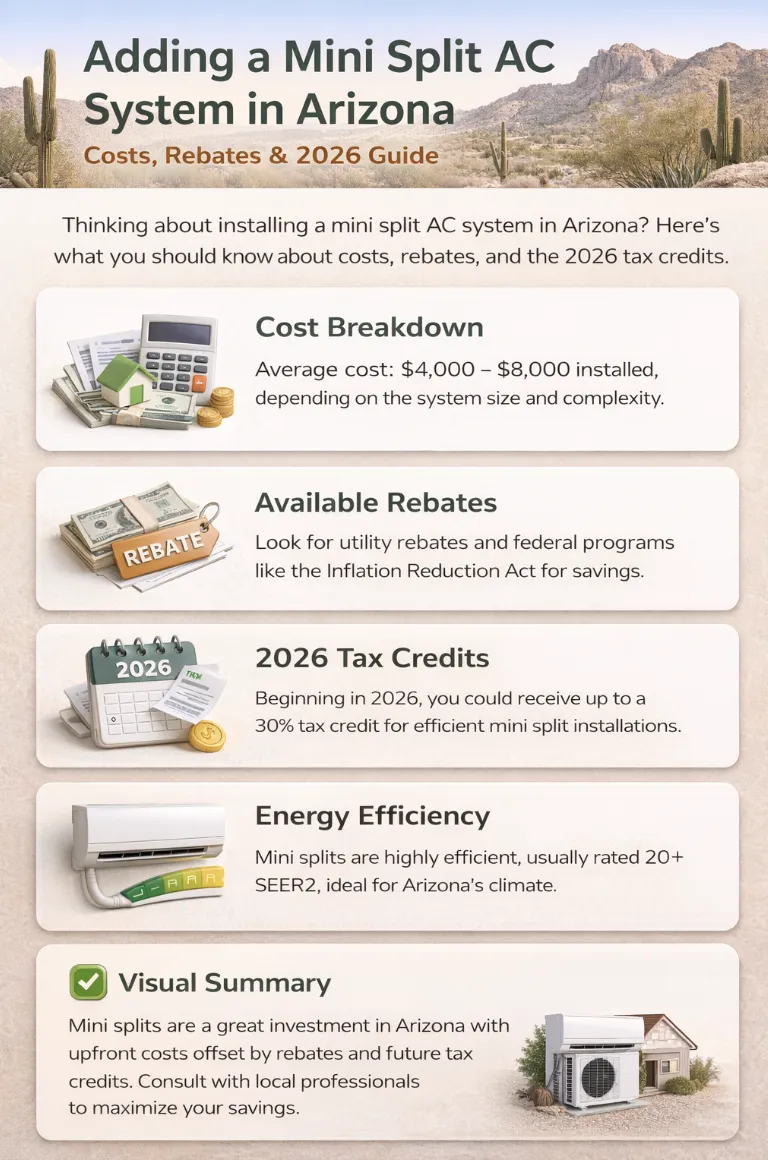
A single-zone mini split runs about $3,000–$7,000 installed in Arizona, and in 2026 you can stack up to three rebate programs on one install. One utility rebate from APS or SRP can combine with Arizona's state HEAR rebate for income-qualified households to lower your net cost. The older federal 25C tax credit expired at the end of 2025, so today's savings come from these state and utility programs.
- APS utility rebate: $200–$500 for qualifying Energy Star systems.
- SRP Cool Cash: up to $225 per ton at 15 SEER2 or higher, plus a $200 bonus for replacing a system 10+ years old.
- Efficiency Arizona HEAR: up to $8,000 for income-qualified households.
Browse systems built for desert heat, then take the quick match quiz below to find your fit.
Shop Filterbuy Mini Split Systems

Answer 3 quick questions and we'll match you to the right mini split for your space.
Arizona homeowners who install mini splits in 2026 can draw from three separate incentive programs on a single installation: two utility rebate programs and a state electrification fund worth up to $8,000 for qualifying households. Most people who apply for one have never heard of the other two.
What follows covers what Arizona mini split installation actually costs right now, how to size a system for desert heat loads rather than a national average, and how to claim every available rebate before any of them shift. Filterbuy has more than a decade in filtration and HVAC equipment, with over two million households served. The patterns we have tracked across extreme-climate installations are built into every recommendation on this page.
TL;DR Quick Answers
Adding a Mini Split AC System Including Rebates in Arizona
Arizona homeowners adding a mini split AC system in 2026 can access up to three stacking incentive programs on a single installation.
What it costs: Single-zone ductless mini split systems run $3,000 to $7,000 fully installed before rebates. Multi-zone systems run $8,000 to $15,000 and up.
What rebates are available in 2026:
APS (Arizona Public Service): Rebates may be available for qualifying mini split heat pump systems installed by a licensed contractor. Check current APS program terms for rebate amounts, efficiency requirements, and eligibility.
SRP (Salt River Project) Cool Cash: up to $225 per ton for inverter-driven systems at 15 SEER2 or higher, plus a $200 bonus for replacing a system 10 years old or older
Efficiency Arizona HEAR Program: up to $8,000 for income-qualified households (under 150% of Area Median Income) at efficiencyarizona.com
Note: The federal IRA Section 25C tax credit expired December 31, 2025. It does not apply to systems installed in 2026.
What size system Arizona homes need: Size up 10 to 20% beyond the standard 20 BTU-per-square-foot calculation to account for Arizona's extreme solar gain, high ambient temperatures, and common insulation gaps in older desert homes.
What qualifies for rebates: Systems must carry active Energy Star certification. SRP requires a minimum of 15 SEER2. Verify your specific model in the AHRI directory at ahridirectory.org before purchase.
What installation requires: A licensed, ROC-certified HVAC contractor. Licensed installation is a condition of qualifying for both APS and SRP rebates.
Top Takeaways
Mini split AC systems are among the most efficient cooling solutions for Arizona homes, particularly in spaces without existing ductwork — room additions, garages, casitas, and older homes where central air falls short.
Arizona homeowners can combine utility and state incentive programs on a single 2026 installation: APS utility rebates ($200 to $500), SRP Cool Cash rebates (up to $225 per ton plus a $200 bonus for older system replacements), and the Efficiency Arizona HEAR program (up to $8,000 for income-qualified households). The federal Section 25C tax credit expired December 31, 2025 and is not available for new 2026 installations.
Proper BTU sizing for Arizona's extreme heat is not optional. Most experienced installers recommend sizing up 10 to 20% beyond standard calculations to account for high solar gain, extreme ambient temperatures, and insulation gaps common in older Arizona homes.
SEER2 of 16 or higher, HSPF2 of 8.6 or higher, and EER2 of 12.5 or higher are the minimum efficiency thresholds for APS and SRP rebate qualification. Verify the specific model in the AHRI directory before purchase.
Single-zone installed costs in Arizona typically run $3,000 to $7,000 before rebates. Stacked utility and HEAR program incentives can bring the net cost down significantly, and spring or fall installation scheduling can reduce contractor costs at the same time.
Arizona's desert environment brings year-round dust, monsoon particulates, and wildfire smoke events that make regular filter maintenance non-negotiable. Clean your mini split's internal pre-filter every two weeks during peak dust season and run MERV 8 to MERV 13 pleated filters in your central air returns to protect both systems.
Arizona law requires licensed, ROC-certified contractor installation for mini splits, and that credential is a condition of APS and SRP rebate eligibility. Verify your installer's ROC license before signing.
Why Arizona Homes Are a Perfect Fit for Mini Split AC Systems
Arizona's climate is hard on cooling equipment in ways that most national HVAC guides do not fully account for. Summer temperatures regularly exceed 115°F in the desert valleys. Rooftop solar gain bakes living spaces from above for months at a stretch, and monsoon season adds humidity spikes that standard ducted systems often handle poorly. For homeowners with central air, the weak spots tend to be familiar: room additions, converted garages, casitas, sunrooms, and older homes built before modern duct standards all get inadequate coverage from the existing system. Ductless mini splits address those gaps without the cost and disruption of opening walls to run new duct lines.
The efficiency numbers are worth knowing. Modern inverter-driven mini splits adjust compressor speed continuously rather than cycling on and off at full capacity. That produces more consistent indoor temperatures and 25 to 40% lower cooling energy use compared to traditional HVAC systems. For Arizona homeowners whose electricity bills climb sharply from May through September, that reduction shows up directly on the monthly statement.
Multi-zone configurations take this further by letting different areas of a home run on independent thermostats. A guest room that sits empty five days a week does not need to match the temperature in the main living area. In a climate where running central air continuously is often the only alternative, that kind of targeted control pays for itself over time.
Mini Split Sizing Guide for Arizona's Extreme Heat
Sizing is where Arizona installations diverge most sharply from the national standard, and where most mistakes happen. An undersized system runs without stopping, never fully cooling the space. An oversized one short-cycles, wearing out components faster and leaving humidity in the room that refuses to drop — which matters considerably more in a monsoon climate than most homeowners expect going in.
The standard starting point — 20 BTUs of cooling capacity per square foot — holds reasonably well in temperate climates. Arizona's combination of extreme solar gain, prolonged high ambient temperatures, and the older single-pane windows and under-insulated attics common in desert homes pushes that baseline up. Experienced installers working in Phoenix and Tucson typically recommend sizing up 10 to 20% beyond that calculation. A space that would need a 9,000 BTU unit in a cooler state may need 12,000 BTUs to perform reliably through a July afternoon in the Valley.
For a practical starting reference in Arizona conditions, a space up to 300 square feet typically needs 9,000 to 12,000 BTUs. Spaces from 400 to 500 square feet call for 12,000 to 18,000 BTUs. Larger spaces or those with challenging exposures often land at 24,000 BTUs or above. Rooms with high ceilings, west- or south-facing walls, or minimal attic insulation may need to go higher still. Use Filterbuy's mini split sizing guide for a recommendation tailored to your specific room dimensions, ceiling height, insulation level, and sun exposure.
Single-zone systems are the right call when the goal is one room or one defined area. Multi-zone systems connect two to four indoor air handlers to a single outdoor compressor, making them a practical option for conditioning multiple spaces without a separate outdoor unit for each. Filterbuy's current mini split lineup is single-zone only. For multi-zone applications, homeowners should consult a licensed installer about multi-zone-capable systems.
On the electrical side, systems at 6,000 to 9,000 BTU typically run on a standard 115V circuit. Anything at 12,000 BTUs and above needs a dedicated 230V circuit. If your panel does not have capacity for a new 230V breaker, build an electrical upgrade into the project budget. A licensed electrician can check your panel in a short visit before you commit to a specific system. For refrigerant, prioritize R32 over the older R410A. It carries a 68% lower global warming potential and handles heat transfer more efficiently — a practical advantage in Arizona's prolonged high-temperature operating cycles.
Ductless Mini Split Installation Costs in Arizona (2026)
The total cost of a ductless mini split installation in Arizona depends on BTU capacity, zone count, installation complexity, and your contractor's local market pricing. Here is what to budget in 2026 before rebates.
A single-zone system, the most common starting point for Arizona homeowners, typically runs between $3,000 and $7,000 fully installed. That range covers the unit, professional labor, electrical work, refrigerant line routing, and any permits the local jurisdiction requires. Entry-level 9,000 to 12,000 BTU systems in accessible installation locations land at the lower end. Premium-efficiency systems in more complex installs, those involving longer refrigerant line runs, higher ceiling clearances, or electrical panel work, push toward the upper end.
Multi-zone systems conditioning two or more spaces cost more: typically $8,000 to $15,000 and up, depending on the number of indoor air handlers, total BTU capacity, and the scope of electrical and line-set work.
A few Arizona-specific cost factors are worth planning for before you schedule. Installation demand peaks from April through August, contractor schedules fill fast, and some installers charge more during peak season. Booking in late winter or early fall typically improves both availability and pricing. Arizona law also requires licensed, ROC-certified HVAC contractors for mini split installation, and licensed labor is priced accordingly. Collecting two or three quotes from ROC-licensed contractors before committing is always the right approach.
Filterbuy sells single-zone mini split systems direct to consumers, which can help reduce the equipment markup that comes with purchasing solely through a contractor. For homeowners who need a multi-zone setup, consult a licensed installer about multi-zone-capable systems. Pairing a Filterbuy system with a local licensed installer can be a practical way to manage costs from both directions.
Arizona Mini Split Rebates — Every Program Available in 2026
Three separate incentive programs apply to qualifying mini split installations for Arizona homeowners in 2026, and most of them can be combined.
Note on the federal IRA Section 25C tax credit: This credit expired December 31, 2025 for new installations under the One Big Beautiful Bill Act. Homeowners who installed a qualifying mini split system in 2025 can still claim the credit when filing their 2025 federal tax return using IRS Form 5695. For systems installed in 2026 or later, the federal credit is not available. The primary financial incentives for 2026 installations are the utility rebate programs and the Efficiency Arizona HEAR program below.
APS (Arizona Public Service) Rebates
APS customers installing qualifying mini split heat pump systems may be eligible for rebates, with amounts and requirements varying by program year and system efficiency level. Confirm current eligibility, rebate amounts, and program terms directly with APS before scheduling installation. The unit must meet Energy Star minimum standards, and a licensed contractor completes the installation and submits the rebate application on your behalf. APS verifies the installation and issues the rebate directly. Check current eligibility and program terms at aps.com before scheduling.
SRP (Salt River Project) Cool Cash Rebates
SRP's mini split rebate structure starts at 15 SEER2. Inverter-driven mini split heat pumps at that rating or above qualify for up to $225 per ton of cooling capacity, and homeowners replacing a system ten years old or older receive an additional $200 on top. SRP does not require pre-approval for most residential installations. Submit your application within 60 days of installation completion; processing typically takes four to six weeks. SRP's Cool Rewards program also provides annual bill credits of $25 to $50 for participating customers. Confirm current terms and amounts at srpnet.com before your installation.
Efficiency Arizona HEAR Program (ArizonaSAVES)
The state's Home Energy Electrification and Affordability Rebate program, administered through Efficiency Arizona, runs on $76.4 million in federal IRA allocations for home electrification projects. Income-qualified households can receive up to $8,000 toward a qualifying heat pump installation, including ductless mini splits. Moderate-income households qualify for up to 50% of project costs. Low-income households may qualify for up to 100% coverage up to the program cap. Your eligibility depends on household income relative to the area median income for your county. Visit efficiencyarizona.com to confirm current program status, income thresholds, and contractor requirements.
Stacking Your Savings
The APS or SRP utility rebates can be combined with the Efficiency Arizona HEAR program for qualifying households. As a working example: an Arizona homeowner installing a $5,000 single-zone mini split could access a qualifying SRP rebate of $450 and, if income-eligible, an Efficiency Arizona HEAR rebate covering up to 50% of remaining project costs. Verify current program terms directly with your utility provider and confirm HEAR eligibility at efficiencyarizona.com before building purchase decisions around specific rebate values.
Protecting Your Mini Split Investment — Filterbuy Filters for Arizona Conditions
Arizona's air quality challenges do not follow a schedule. Desert dust, Sonoran pollen, wildfire smoke particulates, and the sand that haboobs carry into the valley all push through HVAC equipment that runs continuously for months at a time. Mini splits have internal washable pre-filters that catch larger particles, but in Arizona's high-particulate environment those filters need attention more often than the standard manufacturer schedule assumes.
In homes where a mini split runs alongside a central HVAC system, MERV 8 to MERV 13 pleated filters in the central air returns reduce the total particulate load in the home's air and protect both systems from the wear that desert conditions accelerate. Ducted mini split configurations call for even closer attention to filtration from the start.
Filterbuy's pleated filter lineup covers what Arizona homeowners typically need: MERV 8 for general particle capture, MERV 11 for enhanced allergen control, and MERV 13 for fine particle filtration including bacteria carriers and smaller airborne contaminants. Households with pets, allergy sufferers, or homes near construction sites, agricultural land, or high-traffic roads see the most benefit from MERV 11 or MERV 13 options.
For the mini split's internal pre-filter, cleaning every two weeks during peak Arizona dust season and once monthly during cooler months keeps the system at rated efficiency and extends the life of the components. Skip that schedule for a season in Phoenix and you will feel it in performance before it ever shows up on an energy bill.
"In over a decade of developing filtration systems for ductless installations in desert climates, the insight that changes outcomes for Arizona homeowners most reliably is this: the national sizing calculation and the standard maintenance schedule were written for a national average, and Phoenix in July is not average."
7 Essential Resources
Each resource below was selected for its authority and direct relevance to Arizona mini split installation, rebate qualification, and system selection. Verify all URLs are active before publication.
Source: ENERGY STAR — Certified Ductless Mini Split Heat Pumps https://www.energystar.gov/products/ductless_heating_cooling
Use the ENERGY STAR Product Finder to search for certified mini split systems by brand, model, and efficiency rating. ENERGY STAR certification is a prerequisite for both APS and SRP utility rebates and the Efficiency Arizona HEAR program. The site also includes a Rebate Finder tool at https://www.energystar.gov/rebate-finder to identify current utility and local rebates by zip code.
Source: IRS — Residential Energy Credits (Form 5695) https://www.irs.gov/credits-deductions/energy-efficient-home-improvement-credit
For homeowners who installed a qualifying mini split in 2025, this IRS page covers how to claim the Section 25C credit when filing your 2025 taxes. The credit is not available for systems installed in 2026 or later. Use IRS Form 5695 (available at https://www.irs.gov/pub/irs-pdf/f5695.pdf) and have your purchase receipt and manufacturer's AHRI certification ready when you file.
Source: Efficiency Arizona — HEAR Program Portal https://efficiencyarizona.com
State-administered home electrification rebate program for Arizona homeowners. Create an account, confirm your income eligibility, and receive approval before engaging a contractor. The program operates on a point-of-sale model — approval must come before installation begins. Up to $8,000 available for qualifying heat pump installations for income-eligible households through September 30, 2031.
Source: DSIRE — Database of State Incentives for Renewables and Efficiency https://www.dsireusa.org
The most comprehensive national database of state, local, utility, and federal incentives for renewable energy and energy efficiency. Operated by the N.C. Clean Energy Technology Center at N.C. State University, funded by the U.S. Department of Energy. Use the program search at https://programs.dsireusa.org/system/program and filter by Arizona and Heat Pumps to see current active programs, including APS and SRP rebate structures.
Source: U.S. Department of Energy — Ductless Mini Split Heat Pumps https://www.energy.gov/energysaver/ductless-minisplit-heat-pumps
DOE's consumer guide specific to ductless mini split systems. Covers how they work, efficiency advantages (duct losses account for more than 30% of energy consumption in central forced-air systems), sizing guidance, installation requirements, and the use cases where mini splits outperform central air alternatives. SEER2 ratings for ductless systems range from 15.2 to 35 — significantly higher than the 15.2 to 25 range for ducted heat pumps.
Source: AHRI Directory — Equipment Certification Lookup https://www.ahridirectory.org
The industry-standard database for independently verified HVAC equipment performance ratings. Search by brand and model to confirm a system's certified SEER2, HSPF2, and EER2 ratings before purchase. Download the AHRI Certificate of Product Ratings for any system you intend to buy and keep it with your purchase receipt for APS, SRP, and Efficiency Arizona HEAR rebate applications. Note: AHRI certifies matched systems only — both the outdoor unit and indoor air handler must be rated together as a pair.
Source: ENERGY STAR — Federal Tax Credits for Energy Efficiency https://www.energystar.gov/about/federal-tax-credits
The ENERGY STAR plain-language guide to residential energy efficiency credits. For 2026, the most useful feature of this page is the Rebate Finder tool, which identifies current APS and SRP rebate amounts by zip code and confirms active ENERGY STAR certification status for specific models. The tax credit information on this page applies to systems installed through December 31, 2025 and is relevant for homeowners filing 2025 tax returns.
Supporting Statistics
All statistics sourced from .gov or .org domains. Verify URLs are active and figures remain current before publication.
Ductless mini split heat pump systems can reduce cooling energy use by 25 to 40% compared to traditional ducted HVAC systems, making them one of the most efficient cooling options available for homes with high cooling demands.
Source: https://www.energy.gov/energysaver/ductless-minisplit-heat-pumps
Arizona homeowners who meet income qualifications can access up to $8,000 in rebates for qualifying heat pump installation through the Efficiency Arizona Home Energy Electrification and Affordability Rebate Program, funded by $76.4 million in IRA allocations.
Source: https://efficiencyarizona.com
Energy Star certified ductless mini split heat pumps with a SEER2 rating of 16 or higher met the minimum efficiency thresholds for the federal IRA Section 25C Energy Efficient Home Improvement Credit, which covered up to 30% of installed costs with a maximum credit of $2,000 per year for qualifying installations completed through December 31, 2025.
Source: https://www.energystar.gov/about/federal-tax-credits
Final Thoughts and Opinion
The 2026 rebate window is real and, in some cases, genuinely substantial. Inverter-driven mini split technology has reached a level of reliability in Arizona's extreme heat conditions that it simply did not have five years ago, and the financial programs available right now are designed to reward homeowners who move while the funding is active.
The federal tax credit that many homeowners were counting on expired at the end of 2025, which makes it more important than ever to understand what is still on the table: APS and SRP utility rebates remain active, and the Efficiency Arizona HEAR program offers the most significant savings available for qualifying households. Do the eligibility check before installation, select a system with efficiency ratings that qualify for the programs you are applying for, and work with a licensed ROC-certified contractor who submits the required paperwork on your behalf.
Next Steps
Use Filterbuy's mini split sizing guide to confirm the right BTU capacity for your space, accounting for Arizona's extreme heat load and solar gain.
Identify your utility provider (APS or SRP) and visit their rebate portal to check current eligibility, required efficiency ratings, and application deadlines before you schedule your installation.
Review your household income against the Efficiency Arizona HEAR Program thresholds at efficiencyarizona.com to determine whether you qualify for up to $8,000 in rebates.
If you installed a qualifying mini split in 2025, consult a qualified tax professional about claiming the Section 25C credit on your 2025 federal return using IRS Form 5695 before the filing deadline.
Collect quotes from at least two or three licensed, ROC-certified HVAC contractors before selecting an installer. Booking in late winter or early fall typically improves availability and lowers contractor pricing.
Browse Filterbuy single-zone mini split systems to compare efficiency ratings and identify models that meet the SEER2, HSPF2, and EER2 thresholds required for APS and SRP rebate qualification. For multi-zone applications, consult a licensed installer about systems designed for multiple indoor units.
Build your filter maintenance schedule before the system goes into operation. In Arizona conditions, cleaning your mini split's internal pre-filter every two weeks during dust season protects the equipment and keeps it running at rated efficiency.
Frequently Asked Questions
Ready to Install? Start Here
Arizona's 2026 incentive window makes this an unusually good year to install. The systems here are built for the conditions you live in. The rebates are real and combinable. The right filter strategy keeps the investment running long after installation day. Browse Filterbuy mini split systems to find the right capacity and efficiency rating for your home, and use this guide to claim every program available before any of them shift. Better Air For All — starting with yours.
Shop Filterbuy Mini Split Systems | Shop Filterbuy MERV 8–13 Pleated Filters