
Birch Pollen: Season, Where It Grows, and How to Spot It
September 28, 2026
Birch trees belong to the genus Betula in the birch family, Betulaceae. Every spring, their hanging male catkins release clouds of wind-carried pollen, and a single catkin can hold roughly 6 million grains (Thermo Fisher Scientific). Birch isn't the most abundant tree pollen in the U.S., but it punches above its weight: Pollen.com ranks birch second only to oak in importance for tree pollen allergies (Pollen.com).
Here is the part that surprises many people. A main birch pollen protein, Bet v 1, closely resembles a protein in apple called Mal d 1. That similarity is why birch pollen and apples come up together so often. It does not mean everyone who breathes birch pollen will react to apples or any other food.
This guide covers how to identify birch trees and their catkins, how birch compares with aspen and alder, and when birch pollen season typically arrives in your region.
Birch Pollen Quick Facts
| Field | Detail |
|---|---|
| Type | Tree (a few Betula species grow as shrubs) |
| Scientific name | Betula, birch family (Betulaceae) |
| Pollination method | Wind-pollinated |
| Flower type | Male catkins that hang from branch tips in spring |
| Pollen grain size | About 18 to 30 micrometers (Pollen.com) |
| Pollen per catkin | Roughly 6 million grains (Thermo Fisher Scientific) |
| Season | Early to mid-spring, varying by species, weather, and latitude |
| Main U.S. regions | Northeast, Upper Midwest, and Pacific Northwest, plus planted landscapes nationwide (Pollen.com; AAFA) |
| Commonly cross-reacts with | Alder and hazel pollen, plus certain foods (see Birch Pollen Cross-Reactions) |
Is Birch Pollen High Near You Today?
Birch pollen won't show up in your local Air Quality Index. Intact pollen grains are too large for the PM2.5 and PM10 monitors the AQI relies on, which we explain in How Pollen Affects Air Quality Readings. For daily tree pollen counts, check the certified station nearest you on the AAAAI National Allergy Bureau pollen map. On days when smoke or ozone is also a concern, pair it with Filterbuy's AQI Near Me tool.
How to Identify Birch Pollen at the Source: Bark, Leaves, and Catkins
Bark is the first clue, but it varies by species. White bark is not a universal birch trait.
- Paper birch has the classic white, papery bark, which is why it is also called white birch or canoe birch (USDA Silvics of North America).
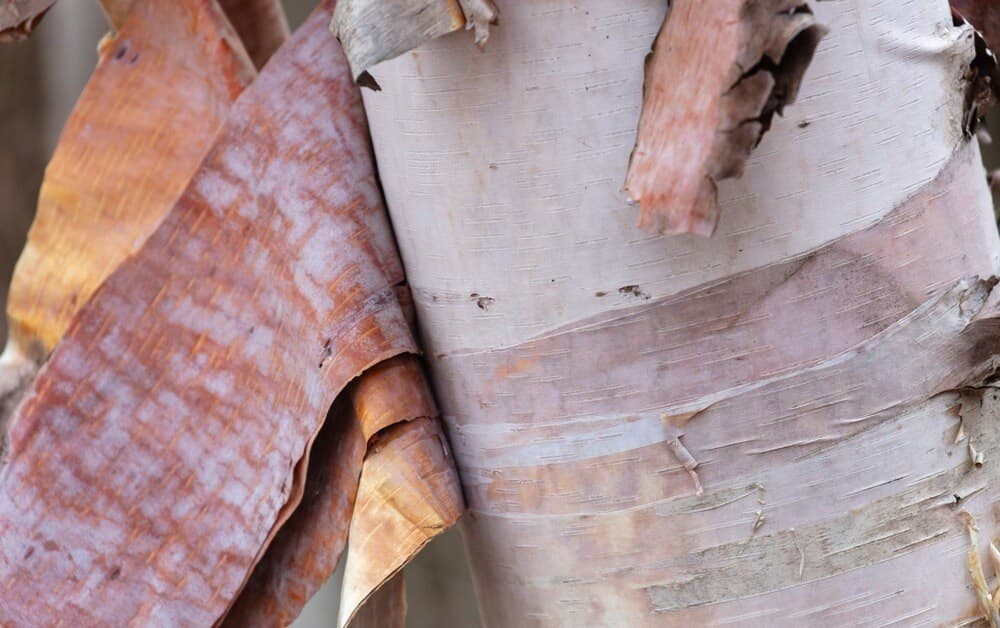
- River birch looks completely different. Young trees have salmon to rust-colored bark that peels in tough, paper-like layers year-round (NC State Extension).
- Leaves are small and toothed. River birch leaves, for example, run 2 to 3½ inches long with doubly serrated edges (NC State Extension).
- Catkins are the pollen source, and you can spot them early. Paper birch forms its male catkins in late summer, holds them through winter at about ¾ to 1 inch long, then lets them stretch to 1½ to 4 inches in spring as they release pollen (USDA Silvics of North America). River birch catkins are slim, light green, and 2 to 3 inches long, appearing before the leaves fully open (NC State Extension).
Birch pollen grains themselves are far too small to see with the naked eye, at roughly 18 to 30 micrometers (Pollen.com). A visible film on your car or porch cannot tell you that birch pollen is present. Confirming birch in the air takes monitored pollen data, not a glance at settled dust.
Birch Pollen Look-Alikes: Aspen and Alder
Aspen
Quaking aspen has smooth, white bark marked with black scars, so it can pass for birch from a distance. The giveaway is the leaves. Aspen leaves hang from long, flattened stalks, so even a slight breeze makes them flutter (National Park Service). Aspen bark is also smooth rather than peeling in papery sheets.
Alder
Alder is in the same birch family and also bears catkins, so it is easy to mix up with birch. Look for alder's small, woody, cone-like fruits (strobiles), which turn dark brown in fall and stay on the branches through winter (NC State Extension). Alder also tends to flower earlier. In the St. Louis area, alder pollen runs from January to April, while birch pollen runs from February to May (St. Louis County Pollen and Mold Center).
Traits vary across species, so use several features together, including bark, leaves, catkins, and fruit, rather than relying on any single one.
When Is Birch Pollen Season? Timing by Region
Birch timing depends on local species, weather, and elevation, and ornamental birches planted in cities can shift what you notice near home. Warm winters can bring an earlier and more intense season (NY Allergy & Sinus Centers). Treat the windows below as typical ranges.
| Region | Typical Birch Window |
|---|---|
| Pacific Northwest | Late February through April, peaking in March and April. Alder and birch produce most of the region's tree pollen. |
| Northeast | March through May, often peaking in April (New York area) |
| Upper Midwest | Starts in March, in full effect in April, still active in May |
| Mid-Mississippi Valley | February through May (St. Louis) |
| Northern forests (paper birch) | Flowers mid-April through early June, depending on location |
Ranges reflect published local calendars. Check your nearest National Allergy Bureau station for the current year.
Live in birch country? Check current conditions for Seattle, New York City, Boston, and Minneapolis. Our seasonal allergy calendar covers what follows birch through summer and fall.
Birch Pollen by the Numbers
- About 6 million grains per catkin. That is the estimate Thermo Fisher Scientific's allergen encyclopedia gives for a single birch catkin (Thermo Fisher Scientific).
- 3.8% of all pollen counted. Across 31 National Allergy Bureau stations from 2003 to 2017, birch made up 3.8% of total pollen. The researchers note that birches are smaller trees that bloom for only a few days, yet birch pollen remains a well-known allergen (Lo et al., Aerobiologia, 2019).
- A tight national window. Birch start dates vary less from place to place than many other tree pollens in the same NAB dataset (Lo et al., 2019).
- About 7 days of flowering. Birch flowers in early spring, before or as its leaves appear, for a short period of roughly a week per tree (Pollen.com).
- Native from Vermont to Texas. River birch is native from Vermont south to Florida, west to Texas, and north through Oklahoma, Nebraska, Michigan, Iowa, and Minnesota (NC State Extension). Paper birch follows the northern tree line from Newfoundland to Alaska and extends south through the Great Lakes, New England, and the Appalachians (USDA Silvics of North America).
Birch Pollen Myths vs. Facts
MYTHEvery white-barked tree is a birch.
FACTQuaking aspen also has white bark (National Park Service), and river birch, a true birch, has salmon to rust-colored bark (NC State Extension). Leaf stalks, catkins, and fruit are more reliable than bark color.
MYTHBirch pollen only matters if a birch grows in my yard.
FACTBirch pollen is carried by wind, and studies in Europe have tracked it traveling between countries, extending the season in places with few local birches (Thermo Fisher Scientific). Ornamental plantings add to local levels too. You don't need a birch on your property to encounter its pollen.
MYTHEveryone sensitive to birch has the same food cross-reactions.
FACTACAAI notes that not everyone with a pollen allergy reacts to the foods commonly associated with it (ACAAI). Cross-reactivity describes related proteins, not a fixed outcome for each person.
Birch Pollen Cross-Reactions and the Apple Connection
This section is descriptive only and is not medical advice.
Pollen. Birch shares related allergy proteins with other members of its family. Thermo Fisher Scientific's allergen encyclopedia reports that about 92% of people sensitized to birch are also sensitized to alder and hazel pollen (Thermo Fisher Scientific).
Foods. Birch pollen's main allergen, Bet v 1, is structurally similar to proteins in certain plant foods, including Mal d 1 in apple (Thermo Fisher Scientific). The American College of Allergy, Asthma and Immunology lists these foods as commonly associated with birch pollen: apple, almond, carrot, celery, cherry, hazelnut, kiwi, peach, pear, and plum (ACAAI).
Two distinctions matter. First, botanical family is not the same as protein similarity. These foods are linked by related proteins, not because they belong to the birch family. Second, a pollen-food association is not a diagnosis of any food allergy. For questions about symptoms or diagnosis, speak with a board-certified allergist.
How to Keep Birch Pollen Out of Your Home
You can't stop birch season, but you can limit how much of it comes inside:
- Check local counts before opening up the house. Use your nearest National Allergy Bureau station during spring.
- Keep windows and doors closed when birch is active. Open windows and doors are one of the main ways pollen gets indoors (2023 scientific review, PMC).
- Leave pollen at the door. Wipe down entry surfaces and sills, change clothes after time outdoors, and wipe pets down when they come in. Our spring allergy prep guide has a full room-by-room checklist.
- Match your HVAC filter to your household. MERV ratings measure how well a filter captures particles between 0.3 and 10 micrometers. A MERV 8 filter must capture at least 70% of particles in the 3 to 10 micrometer range, and a MERV 11 filter at least 85% (EPA). Intact birch pollen grains, at roughly 18 to 30 micrometers, are larger than anything in that test. For most homes, MERV 8 is the standard choice. For households with allergies or pets, step up to MERV 11. Our MERV 8 vs. MERV 11 guide breaks down the difference.
- Change filters on schedule during pollen season. Standard 1-inch filters are typically replaced about every 90 days. Filterbuy 4-inch filters last 6 to 12 months.
These steps reduce how much pollen circulates indoors. They are not a substitute for medical care, and no specific symptom outcome is claimed.
If your filter is due before birch season starts, Filterbuy makes MERV 8 and MERV 11 filters in more than 600 standard sizes, plus custom sizes, so it's easy to find one that fits your system and have it in place before the catkins open.
Shop MERV 8 Filters Shop MERV 11 FiltersFrequently Asked Questions
When is birch pollen season?
Birch pollen season runs in early to mid-spring. It can begin in late February in the Pacific Northwest (Swedish Health Services) and typically runs March through May in the Northeast and Upper Midwest, often peaking in April (NY Allergy & Sinus Centers; Allergychoices).
How long does birch pollen season last?
Each birch tree flowers for only about a week (Pollen.com), but different species and locations flower at different times, so the regional season usually spans several weeks to about three months.
Where do birch trees grow in the U.S.?
Birches are most common in the northern states (Pollen.com). Paper birch grows across the far north, the Great Lakes, New England, and the Appalachians (USDA Silvics of North America), while river birch is native from Vermont to Florida and west to Texas and Minnesota (NC State Extension). Ornamental birches are also planted well beyond these ranges.
How do I recognize a birch tree?
Look at bark, leaves, and catkins together. Paper birch has white, papery bark, while river birch has salmon to rust-colored peeling bark. Birches have small, toothed leaves and hanging male catkins in spring (NC State Extension; USDA Silvics of North America).
Is a white-barked tree a birch or an aspen?
It could be either. Aspen leaves hang from flattened stalks that make them flutter in a breeze, and aspen bark is smooth with black scars rather than peeling (National Park Service). White bark alone doesn't confirm birch.
Why are birch pollen and apples linked?
Birch pollen's Bet v 1 protein is structurally similar to apple's Mal d 1 protein (Thermo Fisher Scientific). That similarity is why ACAAI lists apple among foods commonly associated with birch pollen (ACAAI). Not everyone with a birch allergy reacts to apples.
Are alder and birch pollen the same?
No, but they are closely related. Both trees are in the birch family and produce catkins, and most people sensitized to birch are also sensitized to alder (Thermo Fisher Scientific). Alder usually flowers earlier and forms small, woody, cone-like fruits (St. Louis County Pollen and Mold Center; NC State Extension).
Can birch pollen get into my house?
Yes. Pollen comes in through open doors and windows and on clothing, people, and pets (2023 scientific review, PMC). Keeping windows closed on high-count days and running your HVAC system with a clean filter help limit how much circulates.
What air filter should I use during birch season?
It depends on your household. MERV 8 is the standard choice for most homes. For households with allergies or pets, MERV 11 captures a higher share of larger airborne particles (EPA). See our MERV 8 vs. MERV 11 guide to compare.