
Cool Mist Vs. Warm Mist Humidifier: Which Is Better For A Cold?
November 22, 2026
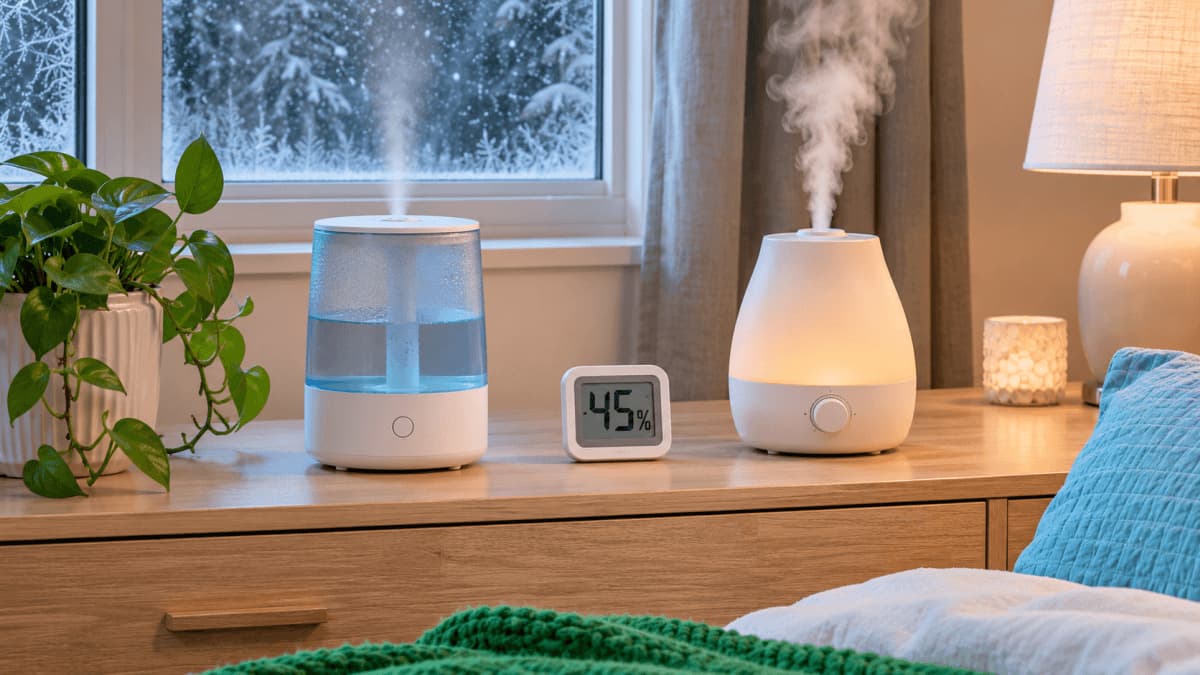
Cool mist and warm mist humidifiers add the same moisture, and neither type will shorten a cold. Where they differ is burn risk, what comes out with the mist, running cost, and cleaning. Because Filterbuy makes air filters, we judge any device by what it adds to your air, and by that measure an evaporative cool mist model comes out ahead in most homes.
TL;DR
Filterbuy recommends a cool mist humidifier for a cold in most homes. Both types humidify equally well, so the choice comes down to safety and upkeep. Warm mist units can scald, which is why pediatric guidance calls for cool mist around kids.
Key Takeaways
Cool mist and warm mist humidifiers add moisture equally well, and their vapor reaches the lower airways at the same temperature.
No humidifier type is proven to shorten a cold, and a Cochrane review found no clear benefit from heated air.
Cool mist is the recommended type for babies and children because warm mist units can cause burns.
Ultrasonic and impeller units spray the most minerals and germs, and evaporative and steam units the fewest.
Boiling a gallon of water takes about 2.7 kWh, roughly 50 cents of electricity.
What Is The Difference Between A Cool Mist And A Warm Mist Humidifier?
A warm mist humidifier boils water and releases steam. A cool mist humidifier skips the heat and adds moisture with an ultrasonic plate, an evaporative fan and wick, or a spinning impeller. In a warm vs. cool humidifier comparison, warm mist carries the burn risk and ultrasonic carries the mineral risk.
Filterbuy Humidifier Comparison By Type
Filterbuy summary of EPA and Mayo Clinic guidance.
Is A Cool Mist Or Warm Mist Humidifier Better For A Cold And Congestion?
Filterbuy's read of the evidence is that neither type works better for a cold or congestion. As Mayo Clinic's answer on warm-mist versus cool-mist humidifiers explains, both humidify equally well, and the vapor reaches the lower airways at the same temperature.
The American Academy of Pediatrics (AAP) guide to simple remedies for kids with colds and flu says a cool-mist humidifier can relieve a stuffy nose and thin congestion.
Heat on its own has not been shown to help. A Cochrane review of heated, humidified air for the common cold pooled six trials with 387 people breathing heated air through a nasal device and found no benefits or harms. A tabletop humidifier delivers far less heat, so warm mist has no edge for a cold.
Filterbuy's guides to telling a cold from the flu and RSV vs. a cold help you tell which you have.
Which Humidifier Is Best For A Baby Or Young Child?
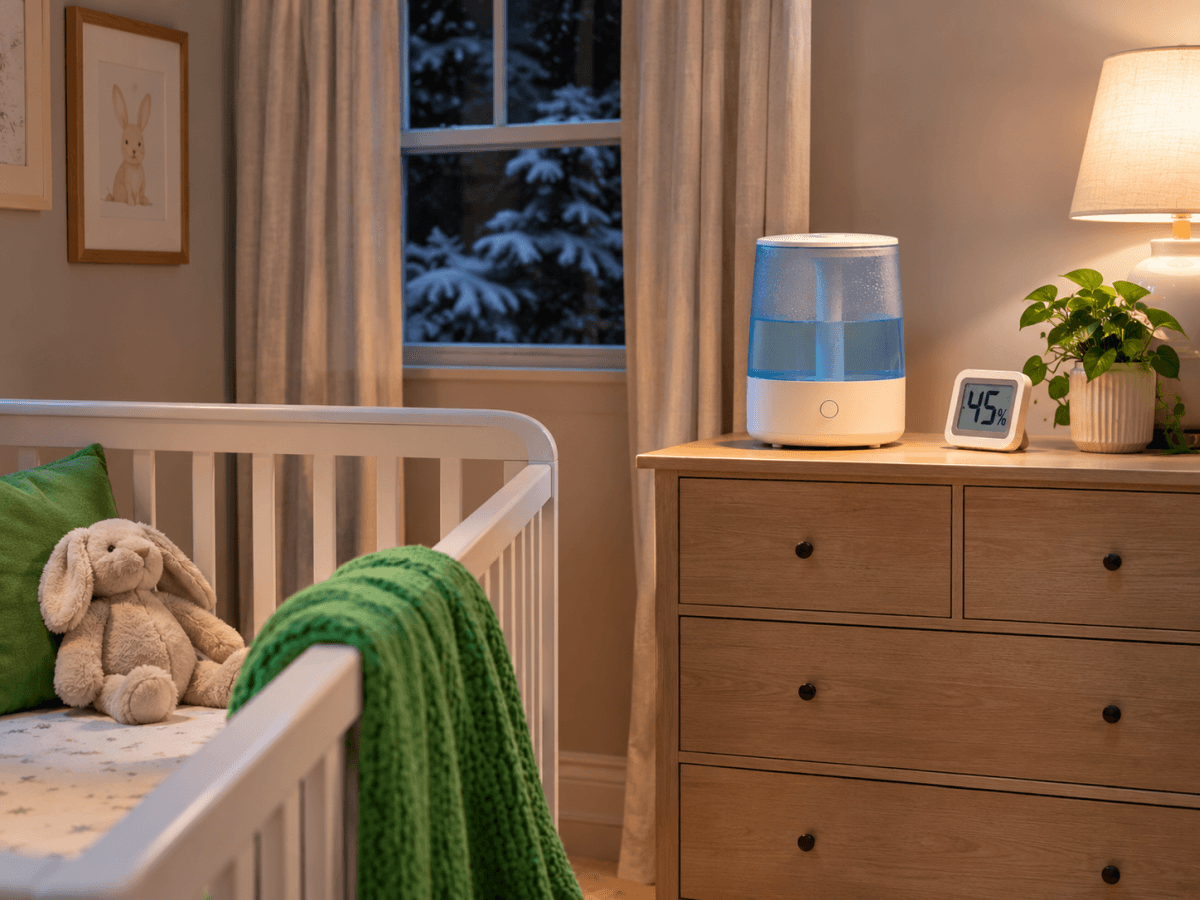
A cool mist humidifier is the right choice for a baby or young child, because steam and hot water from a warm mist unit can burn a child who leans in or knocks it over. MedlinePlus, the National Library of Medicine's health site, agrees and suggests keeping it about 2 meters from the bed.
For a nursery, Filterbuy's pick is an evaporative cool mist model. It makes no visible fog for a toddler to reach into, and it doesn't spray white dust. Its output slows as the room gets humid, so a small bedroom is less likely to drift past 50%. An ultrasonic model works too with distilled water.
Never use a pot of boiling water as a homemade humidifier. Filterbuy's winter air tips for kids, seniors, and allergy sufferers add more ideas.
Ultrasonic Vs. Evaporative Humidifier: Which Cool Mist Type Should You Buy?
For most homes, an evaporative humidifier is the cleaner choice and an ultrasonic one is the more compact, quieter option. The EPA's guide to the use and care of home humidifiers explains why: ultrasonic and impeller units release the most microorganisms and minerals, while steam and evaporative units release few minerals.
An ultrasonic unit filled with tap water becomes a particle source in the same room your HVAC filter is working to clean. The EPA calls distillation the most effective way to remove minerals, so distilled water is the best fill. Hard water leaves white scale on faucets and kettles, and your utility's annual water quality report often lists hardness.
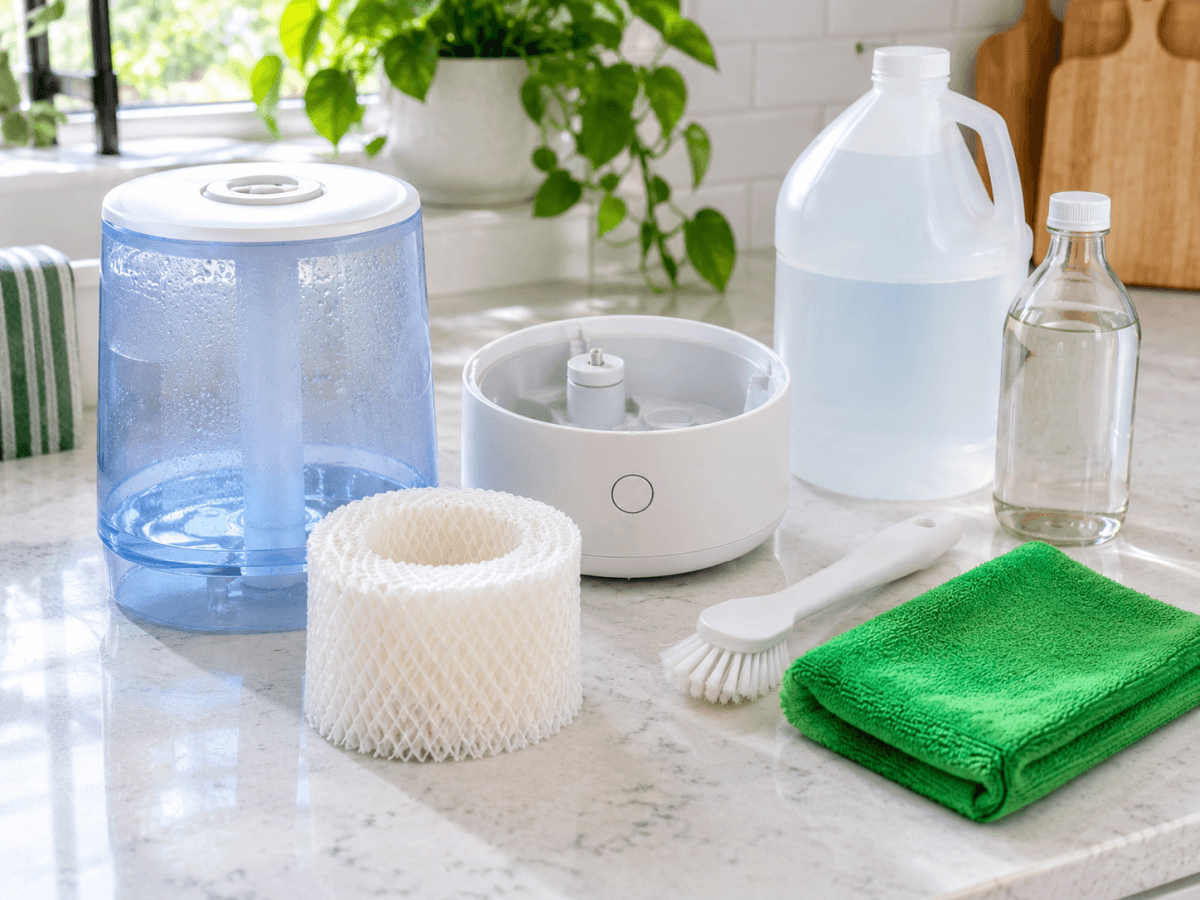
Evaporative units avoid that problem but add a wick filter, which traps minerals and needs replacing. Filterbuy treats the wick like any other filter: once it turns crusty or musty, it is done. Our humidifier filter cleaning and replacement guide walks through cleaning and replacement.
Choose evaporative if you have hard water, young kids, or allergies.
Choose ultrasonic if you want a compact, low-noise unit and will use distilled water.
Choose warm mist only in an adult's room with no children or pets nearby.
Does A Warm Mist Humidifier Cost More To Run?
At the plug, a warm mist humidifier uses far more electricity. When Filterbuy worked through the physics, though, the gap shrank in a heated home. Boiling one gallon takes about 2.7 kWh, roughly 50 cents at the EIA's 2026 forecast of 18.2 cents per kWh. A cool mist unit draws little power, but evaporating that same gallon still pulls about 2.4 kWh of heat from the room, which your heating system replaces.
What It Takes To Turn One Gallon Of Water Into Humidity
Filterbuy calculation using 60°F tap water and 18.2 cents per kWh.
With electric baseboard heat, both types cost about the same in winter. With a gas furnace or heat pump, cool mist usually costs less, because those systems make heat more cheaply. Here is how a heat pump works in winter.
How Much Water Does A Bedroom Humidifier Need?
A typical bedroom needs only about a quarter to a half gallon of water a day to hold 45% humidity in winter. That Filterbuy estimate assumes a 12-by-12-foot room at 68°F on a 30°F day, trading half its air with the outdoors each hour. A sleeping person's breath supplies some of the moisture, so overnight use sits at the low end.
If a unit empties a full gallon overnight in a small room, it is probably overshooting. Size the humidifier to the room, then let a hygrometer or built-in humidistat decide how hard it runs.
How Do You Keep A Humidifier Clean And Safe?
A safe humidifier comes down to a clean tank, low-mineral water, and a room held between 40% and 50% humidity. Our rule of thumb: if the tank water looks cloudy or smells off, dump it and clean the unit.
Empty, wipe dry, and refill the tank daily.
Clean it every third day per the manual, and rinse well.
Use distilled water, especially in ultrasonic models.
Check the room with a hygrometer and aim for 40–50%. Above 50%, dust mites and mold start to thrive.
Replace the wick on schedule. Dry the unit before storing it and keep it out of reach.
Filterbuy's guide to ideal indoor humidity in winter covers very cold weather, and its checklist for setting up a sick room at home helps when someone is ill.
Where Does Your HVAC Filter Fit In?
A humidifier adds moisture, while an HVAC filter captures particles. Moisture does nothing about the dust or pet dander your system circulates.
For most homes, a MERV 8 air filter is the standard choice. MERV 11 suits homes with allergies, asthma, pets, or pollen. When the Air Quality Index (AQI) is over 100, switch to the EPA-recommended MERV 13 filter if you have an HVAC system, and run HEPA air purifiers in each room. Check your HVAC system's manual before moving up a rating. If your furnace has a whole-house humidifier, its pad wears out too, so see whole-house humidifier replacement filters and Filterbuy's flu season HVAC checklist.
“We make air filters, so we judge every device by what it adds to the air. A cool mist humidifier with a clean tank and distilled water adds moisture and almost nothing else. That is the standard I would hold any humidifier to in a home with kids.”
Supporting Statistics
About 1 in 4 U.S. homes uses a humidifier.
29.25 million households use one.
15.77 million run it only in winter.
Source: Table HC6.1 Space Heating in U.S. Homes, by Housing Unit Type, 2020
Up to 350 µg/m³ of PM2.5 from one ultrasonic humidifier.
Indoor PM2.5 ranged from 16 to 350 µg/m³ by fill water, highest with tap water.
An evaporative humidifier added no PM2.5 with any water type.
4–5 children burned in one cold and flu season.
One Shriners Children's Boston nurse practitioner treated them all for second-degree steam burns.
Source: Shriners Children's Boston Warns Parents After Spike in Burn Injuries Linked to DIY Humidifiers
FAQ
Is Cool Mist Or Warm Mist Better For Congestion?
Cool mist, though not because it clears a stuffy nose faster. It adds the same moisture without hot water.
Why Do My Windows Fog When The Humidifier Runs?
Window glass is the coldest surface in the room, so moisture condenses there first when indoor humidity is too high for the weather outside. Turn the humidifier down until the fog clears, and wipe the sill so mold never gets a start.
Is A Cool Mist Humidifier Safe For A Baby?
Yes, as long as you refill it daily with distilled water and keep it out of reach. Hold the room at or below 50%, and check with your pediatrician first if your baby has a breathing condition.
Do Warm Mist Humidifiers Kill Germs?
Boiling kills many germs in the tank, so a warm mist unit releases few into the air. It does nothing, though, about germs already in the room.
Why Is There White Dust Around My Humidifier?
That dust is tap water minerals sprayed by an ultrasonic or impeller humidifier. Distilled water usually solves it, and evaporative models avoid it.
Breathe Easier This Cold Season
Find your size and shop Filterbuy air filters in MERV 8, MERV 11, and MERV 13, with fast and free 2-day delivery to most US states.
Shop Filterbuy Air Filters →Glossary
- Filterbuy:
- Maker of MERV 8, 11, and 13 HVAC air filters.
- Cool mist humidifier:
- Adds moisture without heating the water.
- Warm mist humidifier:
- Boils water and releases steam. Also called a steam vaporizer.
- Ultrasonic humidifier:
- A cool mist type that vibrates water into a fine fog.
- Evaporative humidifier:
- A cool mist type that blows air through a wet wick.
- Impeller humidifier:
- A cool mist type that flings water off a spinning disk.
- Relative humidity (RH):
- Water vapor in the air as a share of its maximum.
- Hygrometer:
- A gauge that measures relative humidity.
- Humidistat:
- A control that holds a set humidity.
- HVAC:
- Heating, ventilation, and air conditioning.
- AQI:
- The EPA's 0–500 Air Quality Index for daily air pollution.
- HEPA:
- High-efficiency particulate air, a filter standard for portable purifiers.
- MERV:
- Minimum Efficiency Reporting Value, a filter's particle capture rating.
- PM2.5:
- Airborne particles 2.5 micrometers or smaller.
- EPA:
- The U.S. Environmental Protection Agency.
- EIA:
- The U.S. Energy Information Administration.
- Cochrane review:
- A review pooling clinical trial results.