
How Long Does the Flu Virus Stay in the Air Inside a Room?
November 9, 2026

TL;DR
The flu virus can stay in the air inside a room for a few seconds to many hours. Humidity decides how long they stay infectious, and airflow decides how long they stay in the room. In a closed-up winter house, clearing 99% of them can take most of a day; running the fan through a MERV 13 filter cuts that to about an hour, and a HEPA purifier gets a sickroom near 20 minutes.
Key Takeaways
Droplets bigger than 100 microns hit the floor in about 6 seconds, but 1-micron aerosols can take about 12 hours.
In a NIOSH study, airborne flu stayed about 5 times more infectious at 23% humidity or lower than at 43% or higher.
Heated winter air often drops to 10–40% relative humidity, which helps flu stay infectious.
The CDC recommends at least 5 clean-air changes per hour, and a MERV 13 filter with the fan ON, plus a sickroom HEPA purifier, gets most homes close.
Our Take: It's an Airflow Problem You Can Control
Most answers stop at "flu lingers for hours." At Filterbuy, we've spent more than a decade building filters in our own U.S. plants, and we see it differently. How long a virus lingers depends mostly on how quickly your home moves air through a good filter, and you can change that tonight.
When flu season hits, the air inside your home matters more than you might think. Airborne viruses can travel in tiny respiratory particles, and the right HVAC filter can help capture some of those particles as air circulates through your system.
You don't need to be an HVAC expert to protect your family's indoor air. My goal is to help you understand which filters work, why MERV ratings matter, and how one simple change can support cleaner, healthier air at home.
How Long Do Flu Particles Stay in Indoor Air?
Flu particles stay in indoor air anywhere from a few seconds to many hours, depending on their size. In still air, a 10-micron particle takes about 8 minutes to fall 5 feet, while a 1-micron particle can take about 12 hours. The smaller the particle, the more airflow, not gravity, decides where it goes.
According to the Centers for Disease Control and Prevention (CDC), flu spreads mainly through droplets. Aerosol scientists draw the line between droplets and aerosols at 100 microns, since anything smaller can stay airborne and be inhaled (Wang et al., Science, 2021).
Source: William G. Lindsley, PhD, NIOSH/CDC, presentation to the National Academies of Sciences, Engineering, and Medicine. Times are for water-density particles falling 5 ft in still air.
Floating vs. Infectious: Why Flu Has Two Clocks
A floating flu particle isn't necessarily infectious. Influenza is an enveloped virus that gradually loses its ability to infect once it leaves the body, and humidity sets the pace. In dry air it stays infectious far longer, which is why the same cough is riskier in a heated winter home than in a humid one.
In a coughing-manikin experiment, researchers at the CDC's National Institute for Occupational Safety and Health (NIOSH) found that flu aerosols kept 70–77% of their infectivity over an hour at 23% relative humidity or lower, compared with just 14–22% at 43% or higher. Most of that loss came within 15 minutes (Noti et al., PLOS ONE, 2013).
Why Is an Airborne Virus Worse in a House in Winter?
An airborne virus in a house lingers longer in winter because heating dries the air, which helps flu stay infectious, and closed windows mean fewer fresh air changes. ASHRAE's long-standing benchmark is just 0.35 air changes per hour, a fraction of the CDC's 5-ACH target (Quartz). In temperate climates, winter indoor humidity typically falls to 10–40% (Božič and Kanduč).
Aim for 40–50% relative humidity, which keeps you above the NIOSH study's 40% mark and inside the 30–50% range the U.S. Environmental Protection Agency (EPA) recommends for mold control.
How Long Do Viruses Linger in a Room After Someone Coughs?
How long viruses linger in a room comes down to its air changes per hour (ACH). Once coughing stops, CDC guidance shows that removing 99% of airborne particles takes 138 minutes at 2 ACH, 46 minutes at 6 ACH, and 23 minutes at 12 ACH.
Source: CDC, Guidelines for Environmental Infection Control in Health-Care Facilities (2003), Appendix B, Table B.1. Assumes an empty, well-mixed room with no ongoing source.
Those figures were built for hospitals, so the Filterbuy team ran the same CDC formula on a typical 2,000-square-foot house:
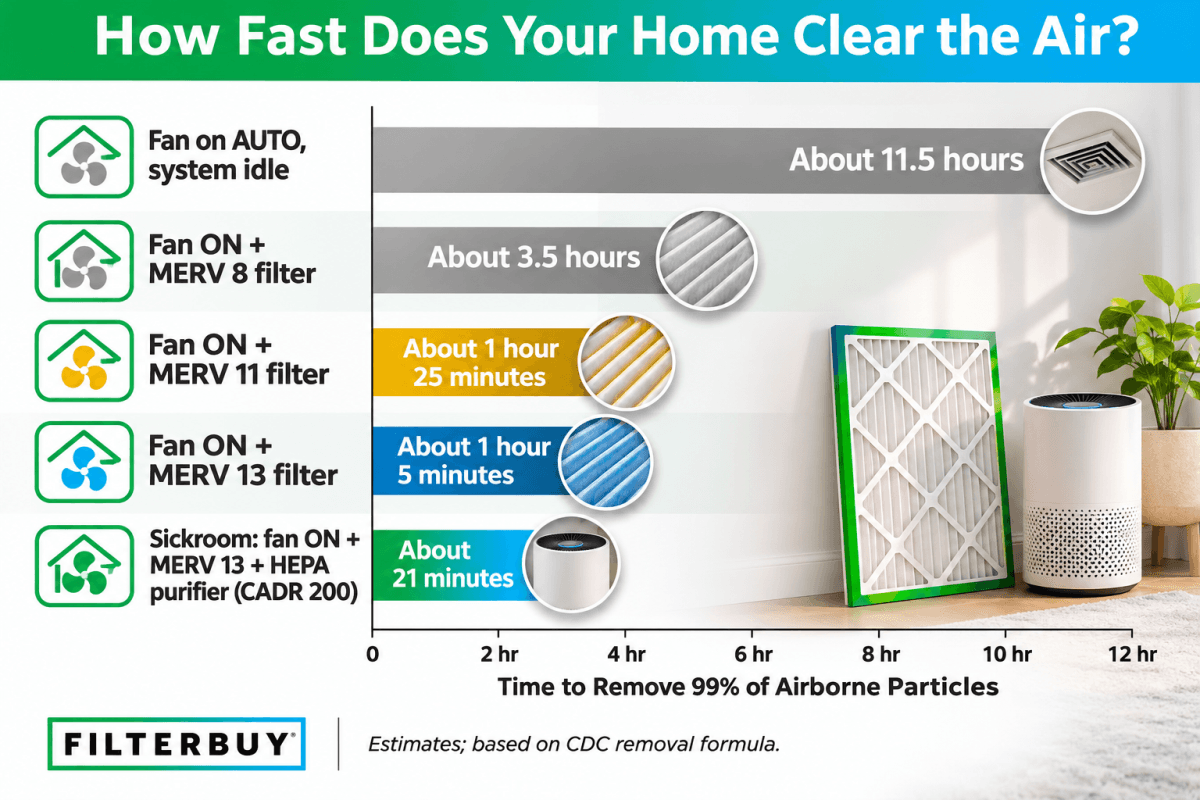
How we estimated this: We assumed a 1,200 CFM blower, typical of a 3-ton system (MERV pressure drop chart), and ASHRAE 52.2 minimum capture rates. Real rooms clear only 20–60% per air change, not the ideal 63%, so expect longer times (ASHRAE Journal).
Filterbuy's biggest takeaway was how much the fan setting matters: switching from AUTO to ON with a MERV 13 cut clearing time from about 11.5 hours to about an hour.
How to Estimate Your Own Room's Clearing Time
You can estimate how long your own room takes to clear with what Filterbuy calls the Rule of 276: divide 276 by the room's air changes per hour (ACH), and the answer is the minutes needed to clear 99% of airborne particles.
Find your ACH. For a purifier: ACH = CADR × 60 ÷ (room square feet × ceiling height).
Divide 276 by your ACH.
Example: In a 12 × 14 ft bedroom (1,344 cubic feet), a purifier with a CADR of 150 adds about 6.7 ACH, so 276 ÷ 6.7 gives about 41 minutes.
Why 276? It's the CDC formula boiled down to one number, and it matches every row of the CDC table. Run it in reverse to size a purifier:
Filterbuy calculation: CADR = 5 ACH × room volume ÷ 60, with 8 ft ceilings. Use the smoke CADR, which is rated at the purifier's highest speed.
Running these numbers, Filterbuy noticed that the EPA's sizing chart (65 CFM per 100 square feet) works out to about 5 ACH, matching the CDC's target, so either guide lands you on the same purifier.
How to Clear Viruses From Room Air: 7 Steps
To clear viruses from room air, add clean air changes and keep humidity at 40–50%. The first two steps do the most, turning your existing HVAC system into a whole-home air cleaner. Together, these seven steps get most homes close to 5 ACH.
Switch the thermostat fan from AUTO to ON. Your filter only works while the fan is running, and the EPA notes most systems run less than 25% of the time. The CDC recommends ON whenever you have visitors.
Upgrade to a MERV 13 filter if your system allows. The EPA says MERV 13 and higher filters can trap smaller particles, including viruses. The question we hear most is "Will it restrict my airflow?" In Filterbuy lab testing at 1,000 CFM, a 4-inch MERV 13 had half the resistance of a 1-inch version (0.11 vs. 0.22 inches of water) (MERV pressure drop chart), so go thicker if your slot allows. Shop Filterbuy MERV 13 air filters or see our best air filter for viruses guide.
Run a HEPA purifier in the sickroom. Size it with the CADR table above, and skip ozone or ionizer units, as Harvard's Healthy Buildings Program advises.
Keep the sick person in one room with the door closed.
Ventilate when the weather allows by cracking a window and running exhaust fans.
Hold humidity at 40–50%, and back off if windows fog.
Change your filter on schedule, and check the fit. The CDC suggests every three months, but in heating season Filterbuy recommends every 30 to 60 days; the biggest gains we see come from changing filters more often, not buying pricier ones. Also watch for a filter that's slightly too small, which lets air slip around the frame. Filterbuy auto-delivery ships your exact size on schedule.
“ During flu season, your HVAC filter does more than catch everyday dust. A properly rated filter, like MERV 13, can help capture tiny airborne particles that may carry flu viruses as air circulates through your home.
But a higher rating only helps if your HVAC system can handle the airflow. Choose the most effective filter your system supports, keep your fan running when appropriate, and replace the filter regularly. Cleaner indoor air starts with the right filter and consistent maintenance. ”
No filter makes a sick household risk-free, though. Pair filtration with flu vaccination and staying home when sick, as the CDC recommends.
Does a Cold Virus Stay in the Air the Same Way?
Cold viruses ride the same droplets and aerosols as flu, but they handle humidity differently. Rhinoviruses, the most common cold viruses, lack flu's outer envelope, and non-enveloped viruses tend to survive longer in very humid air (70–90%) (Božič and Kanduč). That's one more reason to keep humidity near 50%, not higher.
For more, see MERV filters for bacteria vs. viruses.
Supporting Statistics: What the Research Shows
U.S. government agencies and government-funded research back this guide.
Flu is a major yearly threat.
51 million flu illnesses in the 2024–25 season.
710,000 hospitalizations and 45,000 deaths.
Better filters lower infection risk.
MERV 13 cut estimated infection probability 42% vs. MERV 8.
MERV 13 plus a HEPA purifier cut it 50%.
Tested in railcars with virus-size aerosols.
Most exposure happens indoors.
Americans spend about 90% of their time indoors.
Some indoor pollutants run 2–5 times higher than outdoors.
Frequently Asked Questions
How Long Does a Cough Linger in the Air?
With the HVAC fan on AUTO, clearing 99% of a cough's fine aerosols can take about 11 hours. Running the fan through a MERV 13 filter cuts that to about an hour.
Can the Flu Spread Through My HVAC System?
Shared return air can carry fine aerosols between rooms. A MERV 13 filter with the fan set to ON cleans that shared air on every pass.
How Long After Someone With the Flu Leaves a Room Is the Air Clear?
Use the Rule of 276: at 6 air changes per hour, 99% of airborne particles clear in about 46 minutes. People with flu are most contagious in their first three days.
Glossary
An airborne particle under 100 microns that can stay suspended and be inhaled.
How often per hour a room's air is replaced with clean air.
Moisture in the air as a percentage of its maximum at that temperature.
The ASHRAE Standard 52.2 rating, 1 to 16, of how well an HVAC filter captures particles.
A filter that captures at least 99.97% of 0.3-micron particles.
A purifier's filtered airflow in cubic feet per minute.
The engineering society that sets U.S. HVAC and filter standards.
About the Author and Reviewer
Michelle Wan is Brand Manager and Air Quality Writer at Filterbuy and works directly with its U.S. manufacturing team. David Clark, a licensed HVAC technician, reviews Filterbuy's technical content.
Ready to Clear the Air?
Shop Filterbuy MERV 13 air filters and set up convenient Filterbuy auto-delivery before flu season peaks.