
Why Is Flu Season In Winter? Dry Air, Closed Windows, And Crowded Rooms
November 9, 2026

Flu season peaks in the winter because cold, dry air helps influenza viruses survive and spread, and because people spend more of the day in sealed rooms breathing the same air. As an American air filter manufacturer, Filterbuy looks at the season from inside the home. You cannot change the weather, but you can manage the humidity and airflow in your own rooms.
TL;DR
Influenza spreads most in winter because dry air helps the virus survive and cold air weakens the nose's defenses, all while closed homes keep people breathing the same air. In the United States, flu activity usually peaks between December and February. At home, you can raise humidity when it falls too low and keep shared air moving through a clean HVAC filter.
Key Takeaways
In the United States, flu activity usually peaks between December and February, and February is the most common peak month.
Absolute humidity, the actual amount of water vapor in the air, explained 90% of the variability in flu virus survival in a 2009 PNAS analysis.
By Filterbuy's calculation, outdoor air at 30°F and 70% relative humidity drops to about 16% once a furnace heats it to 70°F, before cooking and showers add moisture back.
Filterbuy's winter air plan centers on the three flu season factors a household can adjust: indoor humidity, ventilation, and HVAC filtration.
Why Is Flu Season In Winter?
Flu season lands in winter because several conditions arrive together. Dry air keeps the virus intact longer and cold air weakens the nose's defenses, just as closed windows keep people breathing the same air for hours. When Filterbuy lined up CDC's peak-month records against the calendar, 36 seasons peaked between December and March, right in the heart of the US heating season.
In temperate places like most of the United States, flu transmission climbs once the air turns cold and dry. A 2009 analysis of absolute humidity and influenza survival in the Proceedings of the National Academy of Sciences (PNAS) found that absolute humidity explained 90% of the variability in flu virus survival and 50% of the variability in transmission. Relative humidity explained far less.
How Does Dry Winter Air Help The Flu Spread?
Dry winter air helps the flu spread in two ways. Influenza virus stays stable longer in low-humidity air, and dry air can slow the airway's ability to clear away the particles that carry it. That dryness begins outdoors, where cold air holds little water vapor, and follows you inside whenever the furnace runs.
To show how dry heated air gets, Filterbuy ran standard vapor-pressure math against the most humidity a home can hold before windows sweat.
Filterbuy calculation: outdoor air at 70% relative humidity heated to 70°F with no moisture added. Maximums prevent window condensation (FGIA).
Even on a 5°F day, a home has room for about 25 more points of humidity. Cooking and showers fill part of that gap, so check a hygrometer before adding more.
A 2019 Yale University study on low humidity and airway defenses found that mice kept at 10% to 20% humidity cleared their airways less effectively, and got sicker after influenza exposure, than mice kept at 50%. Results in mice do not always carry over to people.
Why Are Colds More Common In Winter?
Colds are more common in winter partly because cold air wears down the nose's built-in defenses. A 2022 study on cold exposure and nasal immunity in The Journal of Allergy and Clinical Immunology found that cooling nasal tissue to cold-air levels cut the virus-fighting particles nasal cells release, called extracellular vesicles, by nearly 42%. The researchers tested rhinovirus and coronavirus strains, the viruses behind most colds.
Why Do People Get Sick In Winter Indoors?
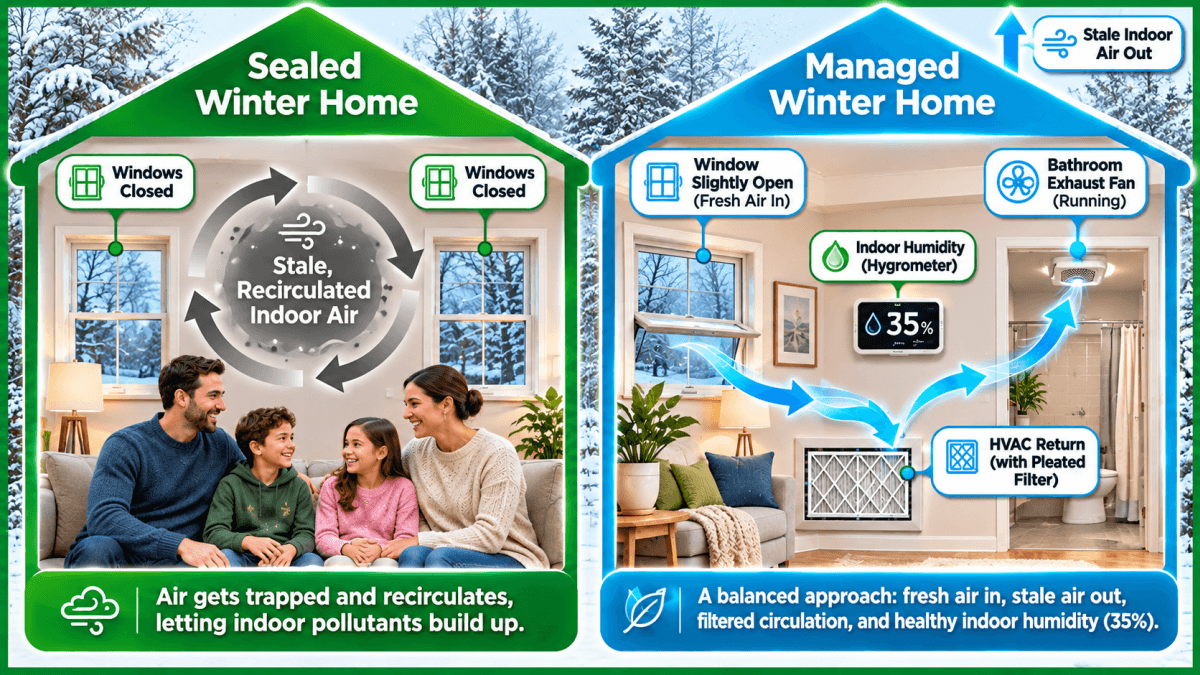
People get sick in winter partly because they spend longer indoors with the windows shut, sharing the same air. The Environmental Protection Agency (EPA) estimates that Americans spend about 90% of their time indoors, and winter pushes that share higher. A closed-up home also brings in less outdoor air to dilute what everyone breathes out.
Winter crowds people together, too. Classrooms fill up and families travel for the holidays during the very months the virus survives best.
Why Do I Get Sick Every Winter?
If you get sick every winter, more exposure and weaker defenses are probably arriving at the same time. Winter puts you near more people in dry, recirculated air, and cold air makes it harder for your nose to clear viruses.
Influenza, respiratory syncytial virus (RSV), and many cold viruses all peak in the colder months, so you can catch more than one a season. Researchers are still studying whether shorter days and lower vitamin D play a part. If you get sick often, talk with your doctor, including about the yearly flu vaccine.
Winter Illness And Indoor Air: What You Control
At home, the winter illness factors you control are indoor humidity, fresh-air ventilation, and how well your HVAC system filters recirculated air. The table sorts each factor by whether you can change it, and the checklist turns the controllable ones into steps.
Humidity guidance assumes a 70°F indoor temperature.
Filterbuy's winter checklist:
Check indoor humidity. Place a hygrometer in a main living area. Our ideal indoor humidity in winter chart lowers the target as outdoor temperatures fall, so windows stay free of fog and drips.
Add moisture carefully. If readings stay below about 30%, run a humidifier. Static shocks and cracked lips are common signs of dry air in your house in winter.
Bring in fresh air. Run exhaust fans and crack a window for a few minutes when the weather allows.
Keep the HVAC filter fresh. Heavy heating use clogs filters faster, so Filterbuy recommends checking yours monthly in winter. See how often to change your furnace filter in winter.
Set the fan to On when someone is sick. Our guide to running your furnace fan on or auto keeps Auto as the everyday, energy-saving setting. A sick household member is the exception, because On keeps air moving through the filter between heating cycles.
What An HVAC Filter Can And Cannot Do
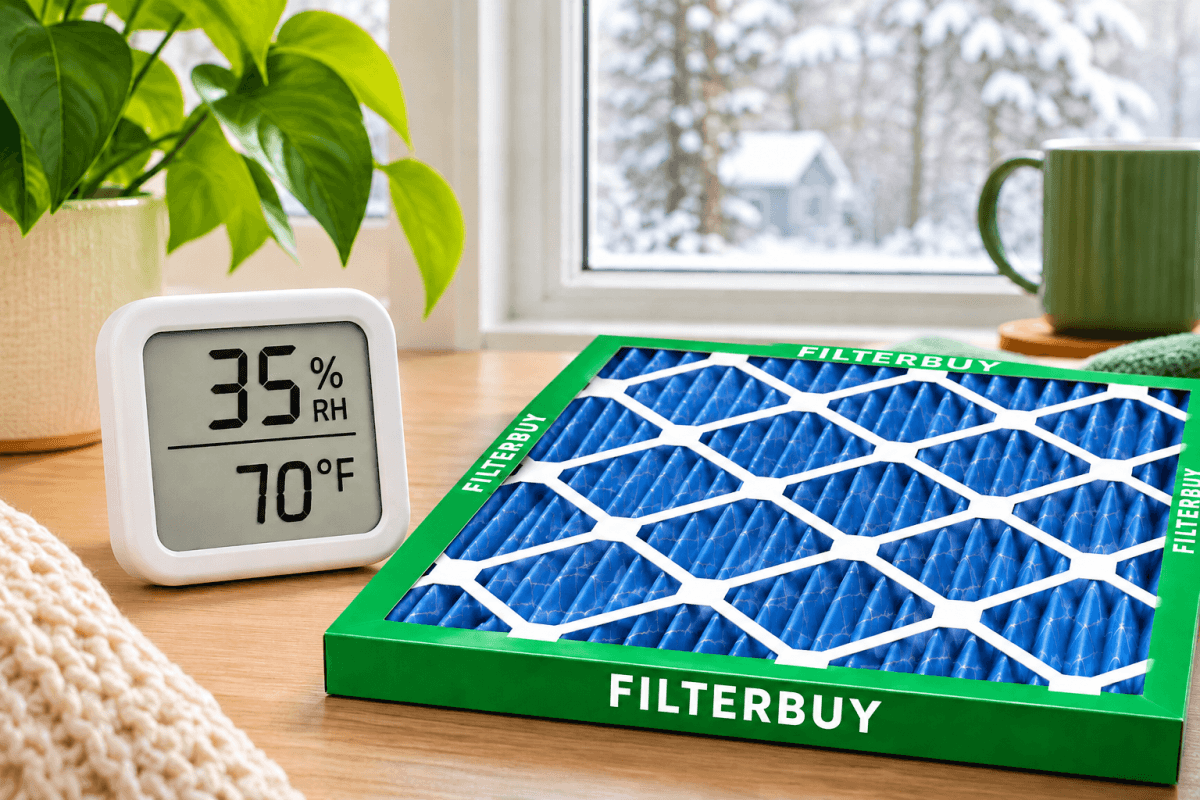
An HVAC filter captures airborne particles only from the air that passes through it, and only while the blower fan runs. A filter cannot keep anyone from catching the flu or stop face-to-face spread. Filtration works as one layer alongside humidity control, fresh air, handwashing, and staying home when sick.
Filterbuy builds pleated filters in MERV 8, MERV 11, and MERV 13, and higher ratings capture a larger share of fine airborne particles. Our guide on whether your HVAC filter can help with colds, flu, and RSV explains where filtration fits. Before upgrading to MERV 13, check your HVAC system's manual or ask an HVAC technician to confirm your equipment accepts it.
Expert Insight“Most flu-season advice stops at handwashing and vaccines. The part I find most overlooked is the air itself. A hygrometer reading and a filter check tell a family more about the air they share all winter than any weather forecast.”
Supporting Statistics
Flu peaks in the heating season. 36 US flu seasons from 1982–1983 through 2023–2024 peaked between December and March. Source: Flu Season
February: 17 seasons
December: 7 seasons
January: 6 seasons
March: 6 seasons
Most hours happen indoors. Americans spend about 90% of their time inside. Some indoor pollutants run 2 to 5 times higher than outdoors. Source: Report on the Environment: Indoor Air Quality
Classrooms fill before flu season. About 55 million US children attend school in shared indoor air. Source: Fast Facts: Back-to-School Statistics
Public schools: 49.6 million students (fall 2022)
Private schools: 5.5 million students (fall 2021)
Frequently Asked Questions
Why Is The Flu Seasonal?
The flu is seasonal because the conditions that help it spread change with the weather. In temperate climates, winter brings low humidity and colder nasal passages just as people spend more time in shared indoor air.
Does Cold Weather Itself Make You Sick?
No. A virus causes the flu or a cold, not the weather itself. Cold, dry air makes it easier for that virus to survive and harder for your nose to fight it off.
What Humidity Level Is Best During Flu Season?
The EPA recommends keeping indoor humidity between 30% and 50%. In winter, Filterbuy suggests staying near 30% to 40%, and lower in very cold weather to keep condensation and mold off windows.
Can A Humidifier Help During Flu Season?
A humidifier can raise indoor humidity when winter air gets too dry, and research links higher humidity to shorter flu virus survival. It will not prevent the flu on its own, though. Mayo Clinic humidifier guidance recommends cleaning the unit every three days, since dirty tanks can grow bacteria and mold.
Breathe Easier All Heating Season
Filterbuy manufactures pleated air filters in MERV 8, MERV 11, and MERV 13 across hundreds of sizes, with fast and free 2-day delivery to most US states. If your HVAC system's manual confirms it accepts that rating, shop MERV 13 air filters and set up auto-delivery so a fresh filter shows up on time all winter.
Glossary
Filterbuy
An American manufacturer of pleated HVAC air filters sold at filterbuy.com.
Influenza (Flu)
A contagious respiratory illness caused by influenza viruses.
Flu Season
The months when influenza activity rises, usually peaking December through February in the US.
Absolute Humidity
The actual amount of water vapor in the air. It hits its yearly low in winter.
Relative Humidity
Water vapor in the air compared with the most it could hold at that temperature.
Extracellular Vesicles
Tiny particles released by nasal cells that bind to viruses and help block infection.
Rhinovirus
The virus family responsible for most common colds.
RSV
Respiratory syncytial virus, a common virus that peaks in fall and winter.
EPA
The US Environmental Protection Agency, which publishes indoor air quality guidance.
CDC
The Centers for Disease Control and Prevention, which tracks US flu activity.
HVAC
Heating, ventilation, and air conditioning, the system that circulates air through a home.
MERV
Minimum Efficiency Reporting Value, a filter rating scale where higher numbers capture more small particles.
MERV 13
A high-efficiency residential filter rating for systems rated to accept it.