
How Long Does the Flu Virus Live on Surfaces, Fabric, and Skin?
November 9, 2026
TL;DR
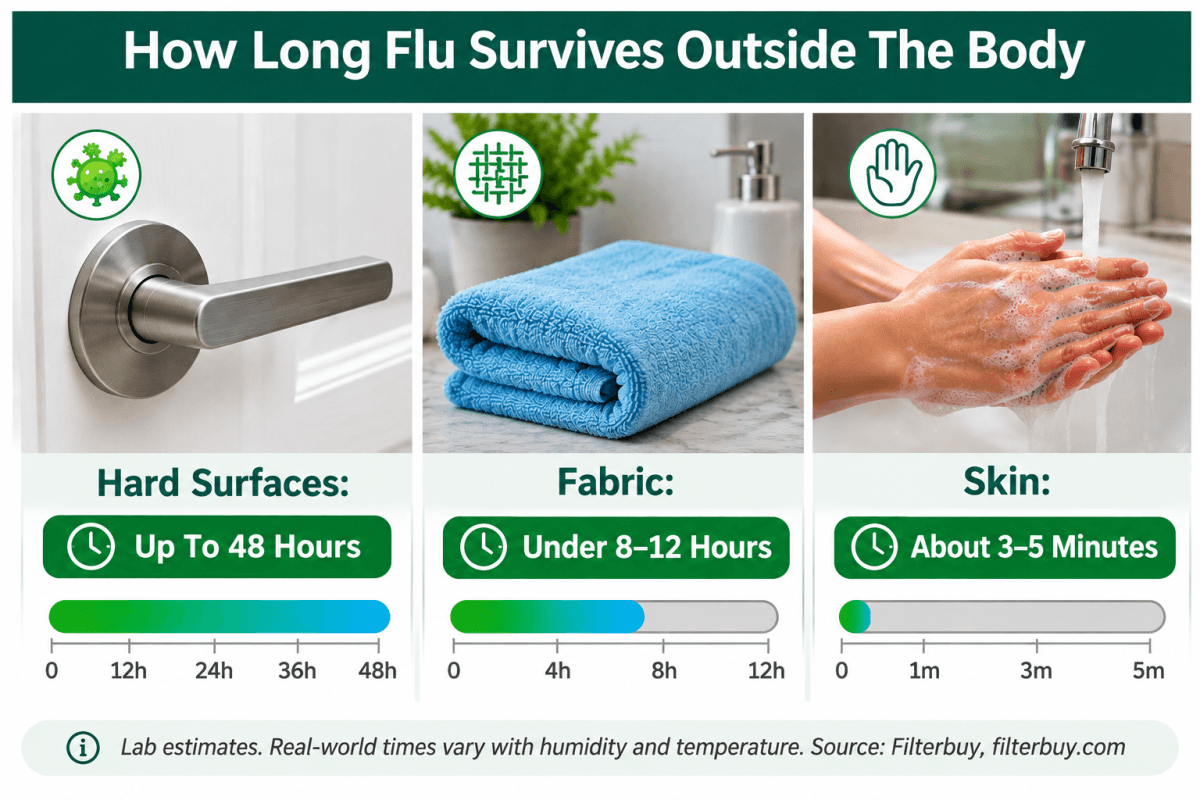
Flu lasts up to about two days on hard surfaces, under half a day on fabric, and only minutes on skin. Filterbuy's advice is to clean metal and plastic handles first, wash a sick person's bedding on hot, wash your hands often, and keep indoor humidity near 40% whenever cold weather allows.
Key Takeaways
In lab testing, flu survived 24 to 48 hours on stainless steel and plastic.
On fabric and tissues, flu stays infectious for under 8 to 12 hours.
Flu lasts only 3 to 5 minutes on hands, but hands are the fastest route from a surface to your face.
Heated winter air can fall below 25% indoor humidity, the dry range where airborne flu lasts longest.
How Long Does the Flu Virus Live on Surfaces?
The flu virus lives longest on hard, nonporous surfaces. In a foundational Journal of Infectious Diseases study, influenza A and B viruses survived 24 to 48 hours on stainless steel and plastic but under 8 to 12 hours on cloth, paper, and tissues.
These are lab numbers, and real homes vary with temperature and humidity, so think of 48 hours as the outer edge.
Flu Virus Survival Time by Surface Type
Lab results from Bean et al. (1982) and the CDC.
How Long Does Flu Live on Clothes and Fabric?
Flu lives on clothes and other fabric for less than 8 to 12 hours. Fabric is porous, and in lab testing, porous tissues passed flu to hands for only about 15 minutes, so washing a sick person's clothes by the end of the day is enough.
How Long Does Flu Live on Skin and Hands?
The flu virus survives on skin for only about 3 to 5 minutes, according to the CDC. Those few minutes still matter, because a hand that picks up virus from a doorknob can reach your face within seconds of the touch.
If we had to pick one habit from this page, it would be handwashing. Washing with soap and water for at least 20 seconds, or using a sanitizer with at least 60% alcohol, breaks the path between a contaminated surface and your face.
How Long Do Germs Live on Doorknobs and Other High-Touch Spots?
Flu germs can live on metal or plastic doorknobs for up to about 48 hours, and nearly everyone touches them, often right after coughing or blowing a nose. The CDC includes doorknobs in its list of frequently touched surfaces to clean at home.
We built Filterbuy's touch-point priority method around two things you can judge without a lab: what a surface is made of and how many people touch it each day. Spots high on both come first.
Flu Season Touch-Point Cleaning Priority
Filterbuy framework by material and touch frequency, not a lab measurement.
How Long Does the Cold Virus Live on Surfaces?
Cold viruses can stay infectious on surfaces for several hours to days, according to Mayo Clinic's guidance on how long cold and flu viruses live outside the body. Most colds are caused by rhinoviruses, and Mayo Clinic notes that some viruses remain infectious longer on hard surfaces, while others stay more infectious on fabrics.
How Long Can Flu Survive Outside the Body in the Air?
Airborne flu survival depends heavily on humidity. In a PLOS ONE study by the CDC's National Institute for Occupational Safety and Health (NIOSH), most flu virus from simulated coughs was still infectious an hour later in dry air at 23% relative humidity or lower. At about 43%, only a small share was.
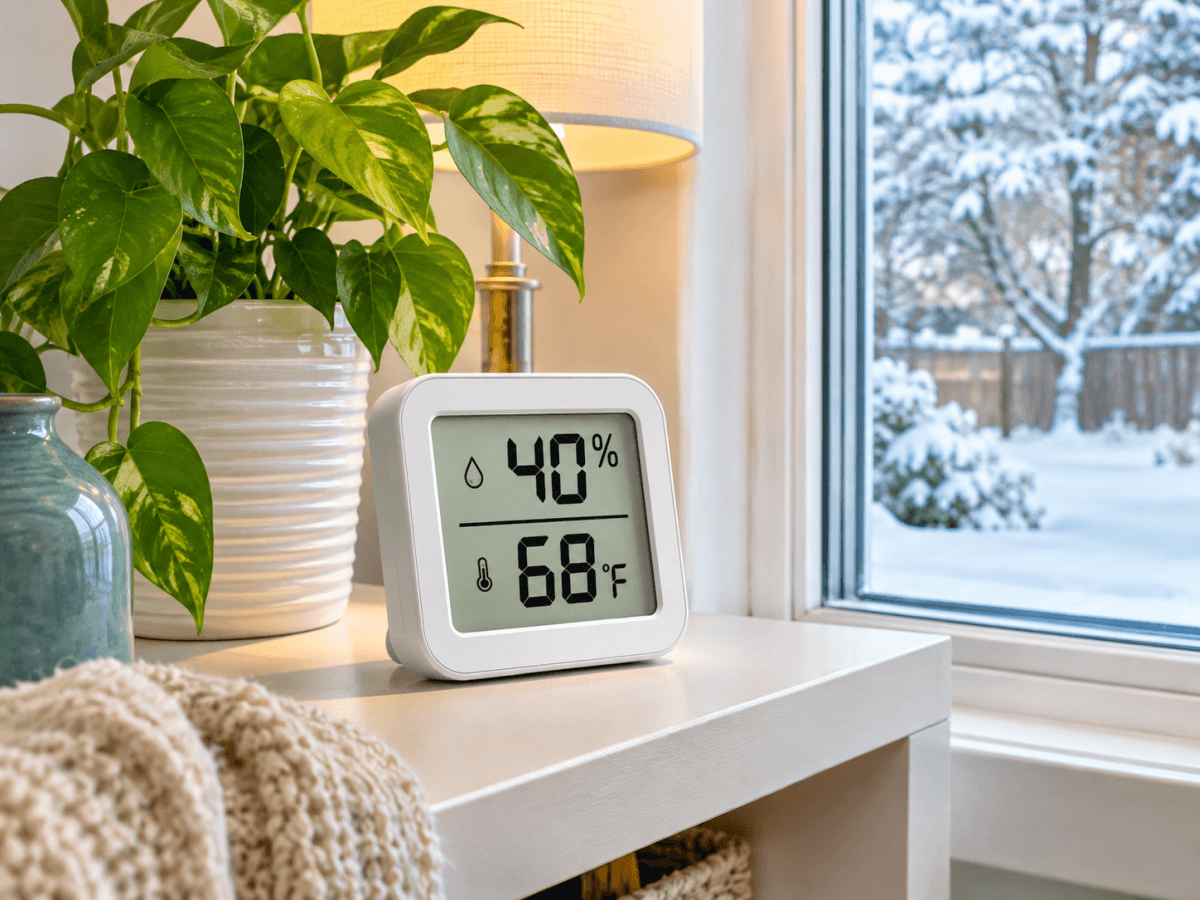
That matters in winter, because heating dries indoor air more than most people expect. Cold air holds little moisture, so warming it indoors drops its relative humidity sharply, even though no water has left the room. The EPA's brief guide to mold, moisture, and your home recommends keeping indoor humidity below 60%, ideally between 30% and 50%.
How Winter Heating Dries Indoor Air
Filterbuy calculation using the Magnus formula, assuming no added moisture. Cooking, showers, people, and humidifiers raise real readings.
Our winter guidance plans around one trade-off. The upper part of the EPA range is harder on airborne flu, but in very cold weather, higher humidity can fog windows and cause condensation inside walls. Filterbuy's chart of ideal indoor humidity in winter shows how far to lower your target as outdoor temperatures drop, so you can stay as close to 40% as your windows allow.
How to Clean Flu Germs off Surfaces and Laundry
Removing flu germs from hard surfaces takes two steps. First, clean off visible grime. Then apply an EPA-registered disinfectant that lists influenza on its label, and leave it wet for the full contact time. Fabric is simpler, since a hot wash and a hot dryer take care of it.
Start with the top tier. Work down the priority table from the top.
Clean, then disinfect. Soap and water lift away dirt and many germs, and disinfectant handles what remains.
Respect the contact time. Some products work in 30 seconds, while others need several minutes.
Handle laundry with care. Carry a sick person's towels and bedding away from your face, then wash hot and dry on high heat, as Geisinger's guide to how long flu lives on surfaces recommends.
Wash your hands when you finish. Cleaning a contaminated surface can leave virus on your hands.
Where Your HVAC System Fits Into Flu Season
Filterbuy makes air filters, so we will say it plainly: your HVAC system affects the air, not your doorknobs. A pleated filter captures airborne particles as air circulates through the return, and a humidifier can keep indoor air out of the dry range. Neither replaces surface cleaning or handwashing, and no air filter can prevent illness on its own. More on this in common air filter myths during cold and flu season.
A MERV 13 filter is built to capture finer airborne particles than MERV 8 or MERV 11, as Filterbuy's MERV 8 vs. MERV 13 comparison explains. Check your system's manual or ask an HVAC technician first, since not every system is designed for a higher MERV rating. A filter works only while the fan runs, so while someone is sick, set the thermostat fan to On instead of Auto, at some energy cost. Our guide explains whether an HVAC filter can help with colds, flu, and RSV.
"The idea that influenza viruses can survive on hard surfaces for up to 48 hours gets attention, but what matters just as much is how easily they can move from a contaminated doorknob to your hands and then to your eyes, nose, or mouth. While flu primarily spreads through respiratory particles in the air, contaminated surfaces can also play a role. Regularly disinfect high-touch surfaces, wash your hands, and maintain indoor humidity around 40–50% to help create a healthier home environment during flu season."
Supporting Statistics
24–48 hours on hard surfaces
In a Journal of Infectious Diseases study, flu lasted 24 to 48 hours on steel and plastic.
On cloth and tissues, it lasted under 8 to 12 hours.
For your home: clean metal and plastic handles first.
Source: Survival of Influenza Viruses on Environmental Surfaces
14% vs. 70–77% still infectious after one hour
CDC NIOSH researchers tested airborne flu from simulated coughs.
At about 43% humidity, roughly 14% stayed infectious.
At 23% humidity or lower, 70–77% stayed infectious.
For your home: humidity is a flu-season variable your HVAC system can change.
Source: Higher Indoor Humidity Inactivates Flu Virus Particles
3–5 minutes on hands, up to 48 hours on surfaces
The CDC reports flu survives only 3 to 5 minutes on hands.
On surfaces, it can stay infectious for up to 48 hours.
For your home: surfaces store the virus, and hands deliver it.
Frequently Asked Questions
Can the Flu Live on Clothes Overnight?
Usually not. Flu stays infectious on fabric for less than 8 to 12 hours, but wash a sick person's bedding right away.
Can You Get the Flu From a Doorknob?
Yes. Flu can survive on metal and plastic doorknobs for up to about 48 hours, and touching one and then your face can pass the virus along. Handwashing and daily disinfecting lower that risk.
How Long Do Flu Germs Live in a House After Someone Is Sick?
Every touch or cough from a sick person restarts the clock on nearby surfaces. Once they stop touching something, hard surfaces pass flu's lab survival window after about 48 hours, and fabrics after about 12. A guest room or car they have not used in two days can wait for routine cleaning. Focus on what they touched today.
Should I Change My Air Filter After Someone Has the Flu?
No rush, but it is a good time to check. If the filter is due or visibly dirty, swap it, bag the old one, and wash your hands. Filterbuy's guide to how clean air filters support a healthier home during cold and flu season covers winter change intervals.
Shop Air Filters for Flu Season
Cleaning covers what you touch, and your HVAC filter covers what circulates. Filterbuy makes pleated air filters in MERV 8, MERV 11, and MERV 13 in hundreds of sizes, with fast and free 2-day delivery to most US states.
Glossary
A contagious respiratory illness caused by influenza A and B viruses.
The viruses behind most common colds.
Porous materials like fabric absorb liquid. Metal and plastic do not.
Air moisture as a percentage of the most the air can hold at that temperature.
How long a disinfectant must stay wet to work.
The National Institute for Occupational Safety and Health, part of the CDC.
Minimum Efficiency Reporting Value, a 1 to 16 filter efficiency scale.
Heating, ventilation, and air conditioning.
Browse MERV 13 air filters and confirm the right filtration rating for your HVAC system before purchasing.
Browse MERV 13 Air Filters