
Allergies or a Cold? How to Tell Which One Is Making You Miserable
November 9, 2026
TL;DR
Itching is the clearest tell. Itchy eyes, nose, or throat point to allergies, while a sore throat or a low fever points to a cold. Timing is the second clue, since a cold rises and fades in about 7–10 days and allergies last as long as you're around the trigger. If your "cold" follows you around the house for weeks, the trigger may be in your home's air.
Key Takeaways
Allergies never cause a fever, and a sore throat is rare with allergies but usual with a cold, according to Mayo Clinic's cold-or-allergy comparison.
Most people recover from a common cold in 7–10 days, per Mayo Clinic.
About 1 in 4 U.S. adults (25.2%) and 1 in 5 children (20.6%) have a diagnosed seasonal allergy, according to CDC's National Center for Health Statistics.
The American College of Allergy, Asthma and Immunology (ACAAI) recommends a disposable HVAC filter rated MERV 11 to 13, typically replaced about every three months.
Why Filterbuy Wrote This
Filterbuy has built air filters in our own U.S. plants since 2013. We make MERV 8, 11, and 13 on the same lines, so we don't earn more when you move up a rating. That lets us be straight with you: if it's a cold, a new filter won't fix it. Where we can help is on the allergy side, when the air in your home keeps symptoms going.
Is It a Cold or Allergies? The Quick Answer
An allergy happens when your immune system overreacts to something harmless, like pollen or pet dander. A common cold is a viral infection of the nose and throat. Both bring sneezing and a stuffy or runny nose, so the real clues are everywhere else.
Allergy vs. Cold Symptoms, Side by Side
The table lines up the symptoms that matter most.
Sources: Mayo Clinic; Centers for Disease Control and Prevention (CDC).
How to Tell Allergies from a Cold in 3 Questions
For a faster answer, Filterbuy's itch, arc, and room test sorts most cases in about a minute by weighing symptoms against timing and location.
Does anything itch? Itchy, watery eyes or an itchy nose and throat lean strongly toward allergies, because colds rarely itch.
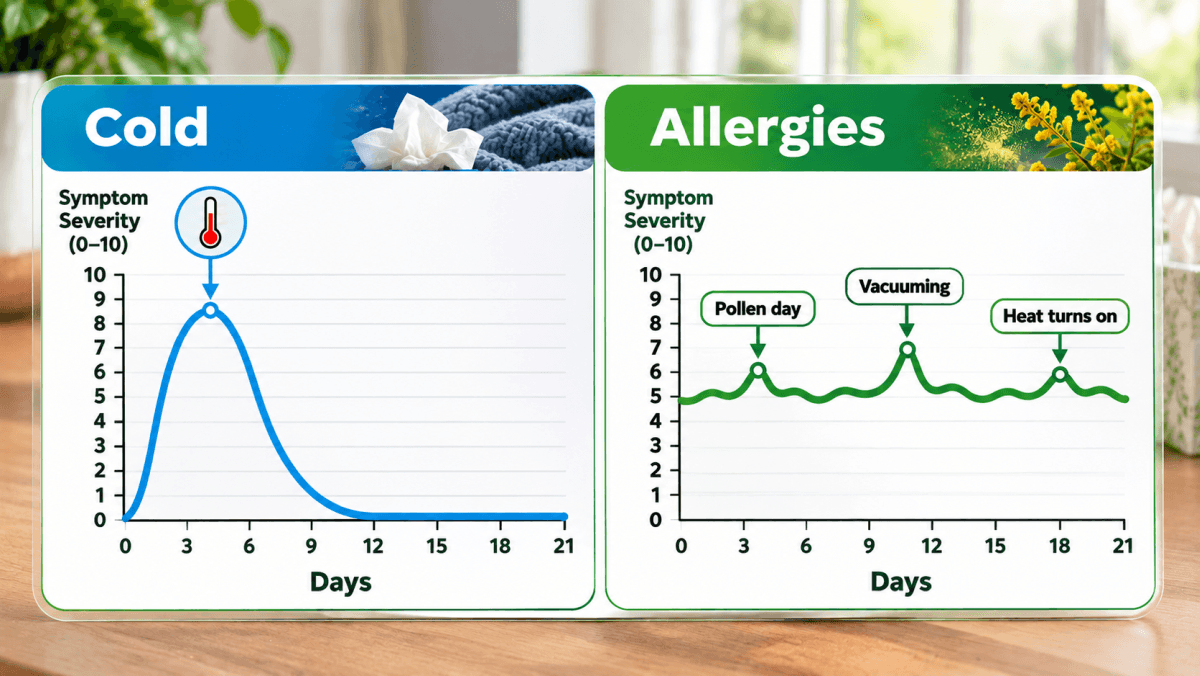
Is there an arc? A cold has a shape. It builds, peaks within 2–3 days, and then fades, though the CDC notes a runny nose and cough can hang on for 10–14 days. Allergies have no arc. They hold steady or flare each time you meet the trigger.
Where does it happen? Feeling worse outdoors on high-pollen days points to seasonal allergies. Feeling worse at home, especially in the bedroom or after the heat kicks on, and better when you travel points to indoor allergies. A household that gets sick one by one almost certainly has a cold.
Seasonal Allergies or a Cold?
Seasonal allergies follow the calendar. Tree pollen arrives in spring, grass in late spring and summer, and ragweed in late summer and fall. So if your "cold" returns the same weeks every year, with itchy eyes and no fever, seasonal allergies are the likelier cause.
Indoor Allergies vs. a Cold: Why Fall and Winter Fool People
Indoor allergies come from allergens that live in your home year-round: dust mites, pet dander, mold spores, and cockroach particles. Sealed-up homes recirculate the same air right through peak cold season, so indoor flare-ups get written off as "my third cold since Thanksgiving." For more, see Filterbuy's guide to how air filters help with winter allergies.
These allergens are close to universal. A National Institutes of Health study of nearly 7,000 U.S. homes found more than 90% had three or more detectable allergens, and 73% had at least one at high levels. Dust mite allergen ran higher in the South and Northeast and in humid climates. These patterns point to an indoor trigger:
Symptoms are worst first thing in the morning or in the bedroom, where dust mites gather in bedding.
You start sneezing shortly after the heat or AC turns on.
Symptoms flare after you vacuum, dust, or cuddle a pet.
You feel noticeably better after a few days away from home.
Still Not Sure? Keep a 7-Day Log
When the signs are mixed, a week of notes usually settles it. Each evening, answer four questions:
Did anything itch today?
Did you have a fever? Use a thermometer, not a guess.
Where were your symptoms worst: outdoors, at home, or in the bedroom?
How old is your HVAC filter?
Most colds clearly improve within 7–10 days. If you're still no better by then, with no fever and notes that keep pointing home, take the log to an allergist.
What to Do If It's a Cold
Because a cold is viral, antibiotics do nothing for it. Rest and fluids carry most of the load, and over-the-counter remedies ease symptoms. Wash your hands often, since colds spread easily at home.
What to Do If It's Allergies: Fix the Trigger in Your Home's Air
Allergy relief starts with less exposure to the trigger, and your HVAC system is one of the best tools you already own. These steps follow ACAAI guidance:
Upgrade your HVAC filter to MERV 11 or MERV 13. The ACAAI calls a disposable MERV 11–13 filter the most cost-efficient whole-house option, and the EPA's Guide to Air Cleaners in the Home recommends at least MERV 13, or as high as your system can accommodate. Fiberglass filters have been shown to be ineffective. Fit matters too, since an unsealed filter lets air slip around its edges. Compare Filterbuy MERV 11 filters and MERV 13 filters, or see our MERV rating chart. "The best filter is the highest rating your system can move air through, in the deepest size your cabinet will take, changed on time," says Michelle Wan, Filterbuy's Brand Manager and Air Quality Writer. "We make every rating on that scale, so I have no reason to sell you a number."
Change the filter on schedule. The ACAAI notes disposable filters are typically replaced about every three months. In Filterbuy's experience, though, one pet roughly halves a filter's life, and a higher-rated filter loads faster because it catches more. Write the install date on the frame and check it at 30 days. As David Clark, Licensed HVAC Technician, puts it, "In the field, the filter rarely gets blamed for the thing it actually caused." See how often to change your HVAC filter.
Run the fan during flare-ups. According to the EPA, a filter only cleans air while the system is running. On bad weeks, switch the thermostat fan from Auto to On, and expect a slightly higher electric bill.
Keep indoor humidity below 50%. Dust mites and mold thrive in damp air, so a dehumidifier helps in humid climates and basements. A filter won't fix mold, though; the EPA says the moisture source has to go.
Use HEPA where you sleep and clean. Vacuum with a HEPA filter, and choose a bedroom HEPA air cleaner with a CADR sized to the room.
Protect the bed and the door. NIH researchers suggest allergen-proof mattress and pillow covers and washing bedding in hot water weekly. During pollen season, leave shoes at the door and groom pets outside.
Confirm your triggers with an allergist. Testing pinpoints what you react to and opens treatment options beyond avoidance.
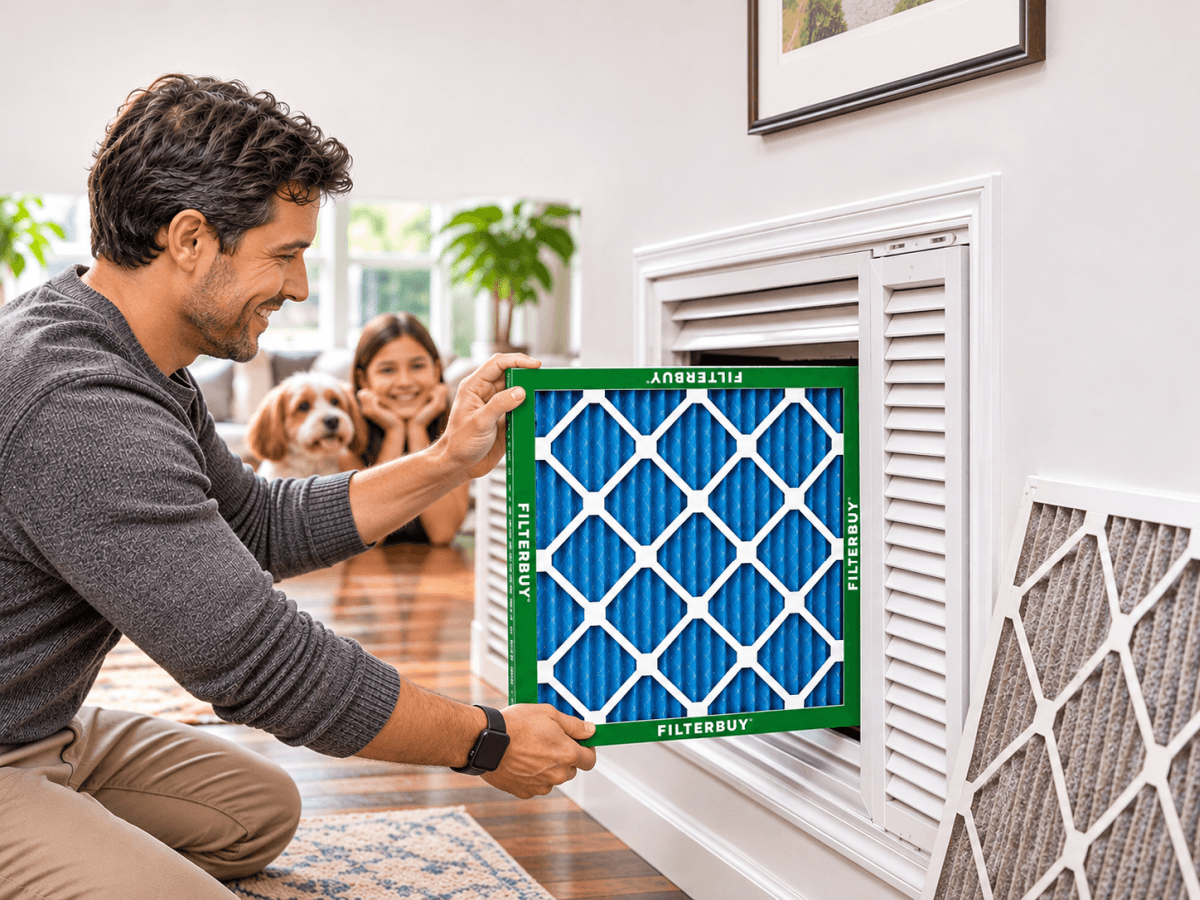
Filterbuy cuts each filter to order in more than 600 sizes and ships it free. With auto-delivery, the next one arrives when it's due.
When to See a Doctor or Allergist
The CDC advises seeing a healthcare professional for trouble breathing, dehydration, a fever lasting more than 4 days, symptoms lasting more than 10 days without improvement, or symptoms that improve and then return or worsen. Call right away if a baby younger than 3 months has a fever of 100.4°F or higher. See an allergist for symptoms that last two weeks or more, return every year, or include wheezing.
Supporting Statistics
Three numbers behind the tells above:
2–3 colds a year is normal for adults.
Colds peak in fall and winter.
A "cold" every few weeks? Rule out allergies.
Source: Mayo Clinic
About 90% of our time is spent indoors.
HVAC systems run under 25% of the time in peak seasons.
Source: U.S. EPA
About 3 in 10 Americans have a diagnosed allergic condition.
Seasonal allergies: 25.6% of rural kids vs. 19.8% of urban kids.
A recurring "cold" in any home deserves a second look.
Source: CDC, 2026
Frequently Asked Questions
Can Allergies Cause a Fever?
No. Mayo Clinic's comparison lists fever as never an allergy symptom. A temperature of 100.4°F or higher usually signals an infection such as a cold, the flu, or a sinus infection.
Can You Have Allergies and a Cold at the Same Time?
Yes. If your familiar itchy eyes suddenly come with body aches and a sore throat, you may have both.
Can a Dirty Air Filter Make Allergies Worse?
Yes. A clogged or low-efficiency filter lets more allergens recirculate, and the ACAAI notes that skipping changes can do more harm than good.
Glossary
Allergen
A harmless substance, like pollen or dander, that triggers an immune reaction in sensitive people.
Allergic rhinitis (hay fever)
Allergy-driven nasal inflammation that causes sneezing and itching, seasonally or year-round.
Common cold
A contagious viral infection of the nose and throat that usually resolves in 7–10 days.
Dust mites
Microscopic bugs in bedding and upholstery whose waste is a leading indoor allergen.
MERV (Minimum Efficiency Reporting Value)
A 1–16 rating of how well an HVAC air filter captures airborne particles.
HEPA (high-efficiency particulate air)
A filter standard that removes at least 99.97% of particles 0.3 microns in size, per the U.S. EPA.
CADR (clean air delivery rate)
How much filtered air a portable air cleaner delivers, used to match it to room size.
Breathe Easier at Home
Sneezing more at home? Your air filter could be the clue. Find your size and explore MERV 11 or MERV 13 filters for cleaner indoor air.
Find Your Filter Size →This article is general information, not medical advice. See a doctor for persistent or severe symptoms.