
Can a Dirty Humidifier Make You Sick? Cleaning It the Right Way
November 23, 2026

TL;DR
Yes, a dirty humidifier can make you sick. Bacteria and mold grow in its standing water, and the mist carries them into the air you breathe. That can cause humidifier fever, a short flu-like illness, or humidifier lung, an immune lung reaction. Our advice at Filterbuy: empty the tank daily, clean it every third day, use distilled water and keep the room at or below 50% humidity.
Key Takeaways
A dirty humidifier can cause flu-like symptoms or lung illness, according to Mayo Clinic and the U.S. Consumer Product Safety Commission (CPSC).
In one study, an ultrasonic humidifier raised indoor PM2.5 to as much as 350 µg/m³, depending on the water. By Filterbuy's comparison, that's above the EPA's Hazardous line.
Timing is the tell: humidifier illness starts hours after the mist and fades once it's off. A cold builds over days.
Filterbuy's point of view: we've built air filters in four U.S. factories since 2013 for more than two million homes. We've learned that whatever grows in a humidifier's tank ends up in the air, so the fix starts with a clean tank.
Can a Dirty Humidifier Make You Sick?
Yes. A dirty humidifier can make you sick because bacteria and mold grow in its standing water, and the unit turns that water into mist you inhale. The CPSC says breathing contaminated humidifier mist can cause problems ranging from flu-like symptoms to serious infection.
A humidifier adds water vapor to indoor air. Mayo Clinic says a dirty unit may release bacteria or mold that trigger flu-like symptoms or even lung illnesses. The U.S. Environmental Protection Agency (EPA) goes further: humidifiers can disperse both microorganisms and minerals from the tank, and breathing the mist has been linked to a type of lung inflammation.
Humidifier Sickness: Humidifier Fever vs. Humidifier Lung
Humidifier sickness usually means one of two conditions. Humidifier fever is a short, flu-like illness caused by microbes and their toxins in humidifier mist. Humidifier lung is a form of hypersensitivity pneumonitis, an immune reaction that inflames the lungs and can scar them with repeated exposure, according to researchers at the National Institute for Occupational Safety and Health (NIOSH).
Both conditions can pass for a cold, so we built Filterbuy's cold-or-humidifier check around timing, the clue that tells them apart.
Sources: Filterbuy cold-or-humidifier check, built from CDC, NIOSH researchers (Parker et al., 1994), MedlinePlus and NHLBI.
“I read the NIOSH and CDC research side by side, and timing stood out. A cold builds over days. Humidifier illness shows up hours after the mist and fades when the machine is off.
Humidifier Mold Symptoms
Humidifier mold symptoms usually look like an allergy or asthma flare: sneezing, a stuffy nose, coughing and wheezing, often worse in the room where the humidifier runs. Mayo Clinic says mist from a dirty humidifier can trigger or worsen asthma and allergy symptoms.
A HEPA air purifier reduces airborne mold spores and MERV-rated filters capture asthma triggers, but in Filterbuy's view, neither fixes a dirty tank.
Signs Your Humidifier Is Making You Sick
The clearest sign your humidifier is making you sick is a pattern: symptoms that start or worsen hours after it runs and ease when you're away from it. Filterbuy has helped thousands of homeowners troubleshoot neglected filters, and in our experience, a musty odor or weaker mist tends to show up first.
Watch for these signs in your body:
Fever, chills or aches that come back on nights the humidifier runs
A dry cough or shortness of breath that lingers past a typical cold
Allergy or asthma symptoms that flare in that room
In the humidifier and room, look for:
Slime or scale in the tank or base
A musty or sour smell from the mist
White dust on furniture, a sign of minerals in the air, per the EPA
Condensation on windows or a hygrometer reading above 50%
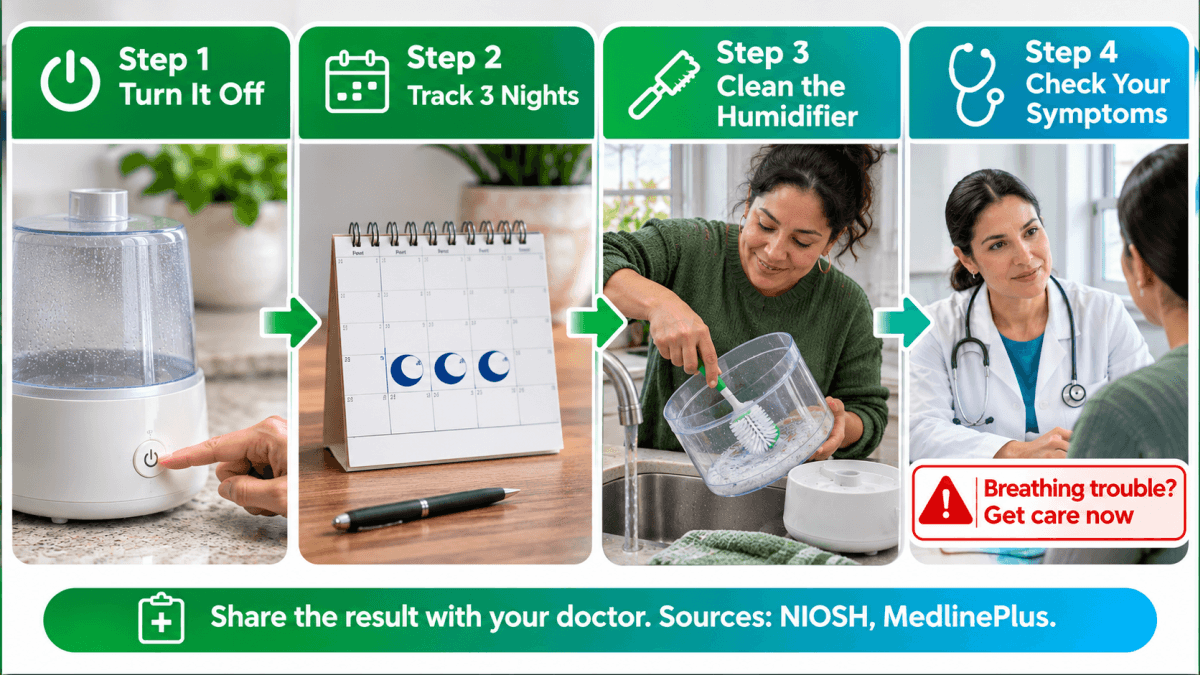
Filterbuy's 72-hour off-switch check turns that pattern into a test you can start tonight. Use the result as a clue to share with your doctor.
Turn the humidifier off and air out the room.
Track your symptoms each evening for three days.
If they ease, deep-clean or replace the unit before using it again, and tell your doctor about the humidifier.
If breathing is hard at any point, skip the test and get care.
Can a Humidifier Make a Cold Worse?
Yes, a humidifier can make a cold worse if it's dirty or set too high. Contaminated mist adds microbes to already irritated airways, and humidity above 50% encourages mold and dust mites, which the EPA says to avoid. Kept clean and between 30% and 50% humidity, as Mayo Clinic advises, a humidifier can ease congestion instead.
Still unsure? Filterbuy's cold vs. flu guide can help.
Who's Most at Risk From a Dirty Humidifier?
Young children, older adults and people with lung disease or respiratory allergies may be more susceptible to humidifier pollutants, according to the EPA. Adults 50 and older and people with weakened immune systems also face a higher risk of Legionnaires' disease, a severe pneumonia caused by Legionella bacteria, per the CDC. North Carolina's health department lists humidifiers and vaporizers among common home sources.
How to Clean a Humidifier the Right Way
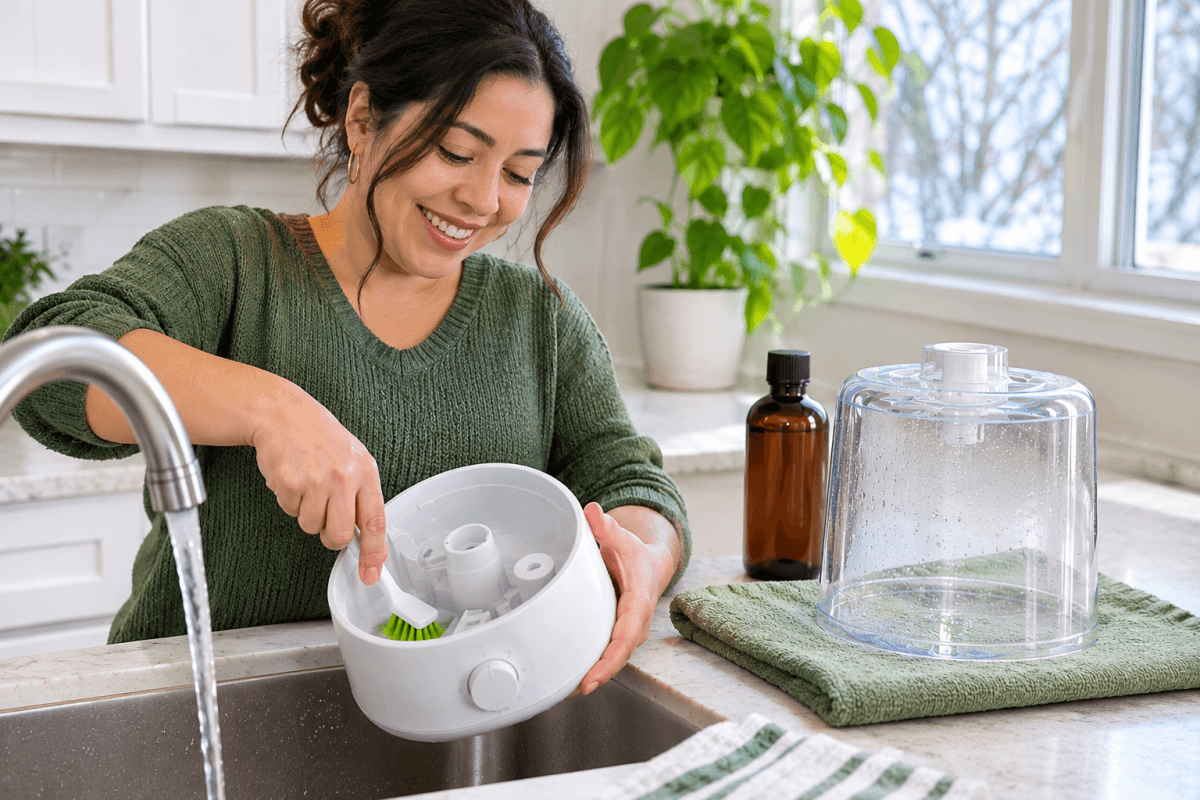
To clean a humidifier the right way, empty and dry the tank every day, scrub it every third day with 3% hydrogen peroxide unless the manual names another cleaner, then rinse it with several changes of water. Filterbuy follows the EPA's routine for portable humidifiers:
Daily: unplug it, empty the tank, wipe every surface dry and refill with fresh water.
Every third day: scrub every surface that touches water with the manufacturer's cleaner or 3% hydrogen peroxide.
Rinse thoroughly so no cleaner ends up in the mist.
Use distilled water in mist humidifiers.
Add nothing to the water. Mayo Clinic advises against additives, including essential oils.
Replace wicks and filters at least as often as the maker says. Filterbuy's humidifier filter cleaning and replacement guide explains how.
End of season: clean the unit and store it dry. If buildup won't come off, replace the humidifier, as Mayo Clinic advises.
Which Humidifiers Put the Most Into Your Air?
Ultrasonic and impeller cool-mist humidifiers put the most microbes and minerals into the air, according to the EPA. Evaporative and steam units disperse less, though any humidifier with standing water can still grow microbes. In ultrasonic tests, mineral and tap water raised PM2.5 most.
Sources: Filterbuy humidifier comparison, built from the EPA, Park et al., IJERPH, 2020 and Mayo Clinic.
Filterbuy compared those readings with the EPA's 2024 Air Quality Index (AQI) breakpoints for PM2.5. The study's high of 350 µg/m³ sits above the 225.5 µg/m³ line where the AQI turns Hazardous, and even 16 µg/m³ falls in Moderate. The AQI uses 24-hour averages, so treat this as a rough guide.
If the outdoor AQI is over 100, switch to an EPA-recommended MERV 13 filter if you have an HVAC system. Either way, run a HEPA air purifier in each room, sized to fit it.
Which Water Should Go in Your Humidifier?
Distilled water is the best choice for any mist humidifier. In a 2020 test of five water types, distilled water barely raised indoor PM2.5 from an ultrasonic unit; mineral water raised it most. Tap water is fine in an evaporative unit.
Sources: Filterbuy water comparison, built from Park et al., IJERPH, 2020 and the EPA.
Filterbuy's take as a filter maker: stop the dust at the tank. Distilled water or an evaporative unit beats any filter downstream.
Whole-House Humidifiers
Whole-house humidifiers need the same care, on a seasonal schedule. Filterbuy's whole-house humidifier filter guide recommends replacing the filter at least once per season, and sooner if you see mold, dirt buildup or discoloration.
When to See a Doctor
See a doctor if you have shortness of breath, a fever that keeps coming back, or a cough that doesn't improve after you stop using the humidifier. Mention the humidifier, since clinicians may not ask. The CDC also advises care for a fever lasting longer than 4 days or symptoms lasting more than 10 days. For severe trouble breathing, call 911.
Supporting Statistics
1. 21% of U.S. Asthma Cases Tied to Home Dampness and Mold
4.6 million people affected
$3.5 billion in asthma costs a year
Why it matters: Damp rooms raise asthma risk, which is why Filterbuy caps humidity at 50%.
Source: Lawrence Berkeley National Laboratory and EPA, Indoor Air, 2007
2. 8.5% of U.S. Adults Have Asthma
6.3% of children have it too (2025)
1.4 million ER visits for asthma (2022)
Why it matters: Dirty mist can trigger flares, says Mayo Clinic.
Source: CDC FastStats: Asthma
3. 1 in 10 Legionnaires' Disease Patients Die
Why it matters: Home humidifiers can harbor Legionella. Filterbuy's rule: empty and dry the tank daily.
Source: CDC, About Legionnaires' Disease
Frequently Asked Questions
Can a Dirty Humidifier Give You Pneumonia?
It can. The CPSC warns that contaminated mist can cause serious infection, and health departments list home humidifiers among possible sources of Legionnaires' disease, a severe pneumonia.
Glossary
- Humidifier Fever
- A short, flu-like illness from microbes and their toxins in humidifier mist.
- Humidifier Lung
- A type of hypersensitivity pneumonitis, an immune lung inflammation caused by inhaling contaminated mist.
- MERV 13
- A high rating on the Minimum Efficiency Reporting Value (MERV) filter scale.
- HEPA
- High-efficiency particulate air, a filter standard for portable air purifiers.
About the Author and Reviewer
Michelle Wan covers indoor air quality for Filterbuy. She researched this page and built its tables. David Clark, a Licensed HVAC Technician, reviews Filterbuy's HVAC guidance.
More from Filterbuy: What humidity your house should be in winter · Winter mold problems · Can an air filter help with mold?
Keep Your Home's Air Clean All Winter
Once your humidifier is clean, a good HVAC filter catches the dust and spores still in the air. Filterbuy makes MERV 13 filters in more than 600 sizes in our U.S. factories, and we carry whole-house humidifier filters too.