
Is an AQI of 100 Bad? Here's What That Reading Actually Means
September 3, 2026

Author: Michelle Wan, Brand Manager and Air Quality Writer | Technically Reviewed By: David Clark, Licensed HVAC Technician | Published: September 3, 2026 | Updated: September 3, 2026
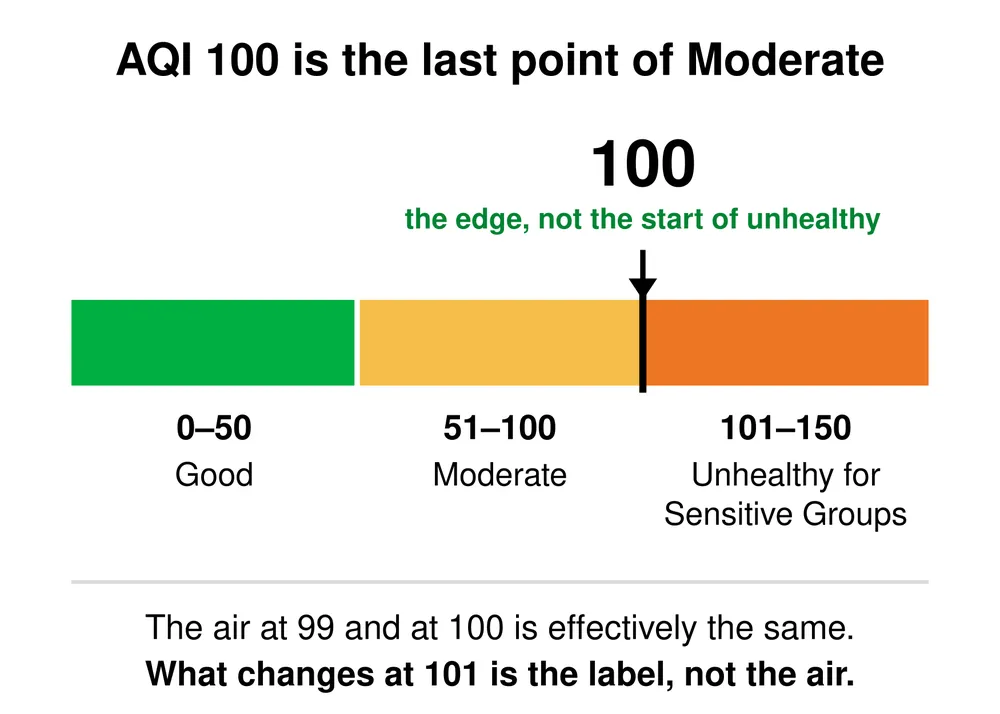
An AQI of 100 is not bad for most people, but it is the highest reading the Moderate category allows. One point higher, at 101, the air is labeled Unhealthy for Sensitive Groups. Healthy adults can carry on normally; children, older adults, and anyone with asthma or a heart or lung condition may want to ease up on hard outdoor exertion.
The AQI describes outdoor air only. The EPA reports some indoor pollutants run two to five times higher than outdoors, so a yellow day outside is a good moment to close the windows and check what is in your return vent. The quiz below matches you to the right filter in a few questions.
Answer 3 quick questions and we will match you to your perfect filter.
Rather browse on your own? Start at Filterbuy and find your size.
An AQI of 100 is not dangerous for most people, but it is the highest reading Moderate allows. One point higher and the air becomes Unhealthy for Sensitive Groups. So 100 is not bad, it is the edge of bad, and what you do depends on who is breathing it.
TL;DR Quick Answer
An AQI of 100 sits at the top of the Moderate (yellow) category, the point the EPA pins to a pollutant's short-term federal health limit. Most healthy adults can go about a normal day. Children, older adults, and anyone with asthma or a heart or lung condition may notice symptoms and should ease up on hard outdoor exertion. Indoors, 100 is Filterbuy's cue to close the windows and upgrade the filter.
Top Takeaways
100 is the ceiling of Moderate, not the start of Unhealthy. That band begins at 101.
AQI 100 is a legal threshold, not a medical one. Federal rules set it at a pollutant's short-term health standard, not where symptoms start.
AQI 100 is a different concentration for every pollutant. For fine particles it is 35.4 µg/m³; for ozone, 0.070 ppm.
"Sensitive groups" is not a fixed list. Ozone days and smoke days put different people at risk.
The AQI only describes outdoor air. Indoors, the EPA reports some pollutants run two to five times higher.
Is an AQI of 100 Bad?
An AQI of 100 is acceptable air, but only barely. The EPA calls the Moderate category, 51 to 100, acceptable but possibly risky for unusually sensitive people (AirNow, AQI Basics). It feels loaded because it sits on a boundary, though the air at 100 and at 99 is effectively identical. What changes at 101 is the label, not the air. Our guide to the AQI scale covers all six categories.
What an AQI of 100 Actually Measures
The number 100 was not chosen because that is where the body starts to struggle. It comes from federal regulation, and this is the part most articles skip. Under 40 CFR Part 58, Appendix G, the rule defining the AQI, an index value of 100 is in most cases set at a pollutant's short-term national ambient air quality standard.
That phrase "in most cases" matters. The 24-hour PM2.5 standard is 35 micrograms per cubic meter, while the AQI 100 breakpoint sits just above it at 35.4. Close enough to plan your day around, but not the same number.
AQI 100 in Real Concentrations, for All Six Pollutants
Because AQI 100 is pinned to each pollutant's own standard, the pollution in the air at 100 depends on what causes it. Filterbuy pulled every figure below from the regulation itself, not a secondhand chart, because secondhand charts are where the retired 12.0 number keeps surviving.
Source: 40 CFR Part 58, Appendix G, Table 2, Breakpoints for the AQI (current as of the May 2024 revision).
Read that averaging column closely. An AQI of 100 is an average across a fixed window, not a reading from the moment you check, so an ozone 100 covers eight hours in which some were worse. The same 100 can feel fine at 8 a.m. and rough by 4 p.m.
Check the date on any AQI chart you find. The EPA revised the PM2.5 breakpoints on May 6, 2024, dropping the Good ceiling from 12.0 to 9.0 µg/m³ while leaving AQI 100 at 35.4 (Federal Register). A chart still showing 12.0 is out of date.
Is an AQI of 100 Safe for You Specifically?
Whether 100 is safe depends on which body is breathing it. The general public is unlikely to feel anything; sensitive groups may notice symptoms during long outdoor exertion.
Activity guidance follows the EPA's published AQI categories. If you have asthma, COPD, or a heart condition, follow the plan your clinician gave you and check AirNow for the day. That decision belongs with your doctor, not with a filter company.
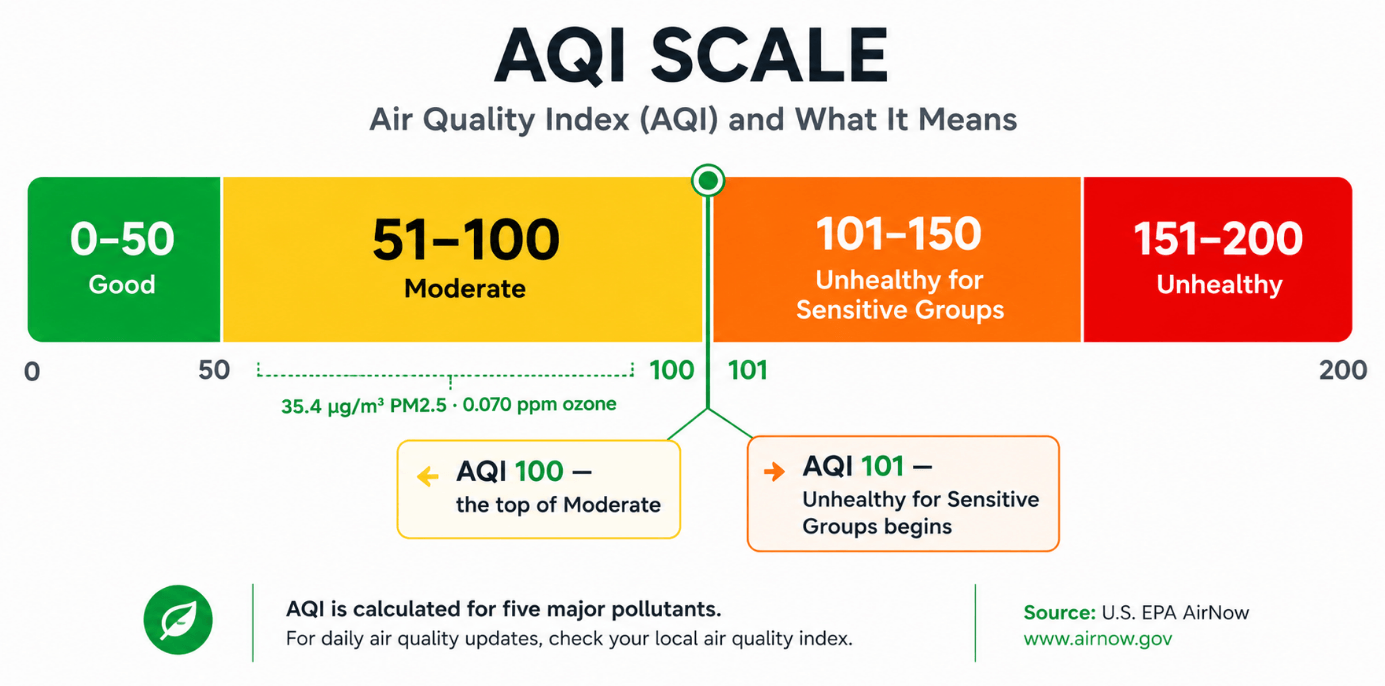
The sensitive group depends on the pollutant driving the number. Federal rules require agencies to name those groups whenever the index passes 100, and each is set separately during the NAAQS review (Appendix G). On a high-ozone afternoon that means people with asthma, children, and anyone exerting outdoors; on a smoky day driven by fine particles, it means people with heart or lung disease and older adults. Same reading, different people.
One limit: federal rules require a daily AQI only for metro areas above 350,000, and the American Lung Association counts 2,295 counties, home to 73.5 million people, with no monitoring. Your 100 may be an estimate borrowed from elsewhere.
AQI 100 vs 150: What Actually Changes
AQI 100 and AQI 150 sit at opposite ends of one category shift. 100 closes Moderate, 101 opens Unhealthy for Sensitive Groups, and 150 closes that band. By 150 there is roughly 56 percent more fine particle pollution than at 100.
Sources: AirNow, AQI Basics; 40 CFR Part 58, Appendix G.
If the reading keeps climbing, our guide on what to do when the AQI goes above 100 covers the rest.
What AQI 100 Outside Means for the Air Inside Your Home
The AQI measures outdoor air at a monitoring station and says nothing about your living room. The EPA reports Americans spend roughly 90 percent of their time indoors, where some pollutants run two to five times higher (EPA Report on the Environment). Indoor levels also linger, because fine particles infiltrate through gaps around windows, doors, and ductwork even in a closed-up house, and nothing indoors disperses them the way wind clears outdoor air. They settle, get stirred up by foot traffic and pets, and stay in circulation until a filter catches them.
Why We Read the 100 Line the Way We Do
Filterbuy has made air filters in the U.S. since 2013, from factories in Alabama, Florida, Pennsylvania, and Utah, serving more than two million households. None of that makes us experts in federal air regulation. It gives us one narrow vantage point: we build the last thing standing between the outdoor number and the room where you sleep. An app treats 100 as a verdict on the day. We read it as the moment the variables you control start to matter most.
"The number outside is a forecast for a whole county. The filter in your return is the part of it you actually get a vote on. That is the entire reason we care where the 100 line falls."
— Michelle Wan, Brand Manager and Air Quality Writer, Filterbuy
What to Do at AQI 100
AQI 100 is Filterbuy's action line. The EPA's boundary sits at 101, so we move at the threshold rather than after crossing it.
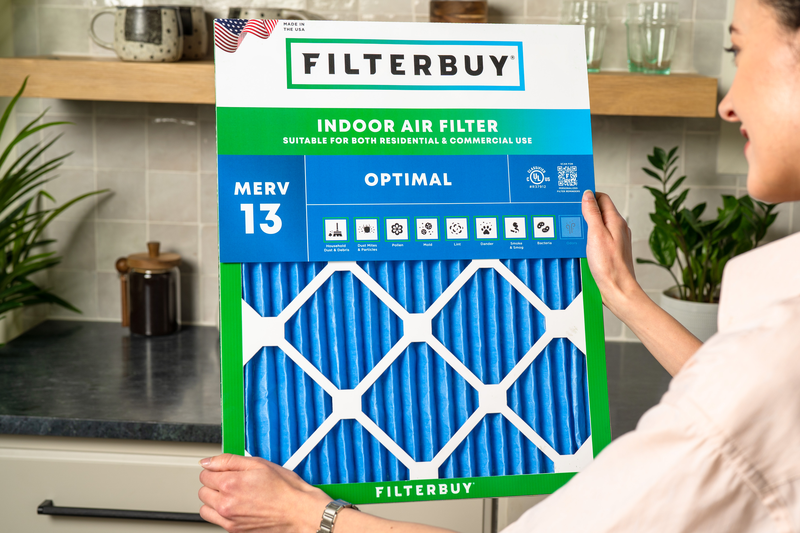
Put a MERV 13 filter in the HVAC. The EPA recommends MERV 13 or higher during smoky periods to remove fine particle pollution (EPA, Preparing for Smoke and Heat). Acting on that at 100 is Filterbuy's house rule, not the EPA's threshold. Find your size.
Set the fan to On. Auto filters only while the system is heating or cooling.
Run a portable HEPA air cleaner in each occupied room, bedrooms first. The EPA sizes a unit by smoke CADR of at least two-thirds of the room's square footage, so a 300 square foot bedroom wants a CADR near 200 (EPA, Create a Clean Room). One unit per occupied room is Filterbuy's recommendation and goes beyond the EPA's single clean room. Skip anything that generates ozone.
Close the house up. Windows and doors shut; hold off on candles, frying, and vacuuming without a sealed unit.
Check the dominant pollutant. AirNow names it. Ozone means bad afternoons; fine particles mean smoke or traffic.
No central HVAC? In an apartment or on window units, portable HEPA cleaners become your primary defense rather than a supplement, sized the same way. Smoke also loads a filter far faster than household dust, so replace yours when it looks dark.
Supporting Statistics
1. Days above AQI 100 in major U.S. cities fell from 2,080 in 2000 to 757 in 2024.
This is the 100 line itself, the days the combined ozone and PM2.5 index passes it. Source: U.S. EPA, Our Nation's Air 2025
2. 8.6 percent of U.S. adults and 6.5 percent of children currently have asthma.
Asthma is the largest group "sensitive" covers at AQI 100, and drives about 1.4 million emergency department visits a year. Source: CDC, FastStats: Asthma
3. Nearly 11.9 million adults and 2.4 million children with asthma live in counties graded F for air pollution.
The same analysis counts 33.5 million children and 24.9 million adults over 65. Source: American Lung Association, State of the Air 2026
Frequently Asked Questions
Is an AQI of 100 bad?
An AQI of 100 is not bad for most people. It is the top of Moderate: acceptable air, though unusually sensitive people may notice mild effects.
What does an AQI of 100 mean?
A pollutant has reached its short-term federal health standard. For fine particles that is 35.4 µg/m³ over 24 hours; for ozone, 0.070 ppm over 8 hours.
What is the difference between AQI 100 and 150?
AQI 100 tops Moderate and AQI 150 tops Unhealthy for Sensitive Groups. Fine particle concentration rises from 35.4 to 55.4 µg/m³ across that range.
Does AQI 100 outside mean my indoor air is also 100?
No. The AQI measures outdoor air only. Indoor levels depend on how much gets in and how much your filter removes.
Should I run an air purifier at AQI 100?
Filterbuy recommends it. Run a portable HEPA cleaner sized to the room in each occupied space, bedrooms first, alongside a MERV 13 filter in central HVAC.
Glossary
AQI (Air Quality Index): The EPA's 0 to 500 scale for outdoor air quality, in six color-coded categories from Good to Hazardous.
Moderate (AQI 51 to 100): The yellow category. Acceptable air that may still pose a risk for unusually sensitive people.
PM2.5: Fine particles 2.5 micrometers or smaller, able to reach deep into the lungs. PM2.5 sets most AQI readings.
NAAQS: The federal health-based limits the EPA sets for six criteria pollutants. AQI 100 is pinned to the short-term one.
Dominant pollutant: The pollutant with the highest index value that day. It sets the reported AQI.
MERV rating: The 1 to 16 scale for filter particle capture. MERV 13 captures a meaningful share of PM2.5-size particles.
Sources
U.S. EPA: AirNow, Air Quality Index (AQI) Basics
Federal Register: 2024 PM NAAQS final rule
U.S. EPA: Create a Clean Room During a Wildfire
CDC: FastStats: Asthma
American Lung Association: State of the Air 2026
Breathe Easier on Yellow-Air Days
An AQI of 100 is a nudge, not an alarm. Check the dominant pollutant, adjust plans for anyone sensitive, and remember that the air you control most is already inside your walls. A properly sized Filterbuy air filter keeps working long after the number outside changes.
Filterbuy reviews this page against the EPA's current AQI breakpoint table each quarter and after any final rule that changes it. Last verified: September 3, 2026.